(What We Have Here is) A Failure to Communicate

Picture a grassland dominated by little bluestem and other grass species.  One that has an abundance of wildflowers, including bird’s foot violet, goat’s rue, partridge pea, and numerous varieties of goldenrod, bushclover, and tickclover – among many others.  This prairie is one of only a few remnant prairies remaining in an ecosystem that once covered large swaths of North America.  Less than 1% of that ecosystem now remains in good condition, and most of its remnants are on sandy soils or steep slopes where farming and other human practices are difficult.  Sound familiar?  What if I told you this grassland ecosystem is found in places like North Carolina, Alabama, and Florida?  Oh, and that when it’s in really good condition, it’s full of pine trees…

Longleaf pine woodland (grassland?) in North Carolina.

If you live in the Midwest or Great Plains regions of North America, you were likely picturing a nearby tallgrass or mixed-grass prairie as I was describing that grassland.  Our prairies here sound, look, and function very much like the grasslands of the longleaf pine ecosystems in the southeastern United States.  Both rely heavily on frequent fire to maintain the species and habitat structure their species rely on.  The main difference is that longleaf pine grasslands have longleaf pine.

So if longleaf and midwestern prairies are so similar, why is there so little interaction between those of us working in the two ecosystem types?  It’s a question that has bothered me for years.  I’m not anywhere close to an expert on longleaf, having visited only twice during prescribed fire training courses.  On the other hand, I felt very much at home while I was there.  I recognized many of the plants – if not the species, at least the genus – and it wasn’t hard to imagine that I was walking through a midwestern oak savanna (with pine cones).  Click HERE to see some photos of longleaf pine wildflowers.

Frequent fire is used to keep longleaf ecosystems in good condition. Mature longleaf pine trees are very resistant to fire, and the fire keeps woody species from becoming overly abundant in the understory.

.

Deciduous trees and shrubs can quickly start to encroach in longleaf pine communities when fire frequency decreases.

.
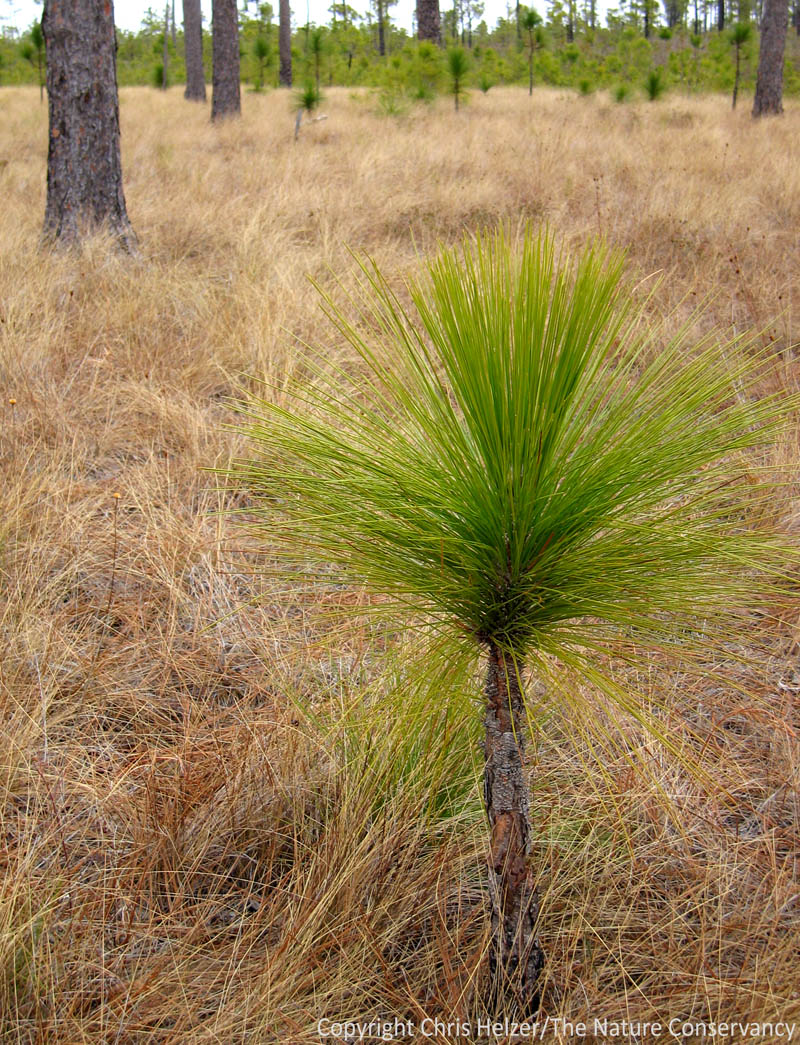
Young longleaf pines - not just older ones - are resistant to fire. When very young, longleaf pines spend several years in a "grass stage" in which the growing point is at the ground level. In the grass stage, the tree invests in root growth belowground and resembles a bunchgrass aboveground - protecting it from fires. The tree in this photo is in the "bottle brush" stage, a phase in between the grass stage and a more mature tree. During this stage, the tree is at its most vulnerable to fire - until it reaches a size that it can again withstand burning.

It seems crazy to me that we’re not consistently exchanging ideas and strategies between midwestern prairies and longleaf pine grasslands – especially because we’re both struggling with many of the same issues.  Both systems become choked with brush and trees in the absence of frequent fire.  Invasive species are a major issue.  Perhaps most importantly, both midwestern prairie and longleaf pine are nearly gone, making restoration a critical need if the ecosystems are to survive.  Restoration efforts involve both the rehabilitation of degraded remnant natural areas and the reconversion of farm land to native vegetation.

I’ve been part of a couple efforts to start information exchanges through The Nature Conservancy and through the Grassland Restoration Network.  Both have mostly fizzled, but the little bit of exchange we managed only strengthened my conviction that we need to keep trying.  From what I can tell, many midwestern prairie ecologists could learn a lot from the way longleaf ecologists focus on ecosystem function – especially fire – as a way to measure success and manipulate habitat.  That heavy emphasis on restoring ecological process is very different from the more species composition-oriented thinking among many midwestern prairie ecologist.  At the same time, I think many longleaf ecologists could gain from infusing their process-oriented approach with more emphasis on plant diversity and the insect and animal diversity associated with those plant species.  In some ways, the differences between longleaf and tallgrass prairie thinking are similar to those between eastern and western prairie thinking within the Central U.S. (as discussed in an earlier post).

One specific opportunity I see is to provide longleaf ecologists better access to lessons learned from the long history of diverse prairie restoration efforts in the Midwest, in which hundreds of plant species are included in seed mixtures.  Most efforts to convert farm fields to longleaf pine communities (with notable exceptions) focus mainly on establishing longleaf pines and grass – largely as a way to facilitate reintroduction of fire.  Increasing the diversity of herbaceous plant species could have some big benefits ecologically, and shouldn’t slow down process of reintroducing fire.  The extent to which midwestern techniques would transfer south is something we should be exploring together.

How do we build the connections?  If I knew the answer, I wouldn’t be writing this post.  However, I do think there are some important steps.  One would be to ensure that longleaf pine ecologists are encouraged and invited to attend the meetings such as the biennial North American Prairie Conference.  Getting us all in the same place to share ideas is absolutely the best way to exchange information.  Better yet, maybe someone in Alabama or South Carolina can host an upcoming prairie conference so that Midwestern prairie folks are forced to come down and see for themselves the wonderful longleaf grasslands.  Facilitating involvement from Midwestern prairie ecologists in existing longleaf conferences would also be valuable (to everyone).

In addition, I think organizations like The Nature Conservancy and others that span multiple states have a responsibility to lead the way in facilitating communication and collaboration.  It’s certainly not easy.  It’s hard enough to work between adjacent states, let alone regions.  On the other hand, none of us have figured out all the challenges in grassland conservation, so we need all the help we can get.  Working and experimenting in separate laboratories without sharing results is just silly.

If anyone sees an opportunity for building bridges between north and south on this issue, please let me know if I can help.

For more information about longleaf pine ecosystems, visit the Longleaf Alliance website.
Grandpa’s “Accidental” Prairie Restoration Project

In the late 1950’s, my grandfather bought a quarter section of farmland just southwest of Stockham, Nebraska.  At the time, all but about 26 acres of that 160 acre land parcel was in row crops.  The unfarmed areas (the steepest slopes and wettest draws) were a combination of native prairie and other “waste” ground.  From what I understand, Grandpa’s intent was to buy the land and put much of the cropland back to native grass pasture, keeping only the flattest areas and most productive soils to farm.  Regardless of whether or not that was his initial intent, he did indeed do that restoration project in 1962 – using the Soil Conservation Service’s Great Plains Program to provide cost-share for the seeding and construction of a livestock dam.  Approximately 87 acres of cropland was planted with a mixture of native grasses, including primarily big bluestem, indiangrass, switchgrass, little bluestem, side oats grama, and western wheatgrass – with a little blue grama thrown in too.  (We still have the receipts from the seed company.)

Starting in 1964, Grandpa started grazing the new pasture – including the unfarmed portions – and it’s been grazed annually ever since.  The pasture grazing was designed to be both profitable and sustainable, and as far as I can tell it has been.  There is no evidence of chronic overgrazing, and a number of “grazing sensitive” plant species are still abundant, especially in the old remnant areas.  My grandpa died in 1990, and Grandma died earlier this year.  After Grandma’s death, most of the other family farm land was sold, but after some long discussions, we kept the ¼ section in the family.  My wife and I now own a 2/3 interest and my aunt and uncle own the other 1/3.  Although I was helping Grandma manage the pasture for more than a decade before her death, actually owning the land makes me see the pasture in a much different way.  Before we shelled out our hard-earned money to buy it, the pasture was an interesting place to go cut cedar trees and walk around, and I tried to help Grandma set up the grazing leases to ensure that the land stayed in good condition while bringing in a reasonable income.  Now, as an owner, that lease income means a whole lot more, as does the current and future condition of the grassland.  Decisions about how to balance stocking rate and income with plant community impacts are a little more real!

I bring all this up as background discussion for the real subject of this post.  Though I’m sure it wasn’t Grandpa’s intent when he seeded the site back to grassland in 1962, he actually did some pretty great prairie conservation work.  He took a series of very small isolated remnant prairie islands and filled the space between them with grassland habitat.  It’s hard to know how many plant and insect species populations have larger and more viable populations now because of his work.  Certainly the site has improved habitat conditions for the grasshopper sparrows, western meadowlarks, and other grassland birds that are nesting there.

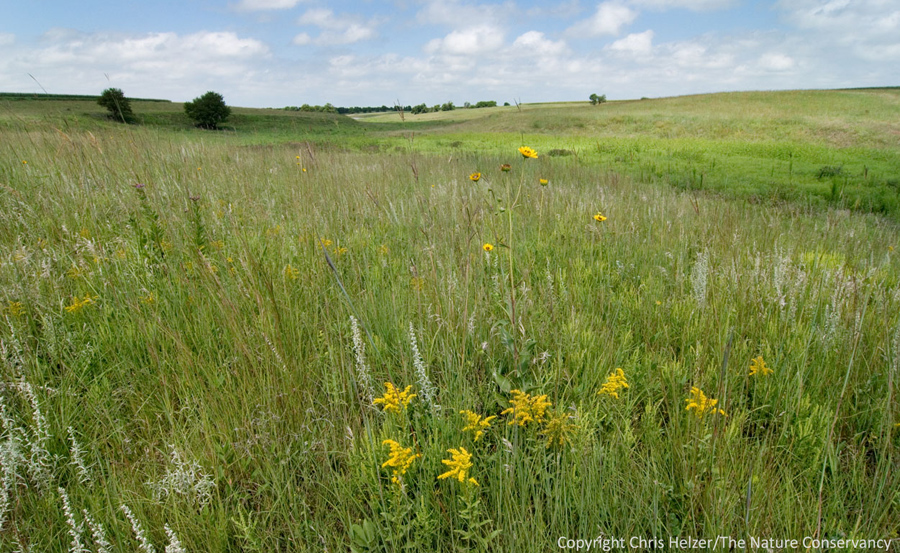
A portion of remnant (unplowed) prairie on our farm. It has retained a good mixed-grass plant community, with fairly abundant leadplant, stiff sunflower, prairie clovers, and other characteristic prairie plants. Shown here are Missouri goldenrod, white sage, stiff goldenrod, and many others.

While any grassland is better than no grassland, the re-seeded areas of the prairie are still distinct in appearance and composition from the unplowed areas.  Many of the prairie remnants contain fairly abundant populations of conservative forb species, including leadplant, stiff sunflower, prairie violet, prairie clovers, and many others.  A few of those species have moved into the re-seeded areas, but mostly at low abundances.  The re-seeded areas are dominated by grasses, but also have an abundance of many common forb species such as goldenrods, white sage, ironweed, hoary vervain, yellow prairie coneflower, dotted gayfeather, yarrow, and others – along with strong populations of sweet clover.

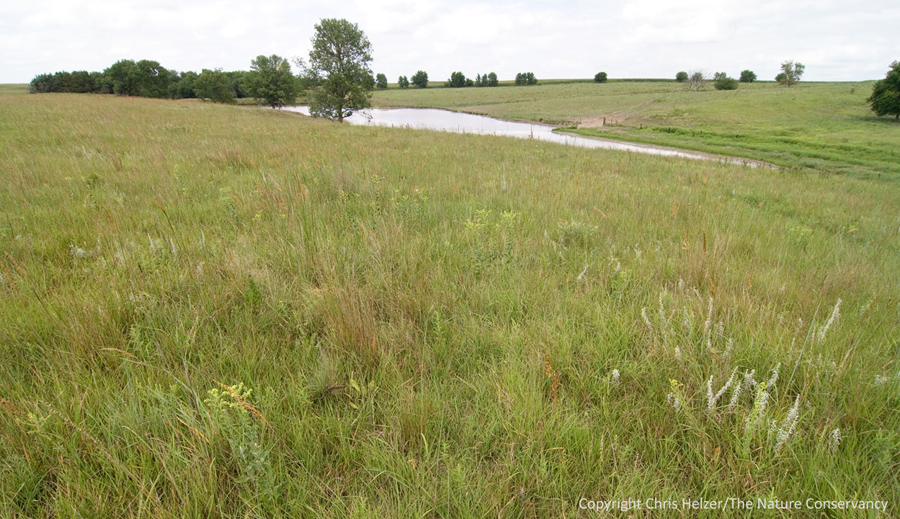
This photo shows some of the re-seeded prairie. Many native forbs have moved into the stand of grass that Grandpa planted, but others are still rare or missing.

I only recently found some hand-drawn maps showing the exact locations of the unplowed areas, and was able to cross-check those with old aerial photos from before and after the 1962 seeding.  Now that I know those locations more exactly, I’ll be able to start making even better comparisons between the remnant and re-seeded areas.  I started that process this last weekend, taking an inventory of plant species in the re-seeded areas (I found 65 species).  I’m sure I’ll add to that list over time, but that’s not too bad, considering only 6-7 grasses were planted there initially.  I don’t know yet how many plant species are in the remnant portions – I’m still working on that.

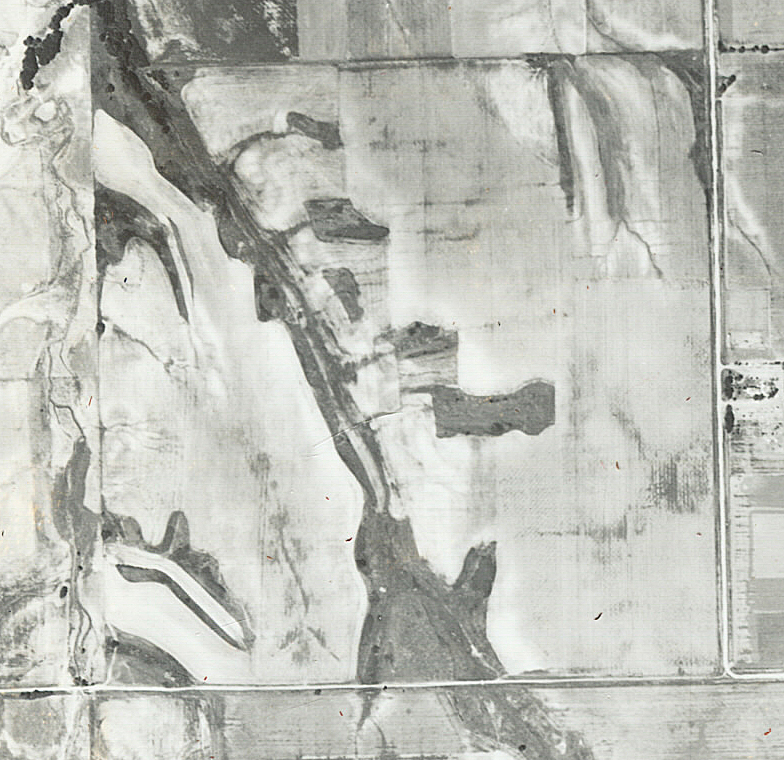
This aerial photo from 1956 shows our 1/4 section just prior to Grandpa buying it. The darkest areas are the unfarmed portions. You can see how small and isolated many of them were. Only the steepest and wettest areas avoided the plow.

In some ways, it’s amazing to see the diversity of plants in those previously farmed areas.  If I took a botanist to the site without divulging its history, I’m pretty they’d have no idea it had once been farmed.  At the same time, while there is good plant diversity at the site, it’s interesting to see how few conservative plant species have made their way into the previously farmed areas.  I’ve seen a few individuals of leadplant, a few patches of purple and white prairie clover, some areas of purple coneflower, and a few stiff sunflower colonies.  Prairie violets have begun creeping from the remnants into the re-seeded areas too – but in 50 years, they’ve only made it about 20 or 30 yards.

All of this points out the importance of protecting and managing remnant prairies to avoid losing those conservative plant species.  Once they’re gone, it’s not realistic to expect them to just come waltzing back in from nearby sites.  During the last 10 years or so, I’ve been overseeding portions of the re-seeded prairie with locally harvested seed.  As is typical, the results of that have been fairly muted, but I’m hoping my work gets those plants to establish a little faster than they otherwise would have…

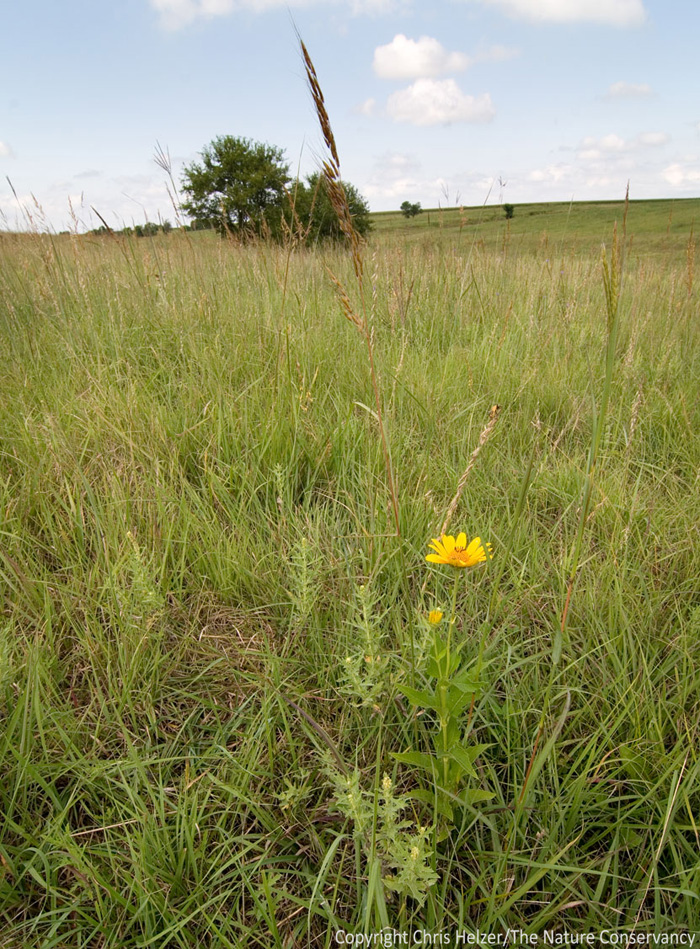
This false sunflower is one of a handful of species that is showing up here and there across the old farmed portions of the prairie as a result of our overseeding efforts. It's a slow process, but one that will, I hope, pay long-term dividends.

Of course, if Grandpa’s restoration project was being done today, and the main goal was really to ecologically reconnect those small prairie islands, the cropland around the prairie remnants would be seeded with a high-diversity mixture of prairie plant species.  That would help ensure that the seeded area facilitated a number of ecological needs, including the availability of host plants for a variety of insects and genetic flow between plant species.  In 1962, no one in Nebraska was even thinking about anything like that, and Grandpa’s goal was (I think) simply to take a piece of land that was being overused and make it into productive agricultural land.  I’m pretty sure he’d never heard of a grasshopper sparrow.  Regardless of his initial goal, there is now a 108 acre prairie in southern Hamilton County, Nebraska – and that’s a rare and valuable commodity.  The nearest prairie to ours is at least several miles away, across many acres of cropland.

I don’t know exactly know how to measure the ecological value of our prairie, but I’m sure proud to own it.