
Winter Cranes – Part Three

It sure looks like we’re going to have sandhill cranes around for the entire winter.  In fact, the consensus among biologists is that the number of cranes has actually grown over the last couple of weeks.  There was even a sighting of three whooping cranes this week, a common event in April, but nearly unheard of in January.

If you haven’t been following this story, Nebraska’s Central Platte River is normally the site of a massive staging event of sandhill cranes each spring, when about 600,000 cranes converge on the river.  Those cranes roost overnight in the river and spend their days feeding and building body condition for the rest of their migration and the breeding season.  Typically, cranes begin arriving on the Platte in mid-February and are mostly gone by early April.

In the fall, cranes pass through the Platte Valley again on their way south, but they don’t usually appear in large numbers or stay very long.  This past fall, however, we kept seeing groups of cranes hanging around, and they never seemed to leave.  By December, it was clear that something unusual was happening.  I speculated in an earlier post about what might be going on, but no one really knows for sure.

This morning, on my drive out to the Platte River prairies, I stopped for a few minutes to look around one of our riverfront prairies just because I hadn’t been there for a while .  As I drove into the property, I got to watch three immature bald eagles chasing each other – apparently playing follow the leader – flying less than a foot apart from each other.  That was pretty impressive, but when the eagles got close to the river, they flushed several hundred cranes into the air.

The cranes circled a few times and returned to the river.  Grabbing my camera, I belly crawled through the tallgrass and shrubs along the river’s edge until I got into a position where I was well hidden but could see and photograph the cranes.  I spent the next 15 minutes or so watching them dance around and listening to calls I normally don’t get to hear in January.  There were only about 500 birds in front of me – a far cry from the tens of thousands that will be here in about a month – but that didn’t really diminish the experience.
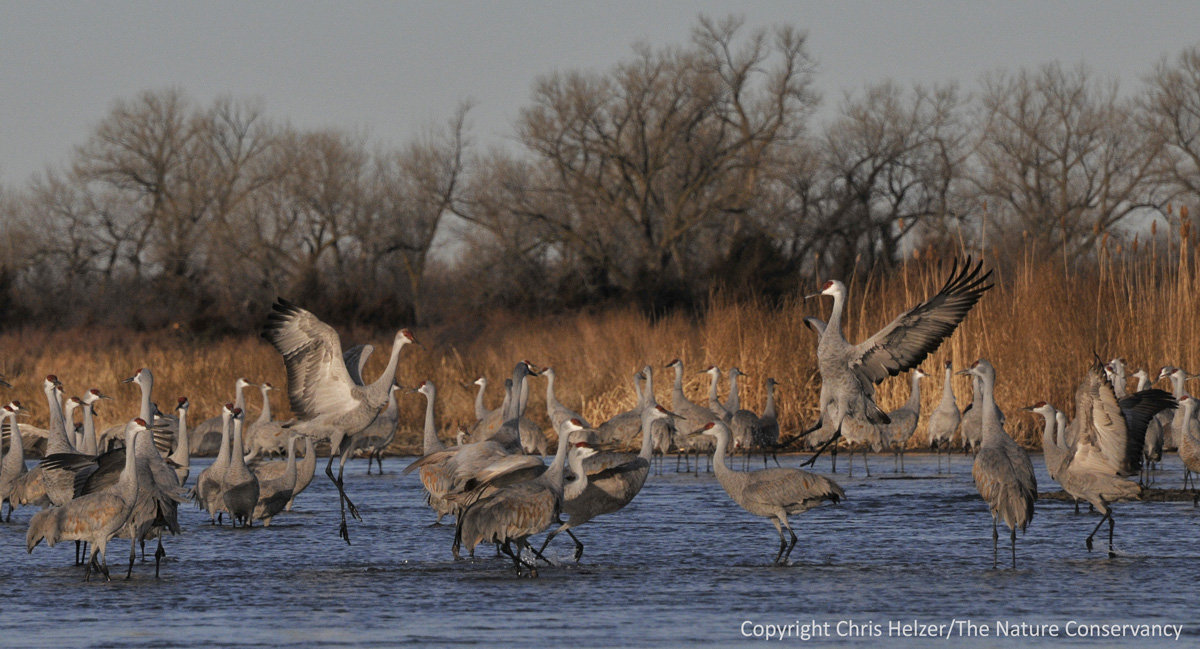
Sandhill cranes on the Platte River in January.

I couldn’t stay long because I was supposed to meet some other people, so after I’d delayed as long as I could, I belly crawled back away from the bank and made my way back to my vehicle.  On the remaining 6 miles of my drive, I saw another couple thousand cranes feeding in the fields and meadows.

All in all, it was a pretty good start to the day.

The cranes seemed to be dancing and posturing just as they typically do later in the spring.

A Prolonged Visit

Sandhill cranes are regular visitors along the Platte River.  During the spring, more than half a million cranes stage here from mid February through early April.  Once they build up sufficient fat reserves they continue north to breed in Minnesota and Canada. 

In the fall, we see the sandhill cranes again, but normally just for a quick visit as they hurry south toward their wintering grounds.  Usually, we see them less than we hear them, as they glide far overhead.  A relative few stop and roost on the river for a night or so, and those overnight guests might do a little feeding in the recently harvested corn fields or meadows while they’re here.  But unless the weather keeps them longer, they usually arrive one evening and leave the next morning.

This fall, however, something’s different.  As I write this, there are thousands of sandhill cranes roosting and feeding along the river – and they’ve been here for more than two months.  For the first several weeks, we assumed it was an anomaly, and that they’d be moving on soon.  Now we’re starting to wonder if they’re planning to stay all winter!

Alright, so this is really a photo from the spring migration, not the fall. (But the cranes look the same)

The unexpected congregation of cranes is causing considerable discussion and speculation among biologists around here.  No one can remember this ever happening before, so why this year?  Is it related to the severe drought in Texas and other places in the south where the cranes typically spend their winter?  If so, did the cranes go down, look around, and turn back north? 

For a while, we figured it was just the mild November temperatures and strong river flows that were keeping them here.  If it’s not cold and snowy, why leave?  But since then, we’ve had some very cold (albeit short) snaps and two substantial snowstorms come through.  And they’re still here.

I emailed Dave Brandt, with the US Geological Survey’s Northern Prairie Wildlife Research Center to get his input on the discussion.  Dave is part of a team (along with Gary Krapu) that has been doing a lot of telemetry work on the mid-continent sandhill crane population, and tracking where they go.  He said that “reflux migration” (cranes bouncing back in the direction they came from) because of severe weather conditions is not unheard of, but is very rare.  They’re not following cranes intensively now, but he did say that there were 16 marked birds they’d been watching, and that all had migrated all the way south. 

Dave was actually in Texas when he emailed, and said there were sandhill cranes there, but that it was very very dry.  His best guess was that “our cranes” were just taking their time coming south because of the nice weather.  That makes good sense to me.  However, that was a month ago, and before the cold and snowy weather hit!

This is one of those phenomena that makes it great to be a biologist.  You think you’ve got a species really figured out, with strong patterns of behavior that repeat time after time – sandhill cranes have been very well studied – and then the species throws you a curve ball.  Out of left field.  Or something. 

Will they stay all winter?  Will they leave in the spring?  Will they do this again next year and for the foreseeable future? 

No one knows.  Fun, isn’t it?