
Snow and Light

We finally got our first measurable snowfall (4-5 inches?) of the year here in east central Nebraska.  I took my camera for a walk at our family prairie yesterday evening, enjoying the way a little snow really transforms a landscape.  I found and followed tracks of coyotes, mice, birds, and deer, and flushed flocks of meadowlarks and tree sparrows.  As the sun started to drop quickly toward the horizon, I wandered through one of the areas we grazed particularly hard last summer, enjoying the broad expanse of whiteness, punctuated by scattered plants poking up through the snow.
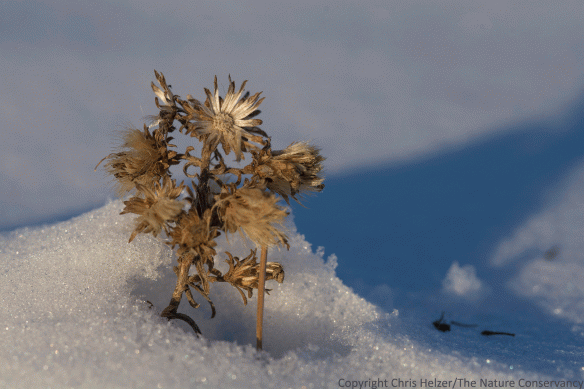
Heath aster (Aster ericoides) protrudes from a tiny mound of snow.

I spent the next half hour mainly lying prone on the snow, tripod legs splayed flat to the ground, photographing heath aster and sideoats grama plants, and having a great time.  As you look through these photos, you’ll be able to see how the quality and color of the light changed as the sun approached the horizon.  Shadows became much less stark and more blue in color, and the plants and snow both reflected increasingly golden-orange light from the setting sun.
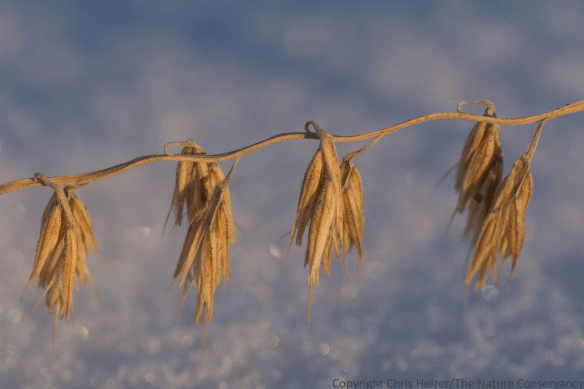
Sideoats grama (Bouteloua curtipendula)

More sideoats

More heath aster

Final sideoats photo, as the sun was right at the horizon.

The opportunity to watch sunrises and sunsets is a big perk of living on the Plains, where we get an unobstructed view of the sun from horizon to horizon, without pesky trees or mountains in the way.   On many nights, the combination of a low sun angle, expansive sky, and scattered clouds can provide spectacular views.  Other times, however, the best way to appreciate a setting sun is to turn and look in the opposite direction at the changing colors of light and shadows.

Merry Christmas everyone!

Hubbard Fellowship Blog- Sprouts

This post was written by Evan Barrientos, one of our Hubbard Fellows.  Evan is a talented writer and photographer and I encourage you to check out his personal blog. If you would like to see more of his photographs, you can follow him on Facebook.

20160321_nebraska_9887

Woolly Plantain (Plantago patagonica) sprouting form a pocket gopher mound.

Watching plants resprout this spring has been really interesting for me. Spending time with Chris Helzer has made me appreciate the small details of prairies, particularly plant diversity and distribution. Through him I’ve learned to read a prairie’s history of management and disturbance even in early spring…and appreciate its minute aesthetics! On March 21 I was taking a sunset walk (looking down rather than at the sky) when I noticed several attractive sprouts growing on the sandy mounds created by pocket gophers as they dig tunnels. I remembered reading how burrowing animals play an important role in plant germination. By providing patches of bare soil, these rodents give seeds an open place to spread their roots and leaves with much less competition from other plants. It was neat to witness this happening for myself!

7D1_0651-INST

On that walk I also found my first flower of the year! Carpeting just a small segment of our trail as it runs through the sandhills were dozens of tiny Sun Sedges (Carex heliophilis) already in bloom. If you weren’t looking for them, you might not even realize what they were. Their flowers were quite small, but in March their waving yellow petals were like thousands of little victory flags. Two nights later, a sudden snowstorm roared through Nebraska. I was eager to see if the delicate flowers had survived, so the next morning I was trekking back to them before sunrise. To my delight, the flowers were still there, poking through the snow. I got on my belly and started photographing. I wanted an image that represented spring’s triumph over winter. As the sun crested the hill it bathed the sedges’ petals in gold. Like dozens of tiny torches, the sedges proclaimed that spring had indeed won.

20160324_nebraska_0788

Sun Sedge (Carex heliophilis) blossoming in snow.