Photo of the Week – September 4, 2014

It’s not often the wind is calm enough to get a good sharp photo of a spider in its web, but everything came together nicely late last week as I walked around one of our restored wetlands.  There were a number of long-jawed orbweaver spiders (Tetragnathidae) in their webs, but this one was the most accomodating…

A long-jawed orbweaver in early morning light.  The Nature Conservancy's Platte River Prairies, Nebraska.

A long-jawed orbweaver in early morning light. The Nature Conservancy’s Platte River Prairies, Nebraska.

Of course, I missed a great shot of a nearby spider that had caught a mosquito.  The light was great, the composition was going to be fantastic, but my tripod leg bumped the grass stem holding the web and the spider hightailed it to safety.  Oh well.  I still got to see and enjoy it – I just can’t share it with you.


Photo of the Week – July 3, 2013

Sometimes danger is waiting just around the corner…

A

An ant explores an annual sunflower for extra-floral nectar, seemingly unware of the crab spider lurking on the other side of the petals.  The Nature Conservancy’s Niobrara Valley Preserve – Nebraska.

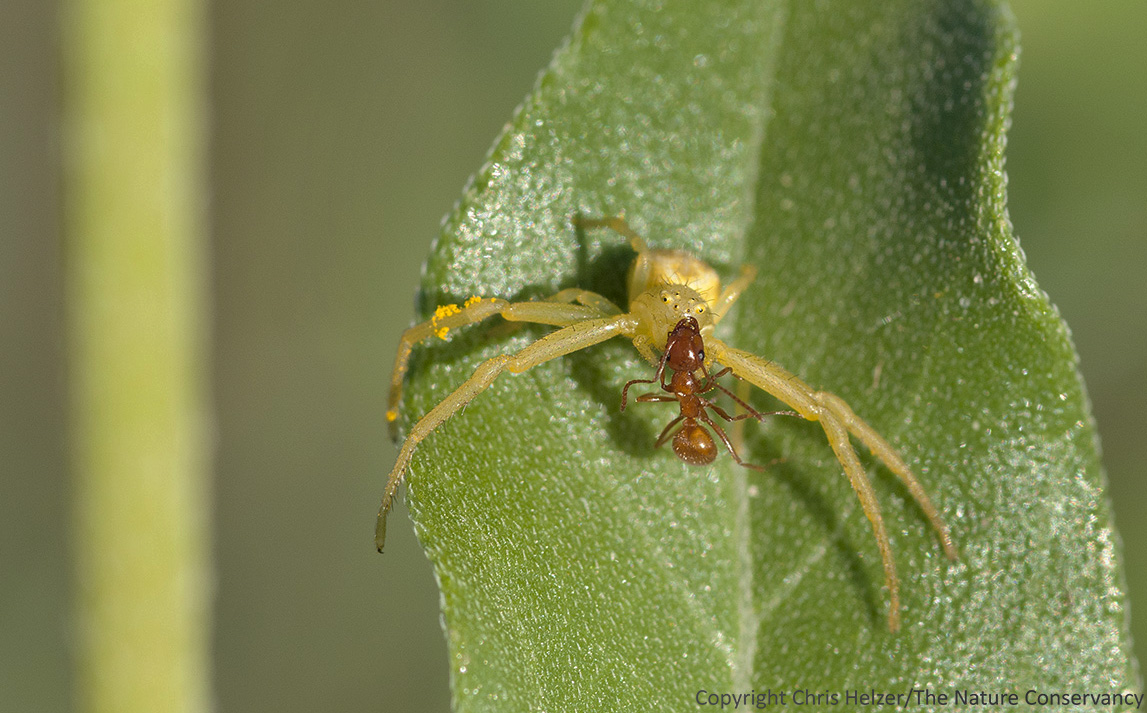
Last summer, I wrote a post about annual sunflowers, including a short bit about how sunflowers secrete extra-floral nectar to attract ants.  The ants eat the sweet substance and may help repel potential herbivores from the sunflower in return.  As you might expect, however, an abundance of ants can also be a potential source of food for other predators – including crab spiders.  When I was at our Niobrara Valley Preserve last week, I noticed several instances where crab spiders were hanging around on sunflowers.  They probably weren’t waiting specifically for ants, but apparently ants are an acceptable prey item if they happen to be available (see below).

B

A crab spider feeds on an ant it caught on an annual sunflower.  This photo was taken a few minutes after the above photo, but it wasn’t the same sunflower, spider, or ant shown in that first photo.

…and that’s life – and death – in the prairie.