Hubbard Fellowship Post – Ruminations While Disking

This post is written by Kim Tri, one of our two Hubbard Fellows for this year.  Kim is an excellent artist, as well as an ecologist, writer, and land steward.  As you can see, her drawings of animals are exceptional.

A Swainson’s hawk takes wing not 30 feet from me, and I feel vindicated.  It rises from a patch of ground which I’ve just disked, and answers the idle question I had when I began disking that day.  I wondered whether the turning under of vegetation and hence the cover of the little critters living there would attract hawks in search of an easy-to-spot snack.  I’d seen it happen on a prescribed burn which I’d sat in on last year, in the property just across the creek.  Once the flames and smoke died down, we counted at least 20 hawks—most of them Swainson’s—soaring overhead.  They were attracted by the aftermath, the ground cleared of protected cover for the disoriented prey.  The black earth left in the wake of the disk plow reminded me of the fire, and got me wondering.
gg

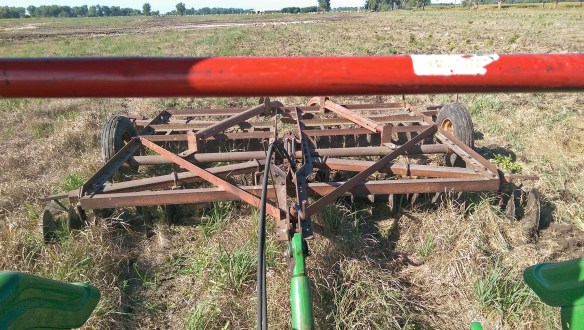
For those of you not familiar with the practice of disking, it involves plowing using a disk plot (pictured above) pulled behind a tractor.  Picture by Kim Tri

I should have kept a tally of how many voles, mice, rabbits, and lizards I saw clearly fleeing across the worked ground as I plowed.  Creatures visible to my weak human eyes would be easy pickings for a (much) sharper-eyed hawk.

Sure enough, a hawk showed up after an hour or so and answered my question.  The neighbor was haying in his field just across the fence, which I’m sure was turning up quite a bounty of prey as well.  I don’t have enough agricultural experience to know whether the hawks usually show up around haying time, but the intent circling of the hawks above the neighbor’s tractor made me think that they’ve cottoned on to it as well as they have to burning.

While disking later that week, also I kept (slowly) chasing groups of killdeer.  A contractor had come in with an excavator only a few weeks before to reconstruct wetlands on the property.  The killdeer scuttled around the newly excavated wetlands, where before they had not seemed to give this property much of their time.  They, too, appeared attracted to the open ground where they might find prey.  After all, the wetland excavation as well as the disk plowing had suddenly provided them with some quite preferable habitat.

kil

A group of startled killdeer flee alongside the track left by an excavator.  Graphite drawing by Kim Tri

It got me thinking about the consequences of our actions as land stewards – the whole ecology of it all.  So often, during a day’s field work, we focus on the plant community.  This makes sense, since it’s really the only thing about our prairies that we can directly manage, and where the effects of our work are most easily observable.  The larger aim, though, is to create a diverse ecosystem with quality habitat for as many faunal species as possible.  We do this intentionally through a variety of practices, such as seeding, prescribed burning, invasive species control, and grazing.

There are plenty of unintended beneficiaries to these.  I did not set out that day with the disk plow to provide a meal to the local Swainson’s hawks.  The objective was actually to clear the remaining vegetation of a low-quality “failed” restoration in order to create a blank canvas for seeding it into a high-quality prairie.  It had been recently sprayed completely to clear out the brome invasion that was its major fault, and since then I’d come to view the area as kind of a dead space.  While looking ahead to what the tract could be, I’d forgotten about all of the things that it still was.  It was still habitat for a wide variety of animal life, judging by the creatures I was seeing.  The cleared ground of the excavated wetlands showed trails of deer and coyote tracks, and even now, after the ground has been completely cleared, the deer and coyotes still keep leaving tracks.

I’ve noticed, too, while mowing fire breaks around our burn units, that there are creatures benefitting.  While making a third pass around with the tractor to widen the line, driving alongside the line I’d already mowed, I noticed many voles and mice scampering out of the clippings left behind.  They seemed drawn to the mowed line, and I felt that I’d just created dream foraging habitat for them.  As well as laying down a dense layer of cover to protect them, I’d just brought down to ground level a cornucopia of seedheads that had previously been out of reach for the little critters.

I acknowledge that there are also species negatively impacted by some of the things we do, but that is a thought for another time.  The mice were definitely not happy about the disking or the hawks, but I hope that we balance this out by working to improve their habitat.

We’ll reseed the disked tract with the seed we’ve collected this year, and in the spring a new prairie will grow, bringing with it an influx of creatures back to the property.  In another few years, it will be burned, and then likely the Swainson’s hawks will come again, drawn by the promise of bounty on the black earth.
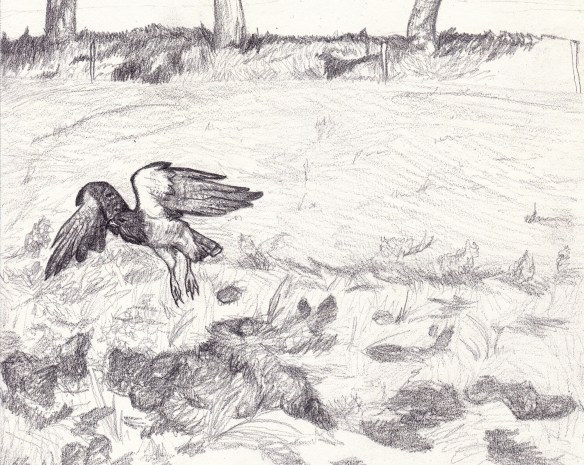
A Swainson’s hawk takes flight from a disked field. (Yes, the ground does look that messy) Graphite drawing by Kim Tri

A Swainson’s hawk takes flight from a disked field. (Yes, the ground does look that messy) Graphite drawing by Kim Tri

From Plant ID to Small Engine Repair – The Complex Life of a Land Steward

It’s been almost 19 years since I started my career with The Nature Conservancy as a land steward.  My job was simple: restore and manage several thousand acres of prairie, wetland, and woodland habitat.  When I started, I felt like I was the luckiest guy on earth.  I was also scared to death.  What if I messed up?  These were extraordinarily complex ecological sites and I was a 25-year old kid with only a college education and a sliver of real world experience.  I had lots of ideas but it was daunting to think about trying those ideas out without knowing they’d work.  Fortunately, Al Steuter, the Director of Science for The Nature Conservancy in Nebraska gave me some advice that helped me tremendously.  In essence, he told me to remember that prairies were incredibly resilient, and that nothing I did in one year (aside from tillage or broadcast herbicides) could ruin them.  That advice was incredibly liberating, and allowed me to start enjoying my work.

I was a very young-looking 25-year-old when I started as a TNC land steward. They weren't sure I should have an actual ATV...

I was a very young-looking 25-year-old when I started as a TNC land steward. They weren’t sure I should have an actual ATV…

Over time, my responsibilities have changed and now, among other things, I serve as advisor to our statewide land management team.  I really like what I do, but land steward was my dream job and I can’t imagine I’ll ever find a better one.  However, as I think about the stewards I know and work with, I’m pretty sure I don’t measure up to today’s standards.

The job description for most land stewards in The Nature Conservancy – at least in the Great Plains – has expanded to the point of almost unattainable proportions.  As a result, it is no exaggeration to say that I am no longer qualified to be a land steward for this organization.  Most land stewards I know work by themselves or with a very small team – often consisting mostly of seasonal employees – and manage thousands of acres of land for biological diversity and wildlife habitat.  As a result, they have to be able to handle whatever challenge presents itself, from plant identification to small engine repair, and everything in between.  To give you an idea of the scope of that work, here is a partial list of what we expect of Nelson Winkel and Evan Suhr, land stewards who work for The Nature Conservancy in Nebraska.

Evan Suhr, Bison roundup at TNC Niobrara Valley Preserve. Nebraska.

Evan Suhr during this fall’s bison roundup at The Nature Conservancy’s Niobrara Valley Preserve. Nebraska.

Ecologist/Natural History Biologist

Evan and Nelson are expected to be able to identify most of the plant and animal species living in the prairies they manage and understand how they interact.  They also have to understand how all those species and interactions respond to various combinations of weather patterns and management treatments.  Obtaining just those skills could easily consume a career.

Research Scientist

Good land stewards always look for ways to test the effectiveness of management strategies so they can keep improving their work – and provide guidance to neighbors and partners facing the same challenges.  Sometimes, that means collaborating with academic scientists on research projects.  More often, it just means setting up an invasive species control or grazing treatment in a way that provides a fair and impartial test of two or more methods.  The results of those tests don’t usually get published in peer-reviewed scientific journals, but in order for the results to be trusted, the tests have to be set up in a scientifically-rigorous way.

Nelson Winkel works to identify a bee during a pollinator workshop with Mike Arduser at TNC's Platte River Prairies, Nebraska.

Nelson Winkel works to identify a bee during a pollinator workshop.  It’s important to understand the biology and ecology of the natural systems you manage.

Ranch Hand

Building and fixing fences, and repairing windmills and solar-powered pumps are frequent tasks for Evan and Nelson.  Even more frequent tasks include manual labor associated with invasive plants – chopping thistles, cutting trees, etc.  Some of those tasks require mainly hard work, but others require specialized knowledge (how to take apart, clean, and reassemble a pump, for example).  In addition, stewards have to stay current on agricultural topics from grazing lease rates to animal husbandry techniques so they can work effectively with Conservancy bison herds or the cattle (and their owners) grazing Conservancy land.

Mechanic

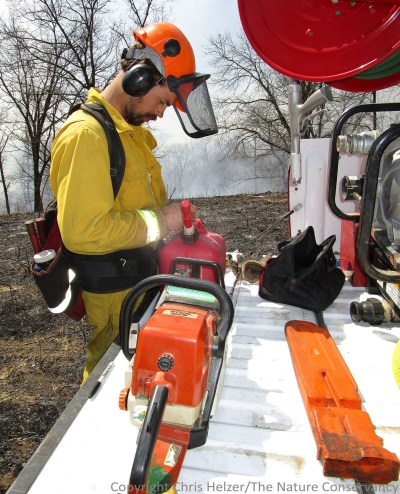
The number of engines involved in land stewardship is astonishing, including those found in trucks, tractors, skidsteer, ATVs, chainsaws, fire equipment, and more.  Land stewards have to be able to maintain all those engines, but also perform at least basic diagnostics and repairs.  When major repairs are needed, they can haul equipment to a professional mechanic, but if they needed professional help for every little mechanical malady, stewards would spend all their time hauling equipment to and from repair shops.  As someone who has never figured out how to correctly adjust a carburetor or do whatever it is you have to do to make a chainsaw actually start correctly when just pulling the cord doesn’t work, I have great admiration for those who have the skill, knowledge base, and intuition to fix engines.

2014 Spring burn at TNC Rulo Bluffs Preserve. Nelson Winkel.

Nelson can operate, maintain, and repair chainsaws.  If a saw goes down during the mop-up operation of a woodland prescribed fire, it’s pretty important that he be able to get it running again.

Plumber/Electrician

Since most land stewardship operations include buildings with plumbing and electrical systems (not to mention electric fences and livestock watering systems), and contracting for repairs in remote areas is usually infeasible because of cost, timeliness, or both, those repairs often fall to land stewards.  Replacing a broken light fixture, finding and repairing a leaky pipe in a house crawlspace, or troubleshooting a short in an electric fence are all tasks that could fall to land steward on any given day.

Biochemist

Much invasive plant control requires the application of herbicide.  The variety of brands and formulations of herbicides can be as overwhelming as the diversity of invasive plant species they help suppress.  Just reading and understanding an herbicide label can be a daunting task, let alone trying to understand how various chemical formulations might affect plants in a way that will kill the ones you want and not the ones you don’t.  Then, once you’ve figured out – for example – whether you should use the amine or ester formulation of a particular chemical (it’s related to risks associated with volatilization on hot days), you still have to calculate the correct amount of each ingredient and calibrate your sprayer.

Nelson Winkel sprays reed canarygrass at TNC Nebraska's Platte River Prairies.

Nelson Winkel sprays reed canarygrass at The Nature Conservancy’s Platte River Prairies.

Fabricator

I am in awe of Nelson’s ability to make specialized tools and equipment for land management work.  Simple welding tasks seem overwhelming to me, let alone building herbicide sprayers, slip-on fire pumper units, and hydraulically-powered augers to dig holes for large fence posts.  Sometimes he builds his own equipment because it’s cheaper than buying it, but other times he does it because it’s not possible to buy something that does what he needs it to do.

Burn Boss

Despite the fact that The Nature Conservancy is a private non-profit organization, becoming qualified to lead a prescribed fire for TNC now requires stewards to work through the NWCG (National Wildfire Coordinating Group) system used by federal agencies that fight wildfires.  Under a best case scenario, it takes several years to take all the courses and get signed off on all the required tasks (including some that necessitate fighting wildfires) to qualify as someone who can lead prescribed fires.  Accomplishing that means spending weeks at a time away from home.  Regardless, prescribed fire is a critically-important component of The Nature Conservancy’s work, so land stewards work through those requirements as best they can.

Nelson Winkel, TNC land manager for Platte River Prairies during a prescribed fire.

Prescribed fire is a big part of prairie management, but becoming qualified as a burn boss takes years worth of training and experience.

Collaborator/Negotiator/Neighbor

Land stewardship doesn’t happen in a vacuum.  All of our properties are nested within land owned by farmers and ranchers.  To be successful, land stewards have to get along with, learn from, and share ideas with those neighbors and other partners.  Often that leads to interesting situations in which a land steward is negotiating a grazing lease with a neighbor who also happens to be on the local fire board and can influence whether or not a burn permit is issued.  Gaining the respect of neighbors and other local conservation partners means taking the time to get to know them, their families, and their personal philosophies on life, conservation, hunting, and football.  Much of that relationship building happens outside of a regular work schedule, but it’s essential – we couldn’t do our work without the support of our neighbors and local communities.  More importantly, building credibility with neighbors and partners is critical because sharing lessons learned from our land management work with others is how we influence conservation beyond the borders of our relatively small land holdings.

……

Perhaps the greatest challenge for land stewards is that despite the amount of work to be done, there are still only 24 hours in a day.  Working as a land steward for The Nature Conservancy is incredibly rewarding but also impossibly complex and difficult – as is working as a land manager for any conservation organization or farm/ranch operation.  I still can’t believe I ever got hired as a land steward, or that I managed a fair amount of success in spite of my shortcomings, especially in terms of mechanical prowess.  It is my privilege to work with stewards like Nelson, Evan, and many others, and I am in awe of the breadth of their knowledge and the extent of their energy.  Not only are they caretakers of their particular natural areas, they are developing, testing, and sharing the techniques the rest of us need in order to conserve the rest of the natural world.