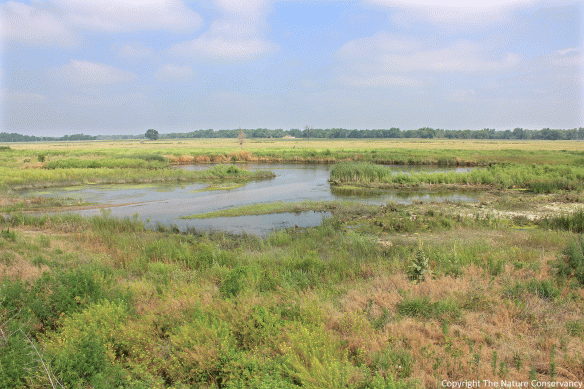
Photo of the Week – August 18, 2017

A few years ago, with technical and financial help from the U.S. Fish and Wildlife Service and Nebraska Game and Parks Commission, we fenced out the pond at our family’s land and installed solar-powered livestock watering facilities.  It was something I’d wanted to do since taking over management of the land, and I was excited to see what positive impacts might result.  As expected, keeping cattle out of the pond has really transformed it.  The water is much less muddy and vegetation has grown up around and in the water, creating some really nice wetland habitat.  Taking advantage of the new habitat conditions are hordes of dragonflies, damselflies along with many other invertebrates, frogs and water birds.  In addition we find tracks of other wildlife all around the edge of the water.
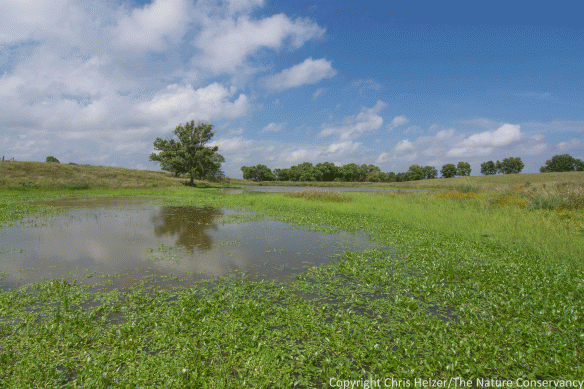
Here is the shallow end of our pond last week, with lots of blue mud plantain, along with arrowhead, pondweed, and other wetland vegetation.  We’ll still use cattle to manage habitat conditions, but now we can let them in when we want to, and for specific purposes, rather than having them stomp around the pond all the time.

One small but really pleasant surprise has been the establishment of a little plant called blue mud plantain (Heteranthera limosa).  It’s an annual emergent wetland plant that is pretty common around Nebraska but it’s gorgeous and I’d never seen it on our land before this year.  All of a sudden, it’s taken over much of the shallow water areas of our wetland and I couldn’t be happier.  It’s not a rare plant, and I have no idea how valuable it might be for wildlife or pollinators – I’ve just always thought it was a pretty little wetland plant and I was excited to find it at our place.  I spent a little time photographing it last week and came away with wet elbows, wet knees, and some nice images of this great little plant.

Blue mud plantain in all its glory…
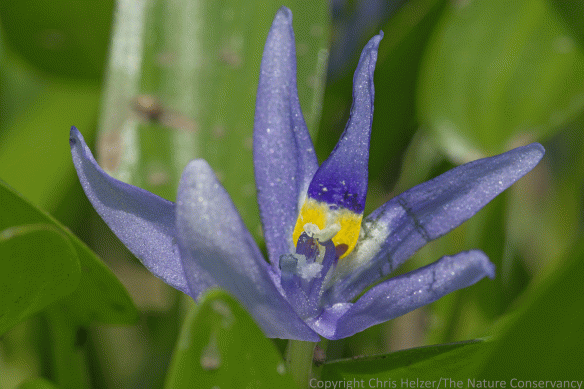
 

Photo of the Week – March 24, 2017

Below are two photos of a creek and associated wetlands taken by a timelapse camera.  The first photo was taken in early June, 2015 and the second photo was taken about a month later.  Looking just at those two photos, you’d think nothing much was happening.

Derr Wetland in early June 2015.

Derr Wetland in early July 2015.

However, now look at the next photo, which was taken in mid-June.  After some rains in early June, the stream swelled and filled much of its floodplain, and that high water lasted a couple weeks before it came back down again.  The photos show how dynamic a stream and its floodplain can (and should) be.

Mid-June 2015.

The area in these photos is a restoration site that was formerly a sand pit lake left behind after gravel mining.  A stream flowed into the narrow lake on one end and out the other, and the lake was surrounded by spoil piles and trees.  After restoration, the site now has a couple stream channels, some adjacent wetlands, and provides wide and open habitat for a diverse number of aquatic and terrestrial animals.  In addition to providing great wildlife habitat and a diverse plant community, though, the restored site also improves the floodplain functionality of this stream.

Flooding is a natural and important process, and floodplains play an essential role in that process.  After big rain events, streams quickly gain water that has to go somewhere.  Ideally, that water spreads out into a floodplain where it slows down and sits until it either drains into the soil or gradually is allowed to proceed downstream.  When we restrict or block access of streams to their floodplains, floodwater is forced downstream in a torrent and sometimes breaks out from its restraints, causing unexpected and often catastrophic damage to property.

The 10 second timelapse video below shows (on a small scale) the kind of gentle rise and fall of water levels a functioning floodplain can facilitate.  The images in the video were taken between June 3 and July 1, 2015.  The water level came up fairly quickly between June 4 and 5, remained high for a couple weeks, and then dropped slowly back to where it had started.  Just like it was supposed to.

(If the above video doesn’t work, try clicking on the title of this blog post to open it in a web browser and then try again.  If that doesn’t work, try just following this link.)