(What We Have Here is) A Failure to Communicate

Picture a grassland dominated by little bluestem and other grass species.  One that has an abundance of wildflowers, including bird’s foot violet, goat’s rue, partridge pea, and numerous varieties of goldenrod, bushclover, and tickclover – among many others.  This prairie is one of only a few remnant prairies remaining in an ecosystem that once covered large swaths of North America.  Less than 1% of that ecosystem now remains in good condition, and most of its remnants are on sandy soils or steep slopes where farming and other human practices are difficult.  Sound familiar?  What if I told you this grassland ecosystem is found in places like North Carolina, Alabama, and Florida?  Oh, and that when it’s in really good condition, it’s full of pine trees…

Longleaf pine woodland (grassland?) in North Carolina.

If you live in the Midwest or Great Plains regions of North America, you were likely picturing a nearby tallgrass or mixed-grass prairie as I was describing that grassland.  Our prairies here sound, look, and function very much like the grasslands of the longleaf pine ecosystems in the southeastern United States.  Both rely heavily on frequent fire to maintain the species and habitat structure their species rely on.  The main difference is that longleaf pine grasslands have longleaf pine.

So if longleaf and midwestern prairies are so similar, why is there so little interaction between those of us working in the two ecosystem types?  It’s a question that has bothered me for years.  I’m not anywhere close to an expert on longleaf, having visited only twice during prescribed fire training courses.  On the other hand, I felt very much at home while I was there.  I recognized many of the plants – if not the species, at least the genus – and it wasn’t hard to imagine that I was walking through a midwestern oak savanna (with pine cones).  Click HERE to see some photos of longleaf pine wildflowers.

Frequent fire is used to keep longleaf ecosystems in good condition. Mature longleaf pine trees are very resistant to fire, and the fire keeps woody species from becoming overly abundant in the understory.

.

Deciduous trees and shrubs can quickly start to encroach in longleaf pine communities when fire frequency decreases.

.
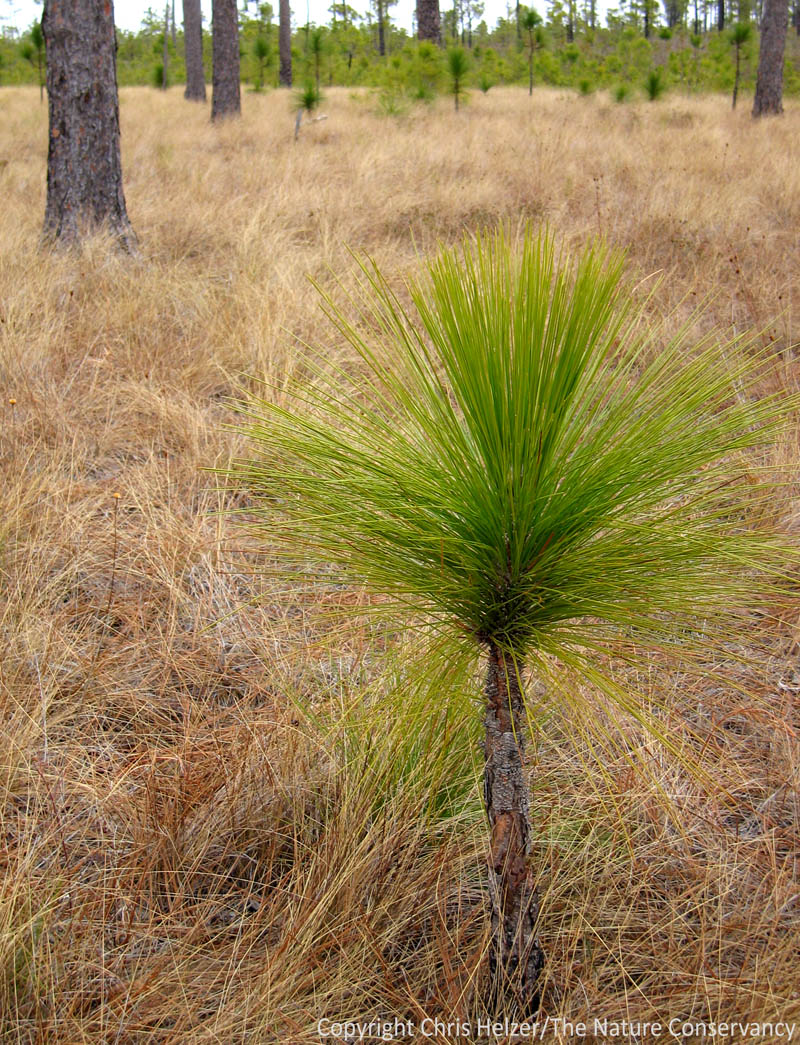
Young longleaf pines - not just older ones - are resistant to fire. When very young, longleaf pines spend several years in a "grass stage" in which the growing point is at the ground level. In the grass stage, the tree invests in root growth belowground and resembles a bunchgrass aboveground - protecting it from fires. The tree in this photo is in the "bottle brush" stage, a phase in between the grass stage and a more mature tree. During this stage, the tree is at its most vulnerable to fire - until it reaches a size that it can again withstand burning.

It seems crazy to me that we’re not consistently exchanging ideas and strategies between midwestern prairies and longleaf pine grasslands – especially because we’re both struggling with many of the same issues.  Both systems become choked with brush and trees in the absence of frequent fire.  Invasive species are a major issue.  Perhaps most importantly, both midwestern prairie and longleaf pine are nearly gone, making restoration a critical need if the ecosystems are to survive.  Restoration efforts involve both the rehabilitation of degraded remnant natural areas and the reconversion of farm land to native vegetation.

I’ve been part of a couple efforts to start information exchanges through The Nature Conservancy and through the Grassland Restoration Network.  Both have mostly fizzled, but the little bit of exchange we managed only strengthened my conviction that we need to keep trying.  From what I can tell, many midwestern prairie ecologists could learn a lot from the way longleaf ecologists focus on ecosystem function – especially fire – as a way to measure success and manipulate habitat.  That heavy emphasis on restoring ecological process is very different from the more species composition-oriented thinking among many midwestern prairie ecologist.  At the same time, I think many longleaf ecologists could gain from infusing their process-oriented approach with more emphasis on plant diversity and the insect and animal diversity associated with those plant species.  In some ways, the differences between longleaf and tallgrass prairie thinking are similar to those between eastern and western prairie thinking within the Central U.S. (as discussed in an earlier post).

One specific opportunity I see is to provide longleaf ecologists better access to lessons learned from the long history of diverse prairie restoration efforts in the Midwest, in which hundreds of plant species are included in seed mixtures.  Most efforts to convert farm fields to longleaf pine communities (with notable exceptions) focus mainly on establishing longleaf pines and grass – largely as a way to facilitate reintroduction of fire.  Increasing the diversity of herbaceous plant species could have some big benefits ecologically, and shouldn’t slow down process of reintroducing fire.  The extent to which midwestern techniques would transfer south is something we should be exploring together.

How do we build the connections?  If I knew the answer, I wouldn’t be writing this post.  However, I do think there are some important steps.  One would be to ensure that longleaf pine ecologists are encouraged and invited to attend the meetings such as the biennial North American Prairie Conference.  Getting us all in the same place to share ideas is absolutely the best way to exchange information.  Better yet, maybe someone in Alabama or South Carolina can host an upcoming prairie conference so that Midwestern prairie folks are forced to come down and see for themselves the wonderful longleaf grasslands.  Facilitating involvement from Midwestern prairie ecologists in existing longleaf conferences would also be valuable (to everyone).

In addition, I think organizations like The Nature Conservancy and others that span multiple states have a responsibility to lead the way in facilitating communication and collaboration.  It’s certainly not easy.  It’s hard enough to work between adjacent states, let alone regions.  On the other hand, none of us have figured out all the challenges in grassland conservation, so we need all the help we can get.  Working and experimenting in separate laboratories without sharing results is just silly.

If anyone sees an opportunity for building bridges between north and south on this issue, please let me know if I can help.

For more information about longleaf pine ecosystems, visit the Longleaf Alliance website.

Savanna and Woodland Burning at the Rulo Bluffs Preserve

The Nature Conservancy’s Rulo Bluffs Preserve is one of the highest quality woodland/savanna habitats in Nebraska. Located at the very southeastern corner of the state, the 444 acre site has very steep topography, small prairies on the ridge tops, and some very nice herbaceous plant species diversity. The site is also located on the far western edge of the geographic distribution of many plant and animal species, including black and chinkapin oak, southern flying squirrel and timber rattlesnake (among many others). While it is a valuable ecological resource, the Rulo Bluffs Preserve also faces a number of significant challenges, including strong expansion of dogwoods in the prairies, too many smaller trees in the woodlands, and encroaching invasive species such as garlic mustard and sericea lespedeza.

Hikers at the Rulo Bluffs Preserve walking down one of the prairie ridges toward the woodland below in early May.

Since the mid-1990’s, the Conservancy has been actively managing the site by cutting small trees and brush, controlling invasive species, and by using prescribed fire. However, the consistency of management actions has been somewhat limited by the logistical challenges associated with site’s distance from the Conservancy’s staff and facilities in Nebraska (the site is about a 4 hour drive from the nearest stewardship staff). Within the last several years, those challenges have eased because of a collaborative relationship with Northern Prairies Land Trust (NPLT) and the Nebraska Game and Parks Commission (NGPC), through which NPLT employee Kent Pfeiffer has been helping to coordinate and implement management at the site. In addition, funding has been provided from several sources (including NGPC, the Cooper Foundation, and Neal Ratzlaff) to help pay for more work to be done at the site by both Conservancy staff and contractors. Kent has helped to secure funding, coordinated most of the on-the-ground work from his nearby office, and has done significant work on the property himself.

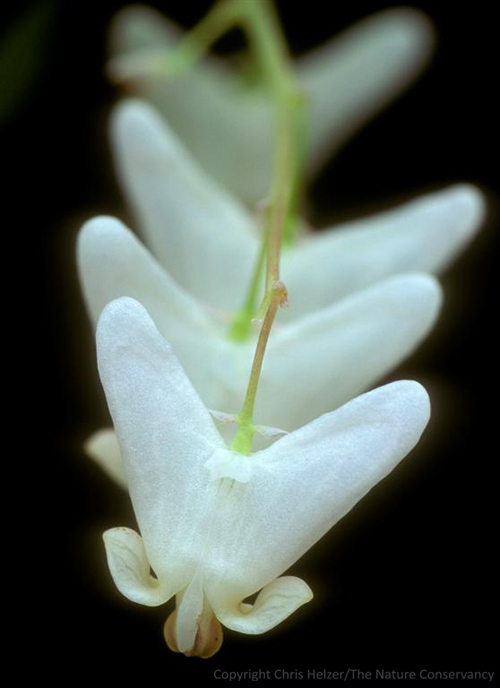
Dutchman's breeches is one of the many woodland flowers found at the Rulo Bluffs Preserve.

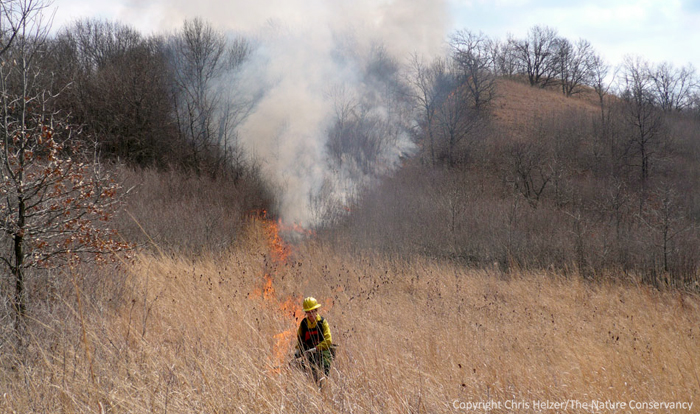
The latest product of all of that coordination and attention to the property was a prescribed burn last week (March 30). During the last several years, previous attempts at burning the property had been stymied by a combination of weather, logistics, and bad luck, so it had been way too long since the previous burn. Our primary objectives for the burn were to reduce the density of trees in both the woodland and prairie/savanna portions of the property and to encourage herbaceous plant diversity and vigor in the understory. We hoped to have the fire carry through the grassland areas of the property and a good portion of the woodland leaf litter – especially on south and west-facing slopes – so that we would top-kill many of the smaller trees and shrubs and remove much of the leaf litter to encourage herbaceous growth.

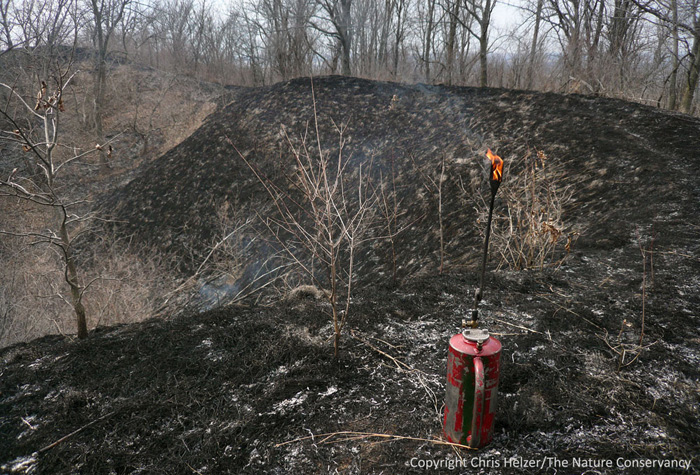
We started the fire on the tops of the prairie ridges, and let it back down the slopes.

While prescribed fire has become much more widely accepted as a tool for managing woodlands and savannas during the last couple decades, not everyone is aware of the benefits of frequent fire in those habitats. For a nice summary of the justification (with references) for using frequent fire in oak woodlands, I suggest William and Sybilla Brown’s blog post on the subject.

The neighbor's pasture made a nice firebreak on our west boundary, and allowed us to use a UTV to patrol at least a short section of the line. The U.S. Fish and Wildlife Service provided the UTV, three employees and other equipment to help with the fire.

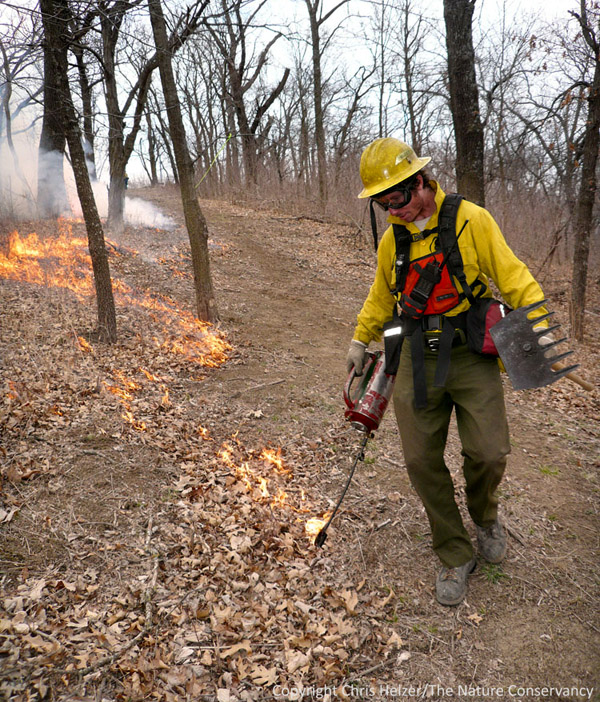
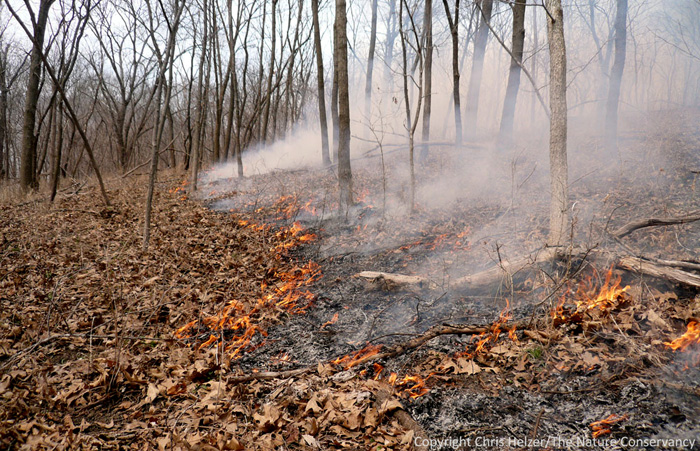
We’d hoped to burn the site earlier in the spring before the herbaceous plants in the woodland started growing. As it was, the woodland floor was just starting to green up a little, but not so much that we were overly worried about the fire suppressing plant growth. More importantly, the leaf litter was dry enough to carry a fire, at least in many places. We started the fire on the prairie ridge tops and let it start backing down the hills from there. Then we lit along the creek at the bottom of the ridge and let the flames run up the hills through the woodland until they met the backing fire in the prairies. (Except that it didn’t really work that way in most places because the fuel – leaf litter – wasn’t continuous enough that the two fire lines actually met each other in many places!) Even after significant interior lighting later in the day, there were still many areas that didn’t burn. We weren’t very concerned about the patchiness of the fire because heterogeneity is a good thing, although there were a few areas we’d really hoped would burn better than they did. We hadn’t expected many of the north-facing slopes to burn well – and they didn’t – because those areas are typically more moist and shaded.

As we lit through the woodland areas, we used firebreaks created by leafblower. Because oak leaf litter fires are relatively low intensity, firebreaks can be more narrow than they are in grassland fires.

In some places, like this, the oak leaf litter was thick enough that the fire burned fairly continuously. In other places, it didn't burn at all. Draws where leaves accumulated in deep piles often burned with the highest intensity.

Ideally, we will be conducting this kind of burn annually for the foreseeable future. While this seems counter to some of my earlier blog posts (e.g. the one about “calendar prairies“) on the importance of not using repetitive management treatments, the patchy nature of woodland burns means that every year’s burn pattern will be different. In addition, I’m viewing this as a restoration project because we’re trying to move the habitat in a fairly linear direction to a more open state (fewer trees and shrubs in the understory). When we get it closer to where we want it, we may back off on the fire frequency somewhat (or maybe we won’t).

This photo shows the steepness of the topography at the preserve. We're hoping to suppress the encroaching dogwood trees by a combination of frequent fire and targeted herbicide treatment.

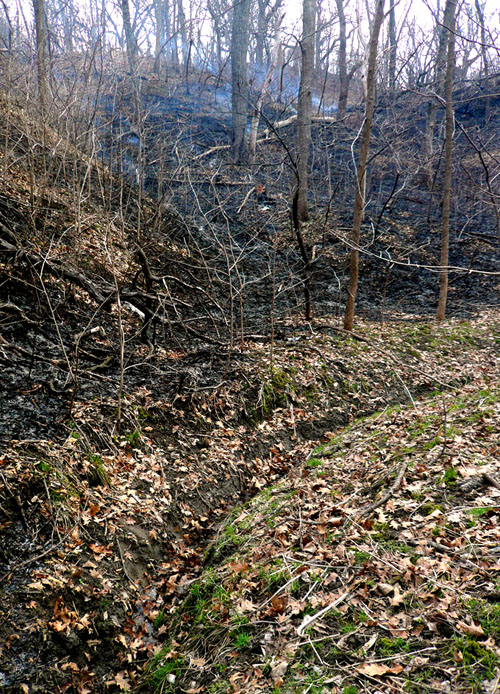
We used the small creek at the bottom of the valley as a firebreak. The moist soil helped keep fire intensity low along the creek.

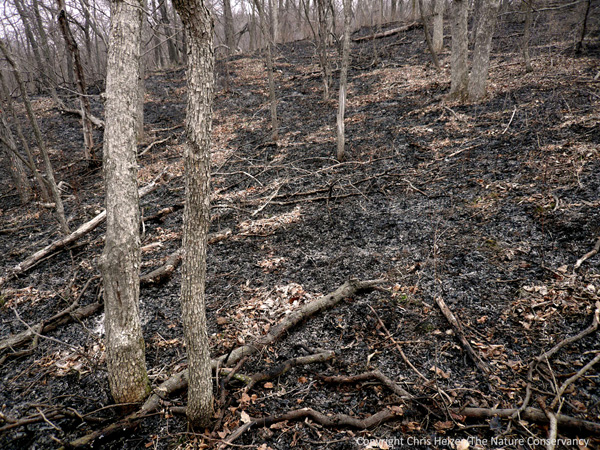
While most of the woodland burned only in patches, some woodland areas, like this one, burned fairly completely - but even here, patches of unburned leaves can still be seen.

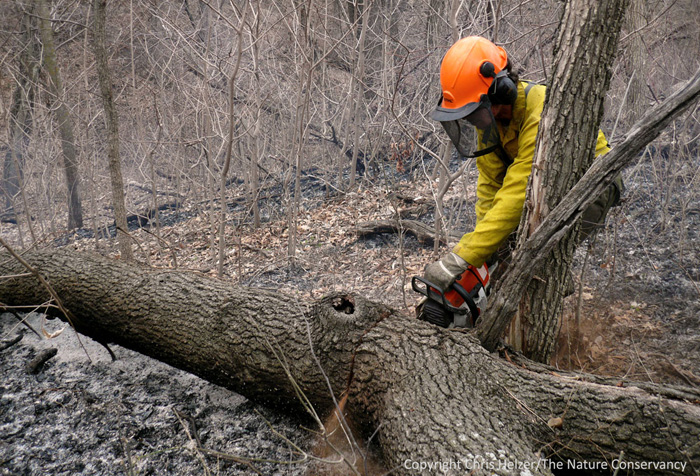
The day after the fire was spent doing mop around the edges of the burn. Here, one of our crew is cutting the burning end off of a log. The burning portion was then pushed/rolled away from the edge and allowed to burn itself out.

This summer or fall we’ll be supplementing the impacts of prescribed fire by having a contractor come in to do some significant thinning of some portions of the woodland – removing trees under 7 inches in diameter. We’re hoping that the thinning will speed up the restoration process and that it won’t cause unforeseen invasive species issues, but we’ll be prepared for both scenarios!

In the meantime, I’m going to be sure to make the 4 hour drive down to the Rulo Bluffs Preserve in a few weeks to enjoy the wildflowers and warblers, and see how many little trees we knocked back with the fire.  If you’re in the neighborhood, feel free to do the same!