
I just got back from a trip through the Nebraska Sandhills. The trip included a brief stop at the beautiful Switzer Ranch – home of Calamus Outfitters, a ranch family-owned business providing opportunities for bird watching, hunting, river floating, photography, and other activities.
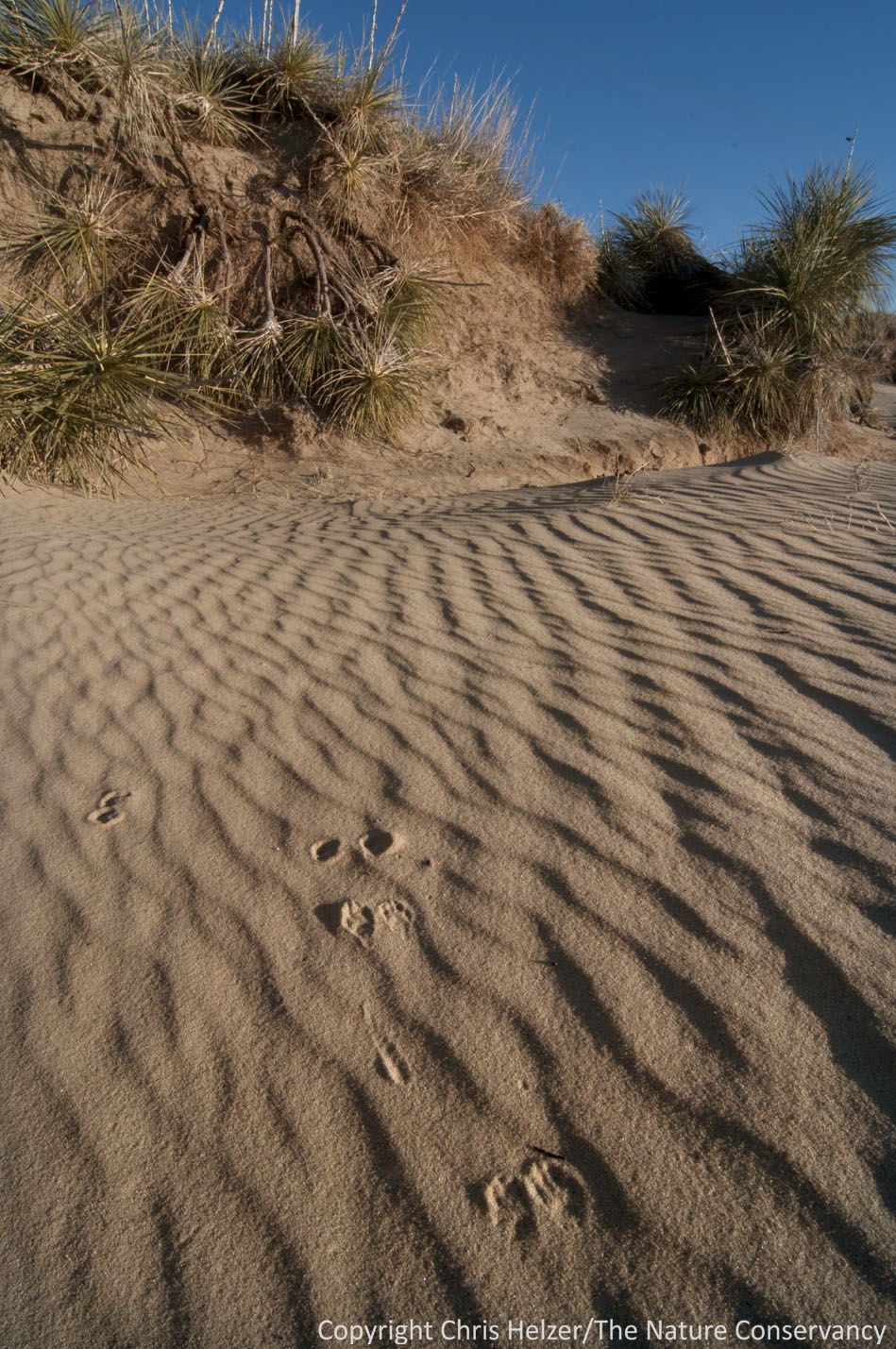
Small mammal tracks across the rippled sand of a sandhills blowout. Switzer Ranch, Nebraska.
It was late afternoon at the ranch, and light from the dropping sun was angling sharply across the prairie, including a large blowout full of the tracks of several animals. (A blowout is a bowl-shaped area of actively moving sand.) Though it was February, temperatures had been above 50 degrees F for a couple days, and it was clear that the warm weather had stimulated numerous creatures to emerge from dens to explore and search for food.
They’d better make good use of their time – the weekend forecast calls for a return to snow and cold temperatures.
 The Prairie Ecologist
Nice picture. Reminds me of weasel tracks. What was the scale?
Hey Tom,
I was thinking weasel too, and the scale would be about right, but I’m not sure.
Unfortunately, black-footed ferrets have not been reintroduced back into Nebraska. They have in neighboring Kansas. Does Nebraska have any plans to reintroduce them?
Tim, I’m not an expert on the subject, but I don’t think Nebraska has large enough dog towns to support a viable ferret population at the moment.
I did not know that about Nebraska, that they did not have sufficient prairie dog towns. So obviously, when they were reintroduced, it was in places that they could be supported with sufficient numbers of prairie dogs.
As My grandfather said there will be no prairie dogs in the Sandhills of Nebraska because the soil (the sand) doesn’t have a support keep the dens for claps in on itself. If there isn’t there isn’t rattlesnakes and then no Ferrets….Well don’t get me wrong there are all the animals above are in Nebraska Sandhills but areas there have some more suitable soils to support dens….my grandfather was a great man and he was Ecologist before the word was used.
If you find burrowing owls, then the soil must be firm enough to also support prairie dogs and black-footed ferrets. We have burrowing owls in eastern Washington, but obviously no prairie dogs, and definitely no black-footed ferrets. So burrowing owls go beyond the range of tall-grassland prairies.
There are prairie dogs in the sandhills, but they tend to be in the low areas between dunes, and restricted to those places.
Nice photo! Looks like a very cool place to visit.
next summer 2013 come to the Hersh Ranch…i have been taking photo for years there. I’m a third Generation that lives there and my Grandfathers Soddy is still use to the very day. The house is in the North Loup River Valley. If interested let me know…we always like visitors…
Thank you for the invitation, Robert. You never know…
Looks like excellent habitat for two nifty tiger beetles—the Blowout Tiger Beetle (Cicindela lengi) and the Sandy Tiger Beetle (C. limbata), along with the much more cosmopolitan Big Sand Tiger Beetle (C. formosa) and Festive Tiger Beetle (C. scutellaris). Spring and fall would be the best times to look for them.