
It’s a tough time of year to be a wildflower photographer. The first spring flowers are still months away, and fall flowers are a distant memory. What’s a guy to do? Gotta make the best of things, I guess.
Here’s a shot from a few weeks ago when we still had snow on the ground.
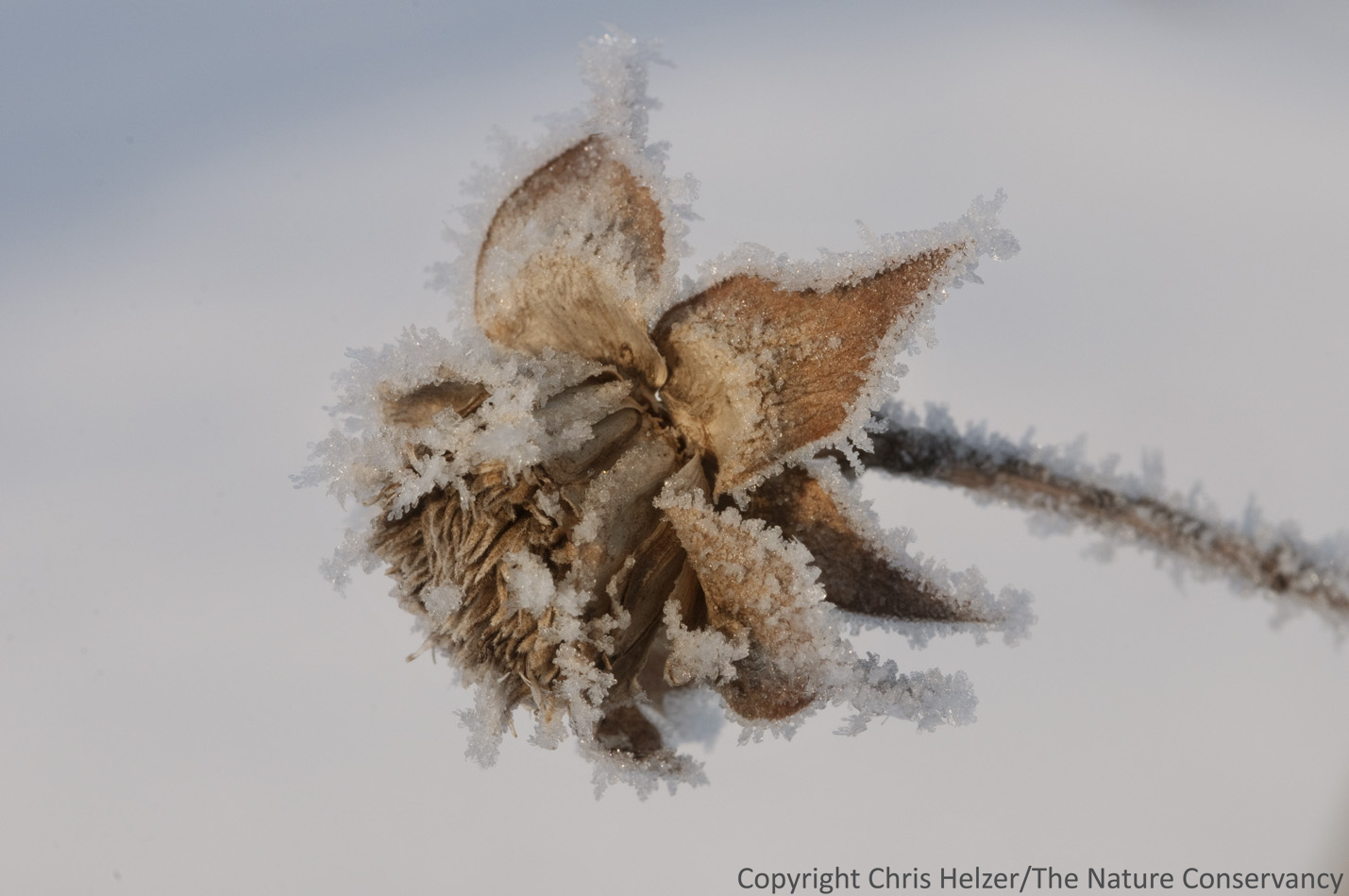
A frosty rosinweed seed head in winter prairie. Aurora, Nebraska.
Many wildflowers lose the majority of their flower parts as winter sets in, making them relatively uninteresting to photograph. Rosinweed (Silphium integrifolium) is an exception; while this one has lost its seeds, it has retained much of its characteristic shape, making it easy to identify and fun to photograph.
The frost doesn’t hurt either.
 The Prairie Ecologist
I like the frost outlines!
Me too… : )
Is it too late to locate some wild rose hips or dusty rose colored annual eriogonum? Like you implied Chris, with the snow gone, our basic landscape has pretty much reached its maximum bleakness.
Still plenty of rose hips (if they’ve not been eaten). Not sure about the Eriogonum – I haven’t been out to our sandy areas for a while.
The rosinweed grows in deep soils in the prairies, and this was prime agricultural land sought by farmers. But the true obstacle for rehabilitating prairie lands are removing the miles of fencing.