What’s Bugging Milkweed?

As I walked a small prairie here in Aurora, Nebraska a few weeks ago, several species of milkweed were flowering abundantly, including butterfly milkweed (Ascelepias tuberosa), showy milkweed (Asclepias speciosa), and common milkweed (Asclepias syriaca).  As always, the milkweed plants were hosting a number of specialist insects that feed on them.  During my walk, the most plentiful of those insects was the large milkweed bug (Oncopeltus fasciatus).

The large milkweed bug on butterfly milkweed - Lincoln Creek Prairies, Aurora, Nebraska.

The large milkweed bug on butterfly milkweed – Lincoln Creek Prairies, Aurora, Nebraska.

.
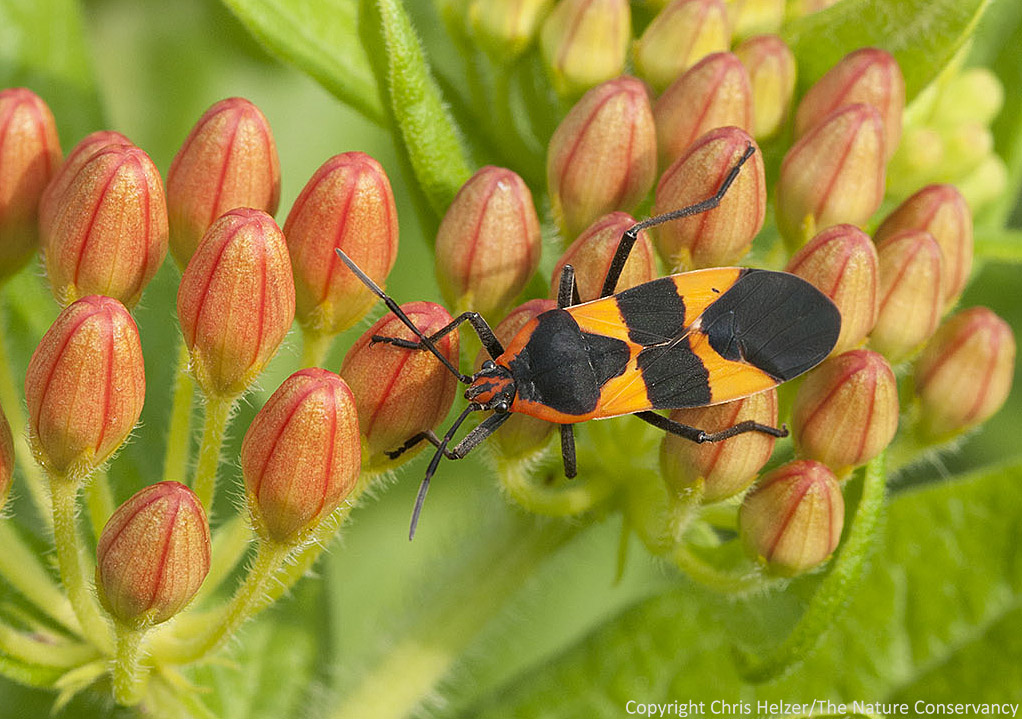
Another view

A view of the bug from the top.  The large milkweed bug somewhat resembles a boxelder bug, but is considerably larger and has more orange color on its back.  It is also larger (obviously) than the small milkweed bug, which looks somewhat similar but has two small white dots on its folded wings, as well as a different pattern of black and orange.

.

Like all Hemipterans (true bugs), the large milkweed bug feeds through a long piercing mouthpart called a rostrum.  From the information I can find, the milkweed bug feeds on the seeds of milkweed, but will also feed on sap from the leaves and stems.  Interestingly, I didn’t find any information about it feeding on the nectar of milkweeds, though that is certainly what it appeared many of the milkweed bugs I saws were doing.  I watched several of them insert their rostrum into a flower and jiggle it up and down as if it were sucking the dregs of a milkshake through a straw.  The photo below shows one with its rostrum inside the flower of a common milkweed.  I’m guessing many entomologists have seen the behavior, but I didn’t find a reference to it.

Butterfly milkweed wasn't the only milkweed species with the bugs on board that day.  This one is on common milkweed (Asclepias tuberosa).

Butterfly milkweed wasn’t the only milkweed species with the bugs on board that day. This one is on a common milkweed flower and appeared to be feeding on nectar.

.

About a year ago, I wrote a post about the arduous and complicated process of milkweed pollination, in which clusters of pollen called pollinia have to become attached to the leg of a visiting insect and then later detached in exactly the right place on a different flower.  If you missed that post, it’s worth a read just to appreciate what seems like a nearly impossible process – though one that has obviously worked out just fine for many milkweed species.  Several of the milkweed bugs I saw at the prairie a few weeks ago had multiple pollinia stuck to their legs, so apparently the bugs can be helpful to milkweed plants – in addition to being seed predators, nectar thieves, and sap suckers!

.

In this photo, you can see pollinia (sticky clumps of pollen) stuck to two legs of this large milkweed bug.

In this photo, you can see pollinia (sticky masses of pollen) stuck to two legs of this large milkweed bug.

.

I visited this same prairie again about two weeks later with my son Daniel.  Since he’s interested in insects, I figured he’d enjoy seeing all the milkweed bugs.  The butterfly milkweed plants were still blooming profusely, but not a single milkweed bug could be found…  Where did they go??  I guess it’s a good thing I took photos when I had the chance.

Hubbard Fellowship Blog – Carp Fishing

Guest Post by Anne Stine, one of our 2013-14 Hubbard Fellows:

The carp are so thick in one of our restored creeks near the Platte that their top fins stick out of the water like a shark’s and you can see small schools of their long bodies grubbing around nose-down in the shallows.  Fish over a foot long fling themselves into the air above the creek’s slow pools when they’re spooked, seemingly at random.  I noticed this abundance on my first day out on the prairie with Chris.  With his blessing, it became my mission to harvest a quantity of this invasive fish-flesh in our stretch of creek near the crew quarters.

My fishing spot.  Photo by Anne Stine.

My fishing spot. Photo by Anne Stine.

I found a beautiful fishing spot on a bridge over the pinch between two large pools.  From the bridge, you could see carp and gar loitering below.  The view of our pastures to the west of the bridge promised a lovely sunset for an evening angler.  I baited my hook with corn kernels and cast it in.

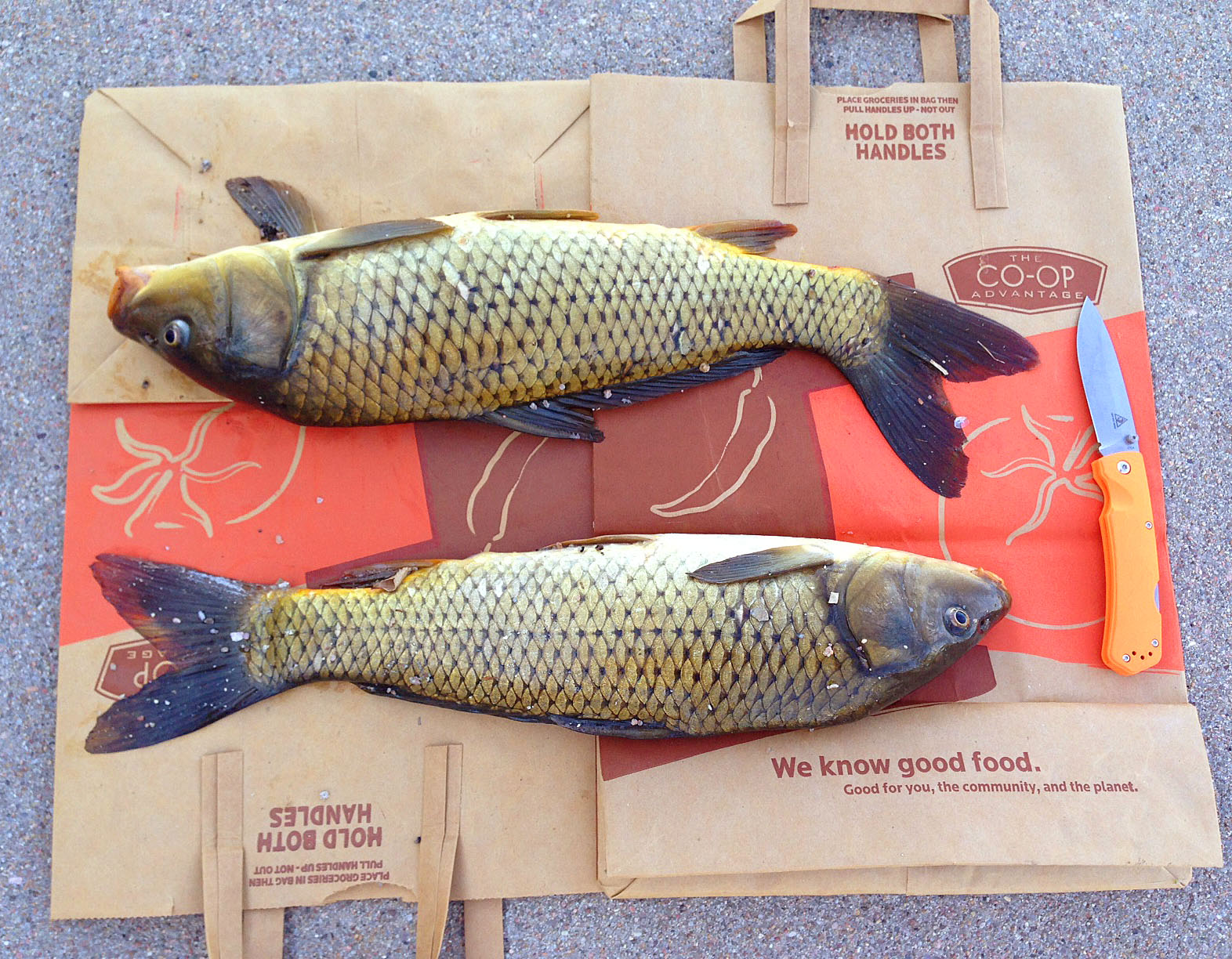
Less than ten minutes later I’d hooked a carp as long and meaty as my forearm.  Supposedly tricky to catch, these trash fish do love corn.  The carp pulled and struggled while I attempted to tire the fish before hauling it in.  I was wary- I’ve snapped lines before by reeling in too soon.  One fish had gotten away after breaking my line above the bobber.  I watched him tow my bobber around and continue to forage for the rest of an evening, the red bobber dragging behind him like a balloon on a string.

Carp are an invasive species for much of the United States.  They are considered problematic because they become over-abundant and eat food used by native fish, and their foraging method stirs up mud and increases turbidity in the creeks, rivers, and ponds where they are established.  It used to be illegal to throw them back in Minnesota.  Nebraska and Iowa still host a “Carp-O-Rama” bowfishing tournament, with prizes awarded based on the highest total weight and the highest total number caught.

Carp’s bad reputation is bolstered by its arguably inferior flavor.  Carp are generally considered trash fish because they can have an earthy taste partially sourced in a ‘mud vein’ running along their sides.  They also have a complex bone structure that makes filleting a challenge.  Common recommendations for preparing carp fillets include scoring the fillets in the diagonal strips so the small bones are softened enough to eat with ease.  Smoking carp is also frequently recommended for the same reason.  Naturally, I didn’t read any of this and assumed that Americans were just being snobby by snubbing this fish that is widely eaten in Europe and Asia.  After catching two moderately sized carp, I went home to fillet the fish and fried them up for my coworkers.

Dinner!  Photo by Anne Stine.

Dinner! Photo by Anne Stine.

I want to say the carp were delicious.  I want to say “Everyone! Go out and help yourself to amazing, readily available fish. Do your river a favor and eat carp.” Frankly, carp is bony with a muddy aftertaste.  I’ll try a few more prep methods, but my enthusiasm for utilizing this neglected resource is greatly diminished now that I’ve had it.  Hopefully bunnies this fall will be easier on the palate.