Unknown's avatar

About Chris Helzer

Chris Helzer is Director of Science and Stewardship for The Nature Conservancy in Nebraska, where he conducts research and supervises the Conservancy’s preserve stewardship program. He also helps develop, test, and share prairie management and restoration strategies. Chris is also dedicated to raising awareness about the value of prairies through his photography, writing and presentations. He is the author of The Prairie Ecologist blog, and two books: The Ecology and Management of Prairies and Hidden Prairie: Photographing Life in One Square Meter. He is also a frequent contributor to NEBRASKAland magazine and other publications. Chris and his family live in Aurora, Nebraska.

Photo of the Week – August 28, 2014

I made a quick run out to our family prairie this week to see how our grazing management was looking.  It was a beautiful evening for a stroll, as the sun went down through layers of diffuse clouds.  The abundant rain this year has fueled tremendous growth in the prairie and has filled up the wetland to its rim.  As planned, a portion of the prairie is short-cropped by cattle grazing while other areas are either ungrazed or lightly grazed, and there was a lot of life on display.

Grasshoppers and katydids exploded around my feet as I walked around – most of them clearly adults since they were flying short distances before landing again (they only get wings after their final molt into adulthood).  They were joined by hordes of other invertebrates, including caterpillars, bees, butterflies, and many others.  I flushed a great horned owl from a big ash tree, and then was very pleased to see a rail (probably a Virginia rail) dangle its feet as it flew across our recovering wetland.  Here are a few photos from the night.

Caterpillar

I’ve seen this same species of caterpillar in a couple places this week.  This one was munching on false boneset.

.

Dotted gayfeather and stiff goldenrod were both abundant upslope of the wetland.

Dotted gayfeather and stiff goldenrod were both abundant uphill from the wetland.

.
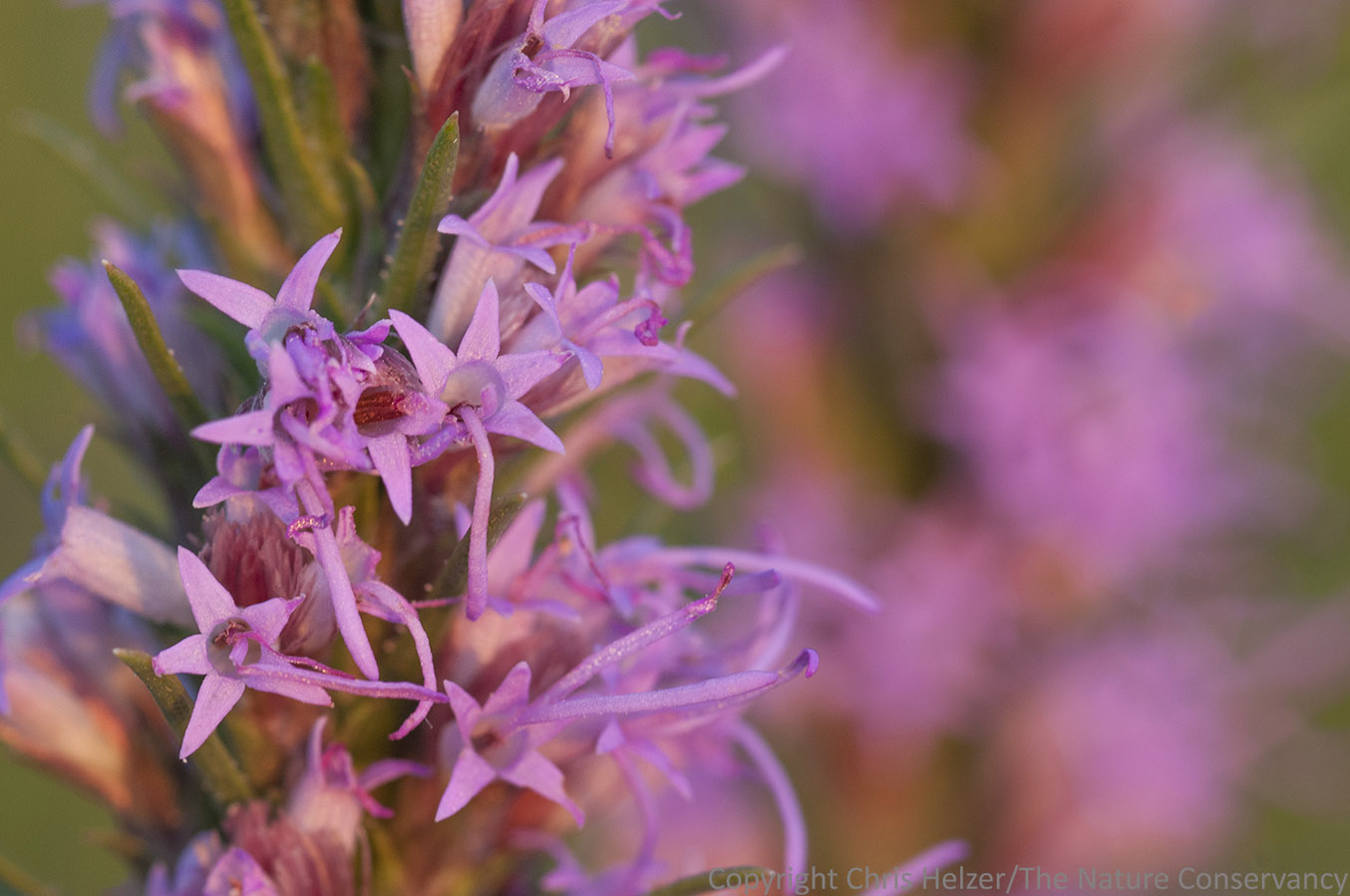
A close-up view of dotted gayfeather.

A close-up view of dotted gayfeather.

.

Our wetland at sunset.

Our wetland at sunset.  The addition of a couple solar-powered wells for livestock water has allowed us to exclude cattle from the pond/wetland area, and the habitat improvements are obvious.

A quick note of thanks:  This blog quietly passed two milestones this week.  I posted my 500th post, and we passed the 1,800 mark on blog subscribers.  Thank you for your continued support of this site – I hope it’s as useful and enjoyable to you as it is to me.

Field Day Reminder – TOMORROW, Rain or Shine! Also, A Bee Photo

A reminder – we will have our Platte River Prairies Field Day tomorrow, August 27, from 9am to 3:30.  Details can be found here.

Rain is in the forecast for tomorrow, but it looks like the best chances for precipitation are before and after the Field Day.  Either way, we’ll be there and will have plenty of things to see, do, and discuss, so please plan to attend.  (However, in addition to your lunch, you might throw in a rain jacket and/or umbrella just in case.)

Now that we’ve got that out of the way, here’s something completely unrelated:

As I was walking across my yard on the way home from work last night, I saw the following happening RIGHT IN THE MIDDLE OF MY SIDEWALK.

Two bumblebees (Bombus impatiens) trying to ensure the next generation of bumblebees.

Two bumblebees (Bombus impatiens) trying to ensure the next generation of bumblebees.

Three things.  First, this is a good way to see the sexual dimorphism of bumblebees.  (Don’t get excited – it just means that males and females are different sizes.)  Second, the stinger on the female looks like it’s in an awkward place.  Finally, the process of making new bumblebees apparently takes a while and the full attention of both parties.  I had time to go back to the truck, grab my camera gear, set up a couple flashes, and take quite a few photos.  After I got my photos, I put my gear away and walked by again and they were still going.

During the whole photography process, the bees completely ignored me, my gear, and the repeated firing of two flash units.  It seems like the bees would be pretty easy quarry for predators at times like this.  Maybe, instead of doing it in the middle of a sidewalk, it’d be a good idea to retreat to somewhere more sheltered?  (Get a room!)

Ok, everyone move along now.  Nothing more to see here.