
Frogs in the Grass

When I think about frogs in the prairie, I usually think of leopard frogs – aka “grass frogs”.  It’s not unusual to see one leaping ahead of me as I walk through our Platte River Prairies, even when I’m not particularly near water.  But during the last couple of years, I’ve been seeing chorus frogs quite a ways from tadpole-rearing sites as well.  A couple weeks ago, I caught one in our yard (middle of town).  After taking a quick trip to school with my son, she’s back in the yard somewhere.  I hope she can find a nice pond by next spring…

Early last summer, I was hiking in Griffith Prairie (Prairie Plains Resource Institute) north of town and came across a chorus frog near the top of a high dry hill.  The closest pond was a few hills away – a long way for a tiny frog to travel through the tall grass.  I had my camera along, so I spent some time photographing the frog, which put up with me very nicely.  Eventually, it jumped and got hung up – temporarily – in some grass, where it kindly stayed long enough for me to get a photo.

A chorus frog on a hilltop at Griffith Prairie (Prairie Plains Resource Institute). My 10-year-old son, who researched chorus frogs after we found the one in our yard, tells me this is a female because there's no dark patch on the throat.

.
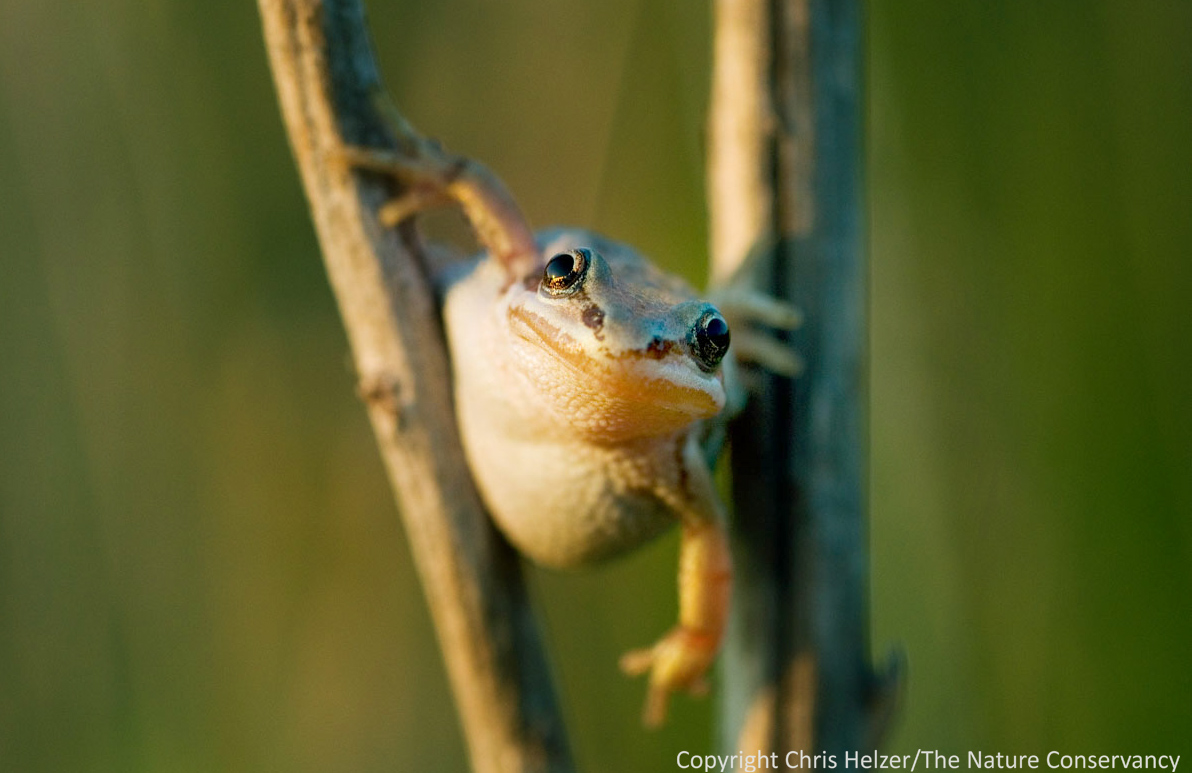
It's hard not to project human thoughts onto the frog in this photo, isn't it? ("How did I get myself into this mess??")

As far as I know, chorus frogs spend their winter nestled down under grass thatch and/or logs and probably freeze solid when the temperature drops sufficiently.  I’ve had a hard time confirming this, so would love to hear from anyone who has good information.

Photo of the Week – September 2, 2011

I photographed this bee in late August of 2009 in a restored (reconstructed) prairie.  At the time, I naively assumed it was a honey bee – not knowing much about bee identification.  I stuck to that assumption a year later when a version of the photo was used on the cover of NEBRASKAland magazine.

Native bee on pitcher sage (Salvia azurea) in restored prairie at the Deep Well Wildlife Management Area near Phillips, Nebraska.

Then, in August of this year, I was giving a presentation to staff of the Missouri Department of Conservation (MDC) about prairie ecology, and I used my “honey bee” photo as part of a slide on the decline of honey bees and the need for a strong community of native bees to pick up the slack.  As I was talking, I glanced over at Mike Arduser, a natural heritage biologist – and bee expert – with MDC and noticed that he had a pained expression on his face.  Knowing I was in trouble, I stopped and asked him what I’d said.

Mike explained that the bee in the photo is actually the native bee, Tetraloniella cressoniana, that feeds only on the pollen of pitcher sage (Salvia azurea) – the plant I photographed it on.  So – far from being a social generalist feeder like a honey bee, this bee is an example of the other extreme.  A specialist bee that relies on pollen from only a single plant species.  How great is that!

Apart from my chagrin about calling it a honey bee, knowing the real story about this bee makes me like the photo even more.  The fact that the photo was taken in a location where cropland had been converted to high-diversity prairie – and there is no other prairie nearby – makes it even more interesting.  I’d love to know how this bee managed to find and nest in/near a prairie that contains pitcher sage.  Where did the bee come from?  Did it search randomly, or does it have a way to “smell” or otherwise sense this plant species?  What a fun thing to think about!

The above photo wasn’t taken in one of our Platte River Prairies, but I’m sure hoping to find Tetraloniella there this fall.  Pitcher sage just started blooming a week or so ago and I’ve been out looking a couple times.  So far, no luck.  I did find a bee with a similar color and striping pattern, but it turned out to be the other species of bee Mike said I’d likely find using pitcher sage (don’t you love experts!).  So I’m still looking… 

.