Quantifying the Value of Plant Diversity

Why is plant diversity important? 

I can come up with lots of reasons, including the value to pollinators, correlations between plant and insect diversity, and contributions to ecological resilience – among others.   But it’s much more difficult to quantify the specific functional differences between high-diversity and low-diversity prairie plantings.  Even basic questions are difficult – for example, how many plant species does it take to see benefits?

Most of us who spend time in prairies know intuitively that plant diversity is important, but if we’re going to influence environmental policy, agricultural practices, and other large-scale conservation strategies, we’re going to need stronger and more quantified answers than intuition provides us.

In an attempt to help find some of those more specific answers, we have built some research plots within our Platte River Prairies, in which we’ve established prairie plantings of various plant diversity.  Each treatment plot is 3/4 acre (1/3 ha) in size – big enough that we hope to compare patterns of invertebrate species composition and activity,  soil changes, differences in the resistance to invasive species, and more.  We’ve actually established two sets of plots now; one in 2006 and the second in 2010.  The 2006 set consists of low diversity (15 species) and high diversity (100 species) plots, and the 2010 set consists of three treatments: a monoculture of big bluestem, low diversity (mostly grasses, with a few forbs), and high diversity (100 or more plant species).  Each treatment is replicated at least 4 times.

Clint Meyer, of Simpson College (Iowa), was out last week doing some sampling of ground-dwelling invertebrates.  Here he examines insects caught in a pitfall trap within our 2010 diversity research plots.
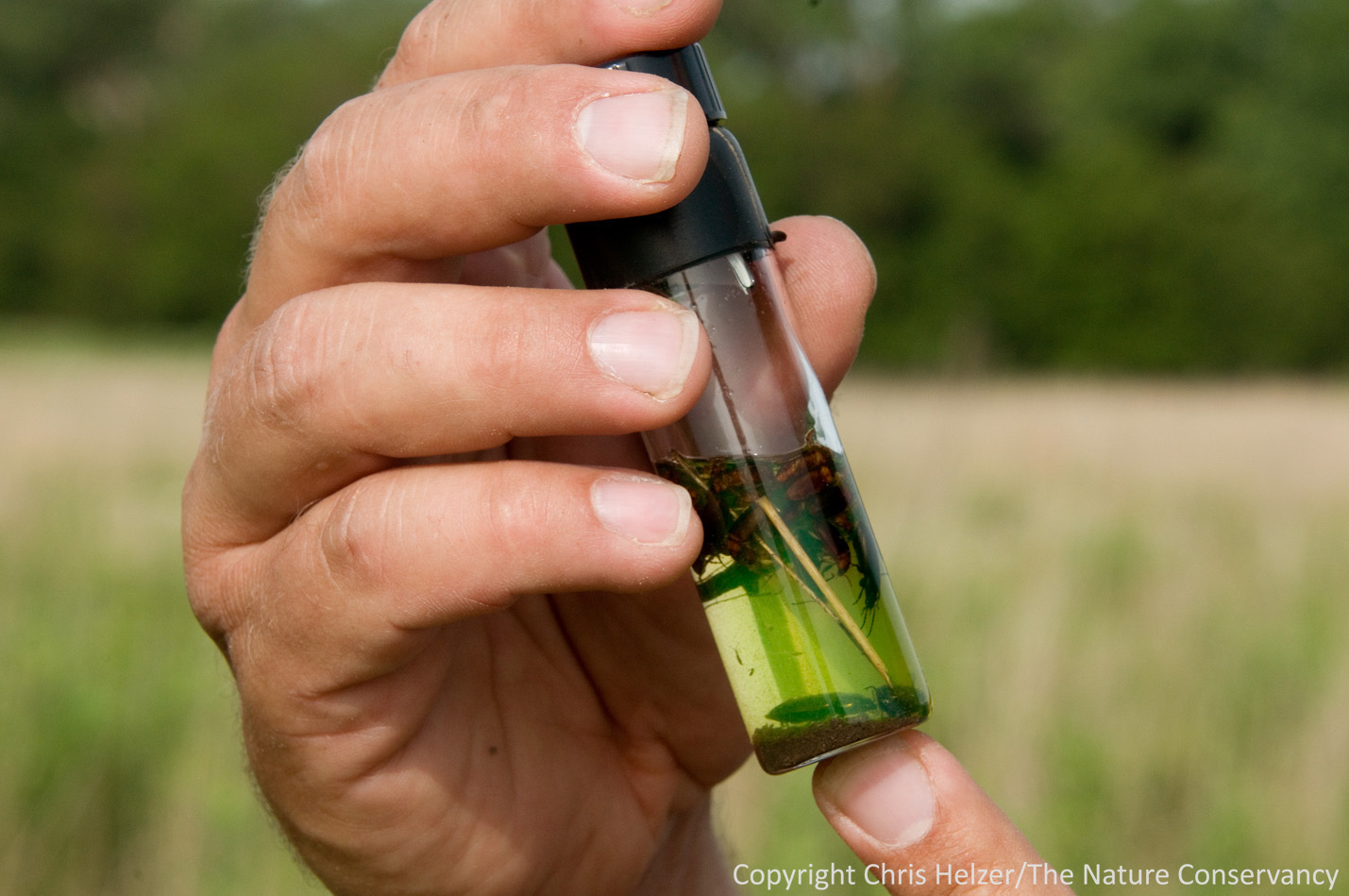
A close-up view of a vial of insects caught in a pitfall trap. There are least two species of ground beetles in the vial (floaters and sinkers!) as well as springtails (the little specks floating in the lower left hand portion of the vial).

Continue reading

A Soldier Beetle Occupation

Everywhere I look, I see soldier beetles.

They’re in my yard, they’re in my prairies, and now I think they’re getting into my head (figuratively speaking).  The linden tree in our front yard is blooming this week, and every flower is loaded with feeding and mating soldier beetles.  Over the weekend, my son and I went to our family’s prairie and it seemed there were soldier beetles on every plant! 

While soldier beetles are predators, they also feed heavily on pollen.  This one is feeding on sensitive briar – aka cat’s claw (Mimosa quadrivalvus) at our family prairie in Hamilton County, Nebraska.

Daniel and I were at the prairie to look for musk thistles (only found one) and check the cows (found them all).  After we accomplished those two objectives, I grabbed my camera to take advantage of the diffused light from the bright overcast skies and Daniel headed to the pond to chase frogs.  Dan didn’t catch any frogs, but I managed to get some decent shots.  Some of those photos included soldier beetles as the primary subject – they were easy to find.  Other photos included soldier beetles accidentally.  In a few cases, I didn’t even know the beetles were in the photo until I loaded the images onto the computer back at home.

While they are sometimes misidentified as lightning bugs, these are soldier beetles feeding on the pollen of a black-eyed Susan flower.  I photographed these on purpose…

.

When I photographed this fly feeding on a daisy fleabane flower, I didn’t even see the soldier beetle in the background – though I shouldn’t be surprised it was there…

.

These regal fritillary butterflies are out very early this year, and are fortunate that milkweed flowers are also out early. I was photographing the butterflies (including the variegated fritillary), but ended up with soldier beetles in the photo as well.

When I zoom in on the butterfly photo above, I can count five soldier beetles. Can you find them all?  One is particularly tricky to find because only the back half shows.  I think I see the leg of another, but I can’t tell for sure.  If you click on the photo and then click again, you’ll get a zoomed in image (if your computer works like mine).

If you want to learn more about soldier beetles – including how to differentiate them from lightning bugs – click here.

I wonder if they’ll chase away the moths…