This post is by Olivia Schouten, one of this year’s Hubbard Fellows. In this post, she writes about the importance of bison and cattle dung in prairie ecosystems – a topic you might not think much about on a daily basis.
When walking through a prairie, or anywhere for that matter, I think most people tend to avoid piles of refuse left behind by critters. While not the most pleasant things to encounter, smell, or step in, scat is an essential part of any ecosystem that many creatures are more than happy to encounter, and in many cases specifically seek out.
While conducting flowering plant surveys at our Niobrara Valley Preserve, I walked through an area of the pasture recently visited by the bison herd and found a couple of organisms making use of the bison pies. First, I found an ornate box turtle square in my path, digging furiously into a half-dried bison pie. Its long, sharp claws efficiently broke away chunks of the pie, revealing to the turtle beetles and other invertebrates attracted to the scat for their own purposes. I think I even heard a crunch when the turtle found something tasty amongst the poo. Considering the number of piles left behind by the bison, I realized just how great a resource these bison pies are to animals like this turtle, as they attract a buffet for easy pickings.
This ornate box turtle (Terrapene ornata) was busy digging in the bison poop when I found it, but once it noticed me hid away in its shell. Photo by Olivia Schouten
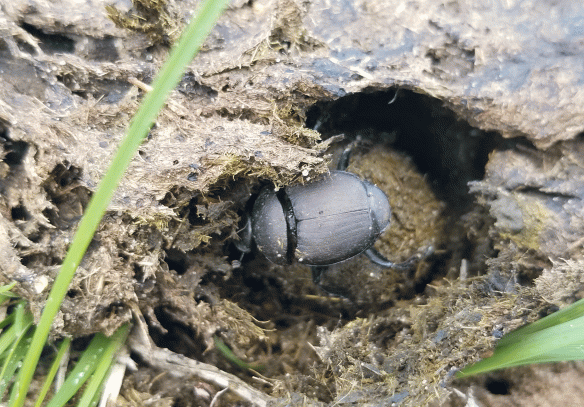
Not long after moving on from the turtle, I found some critters making use of the actual bison scat. Dung beetles are iconic coprophages (excrement eaters), rolling their balls of poop along to feed their larvae, and we have several of our own species right here in Nebraska! These common tumblebugs (Canthon pilularius) had excavated a nice round ball of bison pie, ready to be transported!
This tumble bug was one of three diligently working to make this ball of dung. Photo by Olivia Schouten
Tumblebugs are just one of several species of scarab we have here in Nebraska that make use of animal excrement in much the same way. This colorful rainbow scarab (Phanaeus vindex) visited a cow pie here at the Platte River Prairies.
I managed to get a few pictures of this rainbow scarab before it decided it’d had enough of me and flew away. Photo by Olivia Schouten
Here is a very short video clip of the box turtle and tumblebugs feeding.
So next time you come across a pile of poo, consider stopping for a look! You never know what interesting things you’ll find!
We spent a productive week at the Niobrara Valley Preserve this week, collecting a mountain of data. Five of us spent our days scrambling across the Sandhills, counting flowering plants, quantifying milkweed populations, and estimating habitat cover. As always, we got to observe far more than what we were focusing on for science. We saw bald eagles, box turtles, a couple different snakes, pronghorn, mice, bird nests, families of northern bobwhites and sharp-tailed grouse, countless kinds of invertebrates, and much more. It was an exhausting, but fulfilling week.
The science crew for this week. From left to right: Alex Brechbill and Olivia Schouten (Hubbard Fellows), Amanda Hefner (Conservation Assistant at NVP), and Katharine Hogan (former Hubbard Fellow and current PhD student at the U of Nebraska-Lincoln).
The above photo shows the kind of energy our crew had, though it was also taken just as the week was starting. Hot sun, wet grass, and lots of massive poison ivy patches eventually knocked their enthusiasm down a notch or two, but we all still had a great time. The crew certainly made me feel twice their age (which I am, for at least one of them), and not just because I’m still a little hobbled by my recovering ankle. I appreciated their patience as they waited for me at the end of each sampling grid.
After each day of data collection, I spent the bulk of my evening time trying to build up an inventory of aerial photos and video with our drone. I flew over the river, across open grasslands and prairie dog towns, and among herds of bison. My post from earlier this week showed a small slice of just one evening’s imagery. It’ll probably take me weeks or months to get through all the footage from the last several days, but I do have one tiny video clip to share with you today.
On Tuesday night, I followed a small portion of our east bison herd around for a while. I was skirting the edges of the herd with the drone, trying to get a feel for how close I could get before the bison started to react to the vehicle’s presence. The bison were certainly aware of the drone, but while they edged away when I got too close, they certainly didn’t act frightened or panicked. A few hundred yards from the main group, a lone bison bull was grazing by himself. I decided to test its patience a little (in the name of science, of course). I flew the drone to within 15-20 yards or so of it, and lowered it down to 10 or 12 feet off the ground. Then I just hovered right there while it was eating. (Well, the drone hovered there – I was very safely standing a couple hundred yards away, right next to my truck!)
As I watched through the screen on my controller, the bull glanced up a few times while it grazed, and then eventually raised its head to chew and watch the drone. It chewed and watched for almost a minute. Just as I was getting tired of the experiment and started to push the button to end the video, the bull’s patience apparently ran out.
Oh boy, do I wish I hadn’t hit the “stop recording” button when I did, but you get a pretty good picture of what came next. I don’t know if it would have jumped high enough to hit the drone, but I do know that my suddenly sweaty hands pushed the “UP!!!” button on the controller as fast I could when that bull started its charge. One of the reasons I’m sharing this video is that it’s a great reminder that while bison are incredible and beautiful creatures, they are also unpredictable and dangerous. People die, or are seriously injured, every year on public lands when they ignore the unpredictable and dangerous part of the equation, and try to get too close to these huge animals. Bison aren’t going to chase you down and trample you to death for no reason, but if you invade their comfort zone, they are very capable of defending themselves.
This photo was taken just a few minutes after the video. I was safely in my truck…
As soon as I flew the drone away, the bison returned to calmly grazing, probably congratulating itself on how easily it had scared away that odd-looking, noisy, and pesky bird. After watching the bull for a while from a distance, I drove slowly closer to it and photographed it as it continued grazing. It was well aware of my presence, but is used to being around pickup trucks. Since I wasn’t coming AT him, he calmly grazed and wandered on his way.
I’m fully aware of how fortunate I am to have my job, and to have access to the places we own and conserve. I’m incredibly grateful for everyone who reads this blog, but even more to people whose financial support allows our conservation work to happen. I wish I could give each of you a personalized tour of our sites, but in lieu of that, I’ll continue trying to do the next best thing – show you the diversity and beauty of those places as best I can through writing and photography. You can also come visit, of course, and hike the trails to see what you can see. In the meantime, stay tuned for more photos and videos.
Information on visiting the Niobrara Valley Preserve can be found here and on visiting the Platte River Prairies here.




 The Prairie Ecologist