
Photo of the Week – April 6, 2012

Here’s something I know almost nothing about:  Slugs.

I found this slug in one of our prairies yesterday morning, and managed to get a few decent photos of it.  Slugs are largely considered to be pests in gardens, but I’ve never heard any discussion of the ecological role(s) they might play in grasslands.
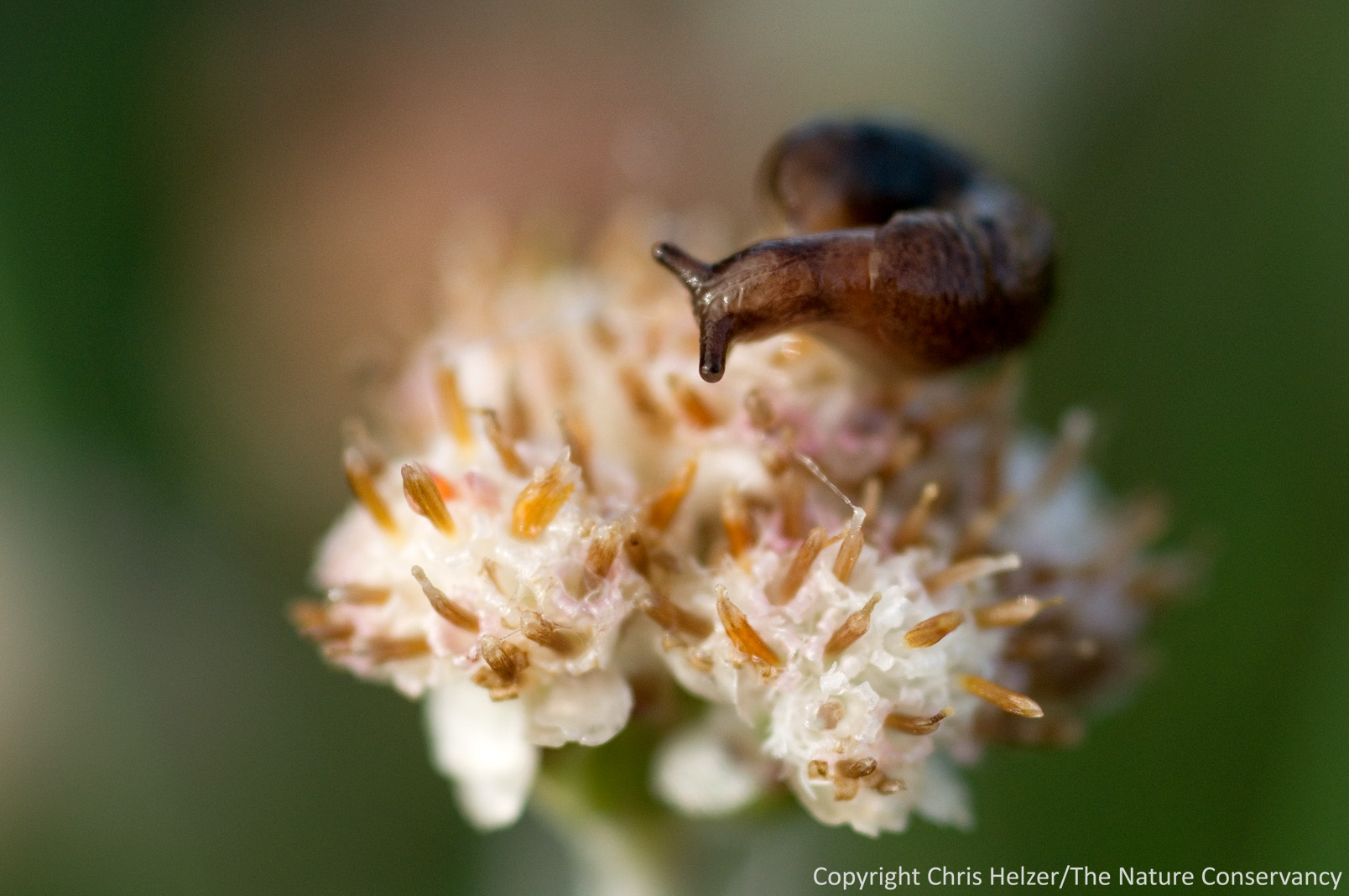
A slug on a pussytoes flower in the Platte River Prairies - Nebraska. What was it doing up there on the flower?

Sure, I know that slugs are gastropods that resemble snails without shells.  They have rasping mouthparts, eyes on tentacles, and leave trails of slime as they travel.  But what do they actually DO in prairies?  How important are they in the ecosystem functioning of a grassland?  My understanding is that most slugs I see are probably introduced species, but are they causing any negative impacts in prairies?

The best information I could find online was this field guide to the slugs of Kentucky.  I thought it was great, but certain members of my family found it wildly amusing that someone had made a field guide for slugs.  Those same family members seem largely uninterested in learning more about slugs, but I think they (slugs) are intriguing creatures, and would love to have someone feed me information on their ecological roles.

Anyone?

Why Prairie Matters – A Guest Essay

It’s never been easy for me to synthesize the importance of prairies into a compact essay or blog post.  My most recent attempt to describe why I care about prairies included, of all things, a Dr. Seuss reference…

The other day, however, I was reading a past issue of the Missouri Prairie Journal (Summer 2011) and ran across an essay by Doug Ladd that encapsulates the importance of prairie better than I could ever hope to do.  Before I was halfway through, I’d already decided to ask Doug for his permission to reprint his words.  Doug is the Director of Conservation Science for The Nature Conservancy of Missouri and a brilliant botanist and ecologist – among other things.  He has had a tremendous influence on the conservation of prairies and other ecosystems.  I learn something every time I’m around him, and I’m not sure there’s a better compliment than that. 

I hope you enjoy Doug’s essay on “Why Prairie Matters.”  Because it was originally intended for the Missouri Prairie Journal, it focuses on Missouri prairies, but it’s easily transferrable to other grasslands.

.

WHY PRAIRIE MATTERS

by Doug Ladd

WHENEVER I AM IN A TALLGRASS PRAIRIE, I AM ASTOUNDED BY THE DIVERSITY AND COMPLEXITY SURROUNDING ME—uncounted numbers of organisms, interacting at multiple levels, both visible and invisible to the human eye, above and below ground, shaping and in turn being shaped by the physical environment. To visit a prairie is to be immersed in the result of thousands of generations of competition and natural selection resulting in a dynamic array of diversity, which, collectively, is supremely attuned to this uniquely midcontinental landscape.

Taberville Prairie – north of Eldorado Springs, Missouri.

Here flourish long-lived, deep-rooted perennial plants annealed by the frequent Native American fires, searing summer droughts, frigid winters, episodes of intensive grazing and trampling, and rapid, recurrent freeze-thaw cycles that exemplify the Midwest. These plants in all their varied magnificence in turn support myriad animals ranging from minute prairie leafhoppers that spend their entire lives in a few square meters to wide-ranging mammals and birds that travel hundreds or even thousands of miles in a season.

Continue reading