
Photo of the Week – August 4, 2011

I just returned from a great week in southwestern Missouri.  The Missouri Department of Conservation invited me to come down and participate in a grassland workshop, and I was happy for an excuse to return to some prairies I’d last visited in 2007 – and also to see some new ones. 

Southwestern Missouri had almost no precipitation (and plenty of heat) during June and July this summer.  The nearly ubiquitous tall fescue pastures in the area were all crispy and brown, and the corn and soybean fields didn’t look much better.  Native prairies, on the other hand, while certainly drier than the last time I visited, still exhibited plenty of life.  I’ll report in more detail next week on some more detailed observations from the prairies and the patch-burn grazing being employed there.  For now, however, I’ll just share this photo of a giant grassland cicada (which is both the name and an apt description of this large noisy insect). 
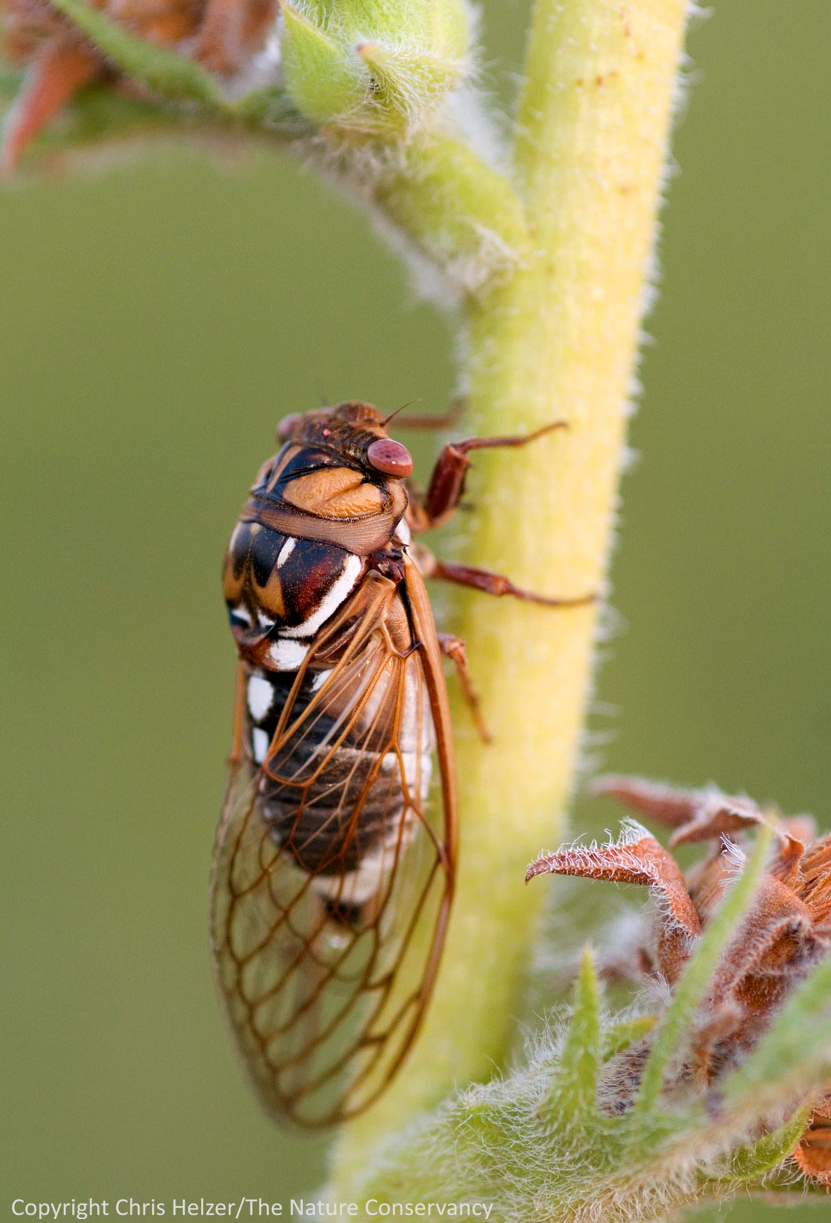
A giant grassland cicada on compass plant - at the Missouri Department of Conservation's Taberville Prairie near Eldorado Springs, Missouri.

Much like during my recent trip to Indiana, the evening I chose to go off by myself and walk the prairie with my camera turned out to be scorching hot with little to no breeze.  Despite the heat, cicadas were both abundant and noisy, and after chasing several around for a while, I finally got one to sit still long enough for me to grab a few photos before it buzzed off once more.  This was one of the last shots I got before the sun finally sank below the horizon and I gratefully climbed into the air conditioned truck and headed for the motel.
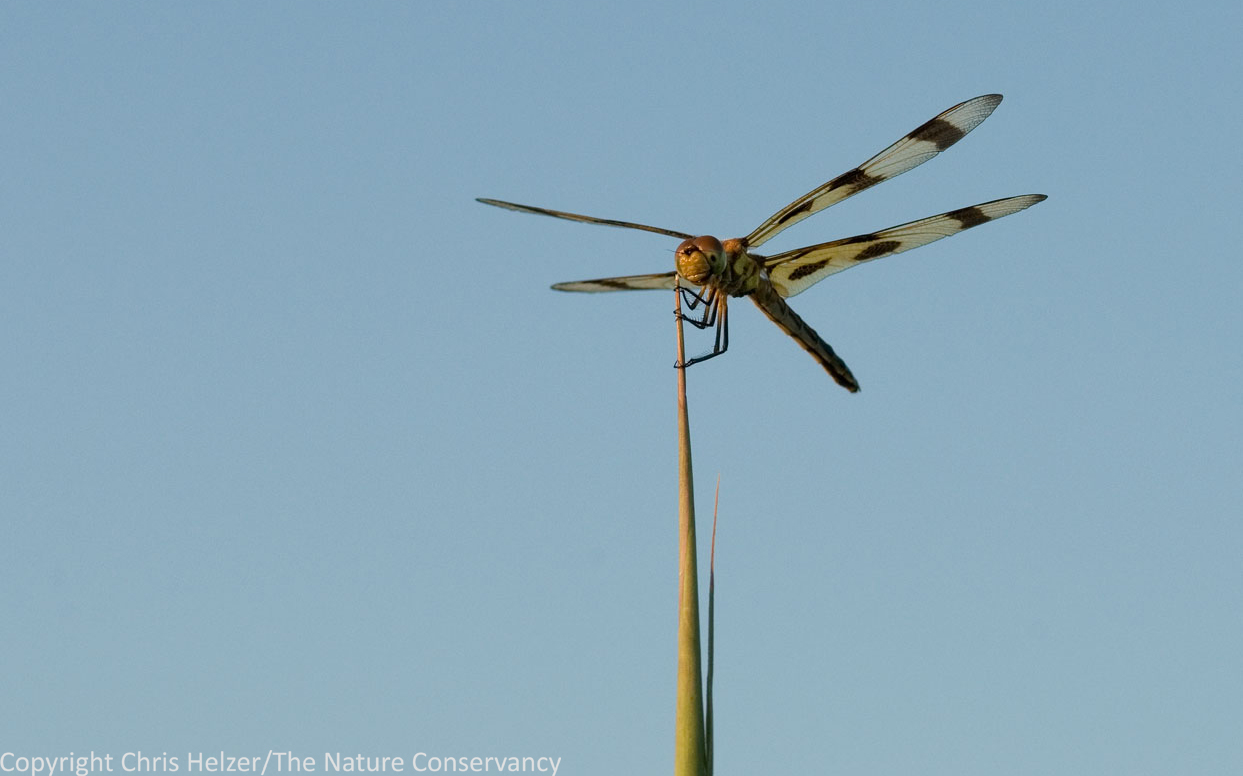
Photo of the Week – July 29, 2011

A dragonfly perched high in a restored prairie - The Nature Conservancy's Kankakee Sands Prairie Restoration, Indiana.

While we were at The Nature Conservancy’s Kankakee Sands prairie restoration site in Indiana last week, we got to see a lot of very nice restored prairies.  The last night we were there, I slipped away from the group for a few hours to look for photos.  The heat was stifling and the sun was still bright as it was dropping toward the horizon, but there were some hazy clouds near the horizon, and I hoped for a little good photo light before the sun disappeared altogether.

My objective was to capture the essence of some of Kankakee Sands’ work by photographing landscape images of restored prairies.  I should have known that wasn’t going to end well.  I don’t envy journalists and others who get sent out on photo shoots with specific objectives, because it never seems to work out for me.  The ideal situation for me is to wander around someplace when the light is favorable and photograph whatever combinations of light and opportunity present themselves.  Whenever I try to force the situation, I end up chasing a shot that doesn’t work well, and I either don’t take any photos or I don’t like any of the ones I take.  And meanwhile, I walk right past all kinds of really nice opportunities.

On this particular night, I spent about a 1/2 hour trying to force landscape photos out of a night that really didn’t work for them.  I was in a completely flat prairie with strong light coming from near the horizon, and the result was that the tops of the flowers and grasses were lit brightly and everything else was in deep shadows.  I actually managed to find a few compositions that showed the plant composition of the site by zooming in on small groups of plants that were all favorably lit.  But it wasn’t what I was really looking for.

Eventually, frustrated and drenched in sweat, I gave up and switched to my macro lens so I could follow some of the dragonflies that had been laughing at me the whole night.  The dragonflies were defending territories from high perches, so they were sitting in beautiful light, and would zoom out in circular flight patterns and then return to the same perches.  They were clearly the appropriate photo subject of the night, and I finally gave in and got a few shots before the light gave out completely. 

The new symbol (for me, anyway) of the Kankakee Sands restoration effort - a territorial dragonfly that laughs at photographers.

So – here you go.  This is my photo of the essence of the Kankakee Sands restoration site.  While it doesn’t show what I’d started the evening looking for, it’s actually not a bad representation of a project that is trying to re-build connections between fragmented prairie and wetland habitats for the benefit of the diverse life that relies on those habitats.  This dragonfly was perched and feeding in a site that had been a cornfield just a few years before.  Maybe it’s not a bad symbol of success. 

And either way, it’s what the light gave me…