As promised, here is a summary of the presentation I gave last weekend to the Winter Meeting of the Iowa Prairie Network. I advocated using prairie restoration to increase the size and connectivity of fragmented remnant prairies and improve our chances of conservation success.
INTRODUCTION
Of all the threats to prairie conservation, habitat fragmentation is by far the most serious. Encroachment by invasive species and woody plants, chronic overgrazing, and broadcast herbicide/pesticide spraying are big threats to prairie species and communities too, but the fragmentation of grasslands into small isolated pieces makes all of those other threats even more dangerous and difficult to counteract.

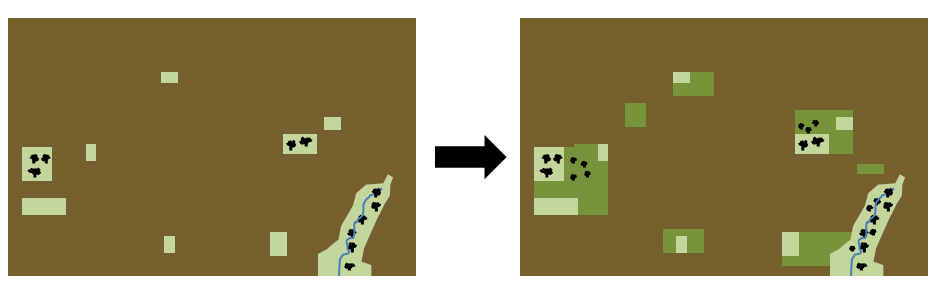
When a large contiguous prairie landscape (left) is broken up into small isolated fragments of prairie surrounded by cropland, roads, and other human developments, prairie conservation becomes very difficult.
For example, pressure from both predation and invasive weeds and trees is usually most severe near the boundaries of a prairie. Because of their size, small prairies have very little area that is not exposed to these “edge effects”, so resident prairie species have no refuge from high predation rates and invasive species. In addition, the intensity of invasive species pressure in prairies with a lot of edge exposure increases the need for control efforts and makes excessive responses like broadcast application of herbicides more likely. Small prairies can also be more likely to be overgrazed because they’re not large enough to make up a significant part of an agricultural landowner’s income – and thus don’t get the careful management that larger grasslands would.
Most importantly, small prairies simply aren’t large enough to provide the physical space and population sizes needed to sustain many species of plants, insects, and animals. Small populations, whether of birds, butterflies, or wildflowers, are much more vulnerable to local extinction because a disease, weather event, management treatment, or other stressor can easily affect the entire population. If one of those small populations is wiped out by a particular event (or series of events), the only chance of that species reappearing is through recolonization from nearby prairies – but in a small AND isolated prairie, that’s unlikely to occur.
The fragile nature of small populations in tiny isolated prairies makes those prairies extremely difficult to manage for biological diversity. Every management decision is going to favor some species at the expense of others. Because small populations aren’t very resilient, it’s easy for them to be much more strongly affected by individual management decisions than they would be in a larger prairie where populations are larger and management treatments are less likely to spread across the entire site (leaving refuges for species to recolonize from, if necessary).
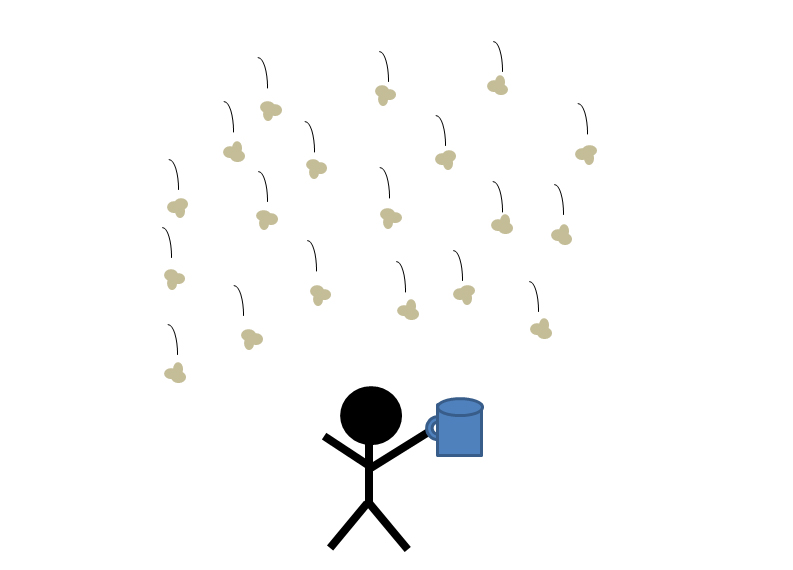
Here’s a goofy but perhaps useful analogy. Imagine that prairie conservation is like trying to catch hundreds of pieces of popcorn falling from the sky. In order to save a species (a piece of popcorn), you have to catch it as it falls. Managing small prairies is like trying to catch all of that falling popcorn in a coffee cup. Because the cup is small, the task is impossible. If you move one way to catch some popcorn pieces, you’ll miss others. And even if you’re really agile, your cup isn’t big enough to hold all the popcorn anyway – so you’re doomed to failure before you start.
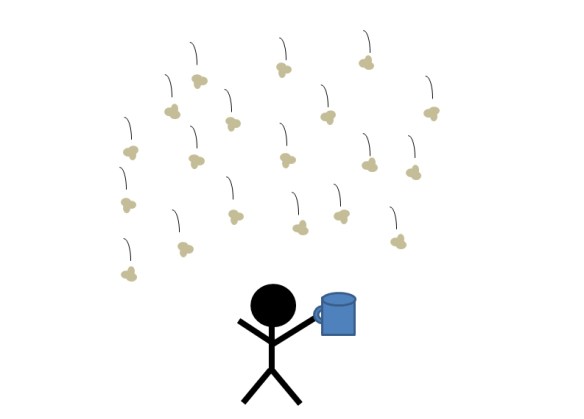
Conserving prairie species in tiny prairies is like trying to catch falling popcorn in a coffee cup. (sort of)
The difficulty of maintaining a prairie ecosystem in small isolated fragments leads to feelings of frustration and helplessness among prairie managers. It also leads to conflicts between managers and advocates of various prairie species/groups. For example, some rare prairie butterfly experts advocate managing prairies without the use of prescribed fire because fires can destroy larvae, and a fire that burns an entire small prairie can completely wipe out the whole population of some rare butterfly species. Avoiding the use of fire may make sense for those few butterfly species, but what about all the other species that would suffer from a lack of fire? Do we manage some prairies exclusively for butterflies – and whatever other species can survive with that management? I don’t think we have enough prairies left to start managing each of them for individual species or groups of species. And yet, the threat of losing butterfly species is real – and important. Unfortunately, the underlying issue is not whether or not fire should be used to manage small prairies, the issue is that rare butterfly populations are small because the prairies they rely on are small and isolated.
Ok, so small isolated prairies create all kinds of problems for conservation, but they’re all we have in many places, particularly in North America’s tallgrass prairie region. What do we do about it? One choice is to continue trying to catch popcorn in our coffee cups, knowing that we will eventually fail to save many species. The second choice is to make more prairie – and enlarge and reconnect some of the existing remnant (pre-existing and unplowed) prairies to give ourselves a better chance of conservation success. In other words, we can turn our prairies into something more like a wading pool – instead of a coffee cup – so that it becomes easier to catch the falling popcorn.
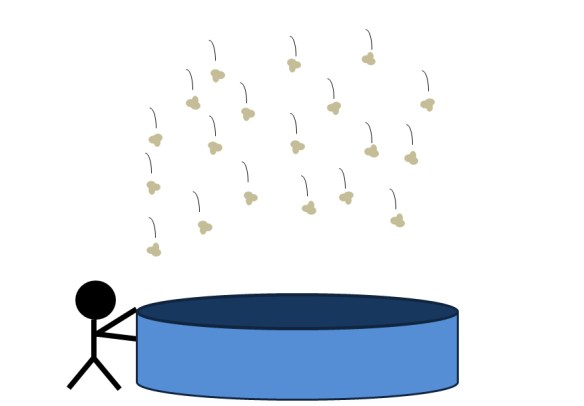
It's much easier to catch falling popcorn (conserve prairie species) with a wading pool (large prairie) than with a coffee cup (small prairie).
Our ability to restore (reconstruct) prairies by harvesting seeds and converting cropland to diverse plant communities has come a long way since its early days. Numerous local pioneers have worked out successful methods of seed harvest, site preparation, planting, and weed control, and know how to establish hundreds of acres of restored high-diversity prairie each year. Those prairies can contain hundreds of plant species, and can support many of the insects and animals found in remnant prairies. However, there’s still much to learn about the extent to which restoring prairie around and between remnants increases population viability for those species, and we still need to identify those species that can’t make the jump between remnants and restorations – and find out why. That said, we know enough to start using restoration to make prairies larger and more connected (and we don’t really have a lot of other options.)

It's not feasible to restore entire landscapes to prairie, but if we can strategically restore parcels of land around and between remnant prairie fragments (right), we can greatly increase our chances of conserving prairie species.
.
GETTING IT DONE
If we’re going to use prairie restoration to make a real difference in conservation, the first step is to get better at strategically targeting our restoration efforts around and between existing small and isolated prairies. This is being done at a few sites, but the vast majority of prairie restoration work is scattered piecemeal across the landscape. Because restored prairie doesn’t compete economically with rowcrop agriculture, prairie restoration on privately-owned land generally happens when an individual landowner makes it a high priority and/or when Farm Bill programs like the Conservation Reserve Program (CRP) or other similar cost-share programs can help close the financial gap. The agencies that administer those cost-share programs typically have little capacity to go out in the field and sell the programs to strategically-located landowners. Instead, they usually sign up the people who come to them (and there are usually enough of those to use up the available money). As a result, the location of prairie restoration depends more upon which landowners express an interest than where their property is located.
Another issue we need to address is the way in which these cost-share program funded restorations are designed. For the most part, agency guidelines allow only enough funding per project to pay for a low-diversity seed mixture. This is largely because the continued funding of these programs by Congress depends heavily on the total number of acres enrolled each year – making it necessary to spread the available money broadly instead of focusing it on a few high-quality projects. While low-diversity seed mixtures can help species like grassland birds, many other species (including pollinators) rely on a high diversity of plant species, and the overall ecological function of a high-diversity prairie is much higher than that with only a few plant species.
Improving the strategic location and quality of prairie restoration will mean taking several approaches. In some cases, conservation groups can simply attempt to purchase tracts of land around and between remnant prairies and restore them. While effective, this can be difficult and expensive. However, if fundraising efforts are targeted toward our highest priority remnant prairies and situations in which the potential for success is high, even small parcels of conservation ownership can be helpful.
In order to bolster the viability of more than a few high priority prairies, however, private lands are going to have to be a large part of the strategy as well. Because agencies like NRCS (Natural Resources Conservation Service) don’t usually have the ability to direct market their programs to landowners, other conservation groups can help by approaching owners of key land parcels and discussing the potential for conservation program enrollment with them. Finding a few interested landowners and helping them enroll can pay big dividends because one successful project often leads to other enrollments by neighbors who see the aesthetic and conservation benefits from across the fence.
Influencing the design of restoration projects funded by NRCS and other agencies is often possible as well. For example, the biggest obstacle to using higher-diversity seed mixes is the cost. If conservation groups can help find additional funds to increase the number of plant species in seed mixes – and if the landowner helps push for it – restoration quality can improve dramatically. In addition, those conservation groups can help by building and maintaining long-term relationships with enrolled landowners. Helping landowners understand the benefits of their restored land, and how it fits into a larger conservation strategy, will improve the chances that the restored prairie will be carefully managed (and even retained as prairie) as the years go by.
Prairie conservation is difficult. In highly fragmented landscapes it can sometimes seem nearly impossible. However, we have the ability to greatly improve our chances of success by converting isolated prairies from coffee cups to wading pools, so to speak. Success will depend upon a concerted and collaborative effort between conservation groups, government agencies, and private landowners, but it is possible. Surely we can agree that prairies are worth the effort?
Epilogue: How do we measure the success of prairie restoration?
I’ll deal with this more extensively in an upcoming post, but a brief mention is important here. When using restoration as a strategy to expand and re-connect remnant prairies, the objective is not to copy the existing remnants (or some historical version of them) but to complement them with restored plant communities that allow the plants, insects and animals within the remnants to have larger and more interconnected populations. Because of this, evaluating differences between remnant and restored communities should not be the primary measure of success.
There are a number of research papers that have shown differences between the relative abundance of individual plant species, levels of soil organic matter, composition of the insect and soil fauna communities, etc., between remnant and restored prairies. These papers often interpret those differences as indicators that we’ve not yet restored “real” prairie. I think that kind of research is interesting, but largely misses the point. If our objective is to replicate existing or historic prairie we will surely fail – but why would we expect otherwise? Trying to recreate exact copies of ecological communities that formed over thousands of years – and doing so on degraded soils, in different climatic conditions, and under pressure from vastly different invasive species and other threats – is not a recipe for success.
However, when we look at restoration as a tool for improving the viability of existing remnants, the most important measures are those that evaluate whether or not prairie populations and communities are larger, more interconnected, and more resilient. Those are difficult things to evaluate, unfortunately, and we need develop better measures than we currently use. That means we’ll need to shift our current research focus from identifying differences between remnants and restorations to investigating how well they interact with each other.