Prairie Dog Spider

Prairie dog towns are known to provide habitat for many species of plants and animals.  Some of those are attractive and/or popular wildlife species like burrowing owls and ferruginous hawks.  Others are attractive (at least to me), but maybe less popular among the general public, including prairie rattlesnakes and black widow spiders.  It’s easy to understand why rattlesnakes would appreciate the availability of burrows.  The snakes can sun themselves on the bare soil at the edge of a burrow, but quickly retreat underground to cool off or escape predation.  From the perspective of spiders, I’m sure the burrows funnel insects nicely into webs, but I’m not sure why prairie dog burrows are so attractive to black widows in particular.  I’ve spent a fair amount of time looking for invertebrates around Nebraska, but prairie dog towns are the only places I’ve ever seen black widows.

A black widow spider in an abandoned prairie dog burrow.

A southern black widow spider (Latrodectus mactans) in an abandoned prairie dog burrow.  The Nature Conservancy’s Niobrara Valley Preserve, Nebraska.  The spider, including spread legs, was only slightly larger than a nickel.

While I was up along the Niobrara River last week, I walked around a small prairie dog town hoping to find either rattlesnakes or black widows to photograph.  I didn’t find any snakes, but did find black widows in two of the first 20 or so burrows I examined.  Both had webs strung across abandoned burrows.  That makes sense, but I wonder if the spiders recognize the burrows as abandoned before they build a web?  If not, I imagine there are some pretty interesting prairie dog/spider interactions as prairie dogs burst in or out of burrows and encounter the webs.  I laughed about something similar with badgers and spiders about a month ago, but the more potent venom in black widow spiders adds an extra degree of risk to prairie dogs…  My guess is that very few, if any, prairie dogs are actually harmed by black widows (the spiders probably just try to get away and prairie dog fur seems thick enough to protect against the small fangs anyway) but I don’t know of any research that’s actually investigated that.

My camera set-up for the above spider photo.

My camera set-up for the above spider photo.

Once I found the two black widow spiders, the next challenge was figuring out how to photograph them.  The first issue was that the late afternoon sunlight was very bright and the tunnels were very dark, making the lighting conditions problematic.  A homemade collapseable diffuser (thin fabric sewed to a plastic hoop) helped cut the light intensity.  The second problem was that the angle of the webs relative to the shape of the burrow made it difficult to get the spider in focus.  I finally gave up trying to find a position from which to photograph the first spider and concentrated on the second.

However, the biggest issue was that the spiders were very tuned in to movement near the edge of the burrow and kept scurrying away into the shadows every time my head, camera, or hand moved across the opening.  The above photo took 45 minutes to obtain.  Most of that time was spent waiting for the spider to return to the web (and the light) every time I re-positioned the camera, focused, or breathed (or so it seemed).  It’s not a fantastic shot, but given the challenging situation it still feels like a kind of victory.

Hubbard Fellowship Blog- Marvels in the Mud

This post was written by Evan Barrientos, one of our Hubbard Fellows.  Evan is a talented writer and photographer and I encourage you to check out his personal blog. If you would like to see more of his photographs, you can follow him on Facebook.

April 2nd was the kind of spring day where you triumphantly open every window in the house. I wanted to get out and explore somewhere new, so I drove to the Fort Kearny Hike and Bike Trail. When I arrived, a bored-looking family was slowly rolling down the weedy trail…in a golf cart. I despaired, thinking that I had driven half an hour to look at weeds with joggers huffing by. Nonetheless, I walked down the crowded trail for a couple of uneventful minutes minutes until it crossed over the Platte River. Much to my relief, there was a staircase inviting visitors to explore the sandbar below. I descended the stairs and started exploring the one place no one else was. It would be another three hours until I returned.

I began by walking in the thicker vegetation, hoping to flush some of the first insects of the year. As I did, several small spiders scurried away. I knelt down to look at them and noticed a few gnats mating on the blades of grass. After a long winter with no insects, these gnats were as exciting for me to photograph as Sandhill Cranes.

20160402_nebraska_0605

Once I was on my belly, more details revealed themselves and a story began to unfold. A few feet from the gnats I spotted a muscid fly. I’m grateful that winter had made me so appreciative of even the common insects; otherwise I might not have taken a closer look. I did, however, and noticed that this wasn’t your typical potato salad-sucking housefly. It was devouring one of the gnats!

The calls of sandpipers drew my attention away from the microcarnage and I went over to the open part of the sandbar. There, I found a migratory flock of Baird’s Sandpipers foraging in the mud. I sat and watched them, wondering how they could possibly find enough food in the muck to sustain their 3,700-mile migration from Argentina. When they flew away, I thought I’d try to figure it out. A tiger beetle distracted me and I started stalking the speedy predator on my belly. Each time I would crawl close enough for a decent photo he would dart a few inches ahead. For several minutes this continued until he had led me to the muddy edge of the sandbar. There, with my nose inches away, it dawned on me how much amazing life that mud contained.

With my camera flat on the ground I spent an hour discovering and photographing insect after insect, many of which I had never seen before. I’m no expert, but I know my insect families fairly well. Yet two of these species were so alien I can’t even tell what order they’re in! If you know, please tell me!

20160402_nebraska_0889

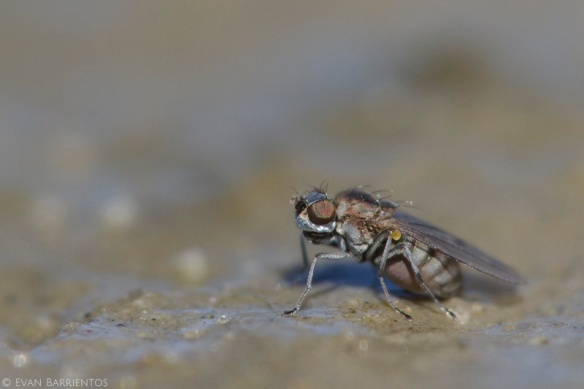
These muscid flies reminded me of sandpipers on a much smaller scale. Both patrol the same mudflats, probing the ground for food. The flies, however, let me watch them from inches away.

20160402_nebraska_0823

This even smaller fly might be contributing to the sandpipers’ food supply. Occasionally I saw the fly press the tip of her abdomen to the mud, perhaps laying eggs or larvae that the sandpipers would certainly slurp up.

20160402_nebraska_0800

Almost every one of these flies was paired with a mate. Presumably, the male is on top, guarding his female from other males while she tries to go about her life as normal. I don’t know that for sure, but I do know of another species that mates this way.

20160402_nebraska_0755

This mystery insect delicately unfolded her cellophane wings in front of me. I have no idea what kind of insect it is. A beetle?

20160402_nebraska_0915

Another mystery insect. I’ve never seen anything like this!

20160402_nebraska_0919

At first I thought this little jewel was a tiger beetle, but I later learned that it’s a marsh ground beetle (Elaphrus sp.). Never seen one before!

20160402_nebraska_0853

Springtails were the tiniest and most abundant invertebrates present, but finding them in my viewfinder was impossible because of their size. I only managed this photo because the springtail jumped into the frame while I was photographing the flies in the background.

20160402_nebraska_0866

Above the muddy valley, a spider hunted for prey.

After completing my goal of photographing every species I could find in that puddle, I got up, stretched my very sore neck, and walked over to the other side of the sandbar. There, I found a small pool with about a dozen small fish huddled together (later identified by Chris as Plains Killifish, Fundulus zebrinus). I began crawling over to them but stopped when I heard some splashing coming from a trickle of water connecting the pool to a larger one. I went to investigate and realized that the splashing was coming from the fish as they struggled to swim through the shallow channel! Like tiny salmon, fish after fish darted through this passage. I wish I knew more about them, but I can only guess that they were on a reproductive migration.

The killifish were extremely wary and freakishly good at spotting me from underwater. I crawled up to their stream and lay still, waiting for them to swim by. I don’t know how they could see me so easily, but I learned that if I moved even the slightest bit they would panic and turn back. After many frustrating failures, I only managed to record a few mediocre videos of this fascinating behavior. To give you an idea of how quick these fish were (and how hard it was to photograph them), these videos are in slow motion at half-speed.

At this point my knees, neck, and elbows could tolerate no more strain. I walked back to my car smeared with mud and drawing lots of puzzled looks. But that was okay, because that mud had given me an afternoon of joy and wonder. If you ever find yourself bored in nature, I recommend you get off the trail and on your belly.