
Photo of the Week – April 28, 2016

During a walk in our family prairie last week, I found a spider web spanning the entrance to a badger tunnel.

Spider and web at the entrance of a badger hunting tunnel (where a badger had dug a tunnel to catch a ground squirrel or some other small creature. Helzer family prairie. nebraska.

If you look closely, you can see the spider near the top of the tunnel entrance.

When I pulled in close with my camera, the shadow behind the web and the bright sunlight on the spider contrasted beautifully.
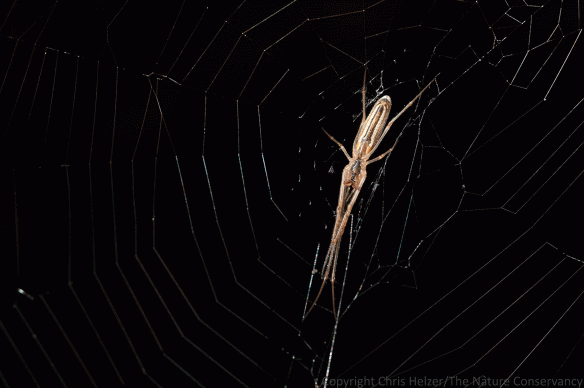
ENPO160422_D003

It might be tempting to think the spider was trying to catch a badger except for three things.  First, that would probably end badly for the spider, and natural selection usually takes care of that kind of thing.  Second, spiders often string webs across any opening that could act as a funnel for flying insects.  A badger hole makes as much sense as any other, I suppose.  Third, this wasn’t a tunnel a badger lived in, just a hole dug while a badger was hunting a ground squirrel or some other small burrowing animal.  Most badger-made tunnels are of that ilk, and if you look closely at them, you can usually see the end of the tunnel within a few feet of the surface.

I do think it’s funny to think about what might happen if a spider hung a web across the opening of an active badger home, though.  I’m imagining a badger emerging from its tunnel in the morning and then hopping around shouting “OOOH!! Ick!  Spider web on my head! Spider web on my head!!”

Photo of the Week – March 4, 2016

Last summer in Minnesota, I saw my all-time favorite insect for only the third time ever.  The camouflaged looper is a tiny inchworm that disguises itself with bits of the flower it is feeding on.  It is a fairly widespread species, and probably pretty common, but it’s rarely seen because it’s so well camouflaged.  I’ve written in more detail about this species in a previous post if you’re interested.

While I was excited to see the inchworm, I have to admit I was also a little disappointed.  In the inchworm.  I mean, really.  This species is usually so well camouflaged that it blends almost perfectly with the flower it is feeding on.  This one stood out like a sore thumb.

The camourfl

A camouflaged looper on a purple coneflower at The Nature Conservancy’s Bluestem Prairie in western Minnesota.  The head is at the top left…  You can see bits of (I think) two different flowers stuck to its back in this picture.

I’m going to give my favorite insect the benefit of the doubt and assume it was in the middle of a costume change when I saw it.  It looked like it had just started to pick up pieces of the purple coneflower it was feeding on, and still had some pieces of some other flower stuck to its back.  I’m sure it was in the process of shedding those other flower pieces and replacing them with coneflower parts.  But still – it was pretty glaringly obvious as a light-colored critter sitting on top of a dark-colored flower head.  It was awfully lucky I was just a nerdy photographer and not a hungry bird