
Photo of the Week – June 12, 2014

While I was in Iowa last week, I took advantage of some free time just before sunset to return to one of the restored (reconstructed) prairies we’d visited earlier in the day at the Kellerton Wildlife Management Area.  As I walked into the prairie, I could hear a few straggler (desperate?) prairie chickens booming on their lek and I flushed a pair of northern bobwhites from the fenceline.  Bobolinks, dickcissels, eastern meadowlarks and grasshopper sparrows were noisily announcing themselves across the prairie, and upland sandpipers were whistling and chattering above.  The insects were less noisy but were abundant, once I started looking closely for them.

Tall white indigo in restored prairie at the Iowa Department of Natural Resources' Kellerton Wildlife Management Area.

Tall white indigo in restored prairie at the Iowa Department of Natural Resources’ Kellerton Wildlife Management Area.

As the sun lowered itself toward the horizon, I reflected upon the various ways the success of this particular prairie restoration effort could be measured.  It was certainly aesthetically pleasing, plant diversity was high, wildlife and insects certainly seemed to be responding well to it, and by replacing cropland with prairie, the Iowa DNR had – at least incrementally – defragmented the grassland landscape.  Seems like success to me!  …I decided to focus on the aesthetics for a while, and took advantage of the golden evening light until the sun disappeared completely.

A stinkbug on purple coneflower.

A stinkbug on purple coneflower.


Crab spider on Ohio spiderwort.
Crab spider on Ohio spiderwort.


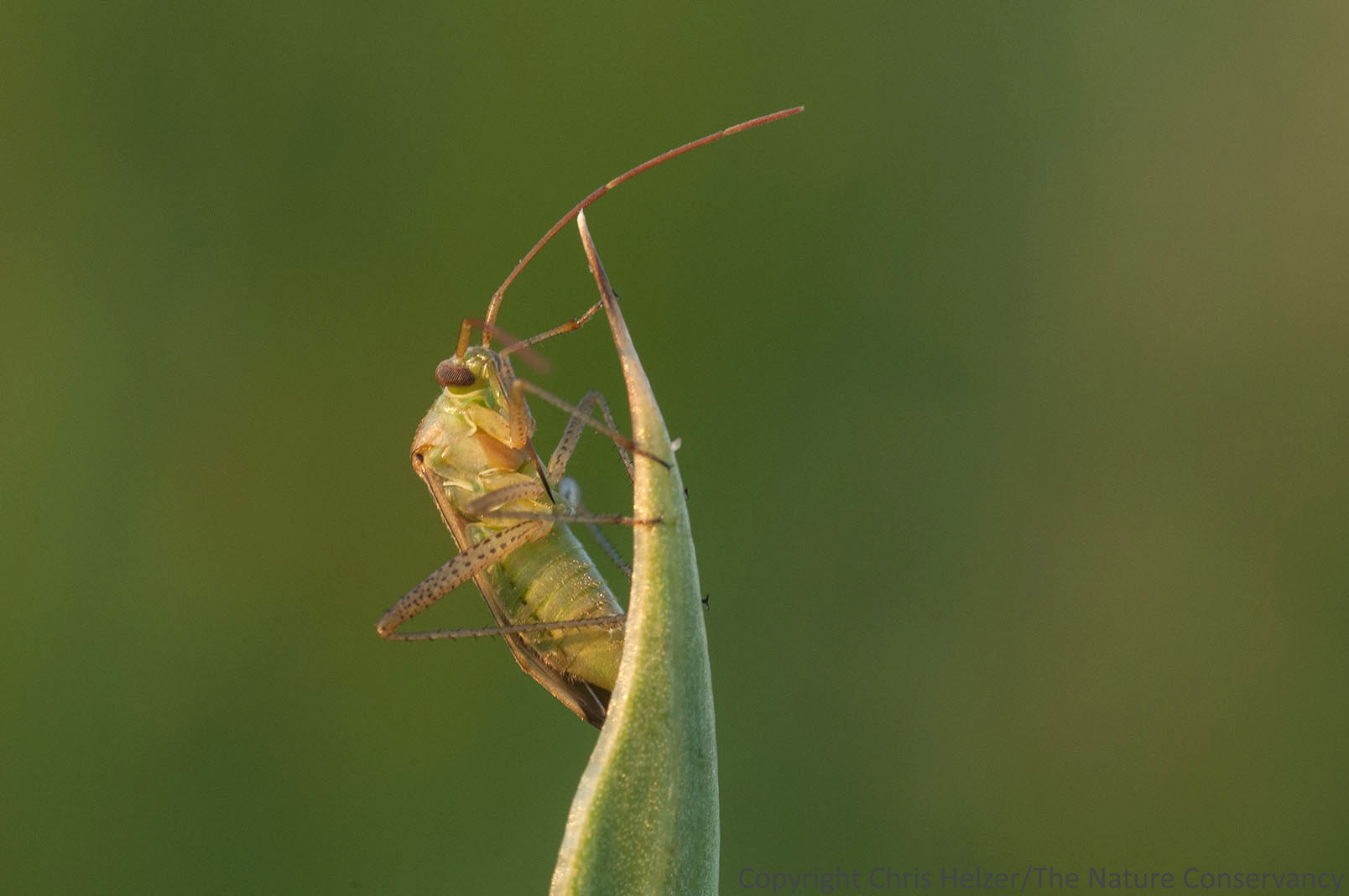
A bug (Hemiptera) sits perched in the late day sunlight.

A bug (Hemiptera) perches in the late day sunlight.


Ohio spiderwort.

Ohio spiderwort in the afterglow of the sunset.


Seventeen-Year Cicadas are Back! (in Iowa, at Least)

I traveled to Iowa this week (more on that next week) and just happened to arrive during the emergence of one of the world’s most intriguing insects – the periodical cicada (Magicicada sp).  Made up of seven different species, periodical cicadas are found only in eastern North America and are named for their long life cycles of either 13 or 17 years.

This newly-emerged cicada (Magicicada sp) hadn't completely dried out yet, so it's wings weren't functional enough to fly away from me.  I put it on a stick for an easy photograph.

This newly-emerged cicada (Magicicada sp) hadn’t completely dried out yet, so it’s wings weren’t functional enough to fly away from me. I put it on a stick for an easy photograph.

All cicadas (that I know of) spend most of their lives underground as larvae before emerging for a brief, noisy life aboveground.  What makes periodical cicadas unique is not so much the length of time spent as larvae – though it’s longer than other cicada species – but rather the synchronization of their emergence.  The common dog-day cicada, for example spends multiple years underground as a larva, but we see adults every year because their emergence is staggered across years.  In contrast, periodical cicadas synchronize their emergence so the entire population in a particular area is on the same schedule.  That timing of emergence, however, does vary by region across North America, so while seventeen-year cicadas are out in Iowa, Illinois, and Missouri this year, they emerged last year in an area covering states including Maryland, New York, and Virginia.  People living in eastern Nebraska will get a chance to see them in 2015.

Emerging as adults in hordes probably helps ensure the survival of individual periodical cicadas (and their species) because predators can’t eat nearly enough to put a dent in the population.  If periodical cicadas showed up in huge numbers every year or two, there would surely be predators with life cycles timed to take advantage of the abundant food source.  However, the extreme length and synchronization of the cicada life cycle has apparently kept any predator species from being able to take advantage (evolutionarily) of the phenomenon.  Fortunately for us, cicadas are harmless to people, and even the damage they do to trees by feeding and laying eggs in stems is almost always temporary.

There is much more fascinating information about periodical cicadas, but others have already covered it far more completely than I can.  If you’re interested, I strongly encourage you to visit the magicicada.org to learn more.