Hill Country

I’m in Austin, Texas this week, attending a conference of science and stewardship staff of The Nature Conservancy from around the country.  Ahead of the conference, I attended a field trip through portions of the Texas Hill Country near Austin.  It was an excellent and thought-provoking tour.  It’s always great to see other sites and talk to their managers about what they’re doing and why.

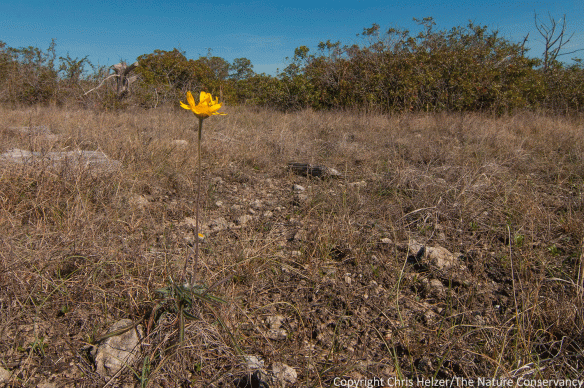
We spent Tuesday morning at the Conservancy’s Barton Creek Preserve, about 4,000 acres of rocky hills near the west side of Austin.  The site manager, Brandon Crawford, talked us through the ecology and management of the preserve.  The most striking feature of the site to me was the lack of soil.  Most (all?) of the Hill Country has a legacy of serious overgrazing – first by cattle, and then by goats after the land would no longer support cattle.  Many years of that mistreatment resulted in a loss topsoil from the hills, leaving a shallow-soiled landscape with even less soil and vegetation than before.

The rock of the Barton Creek Preserve was create

Many years of chronic overgrazing and subsequent erosion of topsoil led to the kind of sparsely vegetated terrain on the hills of the Barton Creek Preserve.

The tops of the hills at the  Barton Creek Preserve are dominated by shrubby species such as mountain laurel, along with scattered live oak trees and Ashe junipers (similar to eastern red cedars).  Growing around and between those woody plants was little bluestem, along with gramas, dropseeds, and a variety of wildflower species.  It was striking to realize that the Barton Creek Preserve receives about the same annual rainfall as our Platte River Prairies back in Nebraska – our sites look incredibly lush compared to the almost desert-like appearance of the Hill Country grasslands.
f;pwer

It was a pleasant shock for a Nebraska ecologist to walk around Texas prairies in 80 degree February weather and see blooming flowers.  The temperatures are above normal in Nebraska this week, but it’s going to be a while before we start seeing flowers in our prairies.

The shallow soil and sparse brushy habitat at the Barton Creek Preserve supports the black-capped vireo, a federally-listed endangered species that nests in low shrubs.  Brandon works to maintain that shrubby habitat structure by using prescribed fire and mechanical cutting to keep the Ashe juniper from becoming too dominant in uplands.  It’s not an easy job – especially given that prescribed fire is tricky when you’re surrounded on all sides by housing developments – but it is very different from the kind of ecological management I’m more familiar with.  Brandon focuses mainly on creating habitat structure for vireos, but he’s also helping out a number of other animal and plant species that continue to scrape out a living in the hills.
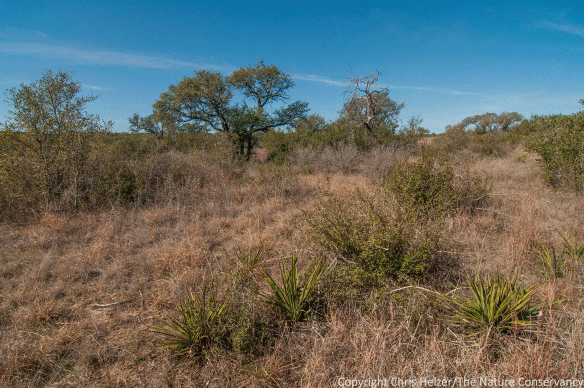
This area was recently cleared of juniper to create the kind of habitat structure needed by black-capped vireos.

This area was recently cleared of juniper to create the kind of habitat structure needed by black-capped vireos.

snail

I was really surprised to see numerous (relatively fresh but empty) snail shells on the dry rocky hills of the Barton Creek Preserve.  Apparently, Brandon’s habitat work supports more than just birds.

Down the slope from the hill tops, much of the Barton Creek Preserve is covered by a kind of “old growth” woodland dominated by live oaks and Ashe junipers.  That woodland is home to another endangered bird species – the golden-cheeked warbler.  Brandon told us the warbler needs about a fifty-fifty mix of oak and juniper in its woodland habitat, with about 95% canopy cover.  So while junipers can cause problems for the vireos on the hilltops, they are a critical piece of the habitat for the warblers on lower portions of the preserve.  At this point, Brandon isn’t using much prescribed fire in those woodland areas, though he’s considering it, and is watching the results of other similar sites where managers are experimenting with low intensity fires that clean out the surface layer beneath oaks and junipers without killing the bigger trees.
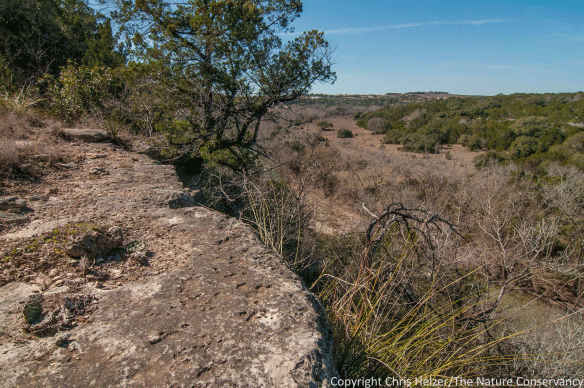
overlook

A rocky overlook above Barton Creek.  The woodland in the top right corner of the photo is where the golden-cheeked warblers make their homes.

At our Platte River Prairies and Niobrara Valley Preserve in Nebraska, our management is aimed at creating a shifting mosaic of habitat types and maintaining plant diversity.  By moving fire and grazing intensity around our sites each year, we always provide a variety of habitat types, and we measure success by the diversity of plant and animal species we support.  By contrast, Brandon’s role at Barton Creek is to manage the structure of two distinct and static habitats – hill tops and lower slopes – and his success is primarily measured by whether or not he’s supporting two endangered bird species.  He’s providing habitat for many other organisms too, of course, but in that fragmented ecosystem surrounded by housing developments, just keeping those birds alive is a pretty good accomplishment.

Good land management starts with clear objectives.  Without them, it’s not possible to measure success.  I’ve met a surprising number of land owners and managers who can’t clearly describe what they’re aiming for on their property.  I’m not sure how they know what to work on each day.  Although Barton Creek Preserve has very different objectives from the ones we’ve set for our prairies in Nebraska, the objectives fit the site and it was interesting to learn about how Brandon is working to meet them.  The people in and around Austin (not to mention the warblers and vireos!) are lucky to have Barton Creek Preserve in such good hands.

Ecologists and land managers from around The Nature Conservancy

Ecologists and land managers from around The Nature Conservancy traded ideas as Brandon (black cowboy hat) showed us his work at Barton Creek Preserve.

Prairie Word of the Day – Habitat Heterogeneity

Do you know what time it is?  It’s time for another PRAIRIE WORD OF THE DAY!

Today’s Prairie Word of the Day (fine, it’s actually two words) is:

Habitat Heterogeneity

Heterogeneity is really just a longer word for Diversity, which is another way of saying “lots of different things”.  So why use the word “heterogeneity” instead of just saying “lots of different things”?  Well, for one thing, using big words makes a person sound smart, and when you’re a prairie ecologist and no one really understands what it is you do for a living, it’s good to at least sound smart.

More importantly, there’s a nice alliterative (another big word!) feel to the phrase Habitat Heterogeneity, which happens to be one of the most important phrases in prairie ecology.  In fact, I would argue that the foremost objective of any prairie manager should be to create habitat heterogeneity within the prairie(s) they manage.

Habitat heterogeneity simply means diversity or variety in habitat types.  Habitat homogeneity is the opposite – a lot of habitat that is all the same.

Every organism in a prairie has its own unique habitat requirements, so the number of different habitat types in a particular prairie is correlated with number of species that can live there.   Let’s use prairie birds as an example.  Birds such as upland sandpipers like to nest in large patches of relatively short-stature grassland.  Around here, a big hay meadow is great habitat for them, especially if it was cut fairly late in the previous year and is still short in stature when the subsequent breeding season starts.  On the other hand, Henslow’s sparrows want to nest in prairie habitats with relatively tall and dense vegetation.  It would be highly unusual to find Henslow’s sparrows and upland sandpipers nesting in the same patch of prairie because their habitat preferences are very different.  So, if you want both species in your prairie, you have to provide both short and tall/dense habitat.  Other birds have their own unique habitat requirements, including nearly bare ground (e.g., horned lark), relatively short, but with abundant thatch (grasshopper sparrow), tall with lots of tall/weedy wildflowers (dickcissels), tall and nearly impenetrably dense vegetation (sedge wrens), and many others.  Only if your prairie provides all those different habitat conditions will you attract all those different bird species.

Dickcissels prefer

Dickcissels prefer habitat with lots of tall wildflowers or weeds.  They often weave their nest into the stems of a tall clump of vegetation.

The same diversity of habitat preferences exists in other groups of prairie species as well.  Among small mammals, for example, voles tend to prefer habitats with abundant thatch, while pocket mice are more often found where bare ground is abundant – and there are many others.  Insects and other invertebrates have the same kind of diversity in habitat preferences

Scale is important.  While a bird, mammal, or insect might have a broad preference for a certain kind of habitat structure, it is likely to need some heterogeneity within that habitat too.  A mouse, for example, might prefer patches of prairie with fairly sparse vegetation, but it is likely to need a few clumps of vegetation dense enough to hide in when predators are near.  Insects and reptiles are ectothermic (cold blooded) and need to regulate temperature, so while a snake might like to hide in tall dense so it can bite your ankle as you walk by (I’M KIDDING!), it also needs some places to bask in the sun.  All of this means that habitat heterogeneity is important any many different scales.  Heterogeneity at a fairly large scale (acres) helps provide places for many different animals to live in a prairie, but heterogeneity within the home range or territory of each animal (square meters, or even centimeters) can be important too.

Some habitat heterogeneity occurs simply because soil texture, nutrients, and moisture, along with topography all vary across a landscape.  A prairie is likely to have areas of more productive soils where vegetation grows tall and thick, and less productive soils where vegetation is more sparse, for example.  In addition, water will pool in some areas of a prairie more than others because of topography, altering the habitat for both plants and animals.  However, despite this “naturally occurring” heterogeneity, it’s still important for prairie managers to look for ways to provide more.

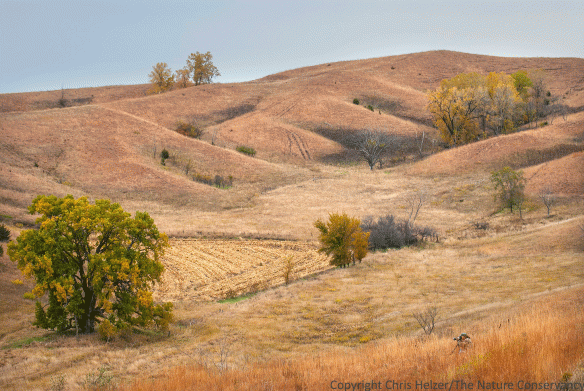
This landscape at The Nature Conservancy's Broken Kettle Grasslands in northwest Iowa shows the kind of natural heterogeneity that occurs in many landscapes.

This landscape at The Nature Conservancy’s Broken Kettle Grasslands in northwest Iowa shows the kind of natural heterogeneity that occurs in many landscapes.  Topography, soil variability, and other factors create a diverse set of conditions for plant growth and habitat structure.  Land management can add to that heterogeneity and improve it even more.

Prescribed fire and haying/mowing do a great job of altering habitat structure at a fairly large scale (acres).  By applying those treatments in different parts of a large prairie each year (and varying the timing of each from year to year), a manager can create a shifting mosaic of habitat patches that supports a wide diversity of animals.  However, both fire and mowing are pretty non-selective – most or all of the vegetation within a burned or mowed area gets the same treatment.  Leaving unmowed patches of grass here and there and varying the height of the mower as it moves across the site can help leave more heterogeneity behind.  Designing prescribed fires so that not all vegetation burns (e.g., mowing around some patches ahead of time, burning on days with lower temperatures or higher humidity, etc.) can also help with habitat heterogeneity – though those kinds of fire might also be less effective at killing trees or accomplishing other objectives.

In prairies where livestock grazing (cattle or bison, for example) is feasible, it is much easier to create small scale heterogeneity because grazers pick and choose which plants, and how much of each plant, to eat at any one time.  By controlling grazing intensity, and varying it across both time and space, managers can create prairie patches that are ungrazed, almost completely grazed, and in various stages of partial grazing – with a mixture of tall vegetation and nearly bare ground.  The uneven application of “fertilizer” from the rear ends of grazers contributes even more to habitat heterogeneity by temporarily altering soil productivity in lots of little spots across the prairie.

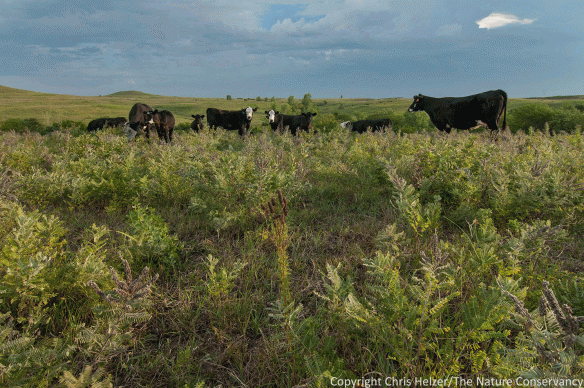
These cattle at Konza Prairie in Kansas

These cattle at Konza Prairie in Kansas have created a nice example of small scale habitat heterogeneity by grazing many of the grasses short while leaving leadplant, purple prairie clover, and other wildflowers ungrazed.

Whether it’s fire, mowing, grazing, herbicides or various combinations of those, creating habitat heterogeneity may the most important job of a prairie manager.  We still have a lot to learn about how the scale and configuration of habitat patches affect wildlife and insect populations.  What we do know, however, is that the prairies thrive when they have a lot of different types of habitat.  …When they have habitat heterogeneity.

And that, folks, is your Prairie Word of the Day.