
Photo of the Week – May 19, 2016

Gjerloff Prairie, formerly known as Griffith Prairie, is a beautiful site on steep loess hills adjacent to the Platte River.  It’s owned and managed by Prairie Plains Resource Institute, and was burned earlier this spring.  I walked around the prairie for an hour or so this week to see how things were progressing since the fire.  From a distance it didn’t look like there was much to see – just a lot of short green grass.  Up close, however, there was a lot going on, and I didn’t have any trouble finding photography subjects..

The topography of Gjerloff Prairie is always interesting - if challenging to hike - but especially so after a fire.

The topography of Gjerloff Prairie is always interesting – if challenging to hike – but especially so after a fire.

Many plants, including this leadplant (Amorpha canescens), were growing strongly after the fire and a month of good rains.

Many plants, including abundant leadplant (Amorpha canescens), were growing strongly after the fire and a month of good rains.

It was nice to visit the only population of tuberous false dandelion (Pyrrhopappus grandiflorus) in Nebraska. The southern Plains wildflower was discovered at Gjerloff prairie in 2004.

It was nice to revisit the only population of tuberous false dandelion (Pyrrhopappus grandiflorus) in Nebraska. Normally found only in Kansas and southward, this wildflower was discovered at Gjerloff prairie in 2004.

Smooth sumac (Rhus aromatica) can be overly abundant in some prairies in our area, but hangs out mainly on a few waslopes at Gjerloff prairie. It resprouts easily after fires, and looked vibrant and healthy this week.

Smooth sumac (Rhus glabra) can be overly abundant in some prairies in our area, but hangs out mainly on a few steep slopes at Gjerloff prairie. It resprouts easily after fires, and looked vibrant and healthy this week.

Spiderwort (Tradescantia occidentalis) was just starting to bloom on the warmer south-facing slopes of the prairie.
Spiderwort (Tradescantia occidentalis) was just starting to bloom on the warmer south-facing slopes of the prairie.

And, of course, I found a crab spider to photograph. Although they are particularly small this time of year, they are all over the place on flowers, and weren't difficult to find once I started looking.

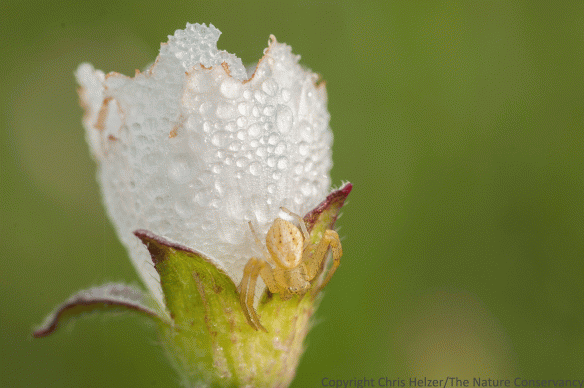
And, of course, I found a crab spider to photograph (on pale poppy mallow – Callirhoe alcaeoides). Although they are particularly small this time of year, crab spiders are all over the place on flowers.


A Toadal Mystery

Ok, I need help solving this mystery.

As I was walking across a large concrete parking lot this weekend, I looked down and saw this:

20160514_181133

It’s clearly the imprint of a Woodhouse’s toad in concrete.  (Yes, I’m guessing on the Woodhouse’s part of that identification, but it’s a very good bet.)

The bigger question is, “How the heck did this happen??”

The print was more than 50 feet into the concrete from any non-concrete surface.  It was also more than a couple feet from the nearest seam between concrete sections.  I have several hypotheses.  If you’re going to disparage any of them, you’d better give me a better one.

Hypothesis A: A great blue heron or other large bird caught a Woodhouse’s toad in a wetland near town and was carrying it back to its nest as food for its young.  As the bird flew over the church parking lot, which was in the process of being poured, it was distracted by the sight of the rotating tub of a concrete truck and accidentally dropped the toad into the soft concrete of a section that had just been smoothed.  After the concrete dried, the deceased toad eventually decomposed or was carried away by a suprised scavenger.

Hypothesis B:  An adventurous toad living in an airplane hanger at the tiny airport north of town nestled itself into some nook or cranny in a small airplane before it took off.  As the plane lifted itself into the air, the poor toad, clinging to the plane with its white-knuckled front feet and flapping like a flag in the wind, finally lost its grip and tumbled several thousand feet into concrete that was nearly, but not completely cured.

Hypothesis C:  Jimmy, the son of Greg the concrete guy, had a pet toad named Harvey.  One night, Greg came home from a long hard day and dropped his jacket on the floor near the front door before shuffling off to a hot shower.  Later that night, Harvey hopped into the pocket of that jacket and decided it was a good place to nap.  Early the next morning, Greg hopped out of bed, refreshed and ready to make some more progress on the parking lot, grabbed his jacket and strode out the door to his truck.  Harvey, still asleep, remained in the jacket pocket.  About mid-morning, as Greg stretched his arm far across the patch of concrete he was smoothing, Harvey felt squeezed by the pocket, squirmed out, and plopped into the concrete.  A few moments later, Greg, who never really cared for Harvey anyway, spotted the toad glaring balefully at him from where he was stuck in wet concrete.  Greg considered his options momentarily before simply turning away to work on the next section of concrete.  The next day, Jimmy, after a long fruitless search of the house for his favorite pet, was presented by Greg with a black lab puppy, which cheered him up considerably.  Meanwhile, Harvey made his escape from the concrete after it dried, and hopped off into a nearby cornfield where he met the love of his life (several of them, actually).

That’s the best I can do.  Any better ideas?