Photo of the Week – September 18, 2015

There are reasons I am primarily a bug and flower photographer.  One of the biggest of those reasons is that bug and flower shot compositions are pretty simple.

Look – a flower!

Or Look – a bug!

Or sometimes Look – a bug on a flower!

One subject, simple background. Piece of cake.
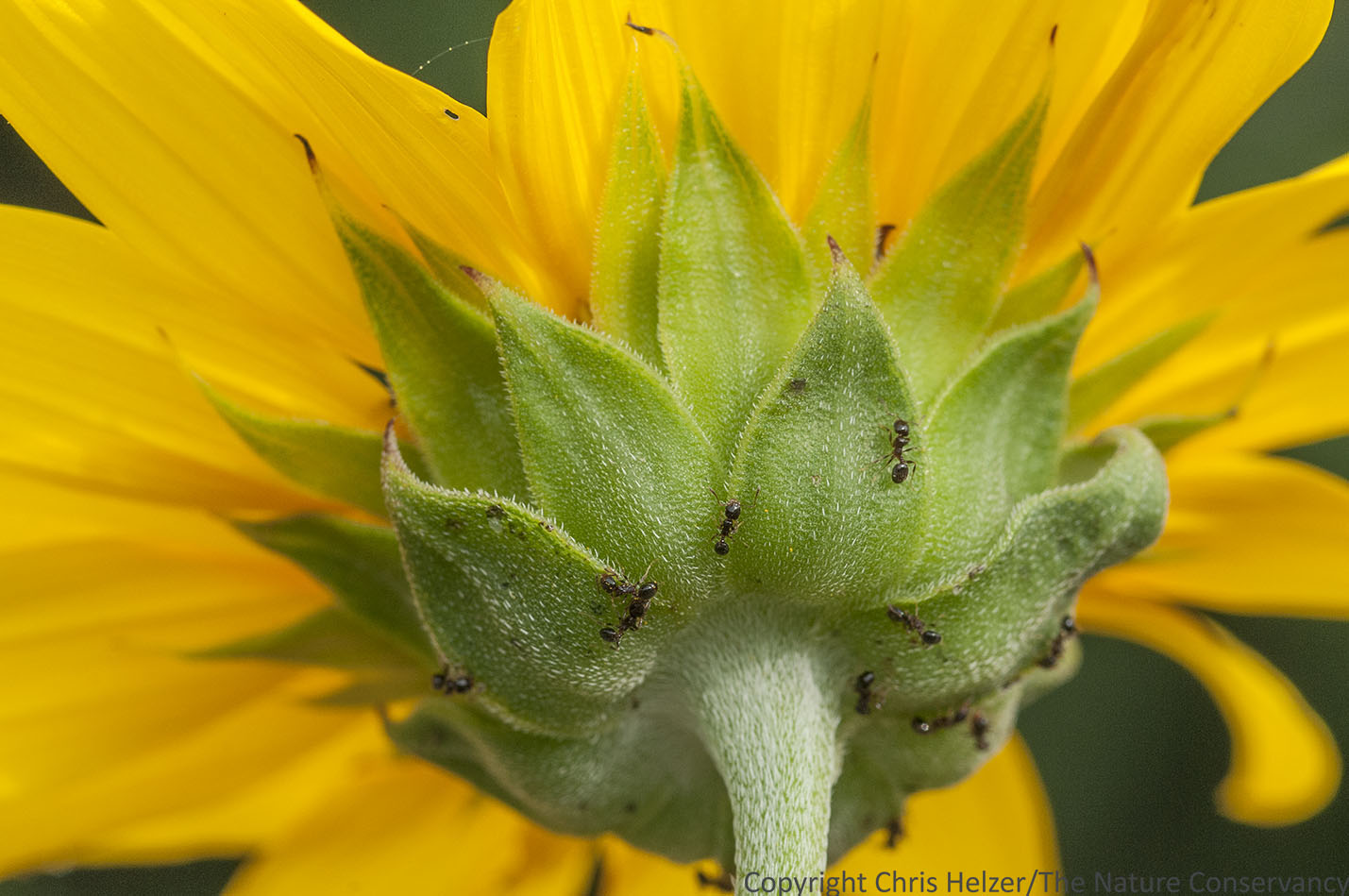
Ants looking for extrafloral nectar on annual sunflower. Valentine National Wildlife Refuge, Nebraska.

Ants looking (I assume) for extrafloral nectar on annual sunflower (Helianthus petiolaris).  The sweet substance produced by sunflowers and some other wildflowers attracts ants, which – in turn – may help repel herbivores.  Nebraska Sandhills on the Valentine National Wildlife Refuge.

I admire good landscape photographers but I feel completely inadequate every time I pretend to be one.  While I’m composing landscape images I usually spend a lot of time fretting and second guessing about foreground, horizon line placement, and other factors that don’t come into play with close-up photography.  For whatever reason, my brain is wired such that composing close-ups of bugs and flowers comes intuitively but landscape photos are mentally painful.

That said, there are times and places when even I can take a decent landscape photo.  Last month, I was on a ranch in the Nebraska Sandhills, possibly the most scenic grassland landscape in the world.  The light was great and I had a little time, so I aimed my camera at a windmill and hay bales to see what I could do.  I took a lot of shots, and though I kept feeling like I wasn’t quite capturing the essence of what I was seeing, I liked the photos well enough.  After about 20 minutes, I had about 100 different images that were all very similar to each other and the next challenge was to narrow it down to my favorite.  I almost got there – I got down to two.

Windmill and hay bales on a ranch in the Nebraska Sandhills. Composition 1.
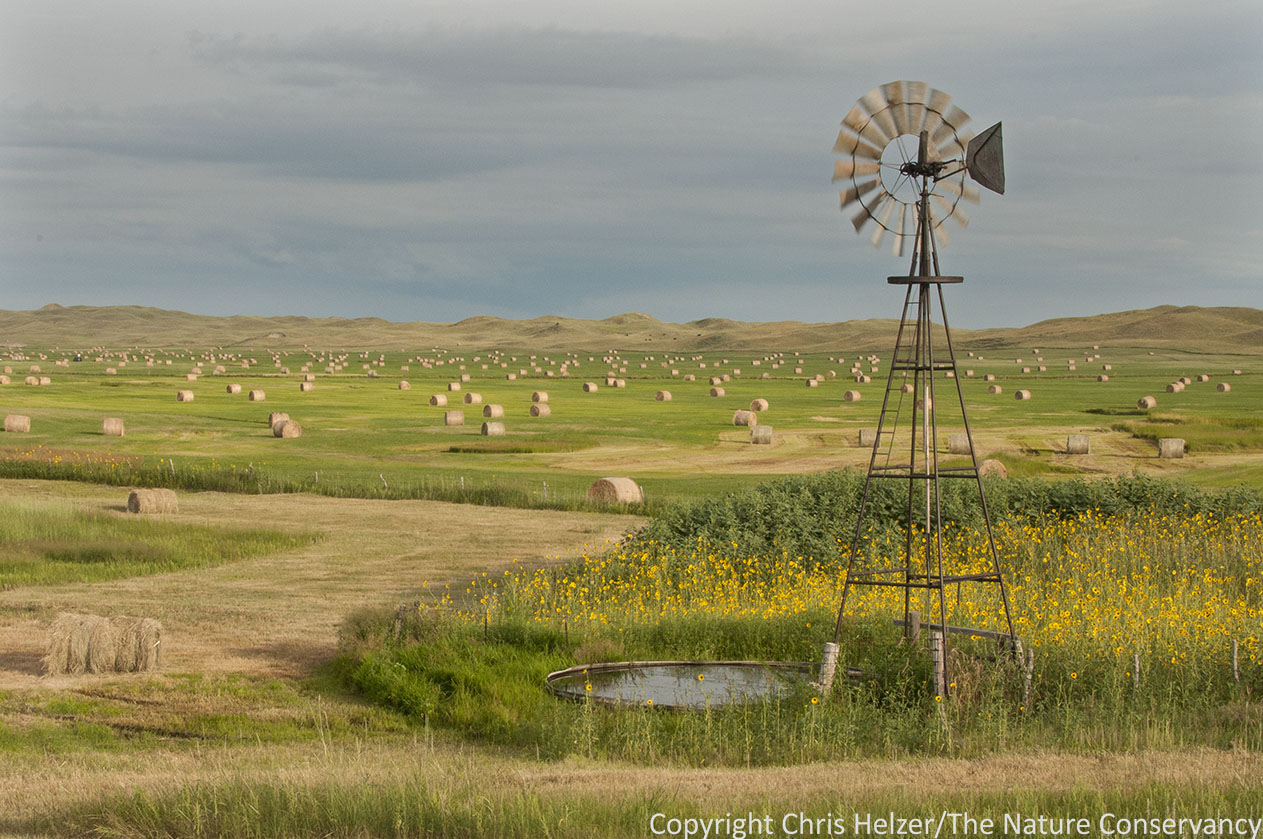
Windmill and hay bales on a ranch in the Nebraska Sandhills. Composition 1.

Option 3.

Composition 2.

Maybe you can help.  Let me know if you like either of these two images, and if so, which you like more. In the meantime, I think I’ll go look for a bug.  On a flower.  Something my brain can handle.

Photo of the Week – September 10, 2015

A few weeks ago, I took my camera across town for a walk in a small local prairie.  There were numerous flowers blooming, but the stiff sunflowers (Helianthus pauciflorus) were stealing the show.  I shot quite a few photos of them from various angles.

Hover fly on Stiff sunflower (Helianthus pauciflorus) Lincoln Creek Prairie, Aurora, Nebraska.

This little hover fly was enjoying a meal of stiff sunflower pollen.  Lincoln Creek Prairie, Aurora, Nebraska.

Stiff sunflower (Helianthus pauciflorus) Lincoln Creek Prairie, Aurora, Nebraska.

The sunflower perspective.

I noticed that a few sunflowers seemed to have their “petals” (technically speaking, they are the ray flowers) folded in toward the center of the flower.  I’d seen this quite a few times before, but this time I decided to investigate.  I gently pulled the petals apart and found they’d be held down with what appeared to be silk.  Beneath them, an insect larva was hiding and, presumably, feeding on pollen or other flower parts.

Caterpillar in Stiff sunflower (Helianthus pauciflorus) Lincoln Creek Prairie, Aurora, Nebraska.

A closed-up stiff sunflower.

Caterpillar in Stiff sunflower (Helianthus pauciflorus) Lincoln Creek Prairie, Aurora, Nebraska.

The larva revealed.  Note the remnants of silk and the anthers still sticking to the petal after I pulled everything apart.

Caterpillar in Stiff sunflower (Helianthus pauciflorus) Lincoln Creek Prairie, Aurora, Nebraska.

A close up of the caterpillar (?)

I’m not expert enough with insect larva identification to know for sure, but I’m guessing the larva is a moth larva – I know at least some of those have the ability to make silk.  Some of you reading this will surely know more about them and comment below.  (Thanks for your help.)

A few days later, I ran across some similarly closed up flowers in a different prairie.  When I opened those up, there was another larva inside, but it was much darker in color.  I wonder how many different species have this behavior?

The larva I found was just one of many examples of insects that create safe hiding places for their young to feed in.  Spittle bugs and gall-forming insects are two others that are common in prairies.  Of course, for every great hiding strategy, there is at least one predator that has developed a counter strategy.  I don’t know what eats the petal-tying larvae, but I bet there’s something out there.  I’m pretty sure guys-with-cameras are not the only ones who can find them.  Fortunately, for the larva I found, I wasn’t hungry at the time.