A Guide to Patch-Burn Grazing for Biological Diversity

Patch-burn grazing is getting a lot of attention from a wide variety of audiences these days.  The management system has generated substantial enthusiasm among some people – particularly those interested in improving habitat for prairie wildlife species.  It has also generated substantial skepticism among others – particularly those concerned about potential negative impacts of grazing in eastern tallgrass prairies.

To date, the majority of research on and demonstration of patch-burn grazing has been oriented toward influencing agricultural grassland management because of the system’s potential to improve wildlife habitat at those sites.  Research has largely shown that farmers and ranchers can reap the habitat benefits of patch-burn grazing without compromising current stocking rates or livestock performance.  Because wider adoption of patch-burn grazing techniques on private lands could have tremendous positive impacts on prairie wildlife populations, those research results are exciting, and the continuation of work toward that objective is very appropriate and important.

However, the emphasis on developing and testing patch-burn grazing as an agricultural tool has also somewhat limited our ability to evaluate the system’s impacts (current and potential) on biological diversity.  Variables such as stocking rates, timing and intensity of grazing, fire season and frequency, and others tend to be defined such that they are compatible with local grazing systems and cultures.  Again, this is very appropriate, but it also narrows the range of possible modifications to the basic patch-burn grazing model that are being tested.

In contrast to research projects oriented toward balancing agricultural production with wildlife habitat, our work with patch-burn grazing in the Platte River Prairies of Nebraska is targeted only at building and sustaining biological diversity.  Our stocking rates, fire frequency, and other variables are all primarily designed to favor plant diversity.  Because few others are experimenting with patch-burn grazing from the same standpoint, we have tried to gather as much data as we can about the impacts of our various patch-burn grazing modifications – especially related to impacts on plant species and plant communities.  We’re taking the approach that if we can learn how to optimize management for plant diversity and overall biological diversity, we can then help translate and modify those methods to fit the specific needs of private landowners, public land managers, and others.

A burned patch in restored prairie along the Platte River in Nebraska. Cattle are concentrating their grazing in this area, but the light stocking rate employed means that while many grasses are being grazed, most forbs are not. In this case, ungrazed forbs include opportunistic plants such as black-eyed susan and hoary vervain, but also compass plant and Canada milkvetch, which are often viewed as negatively affected by cattle grazing.

This week I attempted to capture what we’ve learned about patch-burn grazing to this point and incorporate it into a single document.  We certainly don’t have all the answers, and the document should not be read as a prescription for precisely how to employ patch-burn grazing.  Rather, it is a description of the kinds of things we’re trying on our sites and the results we’ve seen so far.  I hope it will stimulate thought and discussion among other prairie managers looking for new ideas and options for dealing with prairie management challenges.

As I’ve said before on this blog, patch-burn grazing is not an appropriate management system for all prairies.  Moreover, patch-burn grazing often gets treated as a single narrow management system, but should really be seen as a basic template – and should rarely be implemented without tailoring it to meet particular objectives.   This new document describes some of the modifications of that template being tested at our sites and the responses we’ve seen from the prairie communities we manage.

If you’re interested, you can download the document here.
In Celebration of Annuals


When most people think about prairie plants, they think about long-lived perennial grasses and wildflowers.  However, 20-25% of plant species in most prairies are annuals; germinating, flowering, and dying in the same growing season.  Some of those annuals are tiny uncommon species that take advantage of small openings or disturbed areas when they can.  Others are adapted to growing conditions (e.g. saline or alkaline soils) that most other plants can’t grow in, and thrive because of a relative lack of competition.

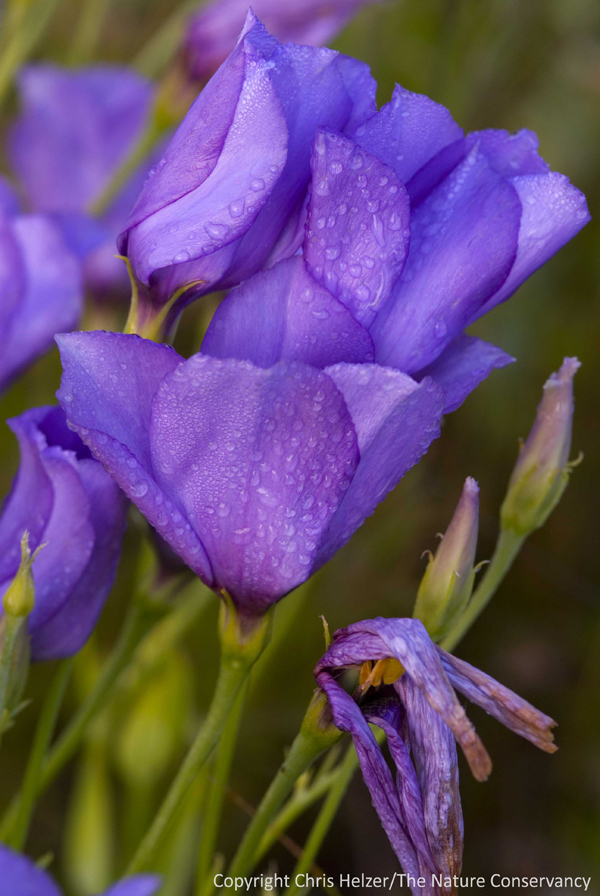
Eustoma grandflorum is a member of the Gentian family, and is known in Nebraska as "Prairie Gentian". This annual plant has purple to white flowers and can be found in moist prairies throughout much of the Great Plains (we often find it in relatively alkaline soils). Its showy nature has led to the creation of horticultural varieties as well.

Most of the best known native annuals, however – think of annual sunflowers, annual ragweeds, and similar species – are largely considered to be weeds.  Because they can quickly become startlingly abundant, they get lumped in with non-native weeds such as buttonweed, exotic pigweeds, lamb’s quarters, and others, that are cropfield pests.  However, that label of “weed” is unfair for most of those annuals (including some of the non-natives).  A better term is “opportunistic”.  And thank goodness for them.  They fill spaces that are opened when the perennial plants around them are weakened, giving herbivores and pollinators something to eat, providing food and cover for wildlife, and helping to stave off true weeds that can take advantage of the same kinds of conditions. 


Plains annual sunflower is on of two annual sunflower species in Nebraska (the majority are perennials).  Plains sunflower inhabits sandier soil than its relative Helianthus annuus.  Both are considered cropfield pests but are also very important components of prairie plant communities.

In our Platte River Prairies, we work to ensure that we harvest seed from as many native annuals as we can each year so they can establish and create a seed bank in our restored prairies.  We do this, in part, because they are native species and part of the prairie community.  However, we also include them because they are a better alternative than some of the invasive species that compete for the same spaces.  We also watch for those annual plants and monitor their ebbs and flows in abundance to help measure whether or not we’re creating open spaces for germination and establish of annual and perennial plants alike.  When I see abundant annuals in our prairie, I know that there are perennials getting an opportunity to spread as well – they’re just not as showy about it.

Woolly plaintain (Plantago patagonica) is an abundant annual in distrubed sandy soils. The small grass seen growing with is is another annual, six-weeks fescue (Vulpia octoflora). We harvest as much seed from both species as we can for our sand prairie restoration work because the two species inhabit the same habitat as exotic annual bromes, and we'd rather have the native species!

These are just a few of the many annuals found in the Nebraska prairies we restore and manage.  They’re not any less interesting than perennial plants – just shorter-lived.  If anything, their short spectacular lives (they HAVE to bloom and produce seed in their single year of life in order to ensure a next generation) with abundant flowers and seeds make them underdogs that are easy to root for.  Go annuals!

Saltwort (Salicornia rubra) is one of several annual plant species that can thrive in very saline soil conditions. In Nebraska it is limited mainly to the saline wetlands around Lincoln, Nebraska and is a state-listed species. It is a succulent plant and tastes like sea water when chewed.


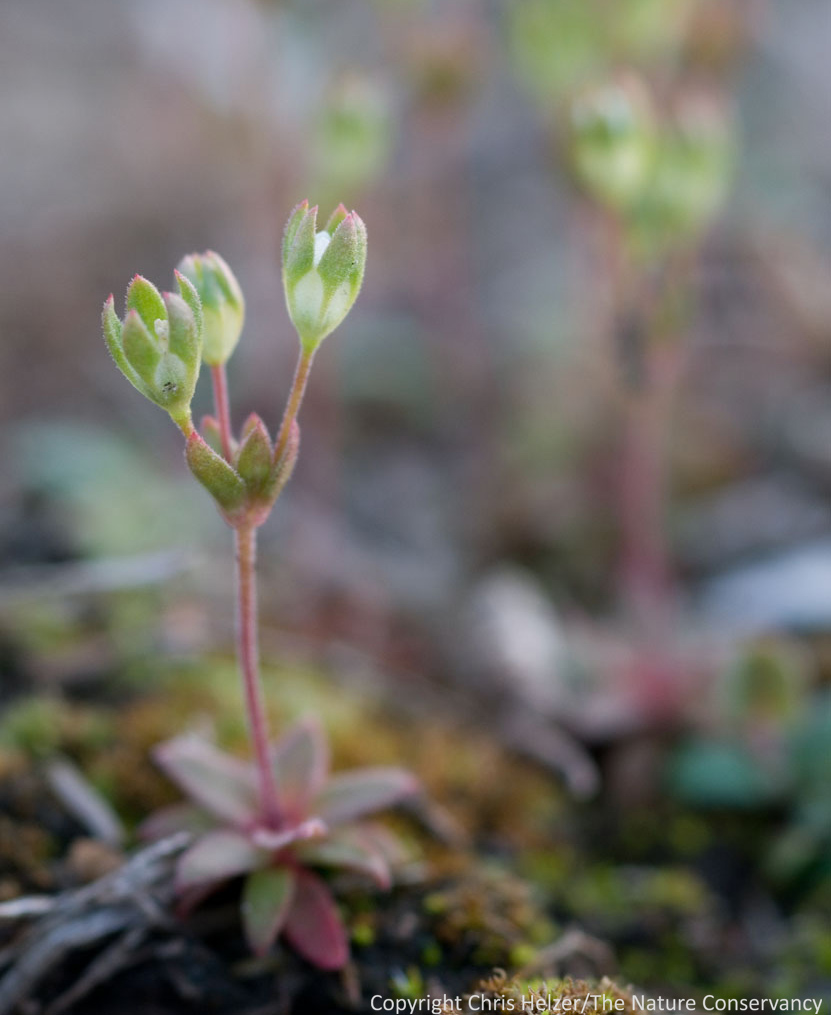
Western rockjasmine (Androsace occidentalis) is a tiny annual plant in the primrose family. Found in much of the western 2/3 of the United States and Canada, it is often difficult to see unless one is looking for it. It is relatively common in Nebraska (though usually overlooked) but is a state-listed threatened/endangered species in Indiana, Michigan, and Ohio.

Deer vetch (Lotus unifoliolatus), aka prairie vetch, is a very common native annual legume in our prairies along the Platte River. It becomes very abundant following grazing, summer fire, or drought.