The Yucca and its Moth

It sounds too good to be true; two species helping each other survive for millions of years – each getting as much as they give.

Soapweed yucca (Yucca glauca) is a common plant in the Great Plains but also occurs in dry sandy and loess soils in Iowa, Missouri, and Arkansas.

For more than 40 million years there has been a relationship between yucca plants and yucca moths.  It’s a particularly important one because neither the yucca or the moth can survive without the other.  The moth’s larvae depend on the seeds of the yucca plant for food, and the yucca plant can only be pollinated by the yucca moth.
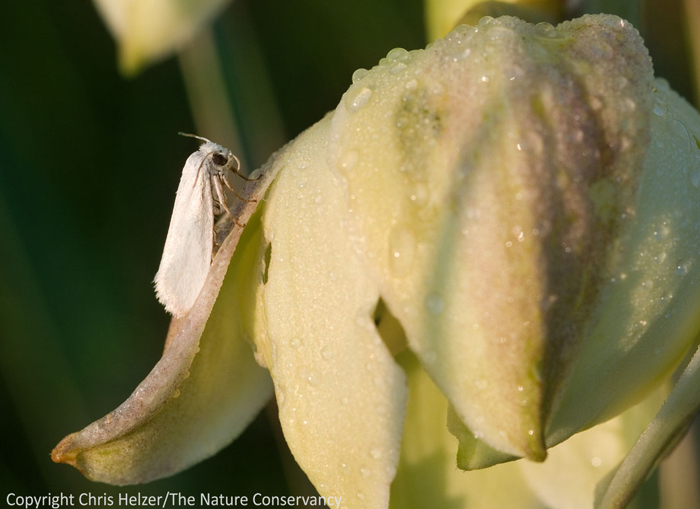
The yucca moth (Tegeticulla yuccasella) on soapweed yucca at The Nature Conservancy's Niobrara Valley Preserve in north-central Nebraska.

In the central United States, soapweed yucca (Yucca glauca)- is pollinated by a moth known as Tegeticulla yuccasella.  Each spring, adult moths emerge from underground cocoons and the males and females meet up with each other on yucca plants to mate.  When a female is ready to lay eggs, she first goes to a yucca flower to collect pollen.  Unlike most moth species, yucca moths have two short tentacles near their mouth that they use to scrape pollen from the anthers of the flower.  As she collects the sticky pollen, the yucca moth packs it into a ball and sticks it under her head.  She then flies off to another yucca flower.

When she arrives at the second yucca flower, usually one that has very recently opened, she goes straight to the bottom to find the ovary.  She opens a small hole in the ovary and lays her eggs inside.  Once the eggs are laid, she scrapes a small amount of pollen from her sticky ball with her tentacles, walks to the stigma of the flower, and packs the pollen into tiny depressions within the style.  She may then return to the ovary of the same flower to lay more eggs or fly to another flower.  Either way, before she leaves the flower, she marks it with a pheromone (a chemical other moths can sense).  The scent marker will tell later visitors that they’re not the first to reach the flower, and they will either lay fewer eggs than the first moth, or none at all, depending upon how many moths have left their scent already.  This helps moderate the number of larva that hatch within each flower, and prevents the plant from aborting the flower altogether, which it will do if too many eggs are laid.
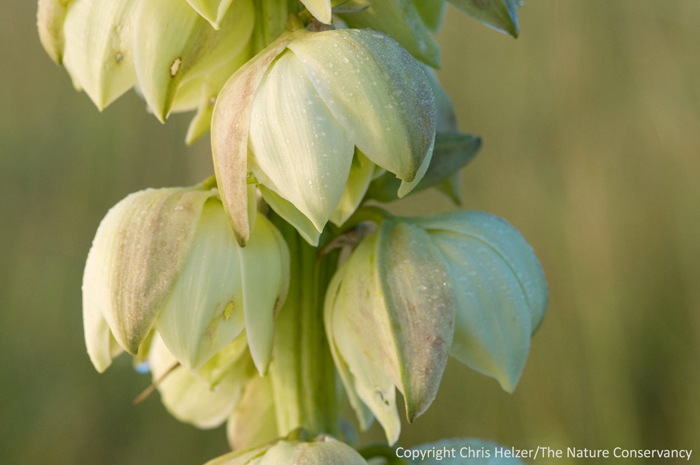
Flowers of soapweed yucca.

When the eggs hatch, the larvae feed on yucca seeds within the fruit.  Typically, there are more seeds than the larvae in a particular flower can eat (since the plant aborts flowers that are too heavily laden with eggs).  When the larvae finish eating, they burrow out of the fruit – usually during rain events, interestingly – and burrow down into the ground to make their cocoon and wait until the next spring when the whole process plays out again.

As far as anyone knows, and it’s been studied since the 1870’s, no other species besides the moth pollinates yucca flowers.  Similarly, yucca moth larvae don’t feed on anything other than yucca seeds.  So each species depends upon each other for survival, and both benefit from the relationship.

It’s a beautiful thing.

If you’re interested in a much more detailed review of yucca moths, you might like this article by Olle Pellmyr.

If you want to read about some additional interelationships with yucca, the moth, and other insects, you might be interested in this article by Laura Hebert.

– thank you to Mary Ann Feist for help with this post.
A Quick Guide to Close-Up Photography (Macro Photography)

I’ve had a number of requests to post something on techniques for close-up photography (macro photography).  To keep long technical details out of a short blog post, I’m presenting some basic tips here and providing a link to a more detailed PDF document for those interested in it.

Carrying a camera with a good macro lens is a fantastic way to explore prairies.  I notice things I wouldn’t otherwise see when I’m looking for close-up photos because my mind has developed a search image for small objects.

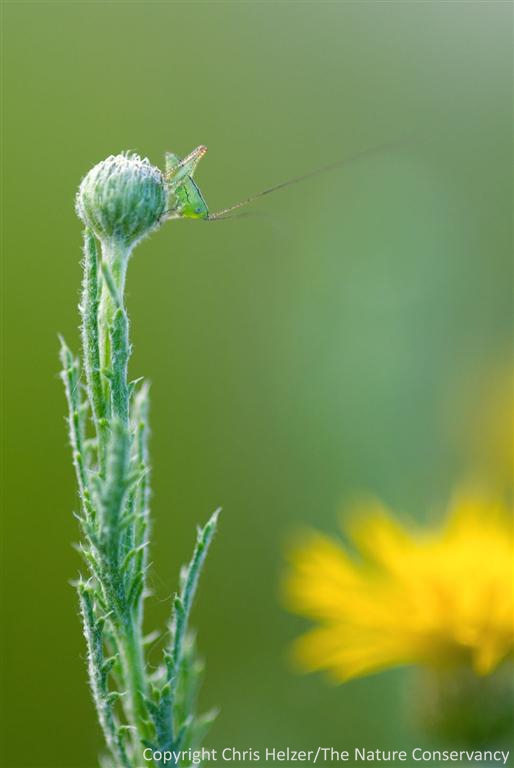
This tiny katydid nymph is sitting on cutleaf ironplant. I never would have seen it if I hadn't been carrying my camera and looking for small things to photograph.

Rather than looking for specific subjects (such as dragonflies or violets) I try to look for things that are well-lit and have interesting colors/backgrounds/patterns.  Early in the day, I often work the edges between shadows and light, trying to find flowers or insects that are catching the warm light but have shadows behind them.  On bright overcast days, everything is evenly lit and saturated with color, so I look for appealing patterns and colors – but just about any subject is fair game.  I rarely pull my camera out on bright sunny days unless I’m documenting something.  The light from a bright mid-day sun is just like the color of the sun – harshly bright and colorless.

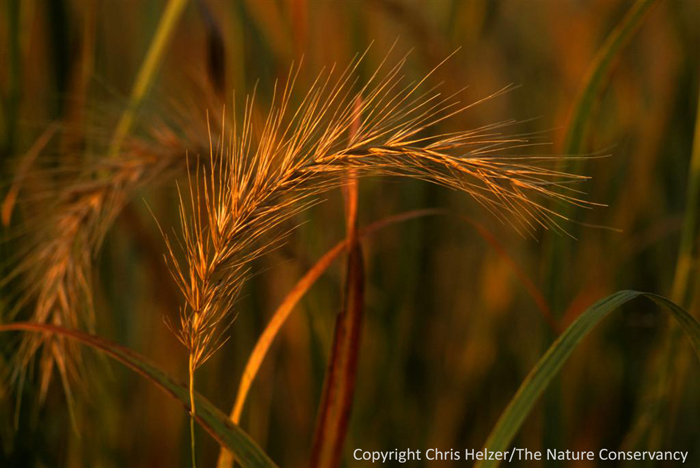
This Canada wildrye seed head is reflecting beautiful golden early morning light.

Close-up photography doesn’t require a lot of equipment, but an SLR camera with manual focus and aperture control, a good macro lens, and a tripod are all necessary items.  Slow shutter speeds (the amount of time the camera’s shutter is open) allow small aperture settings, which helps maximize depth-of-field (the amount of space, front to back, that’s in focus) – something that is very important when focusing in on small subjects.  In order to shoot with slow shutter speeds, it’s impossible to hold a camera still without a tripod.  It’s also difficult to use slow shutter speeds on windy days, so calm wind is a close-up photographer’s best friend.

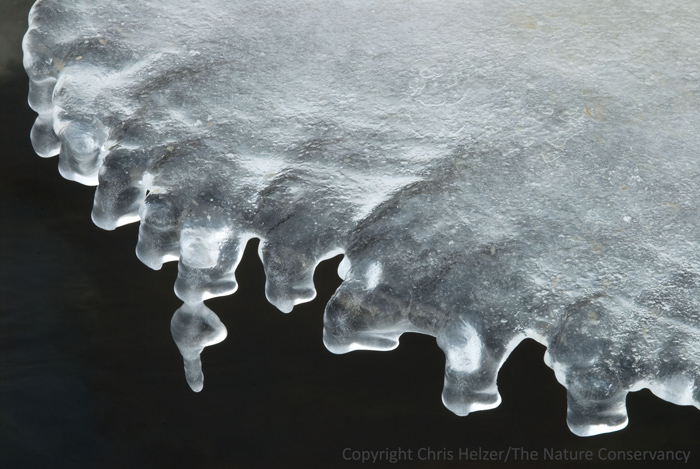
This photograph of ice along a creek was taken at a shutter speed of 1/6 second - much too slow to hand hold (especially with shivering hands). A tripod was a must for this photograph.

The most important – and often overlooked – aspect of a close-up photo may be the background.  When photographing an insect or flower, photographers tend to focus solely on that subject and forget about what is behind it.  An errant grass leaf or stem has been the downfall of many otherwise very nice photos.  An experienced photographer is always conscious of what’s behind the subject, and knows how to make slight adjustments to the position of the camera to create the most interesting (or least distracting) background possible.

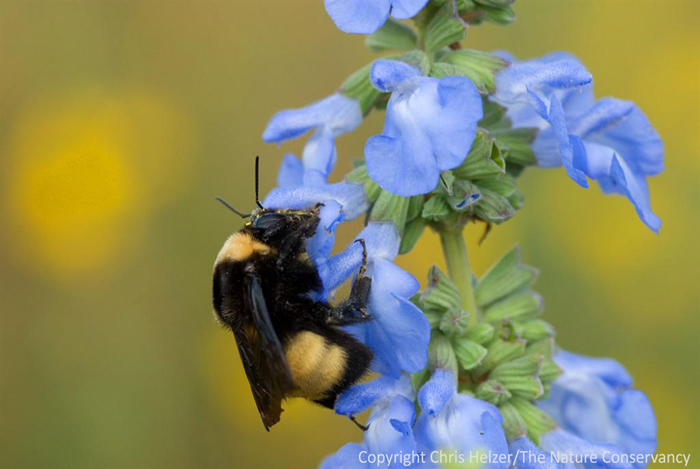
A bumblebee on pitcher sage. I positioned my camera to get the blurred sunflowers in the background as texture and context.

I’ve been lucky to have opportunities to share my photos with others through multiple avenues – magazines, books, slide presentations, and now this blog.  I enjoy being able to show people animals and plants they might not otherwise have seen on their own.  It’s also educational for me because I can’t identify many of the subjects at the time I photograph them, but a good photograph allows me the opportunity to research both the identification and ecology of those species later.  I’ve learned a tremendous amount about prairies just by photographing its small citizens.  If you enjoy photography but don’t own a macro lens, I encourage you to look into getting one – it’s a ticket into a whole new world.

For more photos and tips on macro photography, click to see a PDF of more detailed guidance (macro photography 2010) or a short article I wrote on the same subject for NEBRASKAland magazine back in 2007 (Macro-June2007).