
Science doesn’t have to be complicated or difficult. In fact, the essence of science is really just a way to satisfy our curiosity about the world.
There is great value in rigorous science, with sufficient replication and statistical power to merit publication in peer-reviewed journals. That kind of science moves us forward as a scientific community, and provides checks and balances to make sure we don’t go too far down the wrong path. At the other end of the spectrum, however, is the kind of science that any naturalist or land manager can use to answer basic questions about how the world works. An observation triggers a question, and more observations help answer that question.

I photographed this dotted gayfeather at our family prairie the other night. When I noticed it flowering, I knew it was time to revisit my project from last year.
Exactly one year ago, I posted the results of about a half hour’s worth of data collection on dotted gayfeather (Liatris punctata) plants. I had noticed that plants in one part of one of our restored Platte River Prairies seemed to have a lot more flowering stems than in another part of the same prairie. It was pretty easy to walk around and count enough stems in both patches and see if my observation could be confirmed by data. It was. Gayfeather plants growing in the half that had been burned and grazed intensively during the previous year had many more flowering stems than those growing in the half that hadn’t been burned and was only lightly grazed.

This photo was taken back in 2017, and shows a huge dotted gayfeather plant in an area where the previous year’s burning/grazing had reduced grass competition. You can also see an abundance of yarrow and stiff goldenrod that seemed to respond positively to the less competition.
At the time, I speculated that perhaps the reduced competition from grazed/stressed grasses had allowed the dotted gayfeather plants an opportunity to produce a lot more flowering stems. You can read last year’s post for more details on my hypothesis, if you like, but in that post I’d promised to revisit the site again in future years to see if patterns of stem abundance fit my guess.
Well, I kept my promise yesterday, and the results are very interesting!
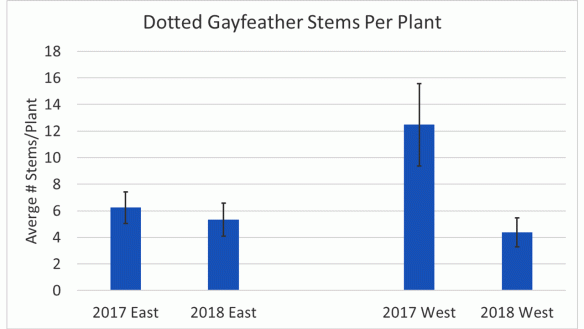
The number of stems per plant in the east half of the prairie didn’t really change between 2017 and 2018. That half was has been largely ungrazed for the last couple years but was burned this spring and is currently being grazed pretty intensively. The west half is where I noticed many more stems per plant in 2017 (the year after it was burned and grazed). However, in 2018, the number of stems/plant in the west half came way down to match that in the east. My initial hypothesis is supported! (The error bars here represent 95% confidence intervals, for those of you who care about that sort of thing.)
The above graph shows averages based on counts of 58 and 63 plants from the east half of the prairie in 2017 and 2018, respectively. In the west half, I counted 53 plants in 2017 and 43 in 2018 – it was harder to find flowering plants in 2018, making me wonder if some didn’t bloom or if they were just hidden in the dense grass (or both).
The west half of the prairie, was burned/grazed in 2016 and had very high numbers of gayfeather stems/plant in 2017. It was completely rested from grazing last year and is only getting very light grazing pressure in 2018. As a result, grasses have recovered very well, and now grow pretty thickly around the dotted gayfeather plants. My prediction was that as grasses recovered, the number of gayfeather stems would decrease. They did. In 2017, I was finding a lot of plants with stem numbers in the 20’s and 30’s, and one gigantic plant had 51 stems! In the same area a year later, I found one plant with 21 stems and all the rest had 10 or fewer (most had 3 or fewer).
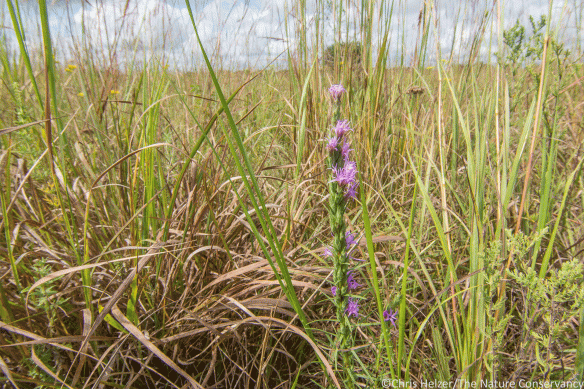
In the west half of the prairie, grasses have recovered after two years of near complete rest, and dotted gayfeather plants now have a lot more competition for light and space. Most plants had only a few flowering stems, and based on how hard I had to look to find them, I wonder if many didn’t even flower this year.
Meanwhile, the east half was burned this spring and has been getting pretty intensive grazing all season long. Cattle have been mainly focusing on grasses like big bluestem and Indiangrass. It’s pretty similar to the way the west half was grazed in 2016, though this year’s high rainfall has let some grasses grow faster than the cattle can eat them. As a result, the overall grazing intensity – and the stress on grass plants – won’t be quite as strong as it was when the west half was grazed in 2016, but I’m hoping it will be enough that grasses will be much less competitive in 2019. If so, and if my hypothesis is right, I should see gayfeather stem numbers go way up in 2019 in this area.

In the east half of the prairie, this year’s burn has led cattle to graze grasses fairly intensively. Those grasses should be much less competitive next year, and I expect to see gayfeather plants produce a lot more stems per plant. We’ll see if I’m right in about a year.
So far, I’ve invested about 2 hours worth of time on this project. That includes about 30 minutes of data collection each year (walking around and counting stems on all the plants I encountered) and about the same amount of time entering the data and creating a graph. Despite that, I’m gaining confidence that my initial hypothesis about grass competition and gayfeather stem numbers was on the right track. A year from now, if gayfeather stem numbers increase dramatically in the east half (burned and grazed this year) and stay about the same in the west, I’ll be pretty confident in my answer.
Now, my results aren’t going to cure cancer or likely change the world in any measurable way. I probably won’t submit my results to a peer-reviewed journal (although I might actually submit a “note” if the results warrant it). On the other hand, I’m learning a lot, and what I’m observing is a small clue to a larger puzzle. I’ve got years of much more rigorous data showing that short-lived wildflowers respond very positively after grazing reduces the vigor of competing grasses. That wildflower response, however, has mostly been from the germination of new plants that fill in while grasses are weak and then die out again as grasses retake their previous territory.
My observations of dotted gayfeather are giving me some intriguing insight into how long-lived perennial plants might respond to the same reduction of grass competition. It appears likely that at least some long-lived plants are able to take advantage of that lighter competition by producing many more stems, leaves, and flowers. That increase must certainly benefit pollinators, and maybe other organisms that feed on gayfeather. Is it also important to the long-term survival of the plants? Good question! The plants sure create a lot more seeds when they make more flowers. It would be really interesting to know if the plants also produce a bonanza of new buds at their bases (those buds are what allow them to grow new stems in the future).

Regardless of whether more flowering stems has long-term benefits of the plant itself, the phenomenon sure provides an abundance of resources for bees, butterflies, and other pollinators.
Remember – this whole story started because I happened to notice a lot of flowers in one part of our prairies and took 30 minutes to count them. That kind of cyclical curiosity and observation is the foundation of science, and is the reason we’ve learned what we have about the world around us. Who knows – maybe my little gayfeather project will lead others to build upon my observations with a more rigorous project that will lead to greater understanding of plant communities, competition, and response to grazing and other stresses. Whether it does or not, I’m already getting what I wanted out of the project – I’m having fun, learning something new, and stimulating my brain to come up with more questions about the prairies I love.
What are you seeing? What kinds of questions are tickling your brain as a result? Do you have a spare hour or two to explore a little further? Think of what all of us could be learning with just a little bit of time and effort!


