I think I’ve captured the last of the initial set of questions you asked as part of the 10 year anniversary of the blog. Thanks again for the insightful, quirky, and (often) earnest questions you submitted. If you have more, please send them in (through the comments) and I’ll collect them for future posts.
Here is the latest batch –
cherylllr asks:
Thank you for this blog. I’m here because of the ‘joke’ book about identifying wildflowers from a moving car, but I think something like that could certainly be very real. So, I guess my question is, do you have any thoughts about publishing a guide to the most common flora and fauna of the Nebraskan Prairie, to help those of us who are not able to study same in depth, be more appreciative?
I’m glad you enjoyed the parody wildflower guide. I’ve thought about making actual field guides, but there are already some great ones out there. For Nebraska, specifically, I love Jon Farrar’s Field Guide to Wildflowers of Nebraska and the Great Plains. Another of my favorites is Dan Fogell’s book, A Guide to the Amphibians and Reptiles of Nebraska. There are lots of other field guides, of course, both for Nebraska and elsewhere. Insect field guides are more difficult because there are SO MANY species. There are a few general ones, but insects and other invertebrates are better suited for online resources like Bugguide.net.
Roger Harms asks:
Hi Chris, Have been enjoying your blog for just the past six months or so. Good work!
My question relates to my imminent conversion of 110 acres of classic corn/soybean farmland in Nemaha County into prairie habitat under the CRP program. The feds prescribe what is planted, (includes 15 pollinator acres), but as we launch into this endeavor I’d like to know what the most common mistakes are, how we can know we are on the right track early in the process, and what the optimal management, (not just the minimum required), might be to optimize the habitat.
I would love to have your insight on all aspects of this endeavor, but any time you can give toward advice regarding this project will be greatly appreciated.
Thanks Roger. First, you can actually have a lot of say in what you plant – be vocal if you have opinions. The ‘feds’ have templates they can follow, but there’s a lot of flexibility within those programs if you and the person you’re working with are willing to push a little.
There are definitely some common mistakes I see. You can avoid a big one by making sure you do your best to eliminate invasive issues before you start. Working from actively farmed land will help with weed seeds in the ground, but take a look around the edges too. Are there trees like Siberian elms near the boundaries that are going to be dumping lots of seeds into the area during the first couple years? If you can eliminate those now (ideally, a few years before planting, actually, but now is better than later) that can be really important. The same goes for other weeds like smooth brome, Canada thistle, etc. Do what you can to slow their invasion by removing them from boundaries (and/or any ditches or waterways that go through the field) well before you plant. Again, it’s usually best to do that several years before planting so the farming can eliminate any remaining seeds, but federal programs don’t usually let you have that kind of time after you sign a contract.
There are lots of potential issues that can arise from plant species selection, but hopefully you’ll have someone who is aware of those. I’d push for the highest possible species diversity you can, sticking with natives, of course. Even though high diversity mixes are more expensive, there are often other organizations (Game and Parks Commission, Fish and Wildlife Service, Pheasants Forever, etc.) who might be willing to chip in for a better mix, especially if you can convince them that the planting is going to last longer than the 10 year contract you sign. Push for a seed mix that isn’t overpowered on grass seeds to the point where the grasses swamp out the wildflowers within the first couple years.
In terms of management, you’ll want to focus on at least three things – reducing competition from dominant grasses so that wildflowers can thrive; providing a variety of patches, representing a range of habitat structure (including short, medium, and tall heights), across the site each year; and preventing too much thatch/litter from building up and smothering everything. I’m not up to speed on the latest management options for CRP, but it sounds like it’s getting easier to incorporate grazing as an option. If you can do that, it’ll be the most flexible way to manipulate habitat, as well as to keep grasses from becoming dominant. Prescribed fire, of course, can also be helpful, especially if you’re using it every few years, not just once in 10 years. If you can work out something with grazing, let me know and we can talk more about specifics, but the ideal scenario would be to provide some kind of ‘shifting mosaic’ approach – something you can read more about in old blog posts of mine.
Good luck, and enjoy it! You’re doing a good thing.
James McGee asks:
If you had to do it all over again, what would you do differently?
Oh boy, so many potential answers here… For one thing, I would have liked to have focused more on invertebrates and other animals in my prairie management book. I did try to get more insect info in the ecology portion and got turned down by my editor, but I should have pushed harder and definitely should have talked more about the impacts of habitat management on invertebrates. I’ve tried to remedy that via the blog.
If I was starting the blog again, I think I would approach the topic of grazing a little differently too. Coming from a part of the world where grazing is widely recognized as a positive disturbance in prairies (that can be damaging if abused, of course) I think I was not as sensitive as I could have been to concerns by people where grazing is not common and often seen as automatically bad for prairies. I made some people defensive by not being as clear as I could have been that I don’t advocate for grazing on every prairie, and that there are many reasons people might choose not to use grazing.
At the same time, I also know there are many misperceptions about grazing and about how resilient prairie species (and prairies in general) are to the impacts of grazing, as long as the grazing is applied correctly. And I still think larger prairies (50 -100 acres and bigger) that aren’t grazed fail to provide the variety of habitat structure types needed to really optimize their potential as habitat for animals. In landscapes where those larger prairies are really rare, having one that doesn’t provide for the entire range of habitat needs for prairie species seems like a big missed opportunity. Sometimes, there are legitimate reasons for not grazing. Other times, though, people just dismiss the idea out of hand without really exploring the possibilities.
Has any task from your job ever made you cry. Besides being allergic to grass pollen. You mentioned that one already.
Yeah, the grass allergies are unfortunate, huh? I’ve been able to mitigate that pretty well in recent years with allergy shots, in addition to Loratadine. Apart from that, there have been plenty of emotional moments – good and bad – but I’m not sure I’ve cried in response to any of them. Most of my crying has come from family moments, rather than work.
Robert Narem asks:
Chris, what luck have you had in overseeding existing degraded prairies?
We’ve had pretty good luck. At The Nature Conservancy’s Platte River Prairies, we’ve had good success broadcasting seeds after a fire in our patch-burn grazed sites, and we get strong responses. It takes more seed than we use for cropland conversions, though. We’ve used up to 8 times as much seed and still haven’t felt like we’re using too much. I think what’s happening is that there are only so many places a seed can land and germinate, even with fire to provide soil contact and grazing to reduce competition from other plants. The more seeds we toss out, the more of those ideal spots we can hit.
On our family prairie, we’ve had good luck too, but there, we don’t use fire. Instead, I broadcast seeds in the winter after a full season of intense grazing (within the open gate system we use). The next spring, we’ll graze that site very briefly for brome control, but otherwise it gets nearly two full seasons of rest. Getting seeds in the ground after the grazing means the vigor of the surrounding grasses is greatly suppressed and there is enough soil exposed for the seeds to get that seed-soil contact. As with the work on the Platte, the more seeds we plant, the more plants we get. Shocking, right?

Jessica Larson asks:
I think I’ve been following for the last half of the decade, thanks to a co-worker friend sharing a post.
I have many posts saved in a folder in my email. I keep them because of inspiration along with a ‘back up’ to my stances on prairie management. I’m not always great about pulling direct information to a question, but I know I have the resources saved so I can get back to a person.
I’m located in the PPR portion of Montana, a breeze away from the Canada border. Many times when I read your blog posts, I have to remind myself that what works in NE doesn’t necessarily work in MT (precipitation, species composition, growing degree days…). So, my question, what about the NE prairie entranced you? I’ve worked tallgrass to the shorter, mixed grass prairie. While I find beauty everywhere, it is this drier prairie that holds me (it could be the humidity thing??).
Thank you for sharing your passion, and promoting all the wildlife that get overlooked!
Wow, Jessica, that’s really great to hear. I’m very gratified that you’re finding the blog to be so helpful. You’re right that there are some significant differences between the prairies I work most with and those in northern Montana, but there are lots of similarities too, of course. Hopefully, you and others can translate accordingly.
What entrances me about Nebraska prairie? Just about everything. The variety, for one. We have rich tallgrass prairie in the east with deep productive soils and lush vegetation. We’ve got several counties with tens of thousands of acres of remnant tallgrass prairie in good to excellent condition – almost all of it on private land, managed either by haying or grazing. While fragmented, those prairies seem to be holding on to most of their diversity, which is inspiring.
In the central part of the state, we have mixed-grass prairie on both loess and sandy soils. Many of our loess hills and bluffs prairies are fragmented because they’re in a landscape with lots of rowcrop potential, but there’s still a lot of prairie in some places. Much of what remains has had a tough history of chronic overgrazing and herbicide use, but there are some gems out there, especially on steep slopes or where management has been more friendly to diversity. Eastern red cedar trees are a huge threat now.
Prairies on sandy soils can be found along rivers (including at our Platte River Prairies). Even more significant is the 12 million acre Nebraska Sandhills, which is a true prairie landscape where most species are doing very well and ranching has sustained the grassland in excellent shape. Cedar trees are a threat there too, but the bigger threat is the invasion of reed canarygrass and hybrid cattails in wetlands and meadows.
Out west, our prairies are much more similar to what you’ve got in northern Montana. We’ve got lots of dry grassland, often with rock outcrops. Some of that is sandy, some not, but there are some significant landscape-scale prairies left with really nice diversity and resilience. Being able to experience that diversity of prairie type across the state makes me feel very fortunate.
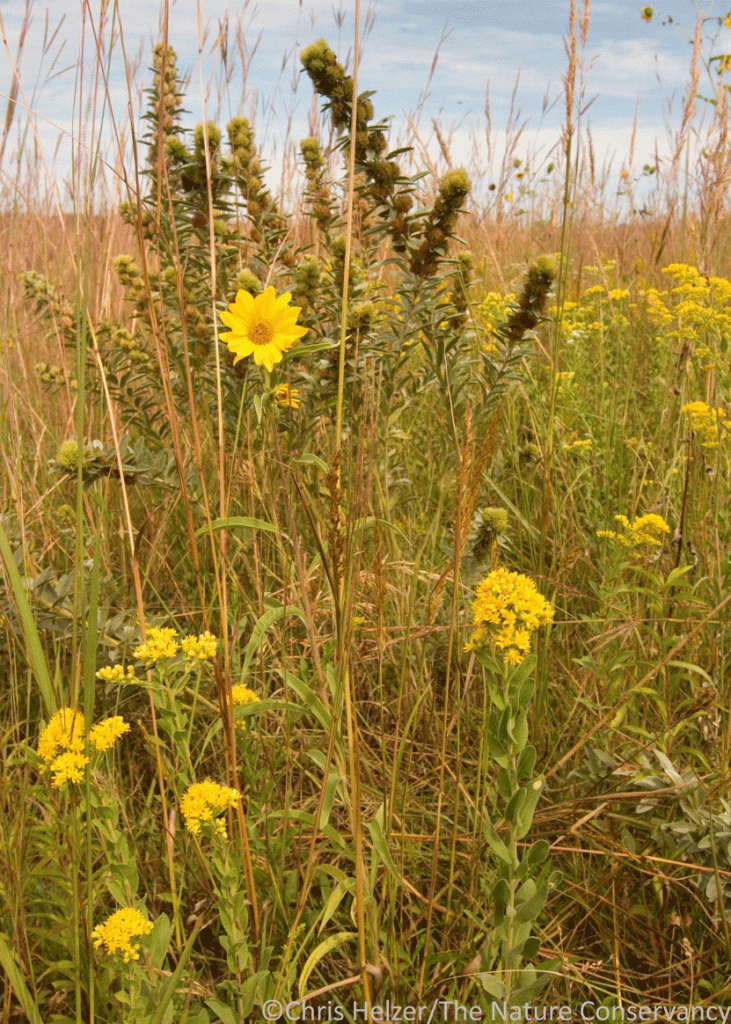
Apart from the variety, I’m most entranced by the resilience of species and communities are within grasslands. I never tire of seeing the responses of prairie species and communities to droughts, fire, and grazing. No matter what gets thrown at a site, it responds with beauty and vigor. When we had the big 2012 drought, the entire Sandhills turned yellow the next year with annual sunflowers, which filled in for other weakened plants and provided food for pollinators and loads of other animals. Watching plants get grubbed down by cattle one year and then bounce back over the next couple years is also inspiring. Similarly, it blows me away how well insects and other animals can find the resources they need each year, even though our management and other factors keep shifting the abundance and location of those resources – sometimes dramatically.
So, there you go. Hopefully, the blog as a whole provides an even better answer to your question. I try hard to share what inspires me every time I post. Thanks very much for tagging along with me.