Finally, A Practical Guide for Roadside Wildflower Viewing

If you’re a fan of wildflowers, I’m sure you’ve noticed the same thing I have – all the field guides out there have one massive flaw. They’re designed for people who are slowly ambling about in prairies and other natural areas with nothing better to do than stop and stare closely at the minute details of flowers.

Of course, there’s nothing wrong with kneeling down and staring closely at wildflowers. I mean, we should all be so lucky to have the free time and – apparently – lack of responsibility to spend our days wandering around in fields of blossoms. I’m sure at least some people who do that are perfectly nice, and probably not at all dangerous.

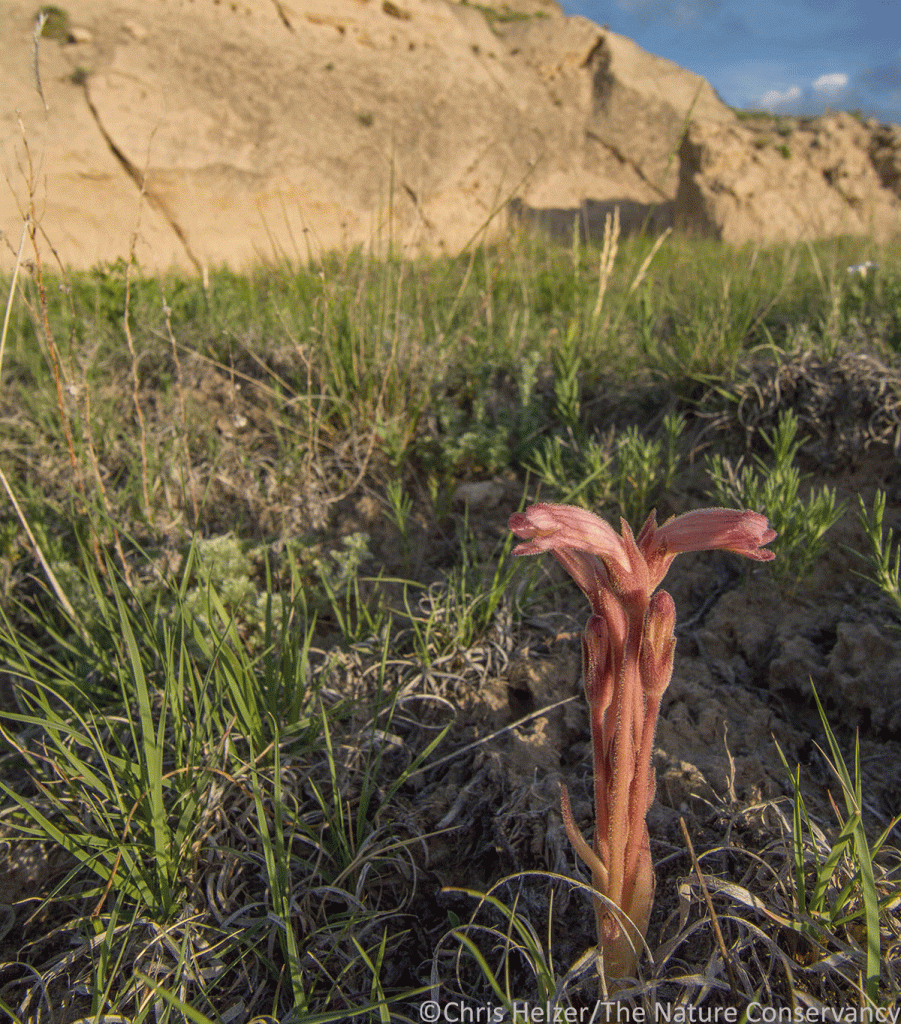
Detailed close-up photos like this one are of no use in identifying wildflowers seen from the window of a moving vehicle.

But what about the silent majority who prefer to experience wildflowers the way General Motors intended – by whizzing past them in a fast, comfortable automobile? How are nature-loving-from-a-distance drivers supposed to learn the names and habits of the wildflowers as they speed blissfully past them at 65 (85?) miles per hour?

Well, at long last, I have bravely stepped into the void to create the wildflower guide that has been missing for as long as field guides and automobiles have awkwardly co-existed on this earth. Today, I am introducing my new book, “A Field Guide to Roadside Wildflowers At Full Speed“. This free, self-published eBook is available right now at THIS LINK.

The wildflowers in the book are arranged by both color and blooming date (within color classes), just as you’ll see in other field guides. However, in this guide, the flowers appear as they actually look when you see them from the road. This much more realistic portrayal of wildflowers will prevent the frustration that comes from staring bleakly at field guide photos that bear little resemblance to what you see out your car window.

Here’s an actual photo from the Field Guide. Black-eyed Susans are a common roadside wildflower. They can often be distinguished from upright yellow coneflowers because the darker brown/black streaks are embedded within the broader yellow streaks in black-eyed Susans, whereas those dark streaks are usually above the yellow in upright yellow coneflowers.

I’m not asking for any monetary compensation for this book. It is offered as a free service to all drivers hungering for a way to learn more about wildflowers without having to stop and walk around like some kind of animal. In the event that you find this field guide useful, you can compensate me by donating toward your favorite conservation organization. There are numerous great organizations to choose from, including a very nice one that kind of rhymes with ‘Duh, may sure gun fervency’.

(Yeah? You try rhyming it!)

Another image from the field guide, showing wild bergamot, aka bee balm. Note the pale green smears amongst the pink, which are characteristic of this species. The limited width of the pink streaks also helps separate this species from similar flowers such as shell-leaf penstemon, though the two also bloom during different seasons.

The current iteration of the book includes many of the most common wildflowers seen in Nebraska and nearby states, but I hope to expand both the number of flower species and the book’s geographic relevance in future editions. In the meantime, I have attempted to apply for a copyright of this book’s concept, but I apparently called the wrong number because I all I could hear was hysterical laughter as I tried to explain my plan. I’ll keep trying. In the meantime, please don’t steal the idea.

Oh, and YOU’RE WELCOME.

Disclaimer: This book should never be used while actually driving. Always use a designated passenger to look up flowers. I mean, they’re going to be staring at their phone anyway – they might as well do something useful for you at the same time.

Photos of the Week – January 9, 2020

I woke up to the first day of a new decade at the Niobrara Valley Preserve – a pretty good spot for the occasion. As the horizon started to brighten, I wasn’t in a big hurry to hop on my ATV and head out because I wasn’t yet sure where I was going. Sandhills? Riverbank? Bluffs north of the river? Just as I decided the bluffs might be the best place to catch first light, I realized the sky had become spectacular. I snatched up my camera gear, threw on my coveralls, and ran for the ATV.

Pre-sunrise color on New Year’s morning – The Nature Conservancy’s Niobrara Valley Preserve.

I headed up the nearest tall hill, knowing there was a nice view from the top. The sky color was still great, but already fading by the time I got up high enough to see the river, so I stopped and quickly composed a couple shots. While the sky was full of color, its reflection off the snow-covered ground was muted. As the color in the eastern sky continued to fade, I happened to glance behind me and discovered the western sky’s color was intensifying. I sprinted to the other side of the hill and set the camera up to photograph the upstream view, just as that sky’s color also began to fade. Ten minutes into my morning jaunt and I was sweating, breathing hard, and feeling like I’d just missed the best of the morning’s show.

Same sky, same river, opposite direction.

As the sky returned to its dull grayish-blue color, I headed north across the river and partway up the steep slope. I took the ATV as far as it would go and then hopped off and trudged through the drifts until I found another nice view of the river. The sun was just starting to peek above the horizon, so I scrambled to find some foreground for a photo. I tried a couple different options, but was finally drawn to the dimpled snow within a yucca plant, accentuated by the shadow and light from the sunrise.

Sunrise, slopes, and yucca, with the Niobrara River in the background.

After taking a few photos of the sunrise, I decided I’d better hurry up and get the drone into the air if I was going to get any aerial shots before the sun got swallowed up by the big bank of clouds just above it. After all, one of the reasons I’d justified this quick trip north was to get some practice with the new drone. I created a makeshift launchpad with a spare sweatshirt, hoping to limit how much snow spray would get kicked up by the propellers and onto the camera lens. It worked like a charm and ‘Dallas Mavic’ lifted up into the sky.

The view of the river, shortly before the sun disappeared for a while behind a bank of clouds. (Drone photo)

I had about five minutes of flight before the light went away, so I headed toward the sun, taking still photos and a little video as I went. Still learning the capabilities of the camera, I tried shooting darker and lighter, and at various focal lengths – testing the zoom lens that had attracted me to this particular model (DJI Mavic 2 Zoom). The light was pretty glorious, so I snapped away freely until the sun finally reached the clouds and the scene became dark and dull.

Looking back to the west and judging the speed of the cloud movement, I thought I saw an open window in the cloud bank that would intersect with the sun for at least a few minutes. I grabbed my gear and headed back down to my ATV and then back across the river to the Sandhills, racing the sun and clouds. A nice relaxed morning in the prairie…

Sharp-tailed grouse sign. You can see faint wing prints where a grouse had burst out of a snow bank and then tracks winding around the same area.

As I rode out into the prairie, keeping an eye on the clouds and the glow of the hidden sun behind them, a short-eared owl ghosted out of the snow, just a few yards away from me. I stopped to watch, and it landed about 10 yards away, glared enigmatically at me for a few seconds, and then floated off and over the horizon. Feeling somehow simultaneously honored and dismissed, I kept moving, trying to find the right place to be when the sun finally reappeared. I spotted several groups of sharp-tailed grouse on the move, some flushing in front of me, others gliding along in the distance. There were tracks all over in the snow, and when the sun finally reappeared, I followed some of them around with my camera.

Wandering grouse tracks.

The window of sunlight was frustratingly small, so I split my time between glorying in the light and scenery and struggling to quickly capture it before it all went away. I had my wide-angle lens on and was wading around in deep drifts, holding the camera up as if I was trying to ford a deep river without getting it wet.

Tracks of mice, birds, deer, and bison, were everywhere. I enjoyed following their trails and trying to interpret what they were doing, but I also didn’t fail to notice they were better at snow travel than I was. The lightweight mice and birds certainly weren’t sinking into the deep drifts like I was, and the bison and deer were smart enough to stay out of those drifts altogether. Meanwhile, my coveralls were glazed white from feet to neck, and only my head and camera remained dry.

Small mammal hole and tracks in the snow on the leeward side of a big dune.

Just as the last flash of sun was winking out behind the resurgent clouds, I spotted a glimpse of red peeking out of the snow and quickly swapped out lenses. My one and only close-up photo of the day was also the last shot of the trip, and captured prairie rose hips within a small ice-rimmed window. The sky was now fully overcast, and it looked like it was going to stay that way, so after taking a pleasantly circuitous route back to the headquarters, I packed up and started the long drive home. Happy New Year indeed!

Wild rose hips peeking out of a snow drift as the light faded and skies became firmly overcast.