This post was written by recent Hubbard Fellow Chelsea Forehead, who just completed her Fellowship with us at the end of January. After hearing numerous discussions about the eastern redcedar invasion in Nebraska and many other places, Chelsea took a deep dive into the literature and talked to numerous biologists to better understand the issue. This blog post synthesizes much of what she learned – and should be helpful to others trying to deal with the cedar challenge.
One of the largest threats facing North American grasslands today is the encroachment of eastern red cedar (Juniperus virginiana). After attending numerous talks about how to combat cedar encroachment it seemed to me that there was a lack of discussion about the source of the species’ dispersal. Amid contemplation of reactive measures, I heard little about the small blue berries being dispersed. Prescribed fires at regular intervals are known to kill off younger cedars. The methods and effectiveness of chemical treatment to remove the juniper are discussed in painstaking detail in the literature. Mechanical removal with large machinery is known to be necessary for taking out larger trees. Grazing goats may help keep the already growing junipers at bay. But is there something that can be done (without the help of bulldozers, goats or burn crews) before eastern red cedar seeds germinate in prairie soils?
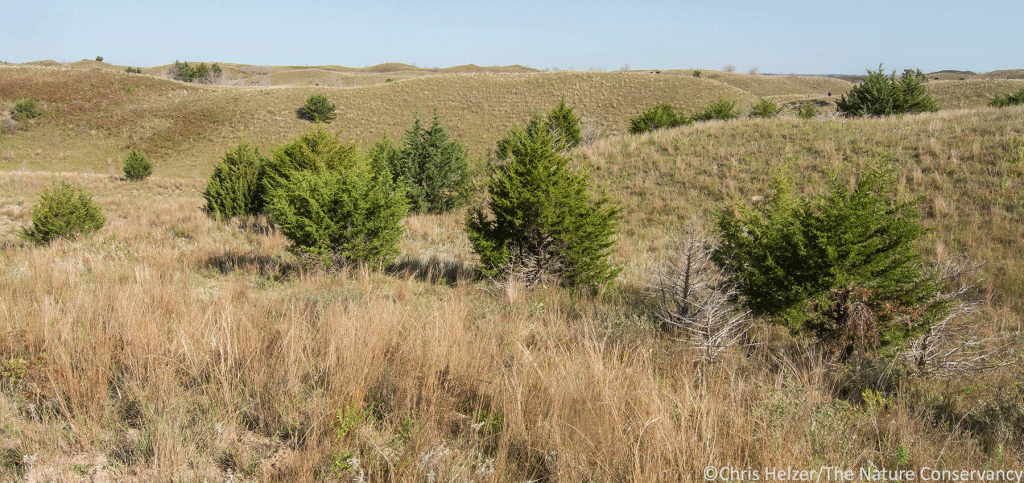
Despite the crisis it has created for grasslands, the native evergreen deserves some credit. Its bushy form has helped producers shield homes, roads, crops, and livestock from the relentless wind and snow that is part and parcel of winters on the plains. The red cedar asks for little in return; a low maintenance choice for windbreaks, it persists in soils that other tree species would turn their noses up at. The eastern red cedar has, therefore, become a trusted choice among landowners for sheltering life on the Great Plains.
There is an average of 850,000 eastern red cedar trees cultivated for distribution in Nebraska each year- more than any other state in the region. The costs and risks of the tree’s invasion are not lost on landowners, however. The conversion of grazing lands to cedar forests can take place within one lifetime, and the loss of forage for livestock can be as high as 80% after just two decades without active control efforts. If eastern red cedar remains the top choice for landowners seeking shelterbelts, and if the presence of the species on their land threatens their livelihood (without persistent control), is there a way to keep cedar windbreaks but stop their seed dispersal?
Eastern red cedar is a dioecious species. This means that it has separate male and female trees. Female trees, therefore, are the only ones bearing fruit and producing seeds. Prioritizing the removal of female trees would therefore do more to stop dispersal than removing males. If removing all cedars of substantial size seems daunting, perhaps removing only those guilty of dispersal is more manageable.
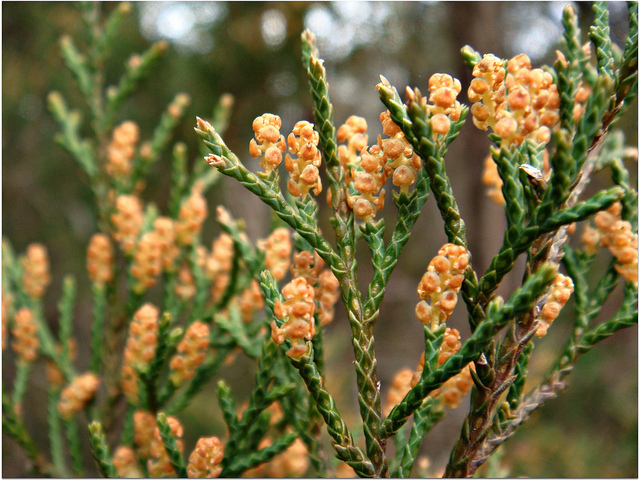
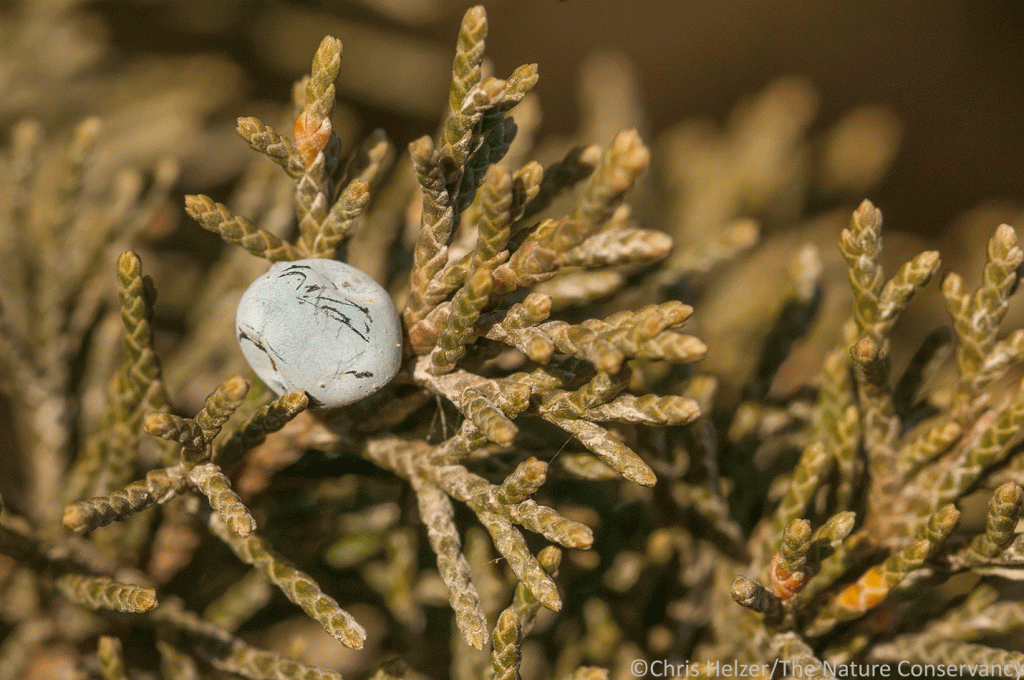
After planting a windbreak or shelterbelt it can take up to 10 years before a landowner might be able to identify whether a red cedar is male or female. With nearly a decade of growth before sexual maturation cutting down female trees could leave holes in a tree line, potentially reducing its effectiveness in sheltering home and farm. Eastern red cedars, however, are bushy enough to serve as a windbreak in single file. With thoughtful design the removal of females from a multi-row planting might result in reduced loss of windbreak effectiveness.
But how many trees might be females? The consensus is that eastern red cedar has a natural sex ratio of 1:1 male to female. Though debated, some studies have even found that ratio to be higher. Harsh conditions and the decreased ability of females to live long and prosper in them is cited as the cause for higher male proportions.
While there is no evidence of sex-change happening in eastern red cedar, the rumors that it might occur have persisted. It would, after all, be pointless to remove females if in doing so the remaining male trees began producing female cones. After braving the bowels of botanical literature, I found that while no evidence or argument exists for the ability of eastern red cedar to change sex, the true confirmation of this relies on the identification of a genetic marker for sex. If available, a test for genetic sex would likely be cost prohibitive on larger scales. Even if they were capable of changing sex, it is more costly to produce female parts than male parts. Sex changing in other species is often in response to harsh environmental conditions like shade and lack of soil nutrients. This means that while sex change in plants is not unidirectional, environmentally induced changes would likely go from female to male in stressful situations, rather than the other direction. Although plants often adapt to their surroundings in surprising ways, all current evidence points to genetically determined sex in eastern red cedars.
Cutting down trees is hard work. I can’t say that my days removing cedars from the preserve were without exertion. I can confidently say, however, that the logistics of cutting down cedars were much simpler than those of carrying out a prescribed burn. Mary and I were able to average 30 minutes per cedar with the help of one trusty chainsaw. The cost, equipment and labor of removing females from windbreaks is, by all accounts, much lower than the cost of reacting to their spread across whole pastures.

The magnitude of cedar invasion across Nebraska and surrounding states is daunting. Saving remaining grasslands from forestation will require the concerted efforts of landowners and conservation organizations alike. For those efforts to be successful, stakeholders will have to take a multi-faceted approach and consider all possible measures of combating cedar spread. Conversations about strategies to combat cedars have become focused on targeting areas where cedar invasion has just begun. Invasion begins with dispersal and dispersal begins with female trees. Removing female cedars from windbreaks would be a way for individual landowners to put some effort, a little time, and a bit of chainsaw fuel towards stopping the coming invasion.
Landowners who take out cone-bearing females will have certainly reduced the number of seeds spread from their land. When a single female can produce around 2 million seeds in a year, cutting down the right trees can magnify the effects of an individual’s efforts. What’s more, eastern red cedar seeds are only viable for around 14 months in the soil. This means a proactive sawyer won’t have to battle their victim’s dropped seeds for more than a year and some change. An all-male cedar windbreak could represent a nice compromise between the conditions of life on the plains and those who live there; a provision of protection for life on the prairie without a threat to the livelihoods earned there.