Why Telling Prairie Stories Matters

Those of us working in the field of prairie conservation face a stark reality.  Regardless of our expertise, work ethic, or number of hours spent restoring and managing prairies, our efforts will fail if we don’t have the support of the public behind us. 

Those of us who love prairies can look at a photo of a grassland like this and think about how fun it would be to explore it in person. It’s easy to forget that most of the public is ambivalent about prairies. They don’t see this as a place to explore – they see it as a place they might have to drive through to get to someplace interesting. That attitude makes prairie conservation really difficult and it’s a challenge we can’t afford to back away from.

Garnering public support for conservation is a challenge faced in all ecosystems, but grasslands (and deserts?) have some added disadvantages.  One of those is that prairies don’t have the kind of obvious aesthetic attraction to people that forests and oceans have.  A second is the fact that relatively few people live in prairie regions, reducing the amount of leverage those regions have in national and international policy discussions that affect conservation.  Finally, except where shallow rock or other geological or topographic barriers exist, many grasslands can be more profitable as cropland or other land uses, making prairie conservation arguments that much more difficult.

Because of those challenges, all of us who work in prairie conservation, regardless of our primary role, need to pull our weight in the fight for public attention and support.  We all need to make sure people remember that prairies exist, see why they matter, and – ideally – see them as places to visit and appreciate.  If we don’t, the grasslands we care so much about will not survive.

I think about this a lot.  It’s a big reason this blog exists and why I work so hard to share photos and stories about prairies through and many other formats as well.  Stories, I believe, are one of the biggest keys to success.  Not my stories, but OUR stories. 

The best stories are those that come from your individual perspective.  What are you seeing in the prairie?  What are you doing while you’re there?  Why do you care? 

The genesis of a great story can be as simple as spotting an interesting flower, butterfly, or bird.  Capturing a photo can be helpful, but it’s not necessary.  It also doesn’t matter whether the species you saw is rare or common.  The power of the story isn’t the flower, butterfly, or bird, it’s your enthusiasm about finding it.  Enthusiasm is contagious.  If you share the experience of finding it with others and your excitement comes through in that telling, it’s a good story.

If you see something that excites you, share that excitement with others! You don’t have to share the natural history of earless lizards (though you certainly can if you want to!). Just showing people that finding one was fun for you is enough.

Good stories can also include what you do in prairies.  As you tell those stories, remember that we connect with other people by identifying with how they feel.  Whether you are struggling to fight off invading trees as a prairie manager, celebrating a particularly successful restoration project, or trying to figure out how you’re going to pull off a tricky prescribed fire, share your emotions with others. They don’t have to understand the context of the situation to empathize with you.  Just give them the basics of what you’re doing and how you feel about it, and a connection will form.

Sharing what you’re seeing or doing usually leads to opportunities to talk about why you care about prairies and their conservation.  Here again, the best sales pitch is whatever is most important to you.  Why do YOU care about prairies?  What made you start caring? 

It can be tempting to lean on facts about why prairies are important for storing carbon or cleaning water.  However, telling someone why prairies are good for them might be better saved for a third or fourth conversation, rather than the first.  Think about two people, each offering you a kind of food you’ve never tried before.  One says, “You’ve got to try this – it’s super good for your blood pressure!”  The other says, “I grew up eating this every holiday season at my grandparents’ house and the amazing flavor always reminds me of family.”  Which is the more compelling pitch?

Most people have very little idea what prairies are, let alone what it takes to manage and protect them. They wonder “what the heck you do all day out there?” Tell them!

Here are some of the arguments I most often get when I encourage people who care about prairies to share their stories, along with my responses:

1. I’m not doing anything interesting enough to tell stories about.

As I said above, it’s not what you’re doing that will engage people, it’s how you feel about it.  Plus, you’d be surprised how interested people can be to hear about you doing things they’ve never heard about.  Sometimes, for example, just bringing up the idea that you cut down trees to help nature can be enough to start a long and productive conversation!

2. I’m not a good writer/photographer.

Doesn’t matter.  Have you seen Facebook or Instagram lately?  Most people who put up photos on those sites aren’t terrific photographers, but they are showing something that matters to them personally, and most (?) have followers that are interested to see those photos because of that.  Similarly, good writing can be hard, but most people are going to pay much more attention to what you’re saying than how you word it.  That’s especially true if you’re writing with enthusiasm.  Try to write like you speak, rather than trying to use fancy words or emulate the way other writers do it.  Be yourself.

3. I don’t like to speak in public.

I get that.  For most people, it’s something that gets easier the more you do it, but if you don’t want to be a public speaker, no problem – there are many other options.  Social media is a great way for people to express opinions without having to physically stand in front of their audience.  While that can enable online bullies and jerks, it can also be a great way for you to share emotions in a way you might not in other situations.  If you have an artistic bent, maybe you can use your favorite medium to get people to think about prairies?  There are lots of ways to tell stories.

In any case, what’s the worst case scenario?  Even a mediocre story gets people to think about prairies for a minute.  Just getting prairies into someone’s consciousness for a brief period is helpful.  Plus, again, if you show how much you care, some of that will rub off, regardless of what you think the quality of your story or storytelling is. 

Enthusiasm is contagious. Even if they think you’re a little crazy, people will be drawn to your stories if you share your emotions. (That said, be careful with fire, everyone.)

Trust me, I understand the energy it can take to start a conversation.  For the most part, I’d much rather spend the day alone in a prairie than in a crowd of people – or, really, in any social situation.  I’m not asking you to walk up to random people on the street and tell them the good news about prairies.  I’m just suggesting that whenever you get the opportunity to tell others about what you care about, you should take it.  Whether it’s through social media, talking with friends at a bar, or standing in front of a local Rotary Club, tell your stories!  Prairies are depending upon you to remind people that they exist and are worth saving .

Part of good storytelling is keeping the story a reasonable length.  I have a lot more to say on this topic, especially about getting people out to prairies and making sure they enjoy the experience. I’ll hold that for another time.

Photos of the Week – December 13, 2019

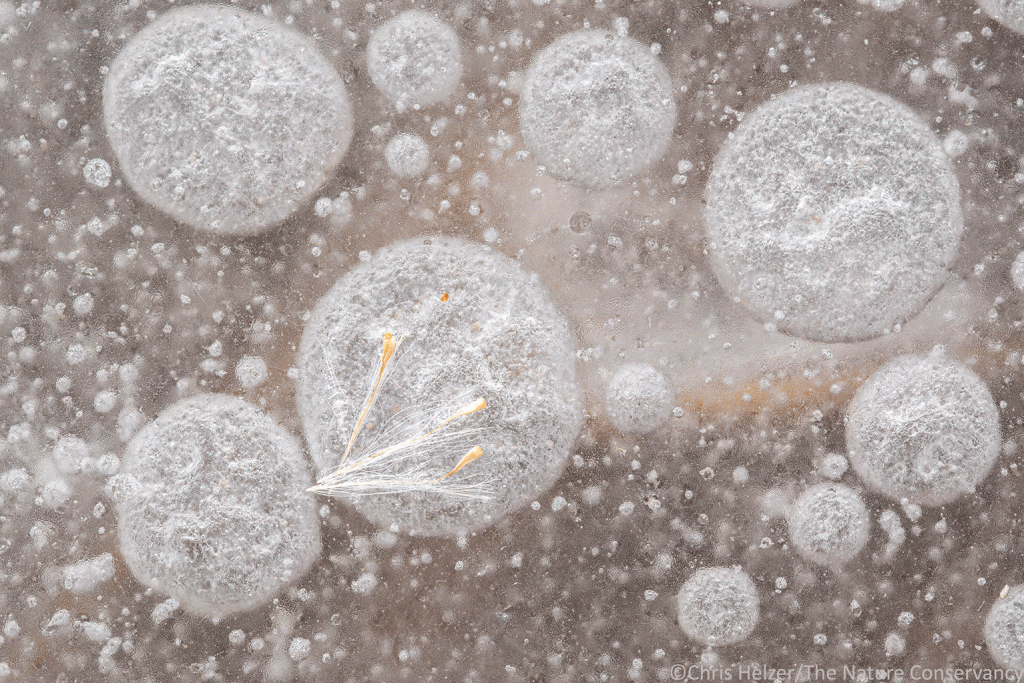
Recent temperature swings, including many freezes and thaws, have created some interesting patterns on the frozen surfaces of wetlands and ponds. Early this week, I took advantage of the latest cold temperatures to wander out on the pond/wetland at our family prairie. There was only minor cracking beneath my feet as I carefully stepped and slid across the (mostly) frozen surface. I stayed near the edges where I knew the water below me was only a foot or so deep and tried to distribute my weight as evenly as I could. That’s all completely normal behavior, right?

As a call-back to my previous post about ‘shooting into the sun’… You can see the kind of interesting patterns that lured me out onto the ice.
There was a thin film of dust across much of the ice, probably blown in by 40-50 mph winds last week.
A helpful Instagram follower alerted me that this is called ‘pancake ice’. These dinner-plate-sized formations were aligned along a line of transition between deeper and shallower water. I assume they were formed by wind pushing slush around along the boundary between the deeper open water (at the time) and shallower frozen portion of the wetland.

I spent about an hour on that ice, much of it waiting for the brief periods when the sun popped out from behind the thin clouds moving across the southern sky. I only stepped through the ice once, and that was when I decided to confirm my suspicion that the ice along the northern shore was probably thinner because of its increased exposure to the sun. Hooray for science… My waterproof boots were more than sufficient to keep me dry.

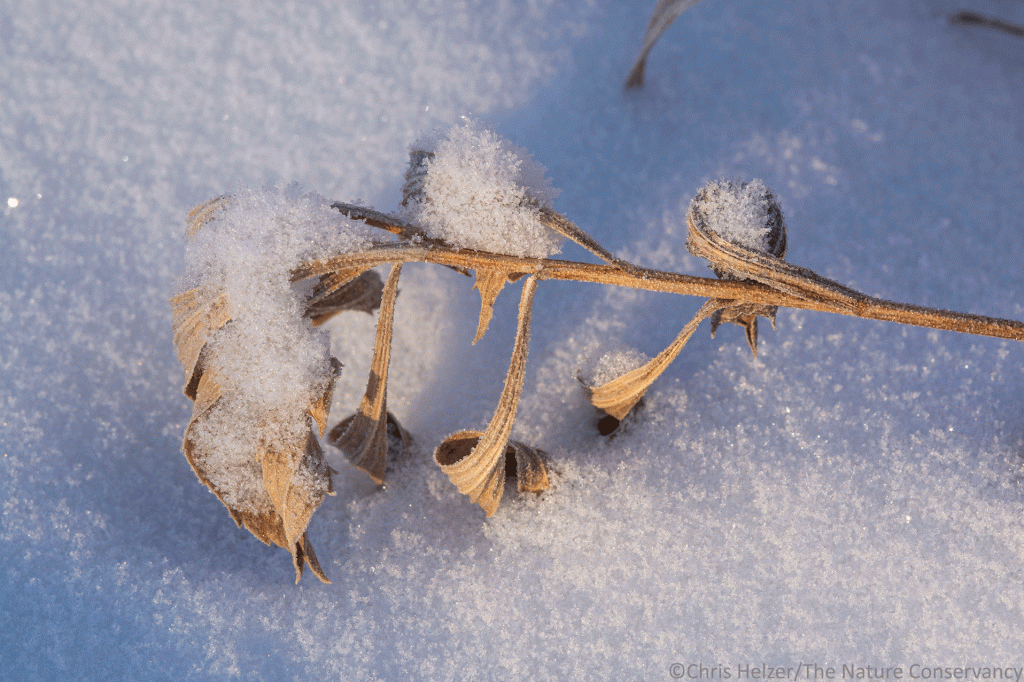
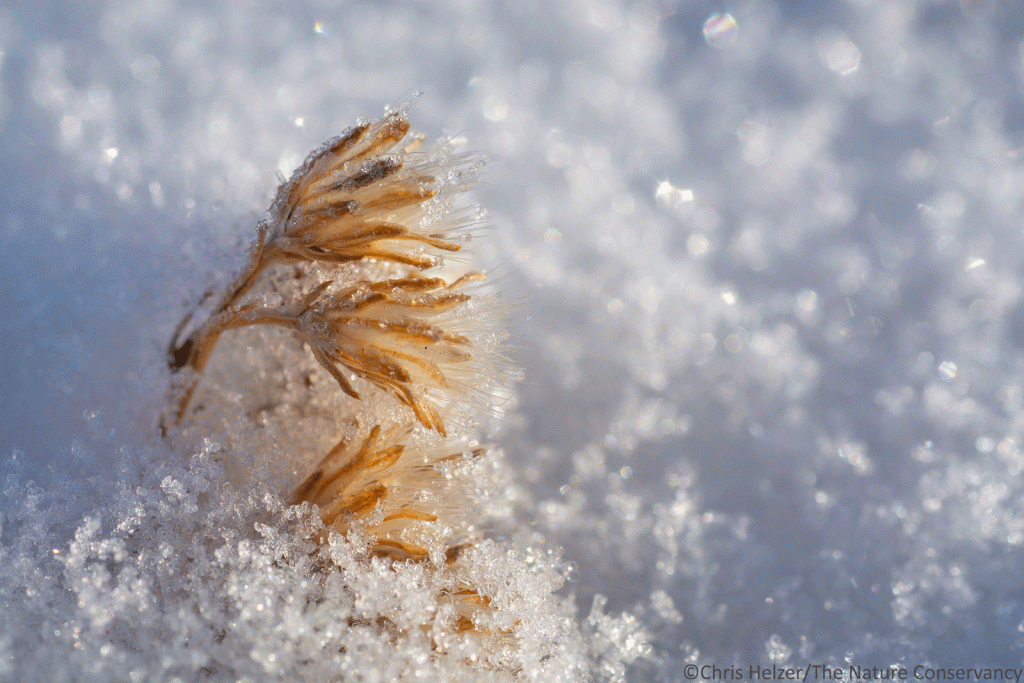
Below are some more photos from my morning jaunt.