
I’ve been asked a number of times why I advocate for cattle grazing in prairies when cattle are such strong contributors to greenhouse gas emissions and rapid climate change. It’s a fair question, but also a complicated one. I don’t have a definitive answer, but I can share some of what makes it a thought-provoking subject. Rather than providing a lot of specific research citations, I’m aiming instead to provide some general information that highlights the complexity of the topic. Feel free to contribute additional information and perspectives in the comments section below (as long as you keep it constructive and polite).
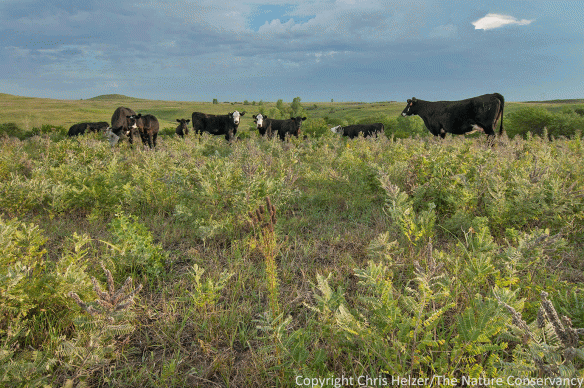
Cattle graze among leadplant and prairie clover at Konza Prairie in the Kansas Flint Hills. What are the ramifications of cattle grazing for greenhouse gas emissions and other contributing factors to climate change?
Cattle: The Downsides
First, here are some reasons people are concerned about the impact of cattle on climate change. According to the EPA, agriculture is responsible for about 9% of the U.S. greenhouse gas emissions, and beef production makes the largest contribution to that category. Most of the impact comes not from carbon emissions, but from methane and nitrous oxide, both of which influence climate change more strongly (pound for pound) than does carbon. “Enteric methane” (cow burps) is a big part of that equation, but so is manure, urine, and application of fertilizers to pastures. These emissions are bad enough, but there are other negative impacts from beef production as well, including emissions from growing corn and other feed for cattle, emissions from manure in feedlots, water consumption by cattle and feed production, and pollution from sedimentation and nutrient runoff of pastureland. Reading a list of bad stuff like this, it’s easy to see how people might wonder why I keep talking about grazing like it’s a good thing.
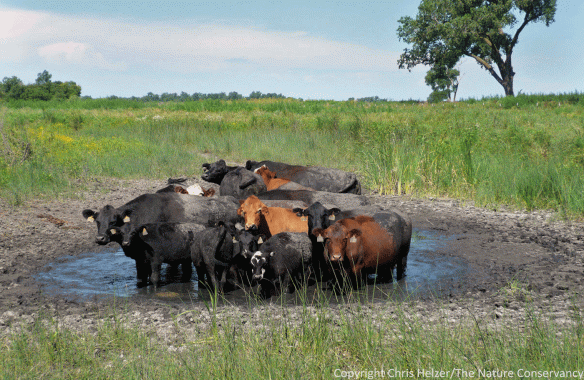
Cattle are sometimes their own worst enemy in terms of advocating for their own existence. I mean, come on, man! This is just not a good look.
Predecessors to Cattle
As I provide some counterpoints, I’m going to do so from the perspective of the central Great Plains – the area of the world I’m most familiar with. Outside the Great Plains, the situation varies greatly; there are places in the world where grazing may not be compatible with local ecosystems, for example, and where forest or other land cover types are being converted to pasture. Here in my part of the country, however, we are in the heart of the historic bison range. Before Europeans entered the picture in the Great Plains, prairies here were being grazed by bison, elk, pronghorn, and other large animals. There are many arguments about the size of those historic bison populations, fluctuations in herd size and geographic range over time, and when/where bison impacts were important for prairie ecology. For the purposes of this discussion, the important point is that cattle (and their emissions) weren’t introduced into a landscape with no history of methane emissions. Bison were here prior to cattle, and they burped too.
The most cited article I’ve seen on the issue of methane emissions from historic bison populations is by Francis Kelliher and Harry Clark. They use a fairly standard estimate of 30 million bison across the Great Plains prior to European contact. Based on their calculations, the methane (CH4) emissions from those bison (2.2 Tg CH4 year-1) are not hugely different from those of today’s 36.5 million cattle across the same geography (2.5 Tg CH4 year-1). The exact numbers are less important than this basic idea: the prairie ecosystem was contributing large amounts of methane to the atmosphere before humans brought cattle to the Plains.
Of course, feedlots, fertilization, and forage production, along with all the greenhouse gas emissions and other concerns associated with them, were not part of the historic bison landscape. We definitely have an obligation to examine those aspects of cattle production and do what we can to limit their negative impacts. In addition, the fact that cattle on native rangeland are producing emissions similar to their bison predecessors doesn’t release us from the responsibility of trying to reduce those emissions where possible. I’m hopeful that research over the next decade or so will provide us with more guidance on how we might do that.
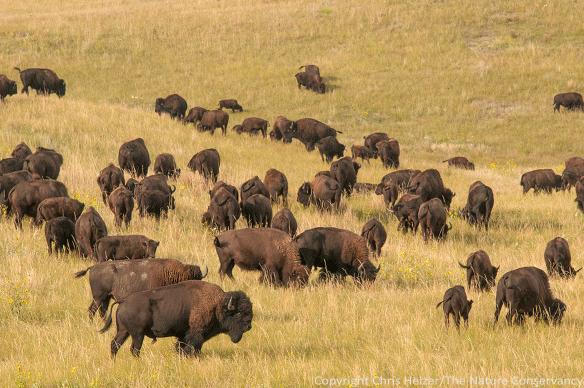
Before there were cattle, bison roamed (and burped) across the Plains.
Get Rid of Cattle?
What if we just stopped grazing cattle on the Great Plains? Well, since the vast majority of the Great Plains is privately owned, grassland still exists primarily because it produces income. Without cattle production, much of that grassland would likely be converted to row crop agriculture – a scenario that would probably be worse for climate change and would certainly spell disaster for prairie ecosystems. Some have argued that a majority of the Great Plains should be turned into public land that would support both wildlife and tourism. There are way too many economic and social issues associated with that for me to deal with here, but from a climate change emissions standpoint, I’m not sure it would solve the problem. Either cattle would be replaced by bison again (see previous paragraph) or, if bison were not reintroduced, prairies would suffer from the loss of grazing, a major component of ecosystem function (see next paragraphs).
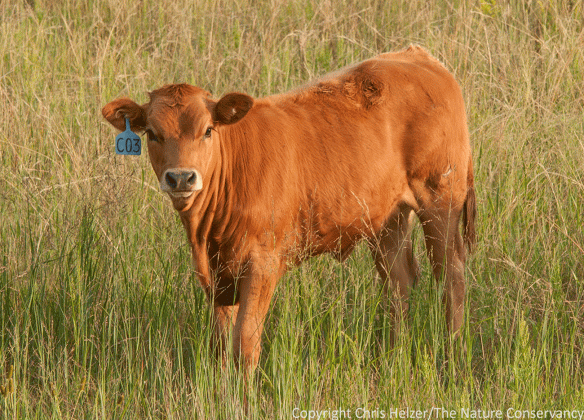
Simply getting rid of cattle altogether is probably not a great strategy for conservation. Besides, how could you get rid of something this cute?
Grazing as a Positive Force
Despite the fact that chronic overgrazing can cause degradation of prairies (loss of plant species and habitat, soil erosion, etc.), grasslands and large grazers evolved together and grazing is still an essential component of grassland ecosystems. This is especially true in North America’s Great Plains where there are still grasslands large enough to support wide-ranging wildlife species such as grouse and pronghorn. Grazing, along with fire and drought, is one of the three major forces that affects prairies and prairie species. For example, large herbivore grazing helps keep grasses from being so competitive that they overwhelm and reduce the diversity of plant communities, something that leads to a cascade of negative and interconnected impacts on pollinators, productivity, wildlife/insect communities, and more. In addition, grazing alters vegetation structure, creating a wide range of habitat conditions. Ungrazed prairie provides fairly uniform vegetation structure, even if it is hayed or burned. Grazed prairie (under the right management) is heterogeneous, with patches of tall/dense vegetation, patches of short/sparse vegetation, and many other habitat types in-between – allowing the widest possible spectrum of prairie wildlife and insect species to thrive.
Maintaining plant and animal diversity, ecosystem function, and ecological resilience within the historic range of American bison would be very difficult without some kind of large ruminant, and in the face of climate change, we need our grasslands to be as resilient as possible. Resilient grasslands will better adapt and maintain their ecological functions as climate changes, and that means they’ll continue to pull carbon from the atmosphere and store it belowground – an incredibly important part of our global climate change strategy. While the impact of grazing on carbon storage of grasslands is, in itself, a complex topic, the general scientific consensus seems to be that a moderate level of grazing facilitates more carbon storage than no grazing (and more than chronic overgrazing).
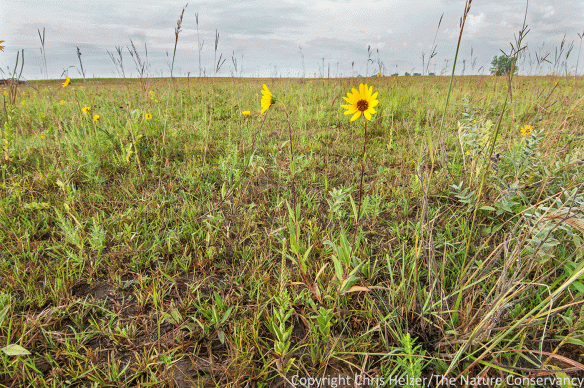
Strategic cattle grazing can create a variety of wildlife habitat structure types and help sustain plant diversity and ecological diversity. It can also help maximize carbon storage in grasslands.
The Upshot
In the Great Plains of North America, grazing is an essential part of grassland ecosystems – a component that maintains the ecological health and resilience of prairies. Cattle have mostly replaced bison as the large ruminant on stage at the moment, but they are filling many of the same basic roles – regulating plant competition and creating wildlife habitat, and also pooping, peeing, and burping. We absolutely need to find ways to minimize the impacts of today’s grazing on climate change. Livestock confinement operations, pasture fertilization, forage production, and other related practices provide opportunities for continued improvement. In addition, some rangeland grazing practices, such as chronic overgrazing, are known to be detrimental, and not just from a climate change standpoint, so that’s an obvious place to focus. Beyond that, we need to figure out how best to limit methane and nitrous oxide emissions and increase carbon storage on rangeland. That will likely mean changing techniques for managing cattle in pastures, but also dealing with issues related to pasture fertilization, forage production, forage and animal transportation, feeding operations, and more.
The topic of cattle grazing and climate change is incredibly complex. There is much more involved than I could possibly cover here, and what I did include is plenty complicated. I don’t pretend to fully understand all the facets of the issue, but for now, I feel comfortable in my stance that cattle (and/or bison) grazing can be compatible with responsible conservation of our prairies here in the Great Plains.
More Information and Acknowledgements
Several scientists from The Nature Conservancy wrote a really helpful piece on the beef supply-chain and its impacts on water, wildlife, and climate. You can see a summary and get access to the full report here.
Special thanks to Jon Fisher and Joe Fargione, who both helped me refine and improve this post. Any remaining errors are my fault, not theirs.


