Photo of the Week – September 1, 2016

Two weeks ago, I posted about Yellow Season in prairies.  That annual phenomenon continues, and at our family prairie this week, stiff goldenrod was front and center.  Pollinators and pollen-eating insects seemed to approve.
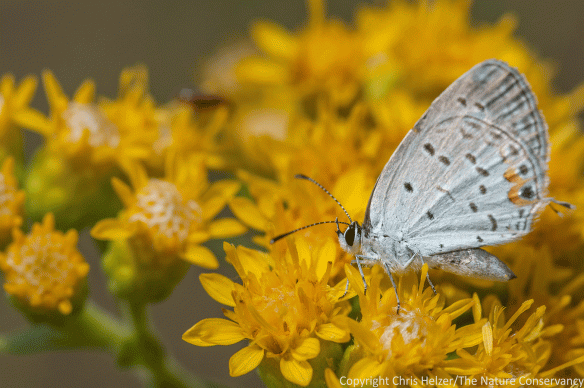
Eastern-tailed blue

Eastern-tailed blue butterflies were abundant on stiff goldenrod flowers.  They were tricky to photograph, however, because at the slightest hint of danger, they flew from the flower and onto a nearby grass leaf where they sat facing directly away from the sun.  I’m not sure if that was always a risk aversion tactic (hard to see them in the shadows when their wings weren’t catching sunlight) or also a heat management tactic (turning their giant solar panel wings away from the sun to cool off).
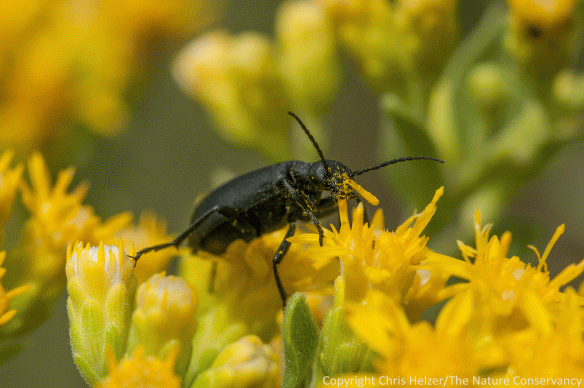
Blister beetles were enjoying meals of goldenrod pollen, but it's not clear whether they were actually pollinating flowers.

Blister beetles were enjoying meals of goldenrod pollen, but it’s not clear whether they were actually pollinating flowers.  Some beetles eat parts of the flowers themselves, not just the pollen.  I couldn’t tell if blister beetles were doing that or not.

Cucumber beetles

Cucumber beetles (here) and soldier beetles (not shown) were also all over the place.  Not much pollen sticks to these smooth beetles, so they probably don’t carry much from flower to flower.
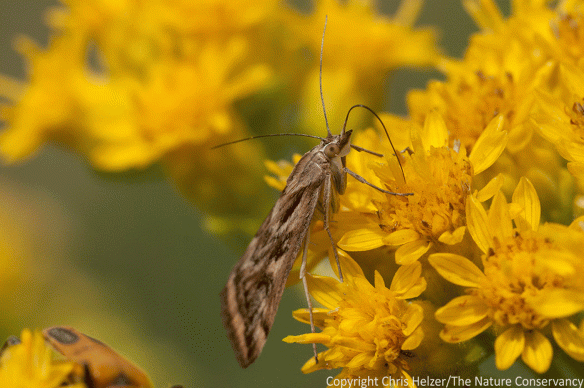
Moths of various species were numerous, but wary, quick, and thus difficult to photograph.

Moths of various species were numerous, but wary, quick, and thus difficult to photograph.  This is the only one I caught.  (You can also see a bit of a soldier beetle in the lower left corner of the image.)

Gray hairstreaks were even more abundant than eastern-tailed blues this week.

Gray hairstreaks were even more abundant than eastern-tailed blues this week.  They also held still better, which was nice.  You can see the long tongue at work on this one.

Bee flies have a rigid

Bee flies are part of a family of flies called Bombyliidae, and and many have a long rigid proboscis and feed on pollen and nectar.  Unlike a butterfly tongue, the fly’s proboscis doesn’t retract, so it just sticks straight out as the bee fly zips around.  The best nickname I’ve heard for these creatures is “beewhal” (get it?  it’s like “narwhal” but for a bee) which is just tremendous.
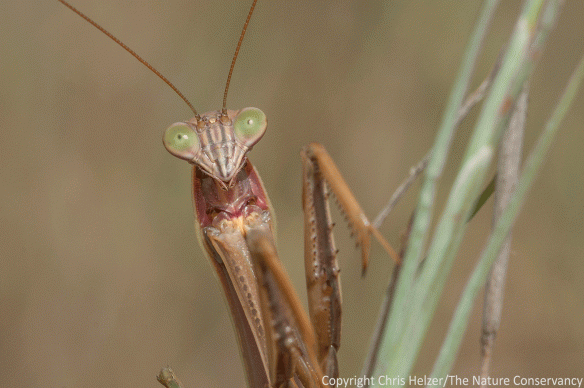
Often, when I post lots of pollinator pictures from a prairie walk, I also include a photo of a crab spider laying in wait. This week I couldn't find a single one! However, there was this big Chinese mantid, which will have to do.

Often, when I post lots of pollinator pictures from a prairie walk, I also include a photo of a crab spider laying in wait for an unwary insect. This week I couldn’t find a single one! However, this big Chinese mantid was lurking about amongst the goldenrod plants, so that will have to do.

That Predator Just Killed My Predator!

I spent last week in the Nebraska Sandhills, possibly the greatest grassland in the world.  Last week’s trip was one of several I’ve gotten to make around that landscape this summer.  It’s been great to see a much wider swath of the Sandhills than I have in previous years, and my appreciation for the area has grown even stronger than before.

The big sand tiger beetle (Cicindela formosa) has been eluding me this summer, but I finally get a good set of photos of one eating a recently captured ant.

The big sand tiger beetle (Cicindela formosa) has been eluding me most of this summer, but I finally got a good set of photos of one eating an ant.  Clicking on this and other photos from this post will give you a larger and more clear image to look at.  It’s worth it.

In a previous post, I wrote about the importance of Sandhills blowouts as habitat for species that thrive in bare sand.  I’ve been trying to document and photograph as many of those creatures as I can this summer.  Some of the most difficult to photograph have been tiger beetles.  These incredible predators run very quickly along the sand in search of small insect prey, but can also fly easily when they see me or other scary things approaching.  It’s been fun to chase them around, but the vast majority of attempts to photograph them end in them flying away just before I’m close enough.

One of the species I’ve been unable to photograph so far is a beautiful metallic blue tiger beetle called the sandy tiger beetle, aka Cicindela limbata.  You can read more about this critter in a great blog post by Ted MacRae.  I had seen and admired the beetle, but was running out of time to photograph it before my trip ended.  Finally, I spotted it again, and started stalking it.  (I should mention that I was doing this while 7 other people were watching and waiting for me, semi-patiently, so we could move to another location.)

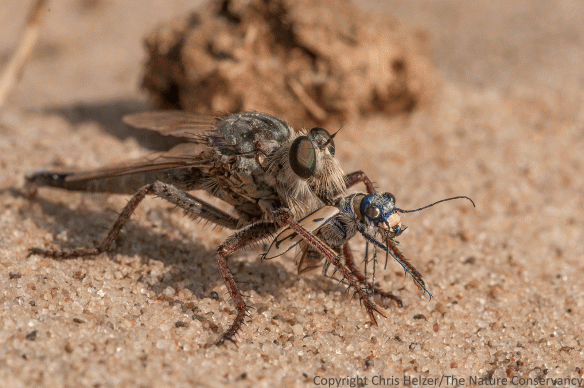
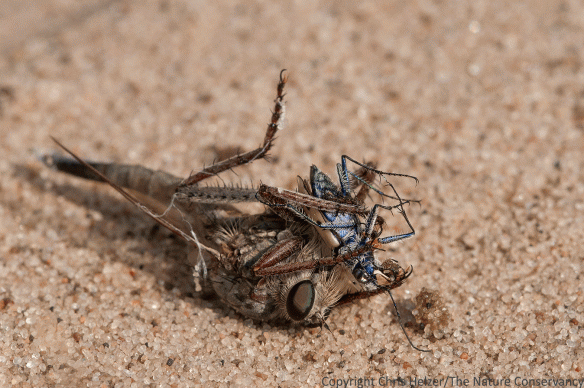
I edged close to the beetle, but (as usual) just as I got almost within photo range, it took off and flew about 15 feet away.  I let out a small sigh and starting creeping toward its new location.  This time, it took off when I was still five feet away.  However, just as the tiger beetle left the earth, a big gray robber fly streaked up from the ground nearby and knocked the beetle right out of the air.  It was like a ground-to-air missile attack, but much faster.  The two tumbled back to the sand together, the tiger beetle firmly in the clutches of the robber fly.

The robber fly and tiger beetle landed upside down right after the initial attack.

The robber fly and tiger beetle landed upside down after the initial attack.  For scale, the tiger beetle is about 1/2 inch long.

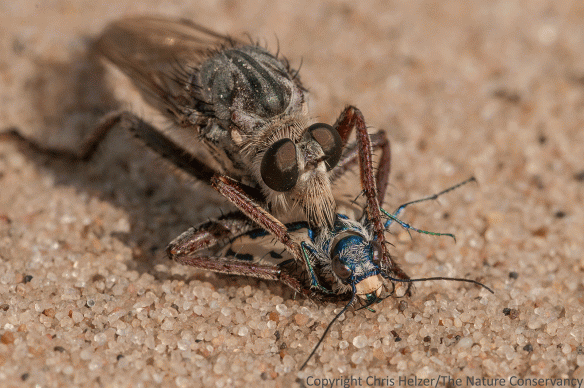
As I watched, the robber fly got back to its feet and struggled to keep a hold on the beetle.  Though I couldn’t see it happening, I knew the fly was also injecting the beetle with toxic saliva to immobilize it.  Eventually, the saliva would also liquefy the innards of the beetle so fly could consume the resulting beetle soup.

Upright again, the robber fly tried to hang on to the beetle while injecting it with toxic saliva.

Upright again, the robber fly tried to hang on to the beetle while injecting it with toxic saliva.

The robber fly had to periodically readjust its grip as the tiger beetle struggled to escape.

The robber fly had to periodically readjust its grip as the tiger beetle struggled to escape.

Within a few minutes, the beetle seemed to stop moving.  Having taken approximately 10,000 photos of the scene (from the perspective of my waiting colleagues), I grudgingly got up off the sand and backed slowly away to move on to our next site.  I still don’t have a stand alone photo of C. limbata, but I’ll get one someday.  In the meantime, I feel like I had a front row seat for a miniature version of the kind of predator/prey attack usually seen in nature documentaries from the Serengeti.  I can live with that.  As I’ve said numerous times before, I’ve got a pretty good job…

A final look at these two magnificent predators.

A final look at these two magnificent and beautiful predators.