I often tell people, “I’m not an insect expert, I’m an insect enthusiast.” I don’t spend nearly enough time immersed in the vagaries of invertebrate taxonomy and biology to know much more than some interesting trivia about most species. This week provided a couple great examples of my lack of expertise.
Early in the week, I was at the Niobrara Valley Preserve. While walking one morning, I noticed a longhorn beetle on a white prairie clover flower. I felt pretty good about recognizing it as a longhorn beetle, and was even able to remember part of the genus (“Typo something, I think”). I also noticed a small weevil on the same flower. “Cool!”

Longhorn beetle (Typocerus confluens or Typocerus octonotatus) and a weevil on white prairie clover (Dalea candida) at The Nature Conservancy’s Niobrara Valley Preserve.
A few steps away, I saw another white prairie clover flower, and sure enough, there was a longhorn beetle on that one too. And another weevil. This second longhorn beetle had a different pattern on its back from the first one, so I assumed it was a second species. “Nice,” I thought, there’s a good example of insect diversity – two different beetle species feeding on the same flower.

Another longhorn beetle on another white prairie clover flower.
A few steps away from that second flower was a third one, and it had a longhorn beetle on it as well. The third beetle looked different than both the first and the second ones. (Oh, and there was a weevil on the third flower too.)

A third longhorn beetle.
As I walked away from the white prairie clover patch, I started composing a blog post in my head about insect diversity. Something about how important it is to have lots of different species within each group of animals so that if one species suffers from a disease or some other malady, there are others that can cover the role it plays in the natural world. Blah blah blah.
When I got back to WiFi, I emailed my longhorn beetle photos to Ted MacRae (an ACTUAL insect expert) who is generous enough to help me with identification of beetle photos. (Check out his fantastic blog here.) I asked him what species these three beetles were so I could name them in my upcoming blog post. When I got his reply, my blog post idea went out the window. They weren’t three different species at all – they were all the same one! (By the way, Ted couldn’t tell for sure from my photos which of two possible species they were. He said he’d need to see the “last ventral abdominal segment” of each to be sure.)
Now, how is an insect enthusiast supposed to keep up when three beetles of the same species don’t even have the common courtesy to look like each other?? I’m ok with the occasional oddball. With flowers, for example, it’s not uncommon to see one white flower out of a big patch of purple spiderwort or vervain flowers. Fine. Genetics provides a few quirks now and then. But I only saw three longhorn beetles, and none of them had the same color pattern on their back?? I give up.
Oh, and the weevils? Don’t even ask. I don’t know. They all look the same to my eye, but what does that mean? They’re probably three different species that just happen to be feeding on the same flower. That would be about right. Geesh.
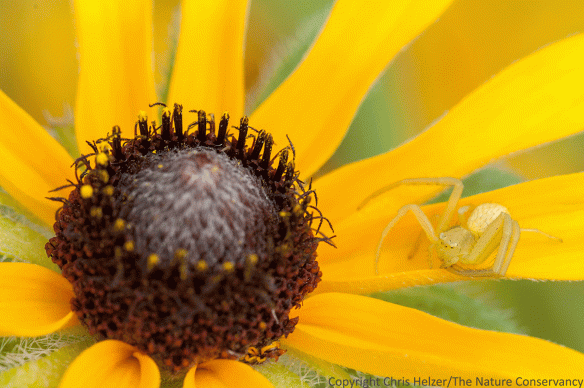
So then yesterday, I was in our Platte River Prairies and noticed a crab spider on a black-eyed Susan flower. It was a pretty spider (you have to admit that) so I stopped and photographed it.

Crab spider on black-eyed Susan flower. The Nature Conservancy’s Platte River Prairies.
After I photographed the spider, I gave the other flowers nearby a quick look, and sure enough – there were crab spiders on several of those too. Now, here’s the thing: the other crab spiders might have been different species, or they might not. I’m not even going to guess. They had different patterns on their abdomens but were generally the same color. The first one was much broader, but that’s likely because she’s a female, and that’s how it works with spiders. The other two might be different species or they could be from different growth stages and the patterns might be different for that reason. Or, apparently, THEY COULD JUST LOOK DIFFERENT FROM EACH OTHER FOR NO PARTICULAR REASON OTHER THAN TO BE CONFUSING.
Another crab spider.

One more crab spider
I could email photos of the crab spiders to a friend who occasionally identifies them for me, but I’m not going to. I’m choosing instead to simply admire the aesthetics of these fascinating little creatures, and appreciate some general trivia about crab spiders (for example, their front two sets of legs are extra long for capturing ambushed prey, and some species of crab spiders can change color to match the flower they sit on). After all, I’m an insect enthusiast, not an insect expert (or a spider expert). So there.


 The Prairie Ecologist