A couple weeks ago, I led a discussion between 30 or 40 ecologists and grassland managers from The Nature Conservancy’s Central United States Division. During that discussion, we reached a consensus that creating a “shifting mosaic of habitats” was a universally effective method for managing prairies. I had introduced the topic with the expectation that we’d have a fairly vigorous discussion about why the shifting mosaic concept works well in some situations but not others, but, surprisingly, the only caveat to our consensus was that it can be difficult to apply in small prairies.
So, what is a shifting mosaic of habitats and how is it employed in prairies? That, friends, is the topic of this episode of the Prairie Word of the Day.
To create a mosaic, an artist arranges many little tiles, stones, or other materials to form a pattern. Each individual tile or stone of the mosaic is important, but mainly because of its contribution to the whole. Looking at an aerial photo or satellite image of a landscape is much like looking at a mosaic – you can see patterns created by woodland, grassland, water, cities and other land cover types. Even when a landscape is almost entirely grassland, there are still patterns – with “tiles” defined by the outlines of land ownership parcels and management units, and characterized by the height, composition, and density of the vegetation within each.

In this Google Maps image of a portion of our Platte River Prairies, you can see “tiles” consisting of different management units – some more obvious than others.
Usually, we think of mosaics as being static. Once they’re created, the artist doesn’t typically go back and rearrange the tiles to make new patterns. A prairie mosaic, however, is not static because active management with fire, grazing, and/or mowing is an important part of maintaining the health of the prairie community. Each time a patch prairie is burned, grazed, or mowed, the prairie vegetation is knocked down and has to grow back. When those treatments are applied sporadically across multiple management units, a shifting mosaic of habitat conditions is created. The tiles of that mosaic include patches of recently burned or grazed vegetation, as well as other patches that are in various stages of regrowth and recovery from their most recent management treatment. As patches recover, they are treated again, and the pattern continues to shift around the landscape.

This is what most of us tend to visualize when we think of “prairie”, but this tall and relatively dense vegetation structure favors some plant and animal species but not others. If this prairie looked like this every year, it would limit the diversity of species it supported.
This shifting mosaic of habitats has important implications for both plant and animal species. Every plant species has its own unique set of preferred growing conditions. For example, there are plants that grow and bloom early in the growing season and others that are active late in the season. Fire or haying during the early part of the season can favor late season species, and vice versa. Some plants don’t compete well with dominant grasses or other plants, and so thrive only when the vigor of those competing plants is suppressed. A shifting mosaic approach means that all plant species in a particular patch of prairie will likely get their preferred growing conditions now and then – helping to ensure their long-term survival.

Upright prairie coneflower (Ratibida columnifera) is a species that likes fairly low competition and thrives best right after fire or grazing treatments.
Like plants, prairie animal species each have their own unique habitat requirements for survival too. Some animals need tall dense vegetation where they can feed and hide under protective cover. Others need more open habitats where they can move around without having to fight their way through a tangle of stems and leaves. Many animals need multiple habitat conditions depending upon their life stage or activity. For example, prairie chickens, pheasants and quail may nest in relatively dense vegetation but then move their young chicks into areas where they can walk and feed easily but have overhead cover from predators. Other animals may spend the winter nestled in the grass litter beneath tall grasses but then seek out areas of shorter or patchier vegetation for the summer. A shifting mosaic of habitats allows animals to move around the landscape and find their preferred habitat when they need it. Alternatively, less mobile animals might temporarily thrive in some years but suffer population declines in others as conditions change from favorable to unfavorable. As long as those unfavorable conditions don’t last too long, however, those populations can ride them out until good times come again.
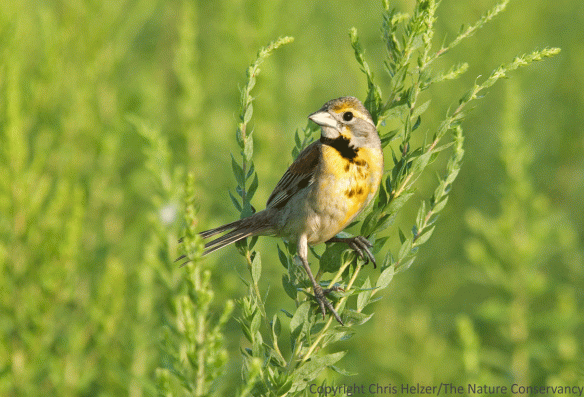
Dickcissels usually like tall vegetation with lots of wildflowers. They are not commonly found in prairie patches undergoing an intensive grazing treatment, but are often abundant during the year or two of recovery from that kind of grazing.
Creating a patchwork of habitats that are the same each year (Patch A is always burned, Patch B is never burned, Patch C is hayed every summer, etc.) can provide important heterogeneity on the landscape but also comes with some big disadvantages. Repetitive management, in which one patch of prairie is hayed or burned every year at the same time, can favor some plant species over others. The losers in that system may eventually disappear from the site. Losing those species and reducing overall plant diversity can impact pollinators, food sources for insects and wildlife, and even increase vulnerability of the prairie to invasive plant species. Second, repetitive management of a habitat patch can allow a buildup of predators and pathogens (disease-causing organisms) which adapt to the constant supply of prey/hosts. An overpopulation of either can seriously disrupt populations of species that might otherwise benefit from the provided habitat. Farmers and gardeners have long recognized the value of rotating crops to avoid buildups of pests and diseases, and prairie managers should learn from their experience.
Ideally, a shifting mosaic of prairie habitats should incorporate the entire spectrum of vegetation structure types, including uniformly short/sparse and tall/dense habitats at the extremes, but also habitats of various heights, densities, and degrees of patchiness in between. Varying the timing of burning and mowing treatments from year to year and patch to patch increase that range of habitat diversity. Grazing can also be valuable, where logistically feasible, because of the selectivity of grazers. Cattle and bison prefer to eat some plants over others, and those preferences change by season. By altering the timing of grazing and the stocking rate of animals, managers can create a wide variety of habitat structure types and influence which plant species are grazed and which are not. Regardless of what management treatments are applied, the key is to have a variety of recently-treated, recovering, and recovered patches across a prairie.

Cattle grazing can create short vegetation structure, but because cattle are selective eaters, they don’t eat everything (if they’re not forced to). By altering stocking rate, timing, and intensity, prairie managers can influence how many and which plants are grazed and ungrazed – creating many kinds of habitat structure.
Patch-burn grazing is a great example of how to create a shifting mosaic of habitats, and it is a concept we’ve found valuable at our Platte River Prairies and at the Niobrara Valley Preserve. However, there are many other ways to create similar shifting mosaics, including the approach I take at our family prairie. Small prairies (less than 30-50 acres?) come with many challenges, and implementing a shifting mosaic is just one of them. On most prairies, however, the shifting mosaic approach seems to be an excellent way to maintain habitat and species diversity, both of which are critical to the resilience and function of prairie communities.
 The Prairie Ecologist