Hubbard Fellowship Blog – The Vanishing Sparrow

This post was written by Evan Barrientos, one of our Hubbard Fellows.  Evan is a talented writer and photographer and I encourage you to check out his personal blog.

A small brown bird that sounds like it doesn’t even want to be singing; what could possibly be interesting enough about this to justify a blog post? As is often the case in nature, there’s a lot more than meets the eye (and ear). In my ten years of birdwatching I had only seen this species once before, six years ago. Central Nebraska is on the far western edge of its range, so I was thrilled to document it attempting to breed in one of our prairies. It turns out, this brown speck is an elusive and declining species that epitomizes why we need to manage our prairie so that the full range of habitat structure is present.

06142015_nebraska_9145

A Henslow’s Sparrow, not normally found in the Platte River Prairies, made an appearance last June.

Often described as “mouselike,” Henslow’s Sparrows spend most of their time on the ground and prefer to run rather than fly when threatened. The only time they emerge from the grass is to whisper their two-note song, described by Roger Tory Peterson as “one of the poorest vocal efforts of any bird.” While this makes them an exciting challenge to find, it has also made them a difficult species to conserve. Due to their secretive lifestyle, scientists have had a very hard time studying basic facts about their lives, including how many of them there are and what habitat they actually prefer. While most sources say that Henslow’s require large grasslands free of trees and shrubs, there are some shrubby prairies that actually have high Henslow’s populations, such as in Missouri. What is certain is that many of the pastures and hayfields that Henslow’s once nested in have been converted to row crops over the last forty years. Lack of fire and grazing in the remaining grasslands have let trees and shrubs establish, which seem to deter nesting in most cases. As a result, Henslow’s are thought to have declined even more than other grassland birds, although it’s difficult to tell for sure.
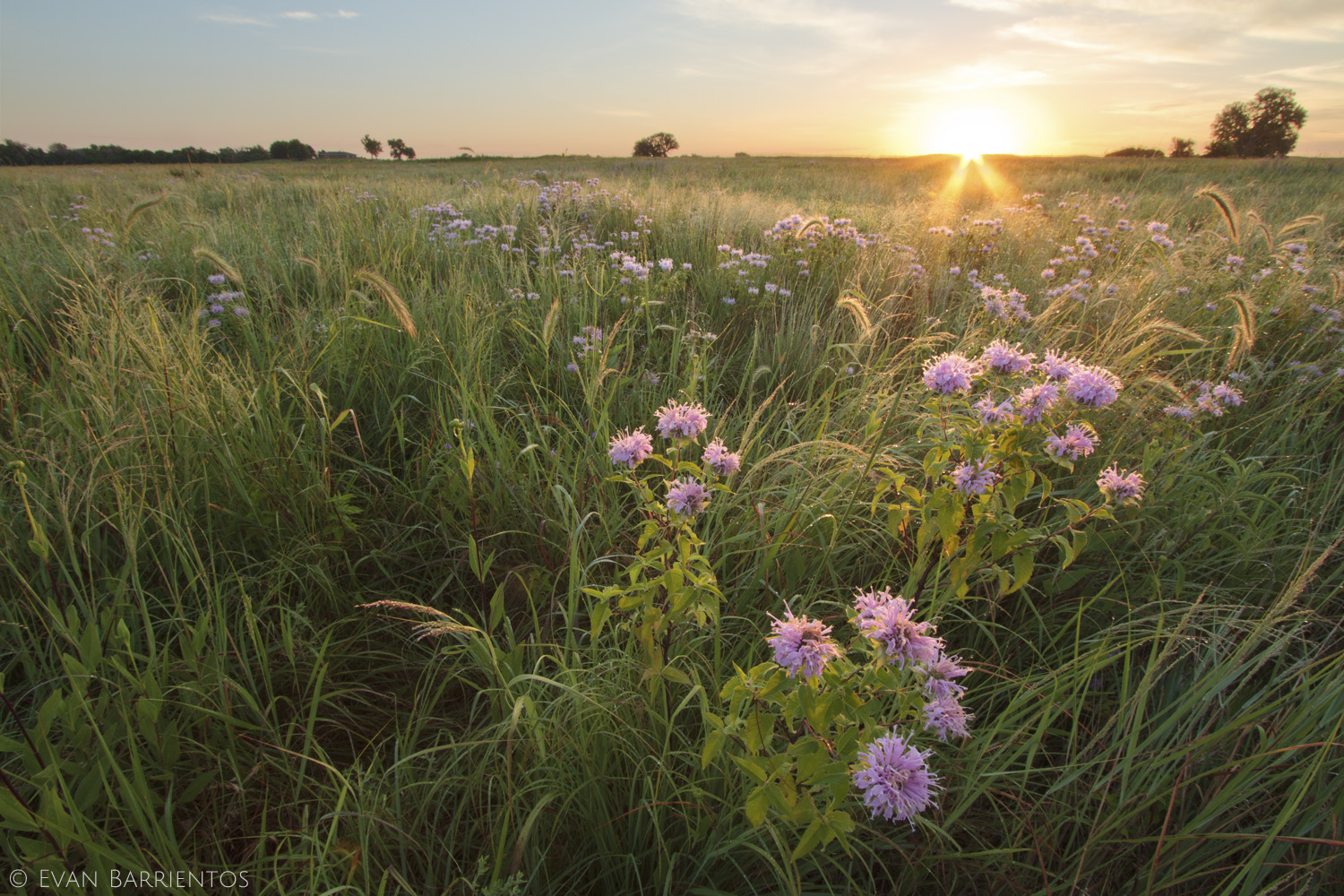
The prairie where I found the Henslow's Sparrow, photographed later in the year.

This is the prairie where I found the Henslow’s Sparrow, photographed a month later. To breed, Henslow’s Sparrows seem to prefer large, treeless prairies with tall, dense vegetation. This habitat is becoming scarce in many areas.

Fortunately, land managers and owners can provide suitable habitat for this species by conducting prescribed burns; removing fencelines, hedgerows, and trees; and allowing the grass in some areas to grow tall and rank. The management strategy that The Nature Conservancy practices here on the Platte River Prairies, called patch burn grazing, helps create this habitat. Additionally, Henslow’s have shown signs of adapting to grasslands created by the Conservation Reserve Program. But convincing people to care about species like Henslow’s might be more difficult. How do we raise appreciation for tiny species that require binoculars, excellent hearing, and lots of patience to see well? It’s tough, but I think an important part of enjoying a Henslow’s is understanding how lucky you are to find one. If you do, it probably means that you’re in a scarce type of grassland, a great observer, and a bit lucky. Drab as they may be, Henslow’s are a special species to find. In many ways, Henslow’s Sparrows epitomize the challenges facing all grassland species. For them to survive, we must preserve large tracts of grassland, manage them for specific conditions, and learn to appreciate prairies slowly and thoughtfully.

Sadly, after two weeks of singing, our Henslow’s Sparrow vanished for the rest of the year. Perhaps the prairie wasn’t big enough, or the grass thick enough, but I wish him luck, and I hope it’s not six more years until I find another.

For more information about Henslow’s Sparrows:

The Much Maligned Coyote

Here in Nebraska, we’ve lost most of our largest predators.  Bears and wolves are gone (excepting rare long-distance wanderers).  Mountain lions are making a slow comeback in the northern and western parts of Nebraska, but the agricultural character and fragmented nature of our state makes it difficult to imagine a much stronger presence of large predators than we have right now.  That’s not a critique – it’s just reality.  It’s difficult to know what effect the absence of those predators has on our wildlife and natural landscapes, but based on what we know from research elsewhere, it’s surely significant.  Throughout the world, and across a wide range of habitat types, major predators stimulate complex cascades of impacts far beyond simply suppressing the populations of their favored prey species.  In fact, the diversity and abundance of many plant, invertebrate, and wildlife species have been shown to decline dramatically when dominant predators disappear.

Illustration by Kim Tri

Coyote illustration by Kim Tri, one of our Hubbard Fellows and, obviously, a talented artist.

Today, in the absence of wolves and bears, coyotes have stepped into the role of top mammalian predator across much of Nebraska.  It’s hard to know if they are as effective as their larger counterparts at maintaining ecosystem function, but there is strong scientific evidence for the strong and positive impacts coyotes have on a number of other grassland species.  Much of the research on this topic was published 15-20 years ago, but few people seem to be familiar with it.  In fact, rather than being celebrated for their importance, coyotes are widely reviled, and often shot on sight, by many (most?) rural citizens across much of prairie regions of North America.

There is much unfortunate irony in the vilification of coyotes.  One common coyote narrative is that coyotes are hard on nesting birds, especially game species like pheasants, quail, turkeys, grouse, and ducks.  In reality, coyotes feed mainly on rodents, and the major predators of birds and their nests tend to be smaller animals, including foxes, raccoons, and cats (especially feral house cats).  Coyotes are large and aggressive enough to intimidate or kill those “mesopredators”, keeping their numbers low and driving them into areas where coyotes spend the least time, such as wooded draws, farmsteads, and even surburbia.  In fact, numerous studies have documented detrimental impacts to bird populations ranging from songbirds to ducks and grouse when coyote numbers are suppressed and mesopredator populations swell.

One of the most dramatic studies of coyote impacts on the structure and function of ecological communities took place on 20,000 hectares of west Texas land back in the 1990’s.  Researchers halved the number of coyotes in one portion of the study area and left the population alone elsewhere.  Within a year of coyote control, the area with fewer coyotes experienced higher populations of bobcats, badgers, and gray foxes.  Perhaps as a result, 11 of the 12 rodent species in that area disappeared, leaving only a skyrocketing population of kangaroo rats.  Jackrabbits also tripled their numbers in the coyote control area, much to the chagrin of ranchers, since jackrabbits compete with livestock for forage.

Another great coyote illustration by Kim Tri.

Another great coyote illustration by Kim Tri.

Speaking of ranchers, many tend not to be coyote fans, in large part because coyotes are sometimes hard on livestock.  Sheep ranchers can suffer big losses to coyotes if they don’t actively protect sheep with dogs, overnight enclosures, and other strategies.  Cattle ranchers can also have trouble with coyotes killing livestock, especially just-born calves.  Coyotes are very good at killing young deer fawns – a great reason for prairie enthusiasts to be coyote fans, by the way – but some transfer that skill to calves as well.  While any self-respecting cow can protect her calf from coyotes under most circumstances, even the toughest mother is weakened enough by the process of giving birth that she is vulnerable to a quick sneak attack.

Unfortunately, the response to livestock losses is often the indiscriminate killing of whatever coyotes ranchers can find.  Research has shown that kind of “coyote control” to be largely ineffective, in part because it usually fails to kill the individuals actually causing problems.  For example, a fourteen year study showed that almost every sheep killed by coyotes was taken by the “alpha pair” in the pack’s social structure.  Those alpha animals are also the wiliest and most difficult to kill.  Furthermore, of course, in the unlikely event that coyote control efforts succeed at suppressing the population in an area, the results might not turn out in favor of the rancher.  Higher numbers of raccoons and foxes, not to mention jackrabbits, along with fewer ducks, grouse, and quail, might take the thrill out of the temporary victory.

Even if coyotes gain wider recognition for their positive effects on natural systems, however, the relationship between coyote and human is bound to be complicated.  As we continue to alter their habitat, coyotes will continue to adapt and survive as best they can.  At times, that will bring them into conflict with us.  It is understandable, for example, that a rancher needs to address livestock losses, and sometimes that could mean tracking down and killing the individual coyote(s) responsible.  However, that kind of careful, targeted response is much different (and more effective) than current broad, indiscriminate campaigns against an animal whose bad reputation is largely based on innuendo and misinformation.

Ideally, seeing coyote tracks on their property would be a positive experience for landowners.

Ideally, seeing coyote tracks on a property would be a positive experience for landowners.

Coyotes and other predators play critically important roles in grassland ecosystems.  It’s easy to understand how they directly suppress populations of their primary prey species.  However, as we continue to study predators, we find more and more of the kind of indirect impacts that ripple through ecological systems in ways that are difficult to predict.  While it seems unlikely that wolves and bears will ever return to prominence in Nebraska or most other prairie regions of North America, coyotes may be able to cover at least some of the ecological roles those larger predators once played.

But only if we let them.