Photo of the Week – November 5, 2015

As I was looking at some of my recent photos from our Niobrara Valley Preserve, I realized that I have a series of photos from approximately the same vantage point that illustrates the site’s recovery from the major wildfire back in 2012.  If you’ve followed this blog for several years, you’re probably aware that we have a significant timelapse project going on at the Niobrara Valley Preserve that is documenting that recovery as well.  Those images will provide a very comprehensive look at change over time, but those cameras weren’t installed until after the fire.  The three photos below are interesting because they represent shots taken before, immediately after the fire, and a few years later.

October 1, 2011

October 1, 2011

The above photo was taken in the fall before the big 2012 wildfire.  The big pine tree on the right is a good landmark to watch as you compare this photo to the next two.  The following photo was taken just a few days after the wildfire.
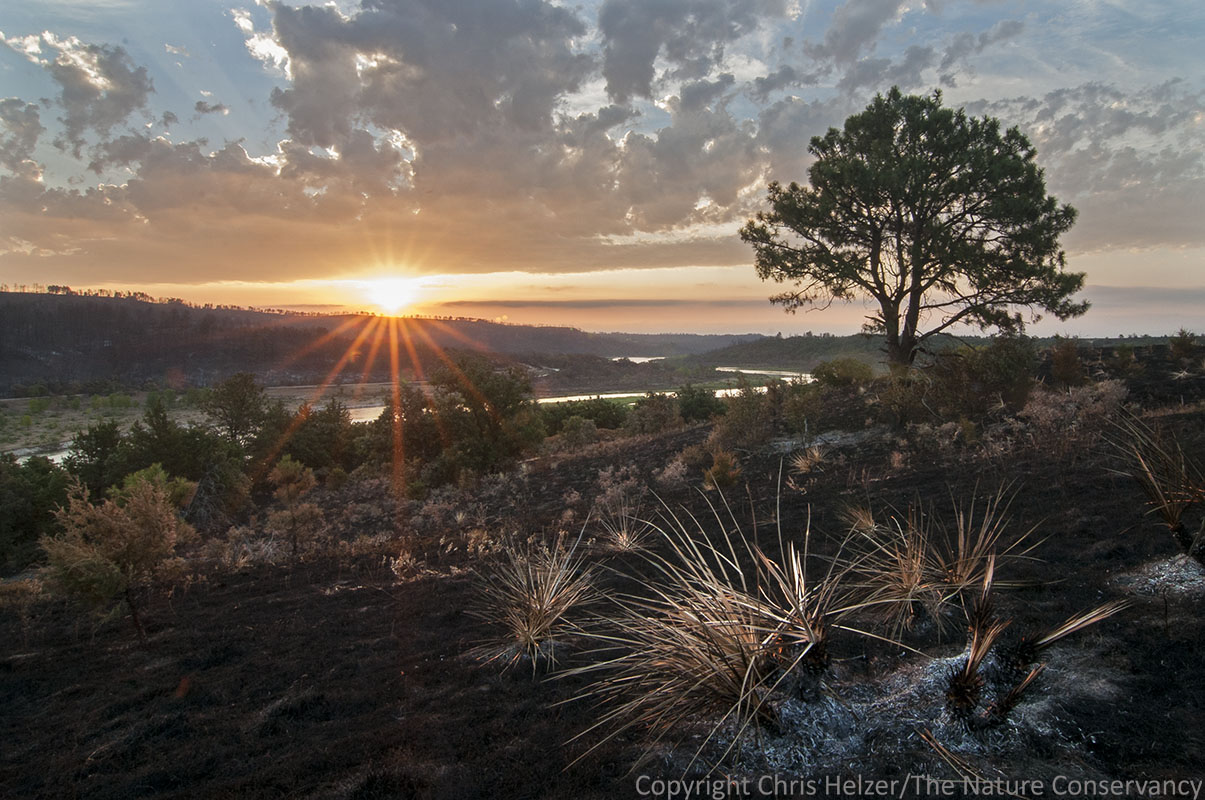
July 25, 2012

July 25, 2012

The last photo (below) was taken just a few weeks ago.  The grass and other vegetation has clearly recovered nicely from the fire.  That’s not really a surprise to any of us who are familiar with grassland fires.  Even a very hot summer fire in the midst of severe drought is not typically fatal to most prairie plants.  In fact, the drought was harder on prairie plants than the fire was, but even so, those plant species are well adapted to both.

TNC Niobrara Valley Preserve, Nebraska.

October 23, 2015

More interesting than the recovery of grasses and wildflowers is the recovery of woody plants.  The two small pine trees on the left side of the image look happy and healthy, despite the fact that young ponderosa pines tend to be vulnerable to fire.  If you look closely at the image taken immediately after the fire, you can see both of those trees.  The one on the right, especially, had the majority of its needles burned by the fire, but both appear to have come out of that stressful period just fine.  Why were those two trees able to survive (along with the big tree) here when just across the river, almost every single pine on the south-facing slope died?  Most likely, there are multiple reasons, including slope, fire intensity, and the fact that these trees were surrounded mostly by grasses instead of lots of other pine trees (and eastern red cedars).  The point of showing these photos isn’t to answer these kinds of questions as much as it is to stimulate them.

It’s also interesting to note that most of the oaks and other big deciduous trees seem to have survived.  That is the case across most of the Preserve, although many of the bur oak trees that were growing close to pine and eastern red cedar trees were top-killed by the fire and are now regrowing from the base.  A few oaks and other deciduous trees (especially cottonwoods) did die from the fire, but most didn’t.

I’m hoping to put together some timelapse sequences this winter that will help tell the story of recovery from multiple locations across the Preserve.  For the most part, those stories will show that the natural communities along the Niobrara River are well-adapted to major disturbances such as the drought and fire that occurred in 2012.  The big exception is the pine woodland that was nearly completely wiped out across big swaths of the landscape. The density of pine and cedar trees led to fire intensity that caused 100% mortality in many stands, and while those areas will recover, they will be grassland and/or shrubland for a very long time, and their long-range future as pine woodlands is far from assured.

Aside from those pine woodlands, however, the natural communities across the Preserve did what natural communities usually do in response to fire, drought, and other major events – they continued to thrive.

Hubbard Fellowship Post – Mother Owl

This post was written by Evan Barrientos, one of our Hubbard Fellows.  Evan is a talented writer and photographer and I encourage you to check out his personal blog.

Warning: This post contains images of fluffy, baby animals.

Along the edge of one of our prairies there is a road lined with mature cottonwood trees. Although I appreciate the wide-open prairie environment, I like to take a walk once a week in the shady security of this miniature forest. The rustling leaves are soothing, shade is a novelty, and the trees bring back memories of hiking in New York’s forests. I also happen to see a lot of interesting wildlife behavior when I go here. One morning in July I was jogging down this road when I spotted an Eastern Screech-Owl being mobbed by Baltimore Orioles and American Robins. I sprinted back to my house, grabbed my video equipment, and hurried back before the action was over.

For several minutes I filmed as the orioles and robins viciously pelted the seemingly harmless owl (click here for a previous post I wrote about this behavior). It amazed me that the owl could withstand such harassment so patiently. Despite several painful-looking beak-jabs to the back of the head, the brave little owl outlasted the assault and was finally left in peace. Only then did I realize why she had refused to leave; she had babies to look after!

06272015_nebraska_9718_face

In a nearby branch I finally noticed three owl fledglings trying to sleep. In addition, there was a second adult screech-owl who seemed equally intent upon sleeping unnoticed. I don’t know which adult was which gender, but I like to imagine that it was the mother who bravely endured blows from the angry songbirds in order to let her family sleep in peace while the lazy dad took a nap. Either way, I always find it touching when I see animals put such great effort into protecting their young.

06272015_nebraska_9707

On another subject, all three birds in this post are species that used to be much less common in Nebraska. Before Europeans arrived, trees were hard to come by in central Nebraska. Over the last century, however, trees from the East have spread into the state as people have planted them around their crops for windbreaks and around their homes for shade. With trees leading the way, many forest species from the East, such as Eastern Screech-Owls, have ventured into Nebraska and the Great Plains. The ecological effects of this tree march are more complex than I’ll go into here, but overall they’re detrimental to grassland plant and wildlife populations. Here are just a few examples:

  1. Trees provide perches for aerial predators (such as owls and hawks), which increases predation rates of prairie grouse and mammals.
  2. Tree corridors provide safehavens for woodland nest predators (such as skunks and opossums) as well as brood parasites (i.e. Brown-headed Cowbirds), who venture into the prairies for prey/hosts. Thus, wildlife in small prairies bordered by trees experience abnormally high rates of nest depredation and parasitism.
  3. If uncontrolled, trees form dense canopies that shade out prairie plants, which are adapted to full sun. This makes it harder for prairie fauna that rely on prairie plants for food and shelter to survive. The result is a positive feedback loop: the presence of trees encourages more trees to grow.
Doom on the horizon? The trees bordering this prairie are the same ones that love walking through.

Trouble on the horizon? The trees bordering this prairie are the same ones that I love walking through.

So what’s the takeaway? Our relationship to nature is complicated. Nothing is simply good or evil. On one hand, trees may seem like a existential threat to prairies, but on the other, I value them for their soothing shelter and the species they harbor. I think the key to this dilemma is diversity. Although I appreciate woodlands, I also appreciate prairies. But healthy prairies are so much more scarce in eastern Nebraska than wooded roadsides, and grassland species are generally in decline, while most woodland species are stable or even increasing.* Therefore, I would choose to cut down trees that are encroaching upon prairies. This does not mean that I think all trees in Nebraska are evil and must be destroyed, just that we need to keep them in check in order to maintain a balance between the two habitats.

*To make things even more complicated, while tree invasion is a real problem, cottonwoods are actually failing to reproduce in Nebraska. To germinate, cottonwoods need floods to scour vegetation and deposit sediment. Now that Nebraska’s rivers are regulated by dams, these floods happen much less often. As a result, we’re seeing very few young cottonwoods taking their parents’ place.