This post is written by Dillon Blankenship, one of our Hubbard Fellows.
Becoming a Prairie Doctor (or Living in a World of Wounds)
Last weekend I drove back to Arkansas to attend a wedding. It is a sizable drive (approximately nine hours from Wood River), but is manageable with a sufficient supply of snacks and music. The trip went smoothly enough and, with the recent honing of my plant identification skills, I was more aware than ever before of the interesting flora to be seen from the interstate. Of course, much of the scenery included corn and soybeans, but there were also many “wild” plants along the way – goldenrod, sunflowers, hoary vervain. Missouri’s I-29 was lined with Illinois bundleflower.
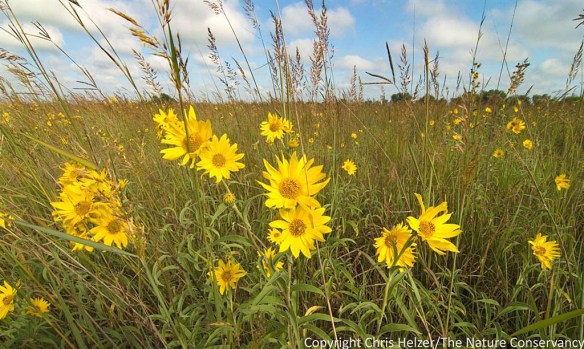
Maximilian sunflower (Helianthus maximiliani) is a native wildflower commonly seen in roadsides this time of year.
Unfortunately, there were a lot of sinister plants to be seen too. Musk thistle, drying up now, sloughed its last seeds into the wind. Old stalks of teasel formed highway-side monocultures. Sericea lespedeza engulfed the road edges and outcroppings as I entered the Ozarks and I was welcomed home by a new patch of Queen Anne’s lace beginning its invasion of the field by my house.
I acknowledge that there are some differences of opinion on exactly how invasive or detrimental some of these exotics are, but given the large amounts of time I have devoted to invasive species control thus far in the fellowship, this sea of weeds was a depressing thing to behold.
It made me think of the oft-quoted line from Aldo Leopold’s Round River essay that, “One of the penalties of an ecological education is that one lives alone in a world of wounds. Much of the damage inflicted on land is quite invisible to laymen. An ecologist must either harden his shell and make believe that the consequences of science are none of his business, or he must be the doctor who sees the marks of death in a community that believes itself well and does not want to be told otherwise.”
These plants were not new to my journey. They were likely there when I first drove to Wood River to interview for the Hubbard Fellowship in February, and they were certainly there when I drove back to Arkansas in June. The difference is that now I can spot these wounds a mile away (I literally see them in my sleep). When I passed them just a few months ago, I had not yet been educated by my mentors at the Platte River Prairies, nor had I invested so many intimate hours into working with these plants (as I spaded and sprayed their cohorts into oblivion).
I am furthering my ecological education on our prairie in many ways – through mastering species identifications, studying the interactions of fire and grazing, working in restorations, conducting wildlife research, and so much more – yet the ever-present threat of invasives continues to have the most pervasive impact on me. I showed some of my friends around the central Platte recently and found myself saying things like, “…and this,” (with a graceful Vanna White arm swing) “is all Reed canary grass” or “this pretty flower covering the sandbars to the horizon is the nefarious Purple loosestrife.” (editor’s note – we also have many areas that are not completely overrun with invasives…)

Purple loosestrife and reed canarygrass on the bank of the Platte River.
Even so, now that I am aware of the damages, I do not think I should shirk away in depression or ignore the problem to save my sanity – this assertion goes beyond the scourge of invasive species to encompass all the other wounds out there. As Leopold continues, you have to know to see, and then you have to study so you can formulate the best prescriptions possible for healing the natural world.
Wish me luck.


 The Prairie Ecologist