A Dizzying Amount of Complex Creepiness

(If you’re reading this in an email, you’ll want to click on the title to open it online so you can see the photos better and watch the short video clip. It’ll be worth your while.)

Two weeks ago, I posted a story about caterpillars and parasitoids and promised another one was coming. Here it is, just in time for Halloween. Prepare yourself – this is going to be an amazing journey. And graphic. It’s going to be an amazing, graphic journey.

.

We painted our garage this year. As a result of that nice clean paint job, it was easier for me to notice that something small was stuck to the wood siding as I walked by. What I saw was very confusing. There was a green caterpillar sitting atop a mass of yellow fuzzy somethings. The caterpillar was moving around, but stayed on top of the yellow mass.

My first illogical thought was that it was protecting its eggs. Hang on, though. Caterpillars don’t lay eggs. They’re not adults.

Ok, maybe another creature laid eggs and then captured the caterpillar and tethered it to the eggs so it would be there for the hatched larvae to eat. Wouldn’t that be wild?

As I was pondering that mystery, I glanced to the right and saw, just a few feet away, a second green caterpillar. It, too, was behaving oddly. In this case, there was no yellow fuzziness. Instead, there was an obscene number of small creatures that seemed to be wriggling their way out of the caterpillar’s body.

WOW! I immediately recognized that I was seeing parasitoid larvae emerging from their host. Some creature, either a wasp or fly, had obviously laid eggs in or on the caterpillar, and when the larvae hatched the burrowed into the caterpillar and fed on its insides. Now they were emerging, well-fed and ready to pupate. I’d read about this, but had never seen this part of the process in real life.

Obviously, my first move was to run for my camera. I took lots of photos, and even some video, while marveling at what I saw. As I watched, the caterpillar was wriggling around as if it was still alive. How could it be alive after having that many larvae inside it and feeding on it?

Here, watch this video clip and you’ll see what I mean:

Short video of the scene. Click to watch it on YouTube. If that’s not working, you’re probably trying to read this post in your email. Click on the post’s title to open it online and activate the link. Trust me, it’ll be worth it.

The other part of the scene, of course, is the adult insects that appear to be supervising the proceedings. Initially, I thought they were flies, but they’re obviously wasps (long antennae, smaller eyes, and a skinny waist are all clues I initially missed.). Aha! Maybe they were the parents and they’d come back to make sure everything went smoothly? Or they’d been hanging around and protecting the caterpillar? That seemed unlikely, and yet, there they were.

I needed answers. Fortunately, I’d just established contact with Dr. Enakshi Ghosh who had helped me interpret another caterpillar/parasite interaction. I emailed her with photos and video, hoping she might have some ideas.

Well. Not only did she have ideas, she’d just published a paper related to what I was seeing! How about that for a coincidence!

Here’s the story, as I understand it. Any errors in this tale are mine, not Dr. Ghosh’s.

First of all, the caterpillar is the larva of a cabbage white butterfly (Pieris rapae), which many of you will recognize as a species that eats big holes in plants like broccoli, cauliflower, and cabbage, among many others. It’s a non-native species in North America, and widely reviled by gardeners. Does that help you feel any better about its fate in this instance?

The larvae emerging from the hapless caterpillar are almost surely those of a wasp called Cotesia glomerata. It doesn’t have a common name. For the purposes of this article, I’m going to call it Cora because there are going to be a lot of Latin names running around. Why “Cora”? Why not?

Cora was introduced to North America in the 1880’s to help control the cabbage white butterflies that had already been here for a few decades. It lays lots of eggs inside young caterpillars (up to 30!) that emerge about 15-20 days later. When they emerge, the larvae immediately start spinning cocoons to pupate in.

So far, we’ve solved several of the mysteries. We know the identity of the caterpillar and (probably) the larvae. In addition, the yellow fuzzy things are the cocoons of the larvae and if you watch the video again, you’ll notice the larvae are actually creating cocoons while their tail ends are still in the caterpillar. However, we still don’t know why the caterpillar seemed to be alive, and we don’t know who the adult wasps are or why they’re hanging around.

Well, it turns out that when Cora inserts its eggs into a caterpillar, it also introduces a virus at the same time. The virus (actually a polydnavirus) does at least two things. First, it neutralizes the immune system of the caterpillar so its blood cells don’t attack the wasp eggs. Second, it alters the nervous system of the caterpillar (neuromodulation). More specifically, the virus helps keep the caterpillar alive and moving, even after most of its insides have been devoured by ravenous wasp larvae.

Scientists think keeping the caterpillar alive and moving helps repel a hyperparasitoid. What’s a hyperparasitoid? Well, it’s not a frenetic wasp, though that’s what it sounds like, huh? A hyperparasitoid is actually a parasitoid that attacks other parasitoids. In this case, there’s a wasp called Lysibia nana that lays eggs on the larva of Cora, either while they’re in the caterpillar or after they emerged and formed cocoons. Again, Lysibia nana has no common name. I’ll call it Lisa.

One way Lisa can find Cora is by detecting airborne chemicals (‘kairomones’) released by plants when they’re attacked by caterpillars. The same kairomones are also used by Cora to find the caterpillar in the first place. Even cooler, there is a difference between the chemical signal from plants being eaten by parasitized and non-parasitized caterpillars! Read more about that here, if you want.

Anyway, if Lisa manages to track down Cora, Cora’s best hope is that the virus-infected mostly-dead caterpillar will be thrashing around enough to prevent Lisa from being able to lay eggs on Cora’s larvae. That behavior by the caterpillar can continue even after Cora’s larvae have crawled out of it and spun themselves cocoons. In fact, this probably explains the confusing behavior of the first caterpillar I found on my garage (first photo above). It was almost surely doing it’s ‘job’ of defending Cora’s pupae from attack.

Dr. Ghosh says the caterpillars do eventually die because they starve to death. I would expect that even if the virus wasn’t forcing them to defend Cora’s kids instead of eating, the caterpillars would starve because those kids ate the caterpillar’s stomach and other inside parts. (I did warn you this would be graphic.)

Now, we’ve only got one mystery left. Who are the small wasps hanging around the second caterpillar while Cora’s babies are emerging from its body and spinning cocoons?

Dr. Ghosh says the wasps are Pteromalids – another kind of parasitoid wasp that can either parasitize the caterpillar or Cora. She didn’t know what species and that’s ok. Dr. Ghosh doesn’t have to know everything. I’m going to call the Pteromalid wasp Pterry.

While it’s hard to know for sure, Dr. Ghosh thinks Pterry was probably hanging around, hoping to lay eggs in the cocoons created by Cora’s babies. That brings up the biggest question of all. Will the thrashing virus-infected mostly-dead caterpillar manage to protect Cora’s cocoons from Pterry like it’s supposed to protect them from Lisa?

I don’t know. I wasn’t able to catch the rest of the story. The caterpillar sure didn’t look to me like it was moving around enough to dissuade Pterry from laying eggs in Cora’s cocoons, but I couldn’t stick around to watch forever. I checked the cocoons periodically over the next few weeks, hoping to see something crawling out of them. Finally, 22 days after I photographed Cora’s larvae exiting the caterpillar, the cocoons were empty.

The cocoons of Cotesia glomerata (Cora) 22 days after I photographed larvae crawling out of the cabbage white butterfly caterpillar. What species of wasp emerged from the cocoons? I don’t know.

Who came out of those cocoons? Was it Cora’s kids, all grown up? Or did Pterry manage to lay eggs in those cocoons? If so, Pterry’s kids probably ate Cora’s kids and pupated inside those same cocoons, eventually emerging as adults to go find their own caterpillars or wasp larvae.

Either way, I’m incredibly grateful to have witnessed parts of this saga, and to have been able to learn so much from Dr. Ghosh about the incredible context around it. It doesn’t matter how many times I say it, it’s no less true. “There is an amazing story behind every single invertebrate species.”

>>>><<<<<

I tried really hard to distill this complicated story into a digestible short tale. If you’re still a little overwhelmed or confused, I don’t blame you. Here’s a quick recap, if it’s helpful:

A wasp named Cora found a cabbage white caterpillar and laid eggs in it. Those eggs hatched and the larvae ate most of the inside of the caterpillar. However, the caterpillar stayed alive because Cora also infected it with a virus that took over its brain and nervous system and forced it to keep moving.

Hyperparasitoid wasps named Lisa and Pterry like to lay their own eggs on Cora’s larvae, either before or after they form cocoons, but Cora hopes the virus-infected, mostly-dead caterpillar will fend them off. In the example I watched, I didn’t see Lisa, but it looked to me like Pterry might have had the tenacity to wait around and lay eggs in Cora’s cocoons, regardless of the bodyguard caterpillar.

Since I didn’t see who came out of the cocoons I don’t know if Cora, Pterry, or even Lisa ended up on top after all the dust settled in this particular case. However, I think we can all agree the caterpillar came out the loser.

How you feel about that is up to you. I find it incredibly fascinating.

.

Photos of the Week – October 22, 2023

I spent much of last week at the Niobrara Valley Preserve. One afternoon, I found myself with a couple hours of free time. It was cloudy, but bright enough that I thought I’d explore one of the many creeks that flow from underneath the Sandhills into the Niobrara River. Those creeks emerge from springs and flow downward through deciduous woodland in what are locally called ‘springbranch canyons’.

A tiny mushroom on a moss-covered log with a waterfall in the background. How nice… 105mm macro lens. ISO 800, f/10, 1/60 sec.
Water cascading over leaves. 105mm macro lens. ISO 640, f/13, 1/60 sec.

Because the streams come from groundwater and then flow through sandy channels, the water is very clear – an unusual situation in Nebraska. The combination of clear water and autumn leaves always makes these creeks fun to explore in October. Photography along their banks is tricky, though, because they’re shaded by both trees and topography.

To an open-country photographer like me, who is used to using early and late day light, that presents a real challenge. During prime post-sunrise and pre-sunset light periods, everything is in shadow. If I wait until the sun is high enough to hit the stream and its banks directly, the light is usually too intense, and the contrast between light and shadow overwhelms a camera’s sensor. The best opportunities I’ve found for photographing these creeks is on cloudy days.

That was a really long explanation for why I decided to hike up a couple creeks. There’s really no need to justify anything. It’s never a bad idea to hike along a creek!

Here’s a stretch of one of the two creeks I was exploring. 10-20mm lens @14mm. ISO 320, f/8, 1/60 sec.
A northern cricket frog on the edge of the creek. 105mm macro lens. ISO 800, f/13, 1/60 sec.
Another cricket frog, but clinging to a log. 105mm macro lens. ISO 800, f/13, 1/60 sec.
A basswood leaf with holes. 105mm macro lens. ISO 320, f/11, 1/60 sec.

It had been a frosty morning, so I was curious to see what kinds of small animals were moving around. I saw several cricket frogs (and managed to photograph a couple), but also a fair number of small invertebrates. There were lots of flies, of course, but also a mayfly and various other insects I wasn’t sure would still be active. I spent a few minutes trying to track a little red velvet mite on a rotting log that didn’t feel like sitting still for a photo. Eventually, I managed to capture a couple sharp photos of it.

A tiny red velvet mite on a rotting log. 105mm macro (cropped). ISO 640, f/13, 1/100 sec.

My boots and lower legs got muddy very quickly. The steep topography along much of the creeks meant that I often walked through the water, or along the soft banks, where I frequently sank a foot down into muck. I didn’t mind a bit. Climbing around on steep and soft ground was a nice, but pleasant, workout. I also wore rain pants so I could easily kneel or lie prone on the ground to photograph things like frogs or mushrooms.

Mushroom and moss. 105mm macro lens. ISO 800, f/16, 1/60 sec.
A slow exposure shot of a waterfall. 18-300mm lens @ 62mm. ISO 320, f/32, 1/4 sec.
Seeds of cow parsnip (Heracleum maximum). 105mm macro lens. ISO 320, f/14, 1/60 sec.
Moss on a log. 105mm macro lens. ISO 640, f/14, 1/80 sec.

One of the springbranch canyons I hiked hosts a population of paper birch trees, a species that really shouldn’t be in Nebraska anymore. It’s a boreal species that still survives in the cool, moist environments of the Middle Niobrara River Valley. Well, I say it survives, but that survival seems awfully tenuous these days. The future of these populations is probably not bright in this particular location, given climbing global temperatures, but we’ll enjoy them while we can.

Paper birch surrounded by fall color. 10-20mm lens @10mm. ISO 1250, f/16, 1/100 sec.
More paper birch. 10-20mm lens @10mm. ISO 1250, f/16, 1/100 sec.

There are a lot of plants and other organisms along these creeks that I don’t see in prairies, so I didn’t know a lot of their names. I get so used to recognizing the identity of species around me (almost unconsciously) that it was a little jarring to be just a few hundred yards from familiar prairie species but unable to name much of what I saw right next to me. I’ve explored these creeks enough that I’d seen the species before, but haven’t had time or opportunity to really get to know them. Besides mystery plants, I came across a lot of mosses and fungi, along with (I think) slime molds, liverworts, and other exotic-seeming organisms.

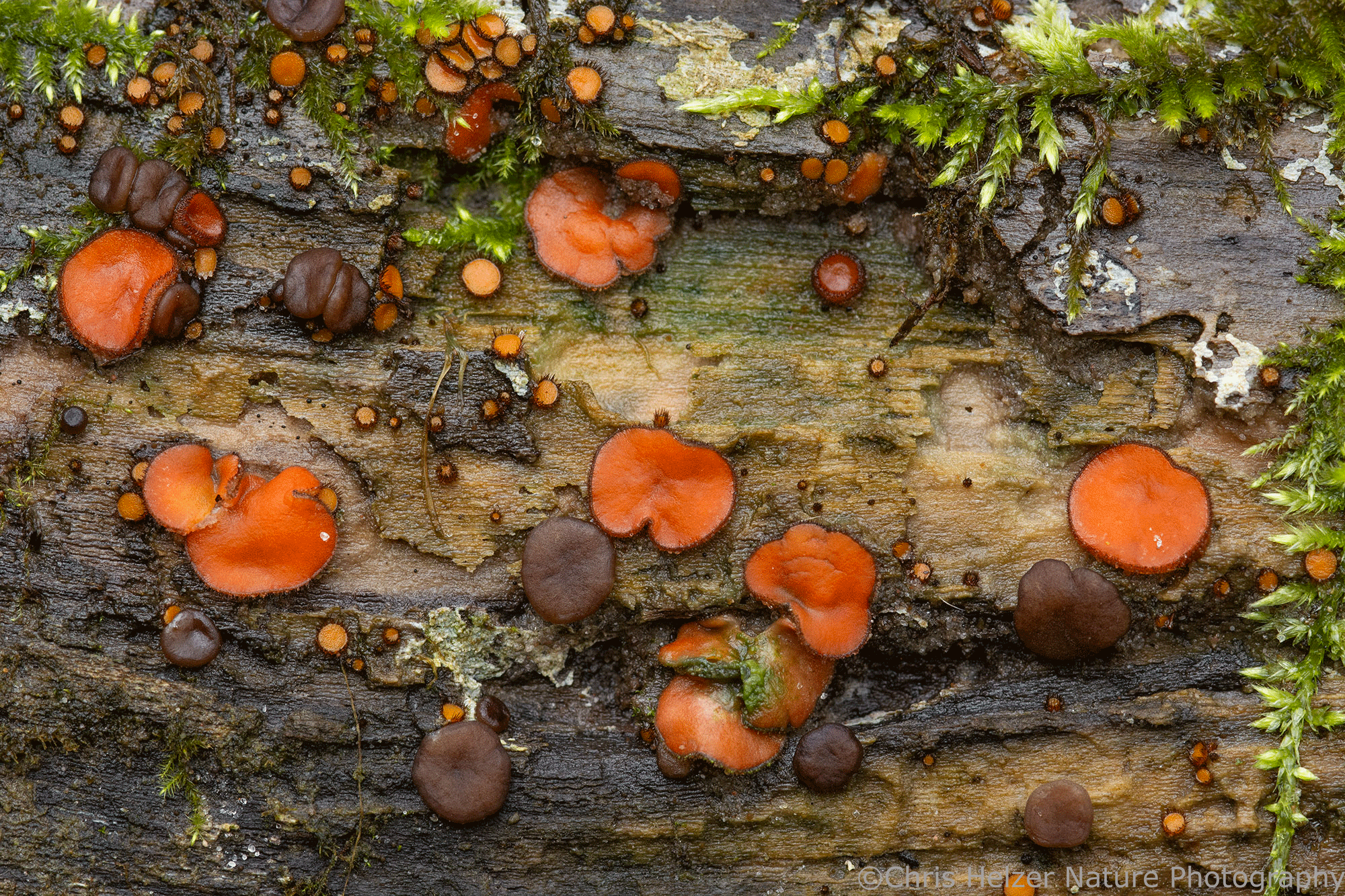
I think these are eyelash cups (Scutellinia?)- a fungus – on a downed log. 105mm macro lens. ISO 640, f/11, 1/60 sec.
Liverwort! 105mm macro lens. ISO 640, f/16, 1/60 sec.

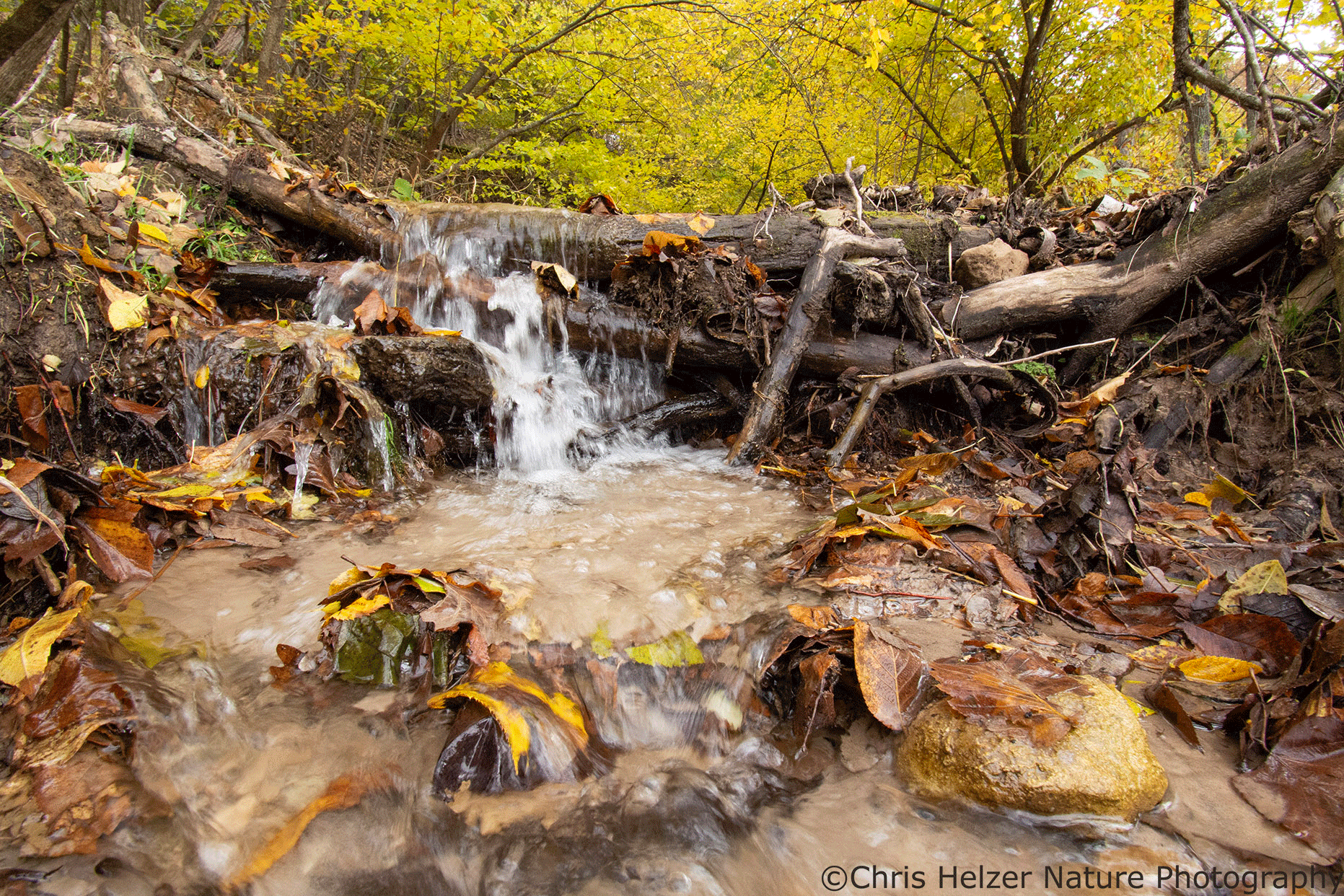
I ended my hike at a small waterfall at the bottom of the second creek I explored. I liked the juxtaposition of golden leaves and rocks in the stream with the falls behind them. Since I was going to walk back to headquarters to change clothes, I took a few extra chances. I laid on the ground with my hips right on the edge of the creek and my torso hanging over the water. I stuck one elbow on a rock and tried to make all of that stable enough to facilitate taking a couple photos. I didn’t come away completely dry, but I was a lot less wet than I could have been.

One of the many small falls along the creeks. 10-20mm lens @10mm. ISO 1250, f/16, 1/60 sec.

I still prefer to wander and photograph prairies, but it’s fun to mix things up, too. An autumn walk through a springbranch canyon was a pretty great way to spend an afternoon. Especially because I was back in the prairie for sunset that evening. I don’t know how people manage to live where sunsets always happen behind trees or ridges. I guess those people probably wonder how people live where there’s nothing to block the wind… Each to their own, I guess.