Corpses of Congregating, Climbing Caterpillars

Alliteration is fun, huh? So is the pursuit of mysteries, especially in nature.

Three years ago, I wrote a post about multitudes of fuzzy caterpillars at our family prairie. Many of them were crawling high up into the vegetation and dying, leaving behind desiccated dead bodies, still clinging to plants. It was morbid, but fascinating. I haven’t seen that phenomenon again – until this year.

A Virginian tiger moth caterpillar gripping and feeding on yellow sweet clover.

In late September, I traveled out to our prairie to do some seed harvesting. As the sun was setting and I was walking back to my truck, I nearly fell over as I spotted a fuzzy caterpillar right in front of me and contorted my body so as not to squish it underfoot. Immediately, I noticed several others nearby.

Within an area the size of my pickup, there were easily 20 or 30 caterpillars that I recognized as larvae of the Virginian tiger moth (Spilosoma virginica). I could only identify them because I’d seen lots of them three years earlier, and that experience stuck prominently in my mind. It was too dark to photograph the caterpillars that night, but I came back the next morning with my camera and chased (ok, that’s an exaggeration) them around for a while.

Tiger moth caterpillars on lambsquarters (Chenopodium album).

I started my early morning caterpillar exploration where I’d seen the big group the night before, but as I wandered around, I found that the congregation of them was much bigger than I’d thought. They weren’t uniformly distributed, but they were spread across several acres of prairie. In some places, I found as many as 4 or 5 per square foot, while in others, I’d walk several steps between sightings. Still, that’s an awful lot of caterpillars – thousands of them, for sure.

Another tiger moth caterpillar feeding on sweetclover.

My ecologist brain was curious about what they were feeding on. At first, I was mainly seeing them on yellow sweetclover plants (Melilotus officinalis), chewing busily away at both leaves and stems. That was handy because it often positioned them off the ground a little bit, and gave me good angles for photography. As I kept looking, though, it was clear their diet was much broader. I saw them feeding on lambsquarters, some kind of pigweed (Amaranthus sp.), green milkweed (Asclepias viridiflora), a species of dock (Rumex sp.), a knotweed (Polygonum sp.) and western snowberry (Symphoricarpus occidentalis). That’s some serious variety.

Still another tiger moth caterpillar feeding on sweet clover.
This one is feeding on green milkweed.
Here’s one eating pigweed flowers.
This one was munching on western snowberry leaves.
This one was feeding on some kind of knotweed.

The feeding behavior was interesting, but that’s not what I was really looking for. I wanted to find evidence of the same ‘crawl-up-high-and-die’ behavior I’d seen three years earlier. Ok, to be clear, I wasn’t rooting for that, necessarily – that would be mean. I just didn’t want to miss the opportunity to see it if it was happening. I also hoped to get a little further in the investigation into what was causing the phenomenon.

Sure enough, as I walked around, about 5 or 10% of the caterpillars seemed to be dead – most of them at the top of plants, or even fenceposts. Some looked like they’d just recently died, but a few had clearly been there a while and had a kind of freeze-dried appearance. I took a few photos and then grabbed one of the dead ones to bring home with me.

As luck would have it, I was talking to former Hubbard Fellow Evan Barrientos shortly thereafter, and was reminded that he’d introduced me to Dr. Enakshi Ghosh earlier this year. Dr. Ghosh is a Post-doctoral researcher at the Natural Enemy Ecology Lab at Colorado State University. She studies cool things like parasitoid wasps that affect caterpillar populations. Evan helped me reach out to Dr. Ghosh and that email conversation led to me returning to the prairie to grab more caterpillar samples.

The next day, I shipped some caterpillar corpses to Colorado (that’s a normal, socially-appropriate thing to do, right?), hoping to solve the mystery of what killed them. A few days later, I got an email. Unfortunately, Dr. Ghosh wasn’t able to magically deduce exactly what had happened, but I did learn some things. First, she pointed out that the corpses were hollow – “which is a sign of developing parasitoids eating up their organs.”

In addition, she said there was a secondary fungal growth on them. I’d noticed that as well – it looked like some of them were covered with whitish powder. I wondered if that might somehow be tied to the parasitoid, but Dr. Ghosh didn’t think so. She also couldn’t find or examine the hole(s) used by parasitoid larva(e) to exit the carcasses after their death, probably because the caterpillar bodies had dried up too much.

The pale appearance of this very dead caterpillar is partly because of the white fungal growth on it.

The mystery isn’t fully solved yet, but I feel good knowing that it’s a parasitoid-related case. Unfortunately, I didn’t get back out to our prairie before it froze last week, so I wasn’t able to grab some living caterpillars and see what came out of them. I apologize for that dereliction of duty. Maybe, in another three years (hopefully less??) I’ll get another chance.

Should I use ‘less’ or ‘fewer’ in that last sentence? If I was talking about something like mosquito bites, I’d say “hopefully fewer”. Especially with mosquito bites. It should probably be ‘fewer’ when I’m talking about years, too, but my brain is telling me that we’re talking about an amount of time, and it’s appropriate to say “less time”. But since ‘years’ is the unit, I suppose it should be “fewer”. Let’s just all pretend I said “fewer” and I’ll move on with the story. Also, please ignore the irrational use of single and double parentheses in this paragraph.

In the meantime, I’m left to wonder why I don’t see this event every year. Are the caterpillars (and their parasitoid) in our prairie annually, but I don’t always see them? That’s sure possible, but I walk around that prairie a lot, and it seems a little wild that I’d miss big caterpillar congregations that span several acres.

Also, where did all the caterpillars come from? I mean, I know how they came to be, but was it a particularly big year for adult tiger moths this year? I photographed one in town, but don’t remember coming across hordes of them out at our prairie. That doesn’t mean much, of course. I could easily have missed them (they’re small and often sit low in vegetation during the day). Plus, I don’t know how many adults you need to lay enough eggs to explain the caterpillar abundance I saw this fall. Or, maybe it’s more important to wonder whether a disease organism or predator was less abundant this year, and not able to reduce the caterpillar population before it started.

I photographed this adult tiger moth in late August at Lincoln Creek Prairie in Aurora. I think it’s the Virginia tiger moth, but I don’t promise anything. I sure don’t remember seeing lots of them at our family prairie this year, but definitely could have missed them.

As I say all the time, I don’t need to know all the answers. It’s the questions that make this fun! Even when I do get answers, those inevitably lead to more questions, so there’s no risk of running out. Let’s all just keep trying to observe, question, and investigate. These days, it’s easier than ever to find information about observations, especially with more apps to help us identify species and lots of online information. And, of course, in my case, I’m super lucky to have smart friends who agree to lend their expertise to my questions and save me lots of time.

.

….By the way, if you think this story is amazing, just wait. I’ve got another story to share soon that will blow your mind! I’m hoping for a few more photos to wrap that story up, but I hope to post something about it within the next week or two, regardless of my success or failure.

I’m obviously very grateful for Dr. Enakshi Ghosh’s generous help with this. Not to provide too much of a spoiler, but she’s also connected to the other story I’m working on…

Photos of the Week – October 6, 2023

As I mentioned in my last post, Kim and I visited Konza Prairie Biological Station this past weekend. While she was fighting through a long training run in the heat, I was fighting the breeze and trying to get some decent photos. It’s a good thing both of us are equally tough and resilient people and managed to deal with challenges of similar difficulty.

Public hiking trail at Konza Prairie Biological Station at sunrise. Nikon 10-20mm lens @10mm. ISO 640, f/14, 1/60 sec.

(As always, you can click on an image to see a bigger version. If you’re reading this in an email, click on the post title to open it online so you can click on images.)

I made it to the top of the first big hill just after sunrise and tried to capture that early light on the prairie. It was beautiful, but the effects of the severe drought on the prairie were pretty obvious. Since we were going three hours south of home, I’d expected to see more green vegetation and flowers than we have left up here. That wasn’t the case, at least not in the places I hiked.

Don’t get me wrong, there was plenty to see and enjoy. There were still flowers around, as well as lots of fun seed heads, colorful leaves, etc. Invertebrates were also relatively plentiful, and I had fun finding them.

The wind, though, was a real pain. I ended up taking a LOT of shots, hoping at least one would be sharply focused, and I tried to time shots between stronger gusts. Landscape shots were a lot easier than close-up photos because the swaying motion of plants was less of an issue at a distance. For some reason, Kim seemed to enjoy that breeze more than I did as she ran her 25 miles through the increasingly hot day. It takes all kinds, I guess.

Flint hills prairie. Tamron 100-400mm lens @380mm. ISO 1000, f/6.3, 1/1250.

For a while, I tried chasing grasshoppers along the edge of the trail because I figured if they were sitting on the ground, the wind wouldn’t affect them. That would have worked a lot better if they’d been willing to sit still long enough for me to creep up to them. I did manage to get close to one toothpick grasshopper, but all the others were having fun baiting me and then cackling with laughter (I may be projecting) as they hopped/flew away.

Toothpick grasshopper on the hiking trail. Nikon 105mm macro lens. ISO 640, f/13, 1/125 sec.
A hiker on the trail. Tamron 100-400mm lens @380mm. ISO 1000, f/6.3, 1/1250.

To help with both the wind and the increasing brightness of the light, I started gravitating toward copses of trees, where I could work in the diffused light near the edge of their shadows. I also photographed a lot of backlit subjects.

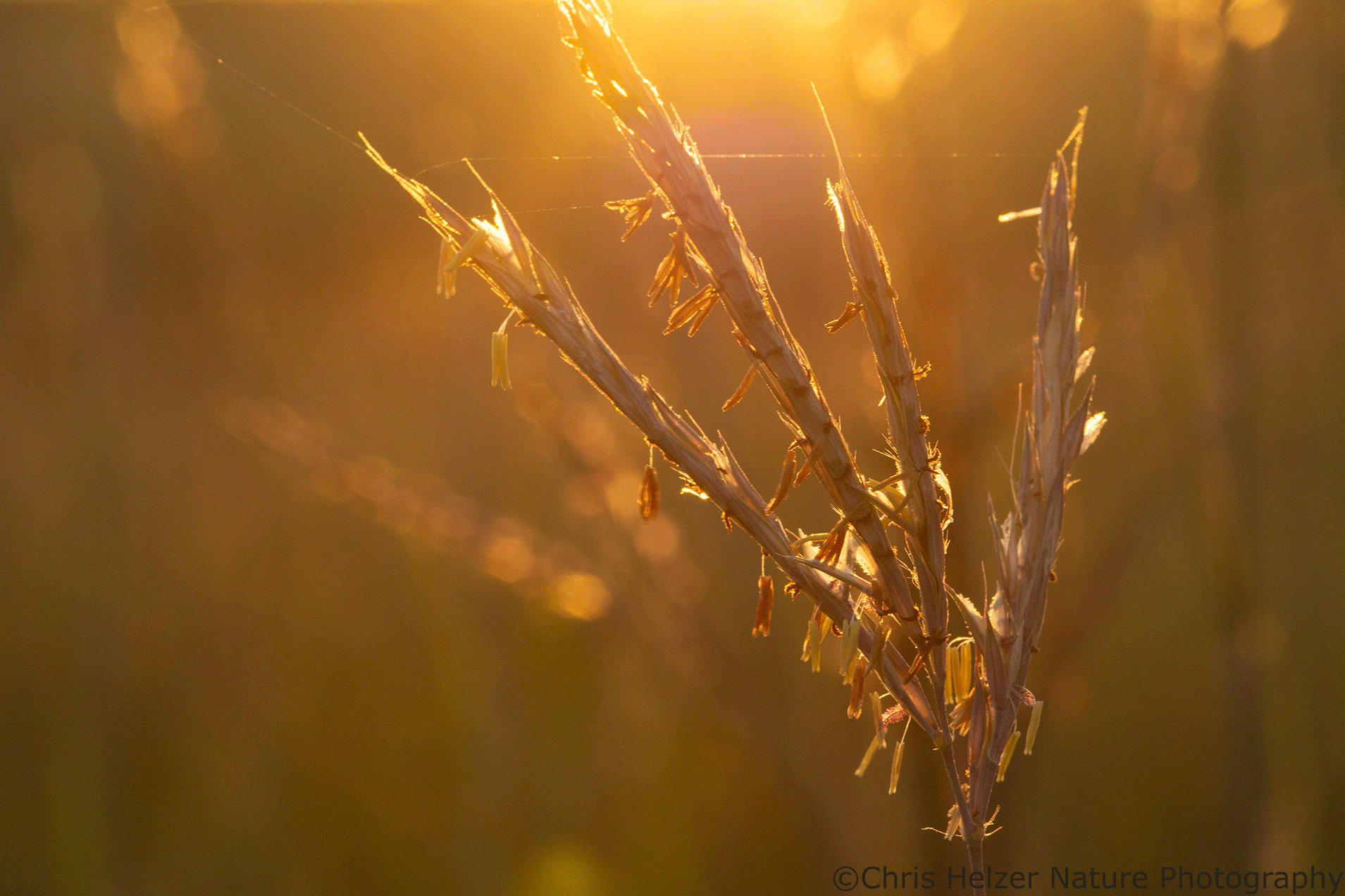
Backlit Indiangrass. Nikon 105mm macro lens. ISO 640, f/8, 1/800 sec.
Backlit Indiangrass seed head. Nikon 105mm macro lens. ISO 640, f/16, 1/250 sec.
Compass plant and drought-stricken autumn prairie. Nikon 10-20 mm lens @10mm. ISO 640, f/14, 1/100 sec.
Four o’clock (Mirabilis sp.) and prairie. Nikon 10-20 mm lens @10mm. ISO 640, f/11, 1/160 sec.
Four o’clock seed, backlit with shadows behind. Nikon 105mm macro lens. ISO 640, f/16, 1/640 sec.
False boneset (Brickellia eupataroides) and autumn prairie. Nikon 10-20 mm lens @10mm. ISO 640, f/14, 1/60 sec.
False boneset seed head. Nikon 105mm macro lens. ISO 640, f/14, 1/100 sec.

Smooth sumac was turning color, and I found some that was slightly sheltered from the wind. I spent quite a bit of time trying to find compositions I liked. I don’t know that I got any world-changing photos, but I got a least a few that made me happy. I love looking at the patterns of color-change within each leaf, and wondering who/what caused the little injuries many of the leaves had.

Smooth sumac leaves turning color. Nikon 105mm macro lens. ISO 640, f/13, 1/500 sec.

Eventually, I worked my way back toward the trail head and spent time working along the edge of the tree shadows there. That’s where I found the spiders I featured in my last post, but also lots of other insects. There was still enough breeze to be challenging, so I didn’t get photos of the monarch and other butterflies, for example, that were moving around. I did, though, manage to sneak up on a couple grasshoppers.

Grasshopper (Melanoplus sp.?) in the diffused light near some trees. Nikon 105mm macro lens. ISO 640, f/11, 1/250 sec.

Other than the orb weaver spiders I watched for a long time, the other big invertebrate highlight of the day was finding two big wheel bugs. I’d seen them before, but hadn’t ever been able to photograph them (other than one that once sat on my hand just long enough for a quick shot.) These two seemed to be hunting on and around some stiff goldenrod plants.

North American wheel bug on stiff goldenrod. Nikon 105mm macro lens. ISO 640, f/16, 1/250 sec.
The same wheel bug, but from a different perspective. Nikon 10-20mm lens @20mm. ISO 640, f/16, 1/400 sec.

If you’re not familiar with this kind of insect, you might reasonably think they’re fake. I can assure you they’re wheel bugs. The ‘wheel’ on their backs wasn’t as fully formed as I’ve seen before, but not in a way that detracted from their attractiveness. While the wind was pushing the goldenrod plants around, the bugs, at least, moved slowly enough that I could keep up with them as they patrolled for prey.

Wheel bugs are a kind of assassin bug, and they capture and eat prey just like their cousins do. They grab their prey and then jab their long, sharp mouthpart into them. The wheel bug then injects chemicals that paralyze and then ‘pre-digest’ the soft tissues in that hapless creature. Once its prey is sufficiently internally-liquefied, the week bug uses its tubular mouthpart like a big straw to suck up all the goodness before it discards the empty shell that remains.

Because they’re big (1 to 1 1/2 inches in length) and armored, wheel bugs look pretty scary. If you harass them, they can give you a pretty nasty bite that will make you wish you hadn’t. They’re not out to get you, though. I’ve spent a lot of time up close to various assassin bugs, including a few wheel bugs, and haven’t ever triggered them to bite me. As with most of our fellow creatures on earth, if you treat them respectfully, they’ll do the same.

A closer look at the wheel bug. Nikon 105mm macro lens. ISO 640, f/16, 1/320 sec.

It was great to be back in the Kansas Flint Hills for a while. I enjoy seeing rocks in prairie, for example, which I don’t get very often around home. The topography is also fun, especially when I’m just meandering up and down the hills (as opposed to, say, running 25 miles on a hot day). I’m grateful to be only a few hours away from such a terrific landscape.

We’re forecast to drop down to about 32 degrees Fahrenheit here tonight. That means the number of flowers and invertebrates around to photograph will also be dropping soon. It’ll still be fun to wander the prairies after that, of course. There’s a lot to look forward to this fall, including more fluffy seed heads, frosty mornings, lots of pre-winter food gathering by small mammals, and much more. I’ll miss the bees, butterflies and flowers, though.

April seems a long way off…