Photo of the Week – June 29, 2018

We spent a productive week at the Niobrara Valley Preserve this week, collecting a mountain of data.  Five of us spent our days scrambling across the Sandhills, counting flowering plants, quantifying milkweed populations, and estimating habitat cover.  As always, we got to observe far more than what we were focusing on for science.  We saw bald eagles, box turtles, a couple different snakes, pronghorn, mice, bird nests, families of northern bobwhites and sharp-tailed grouse, countless kinds of invertebrates, and much more.  It was an exhausting, but fulfilling week.

The science crew for this week. From left to right: Alex Brechbill and Olivia Schouten (Hubbard Fellows), Amanda Hefner (Conservation Assistant at NVP), and Katharine Hogan (former Hubbard Fellow and current PhD student at the U of Nebraska-Lincoln).

The above photo shows the kind of energy our crew had, though it was also taken just as the week was starting.  Hot sun, wet grass, and lots of massive poison ivy patches eventually knocked their enthusiasm down a notch or two, but we all still had a great time.  The crew certainly made me feel twice their age (which I am, for at least one of them), and not just because I’m still a little hobbled by my recovering ankle.  I appreciated their patience as they waited for me at the end of each sampling grid.

After each day of data collection, I spent the bulk of my evening time trying to build up an inventory of aerial photos and video with our drone.  I flew over the river, across open grasslands and prairie dog towns, and among herds of bison.  My post from earlier this week showed a small slice of just one evening’s imagery.  It’ll probably take me weeks or months to get through all the footage from the last several days, but I do have one tiny video clip to share with you today.

On Tuesday night, I  followed a small portion of our east bison herd around for a while.  I was skirting the edges of the herd with the drone, trying to get a feel for how close I could get before the bison started to react to the vehicle’s presence.  The bison were certainly aware of the drone, but while they edged away when I got too close, they certainly didn’t act frightened or panicked.  A few hundred yards from the main group, a lone bison bull was grazing by himself.  I decided to test its patience a little (in the name of science, of course).  I flew the drone to within 15-20 yards or so of it, and lowered it down to 10 or 12 feet off the ground.  Then I just hovered right there while it was eating.  (Well, the drone hovered there – I was very safely standing a couple hundred yards away, right next to my truck!)

As I watched through the screen on my controller, the bull glanced up a few times while it grazed, and then eventually raised its head to chew and watch the drone.  It chewed and watched for almost a minute.  Just as I was getting tired of the experiment and started to push the button to end the video, the bull’s patience apparently ran out.

Oh boy, do I wish I hadn’t hit the “stop recording” button when I did, but you get a pretty good picture of what came next.  I don’t know if it would have jumped high enough to hit the drone, but I do know that my suddenly sweaty hands pushed the “UP!!!” button on the controller as fast I could when that bull started its charge.  One of the reasons I’m sharing this video is that it’s a great reminder that while bison are incredible and beautiful creatures, they are also unpredictable and dangerous.  People die, or are seriously injured, every year on public lands when they ignore the unpredictable and dangerous part of the equation, and try to get too close to these huge animals.  Bison aren’t going to chase you down and trample you to death for no reason, but if you invade their comfort zone, they are very capable of defending themselves.

This photo was taken just a few minutes after the video.  I was safely in my truck…

As soon as I flew the drone away, the bison returned to calmly grazing, probably congratulating itself on how easily it had scared away that odd-looking, noisy, and pesky bird.  After watching the bull for a while from a distance, I drove slowly closer to it and photographed it as it continued grazing.  It was well aware of my presence, but is used to being around pickup trucks.  Since I wasn’t coming AT him, he calmly grazed and wandered on his way.

I’m fully aware of how fortunate I am to have my job, and to have access to the places we own and conserve. I’m incredibly grateful for everyone who reads this blog, but even more to people whose financial support allows our conservation work to happen.  I wish I could give each of you a personalized tour of our sites, but in lieu of that, I’ll continue trying to do the next best thing – show you the diversity and beauty of those places as best I can through writing and photography.  You can also come visit, of course, and hike the trails to see what you can see.  In the meantime, stay tuned for more photos and videos.

Information on visiting the Niobrara Valley Preserve can be found here and on visiting the Platte River Prairies here.
Compatibility of Cows, Conservation and Climate Change?

I’ve been asked a number of times why I advocate for cattle grazing in prairies when cattle are such strong contributors to greenhouse gas emissions and rapid climate change.  It’s a fair question, but also a complicated one.  I don’t have a definitive answer, but I can share some of what makes it a thought-provoking subject.  Rather than providing a lot of specific research citations, I’m aiming instead to provide some general information that highlights the complexity of the topic.  Feel free to contribute additional information and perspectives in the comments section below (as long as you keep it constructive and polite).

C

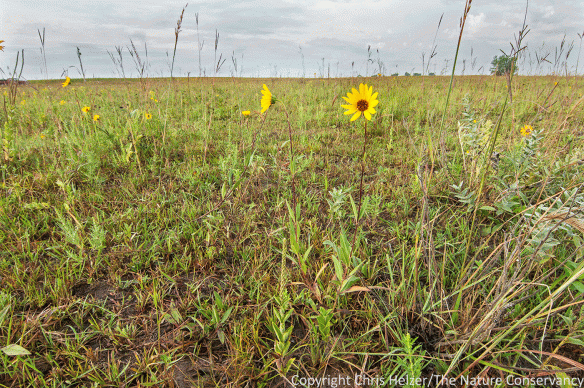
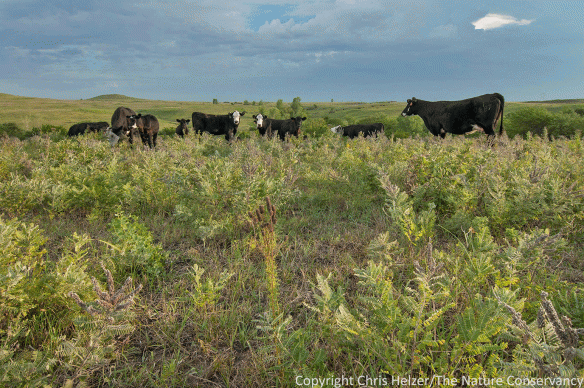
Cattle graze among leadplant and prairie clover at Konza Prairie in the Kansas Flint Hills.  What are the ramifications of cattle grazing for greenhouse gas emissions and other contributing factors to climate change?

Cattle: The Downsides

First, here are some reasons people are concerned about the impact of cattle on climate change.  According to the EPA, agriculture is responsible for about 9% of the U.S. greenhouse gas emissions, and beef production makes the largest contribution to that category.  Most of the impact comes not from carbon emissions, but from methane and nitrous oxide, both of which influence climate change more strongly (pound for pound) than does carbon.  “Enteric methane” (cow burps) is a big part of that equation, but so is manure, urine, and application of fertilizers to pastures.  These emissions are bad enough, but there are other negative impacts from beef production as well, including emissions from growing corn and other feed for cattle, emissions from manure in feedlots, water consumption by cattle and feed production, and pollution from sedimentation and nutrient runoff of pastureland.  Reading a list of bad stuff like this, it’s easy to see how people might wonder why I keep talking about grazing like it’s a good thing.

Cattle

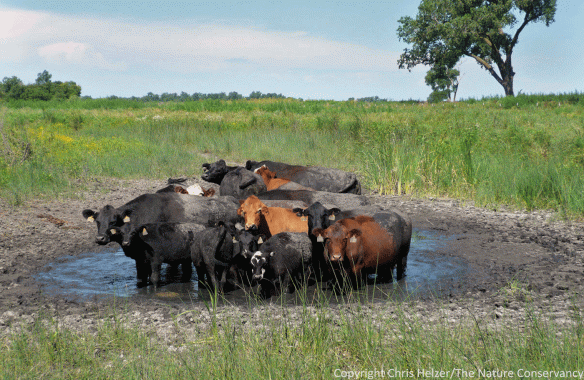
Cattle are sometimes their own worst enemy in terms of advocating for their own existence.  I mean, come on, man!  This is just not a good look.

Predecessors to Cattle

As I provide some counterpoints, I’m going to do so from the perspective of the central Great Plains – the area of the world I’m most familiar with.  Outside the Great Plains, the situation varies greatly; there are places in the world where grazing may not be compatible with local ecosystems, for example, and where forest or other land cover types are being converted to pasture.  Here in my part of the country, however, we are in the heart of the historic bison range.  Before Europeans entered the picture in the Great Plains, prairies here were being grazed by bison, elk, pronghorn, and other large animals.  There are many arguments about the size of those historic bison populations, fluctuations in herd size and geographic range over time, and when/where bison impacts were important for prairie ecology.  For the purposes of this discussion, the important point is that cattle (and their emissions) weren’t introduced into a landscape with no history of methane emissions.  Bison were here prior to cattle, and they burped too.

The most cited article I’ve seen on the issue of methane emissions from historic bison populations is by Francis Kelliher and Harry Clark.  They use a fairly standard estimate of 30 million bison across the Great Plains prior to European contact.  Based on their calculations, the methane (CH4) emissions from those bison (2.2 Tg CH4 year-1) are not hugely different from those of today’s 36.5 million cattle across the same geography (2.5 Tg CH4 year-1).  The exact numbers are less important than this basic idea: the prairie ecosystem was contributing large amounts of methane to the atmosphere before humans brought cattle to the Plains.

Of course, feedlots, fertilization, and forage production, along with all the greenhouse gas emissions and other concerns associated with them, were not part of the historic bison landscape.  We definitely have an obligation to examine those aspects of cattle production and do what we can to limit their negative impacts.  In addition, the fact that cattle on native rangeland are producing emissions similar to their bison predecessors doesn’t release us from the responsibility of trying to reduce those emissions where possible.  I’m hopeful that research over the next decade or so will provide us with more guidance on how we might do that.

Bison

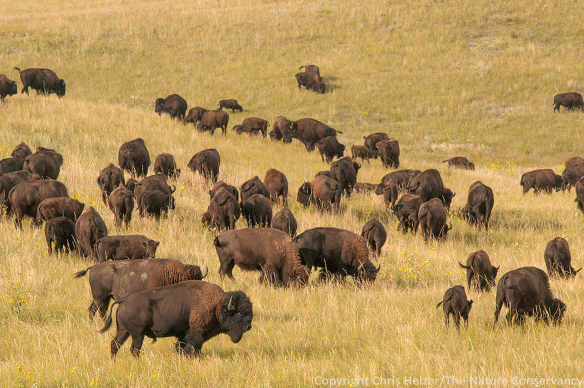
Before there were cattle, bison roamed (and burped) across the Plains.

Get Rid of Cattle?

What if we just stopped grazing cattle on the Great Plains?  Well, since the vast majority of the Great Plains is privately owned, grassland still exists primarily because it produces income.  Without cattle production, much of that grassland would likely be converted to row crop agriculture – a scenario that would probably be worse for climate change and would certainly spell disaster for prairie ecosystems.  Some have argued that a majority of the Great Plains should be turned into public land that would support both wildlife and tourism.  There are way too many economic and social issues associated with that for me to deal with here, but from a climate change emissions standpoint, I’m not sure it would solve the problem.  Either cattle would be replaced by bison again (see previous paragraph) or, if bison were not reintroduced, prairies would suffer from the loss of grazing, a major component of ecosystem function (see next paragraphs).

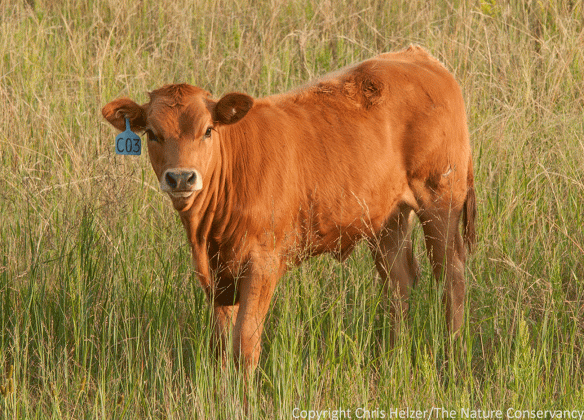
Simply getting rid of cattle altogether is probably not a great strategy for conservation. Plus, how could you get rid of something this cute?

Simply getting rid of cattle altogether is probably not a great strategy for conservation. Besides, how could you get rid of something this cute?

Grazing as a Positive Force

Despite the fact that chronic overgrazing can cause degradation of prairies (loss of plant species and habitat, soil erosion, etc.), grasslands and large grazers evolved together and grazing is still an essential component of grassland ecosystems.  This is especially true in North America’s Great Plains where there are still grasslands large enough to support wide-ranging wildlife species such as grouse and pronghorn.  Grazing, along with fire and drought, is one of the three major forces that affects prairies and prairie species.  For example, large herbivore grazing helps keep grasses from being so competitive that they overwhelm and reduce the diversity of plant communities, something that leads to a cascade of negative and interconnected impacts on pollinators, productivity, wildlife/insect communities, and more.  In addition, grazing alters vegetation structure, creating a wide range of habitat conditions.  Ungrazed prairie provides fairly uniform vegetation structure, even if it is hayed or burned.  Grazed prairie (under the right management) is heterogeneous, with patches of tall/dense vegetation, patches of short/sparse vegetation, and many other habitat types in-between – allowing the widest possible spectrum of prairie wildlife and insect species to thrive.

Maintaining plant and animal diversity, ecosystem function, and ecological resilience within the historic range of American bison would be very difficult without some kind of large ruminant, and in the face of climate change, we need our grasslands to be as resilient as possible.  Resilient grasslands will better adapt and maintain their ecological functions as climate changes, and that means they’ll continue to pull carbon from the atmosphere and store it belowground – an incredibly important part of our global climate change strategy.  While the impact of grazing on carbon storage of grasslands is, in itself, a complex topic, the general scientific consensus seems to be that a moderate level of grazing facilitates more carbon storage than no grazing (and more than chronic overgrazing).

G

Strategic cattle grazing can create a variety of wildlife habitat structure types and help sustain plant diversity and ecological diversity.  It can also help maximize carbon storage in grasslands.

The Upshot

In the Great Plains of North America, grazing is an essential part of grassland ecosystems – a component that maintains the ecological health and resilience of prairies.  Cattle have mostly replaced bison as the large ruminant on stage at the moment, but they are filling many of the same basic roles – regulating plant competition and creating wildlife habitat, and also pooping, peeing, and burping.  We absolutely need to find ways to minimize the impacts of today’s grazing on climate change.  Livestock confinement operations, pasture fertilization, forage production, and other related practices provide opportunities for continued improvement.  In addition, some rangeland grazing practices, such as chronic overgrazing, are known to be detrimental, and not just from a climate change standpoint, so that’s an obvious place to focus.  Beyond that, we need to figure out how best to limit methane and nitrous oxide emissions and increase carbon storage on rangeland.  That will likely mean changing techniques for managing cattle in pastures, but also dealing with issues related to pasture fertilization, forage production, forage and animal transportation, feeding operations, and more.

The topic of cattle grazing and climate change is incredibly complex.  There is much more involved than I could possibly cover here, and what I did include is plenty complicated.  I don’t pretend to fully understand all the facets of the issue, but for now, I feel comfortable in my stance that cattle (and/or bison) grazing can be compatible with responsible conservation of our prairies here in the Great Plains.


More Information and Acknowledgements

Several scientists from The Nature Conservancy wrote a really helpful piece on the beef supply-chain and its impacts on water, wildlife, and climate.  You can see a summary and get access to the full report here.

Special thanks to Jon Fisher and Joe Fargione, who both helped me refine and improve this post.  Any remaining errors are my fault, not theirs.