
Photo of the Week – September 6, 2013

Here are three photos from the last couple weeks that didn’t fit into any particular story or theme.  Each is from a different prairie, and each was the result of a quick opportunistic stop in the midst of doing something else.  The pitcher sage photo (immediately below) came after I walked past a patch of the flowers and then backed up to capture the image that stuck in my head when I first walked past.  I noticed the soldier beetle (second photo) as I was walking back to take more photos of the praying mantis eating the sphinx moth.  Finally, I spotted the bee sitting on a dew-covered gayfeather flower (third photo) as I got out of my truck to work on a fence project at our farm.

Pitcher sage (Salvia azurea) in our plant diversity research plots.  Platte River Prairies, Nebraska.

Pitcher sage (Salvia azurea) in our plant diversity research plots. Platte River Prairies, Nebraska.

.

A soldier beetle on a grass leaf.  Lincoln Creek Prairie - Aurora, Nebraska.

A soldier beetle on a grass leaf. Lincoln Creek Prairie – Aurora, Nebraska.

.

A male long-horned bee (Melissodes sp) on dotted gayfeather (Liatris punctata).  Helzer family prairie - south of Aurora, Nebraska.

A male long-horned bee (Melissodes sp) on dotted gayfeather (Liatris punctata). Helzer family prairie – south of Aurora, Nebraska.
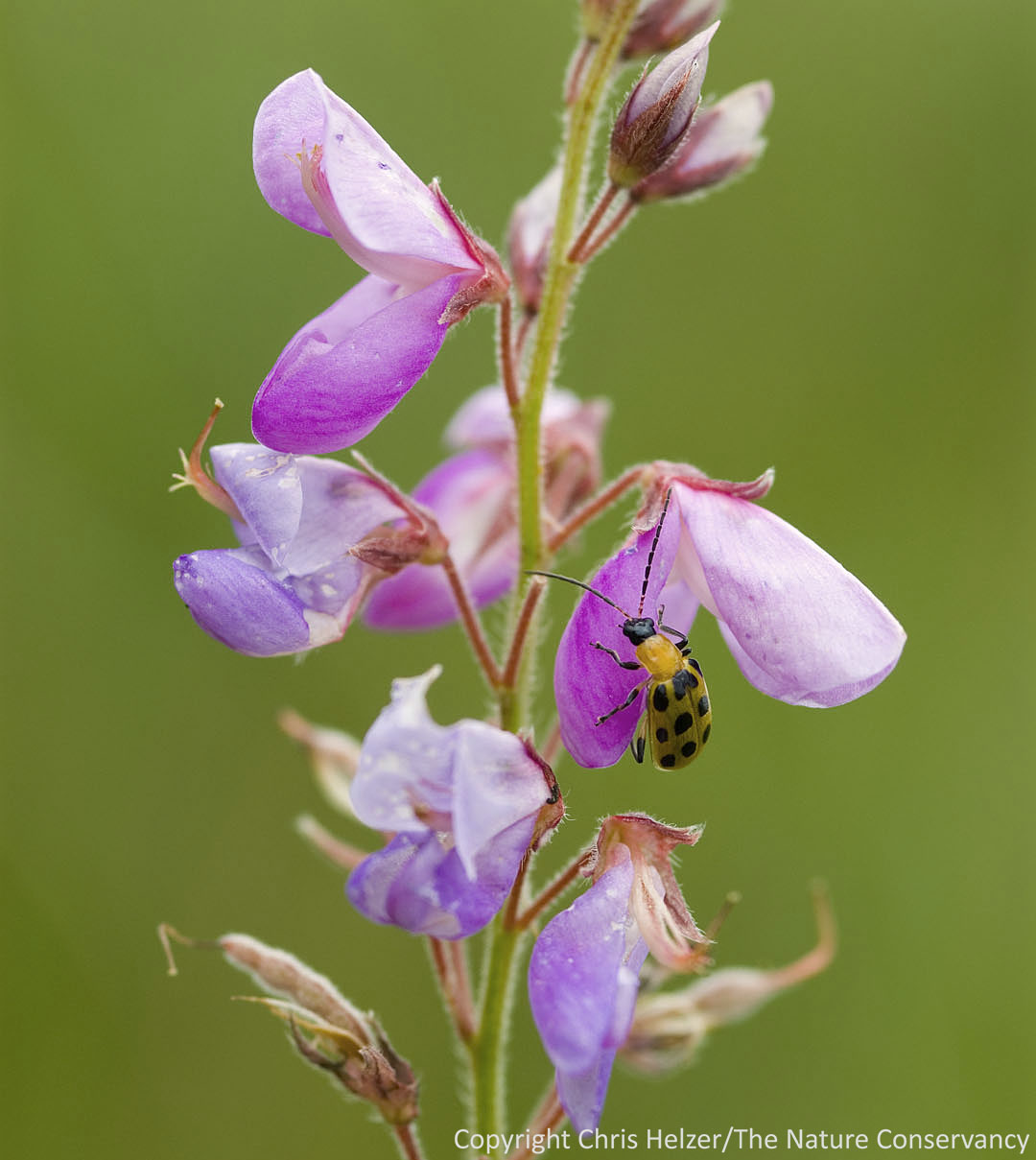
Photo of the Week – August 23, 2013

As we’ve been looking for bees lately, I’ve noticed the abundance of spotted cucumber beetles (Diabrotica undecimpunctata) in our prairies.  I’ve primarily noticed them because they are feeding on the pollen of flowers, and from a distance they look like a bee.  I can’t count the number of times I’ve crept up to a flower to see what kind of bee is on it, only to find that it’s just another cucumber beetle…

Spotted cucumber beetle on showy tick trefoil (Demodium canadensis)

Spotted cucumber beetle on showy tick trefoil (Demodium canadensis)

Spotted cucumber beetle has another name that will be very familiar to farmers – southern corn rootworm.  While it’s a native insect in North America, it has adapted very well to human agriculture and is now considered a pest in both crop fields (corn and other crops) and gardens (cucumbers and other cucurbits).  I’m hoping some of the readers of this blog can help me answer a couple questions I have about cucumber beetles.

1. Are spotted cucumber beetles more abundant in prairies now than historically because of the prevalence of nearby crop fields?

2. Do cucumber beetles have a significant impact on any particular prairie plant species or on the overall ecology of prairies?

As far as I know, cucumber beetles are just nicely adapting to human-dominated landscapes, and while I see a lot of them, their primary impact is that they keep fooling me into thinking they’re bees…