Photo of the Week – April 15, 2016

Back in July, I got to photograph flowers and insects at The Nature Conservancy’s Bluestem Prairie in Minnesota.  One of the subjects I enjoyed photographing was a little yellow-flowered plant in the genus Lysimachia.  I don’t know the name of the species (I’m sure someone will tell me what it is, which would be fantastic).

I played around with the background in my Lysimachia photos.  I moved the camera slightly up and down, changing what was visible behind the flowers.  The problem with doing that, of course, is that I had to later decide which version of the photo I liked better.  Or, as I sometimes do, I get lazy and just put multiple versions in a blog post to see if you have a preference.

Lysimachia sp. at The Nature Conservancy's Bluestem Prairie. Version one (a little lower perspective to show a little sky in the background).

Version 1. (a little lower perspective to show a little sky in the background).

Version 2.

Version 2.  (the camera was a little higher so the sky is not visible.)

If you have strong feelings, let me know if you like one or the other better, but don’t feel obligated to encourage my laziness.

And, just for fun, here’s a completely different composition of a different plant of the same species (from the same morning).  I actually like this composition less well, partly from an artistic standpoint, and partly because I just think the two earlier images better represent the way the flowers tend to delicately droop on either side of the plant.

Version 3.

Version 3. (Different plant, same morning)

Someone I know, not-to-be-named, likes the last composition much better than the first two.  That person is wrong, but to be fair to them, I’m including the composition in the post.  I’m sure all of you will agree it’s nice, but not as good as the first two…

Right?

Photo of the Week – September 10, 2015

A few weeks ago, I took my camera across town for a walk in a small local prairie.  There were numerous flowers blooming, but the stiff sunflowers (Helianthus pauciflorus) were stealing the show.  I shot quite a few photos of them from various angles.

Hover fly on Stiff sunflower (Helianthus pauciflorus) Lincoln Creek Prairie, Aurora, Nebraska.

This little hover fly was enjoying a meal of stiff sunflower pollen.  Lincoln Creek Prairie, Aurora, Nebraska.

Stiff sunflower (Helianthus pauciflorus) Lincoln Creek Prairie, Aurora, Nebraska.

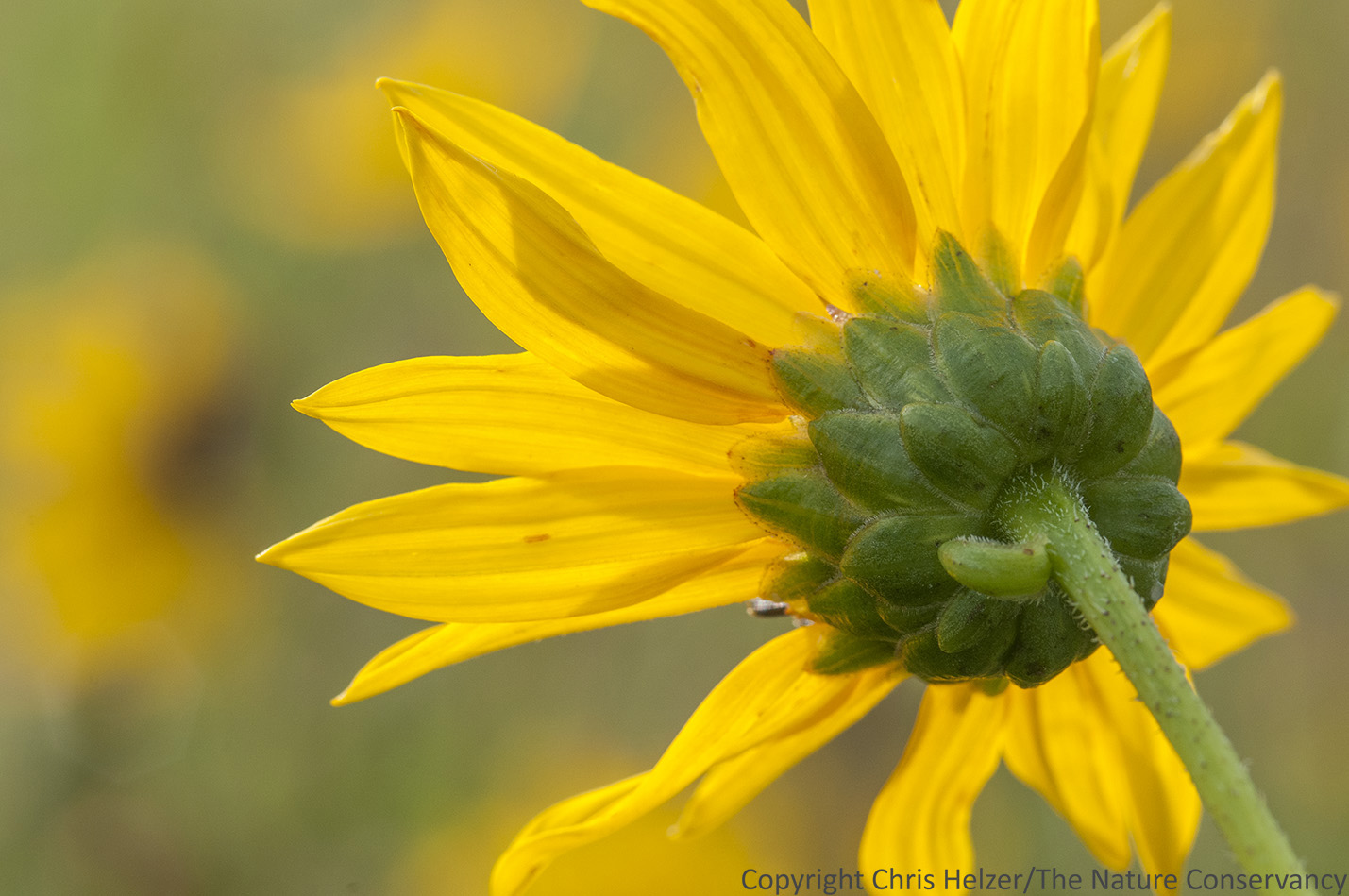
The sunflower perspective.

I noticed that a few sunflowers seemed to have their “petals” (technically speaking, they are the ray flowers) folded in toward the center of the flower.  I’d seen this quite a few times before, but this time I decided to investigate.  I gently pulled the petals apart and found they’d be held down with what appeared to be silk.  Beneath them, an insect larva was hiding and, presumably, feeding on pollen or other flower parts.

Caterpillar in Stiff sunflower (Helianthus pauciflorus) Lincoln Creek Prairie, Aurora, Nebraska.

A closed-up stiff sunflower.

Caterpillar in Stiff sunflower (Helianthus pauciflorus) Lincoln Creek Prairie, Aurora, Nebraska.

The larva revealed.  Note the remnants of silk and the anthers still sticking to the petal after I pulled everything apart.

Caterpillar in Stiff sunflower (Helianthus pauciflorus) Lincoln Creek Prairie, Aurora, Nebraska.

A close up of the caterpillar (?)

I’m not expert enough with insect larva identification to know for sure, but I’m guessing the larva is a moth larva – I know at least some of those have the ability to make silk.  Some of you reading this will surely know more about them and comment below.  (Thanks for your help.)

A few days later, I ran across some similarly closed up flowers in a different prairie.  When I opened those up, there was another larva inside, but it was much darker in color.  I wonder how many different species have this behavior?

The larva I found was just one of many examples of insects that create safe hiding places for their young to feed in.  Spittle bugs and gall-forming insects are two others that are common in prairies.  Of course, for every great hiding strategy, there is at least one predator that has developed a counter strategy.  I don’t know what eats the petal-tying larvae, but I bet there’s something out there.  I’m pretty sure guys-with-cameras are not the only ones who can find them.  Fortunately, for the larva I found, I wasn’t hungry at the time.