What Do I Do With This Sludge? A Wetland Restoration Report and Plea for Advice.

This fall, we completed (mostly) a wetland restoration project I’ve been trying to finish for more than a decade.  A beautiful clearwater meandering stream runs through our Platte River Prairies south of Wood River, Nebraska.  At one point, however, the stream enters the remnants of a sand and gravel mining operation from early last century.  What was left after the gravel extraction was a long lake with big piles of spoil sand all around it.  Before our restoration project began, the stream dumped into one end of the lake and flowed out the other.  While the lake had good fishing in it, it didn’t meet some of our real objectives for the site, including shallow wetland plant communities, and habitat for migratory birds, freshwater mussels, and other wetland animals.

In 2001, in partnership with the US Fish and Wildlife Service’s Partners for Wildlife Program and Ducks Unlimited, we restored the west half of the lake to a meandering stream channel and backwater wetlands.  The west half was the easy and cheap half because the lake was relatively shallow (6 feet and less) and there were big piles of sand right along the edge.  The project essentially consisted of pushing those sand piles into the lake with a bulldozer and using an excavator to create new stream channels. 

The results of that initial effort were encouraging.  We had excellent establishment of wetland and wet meadow plants from our seeding after the construction was done, and the area is heavily used by many wetland wildlife species, including shorebirds and waterfowl, river otters, beaver, muskrats, and many others. 
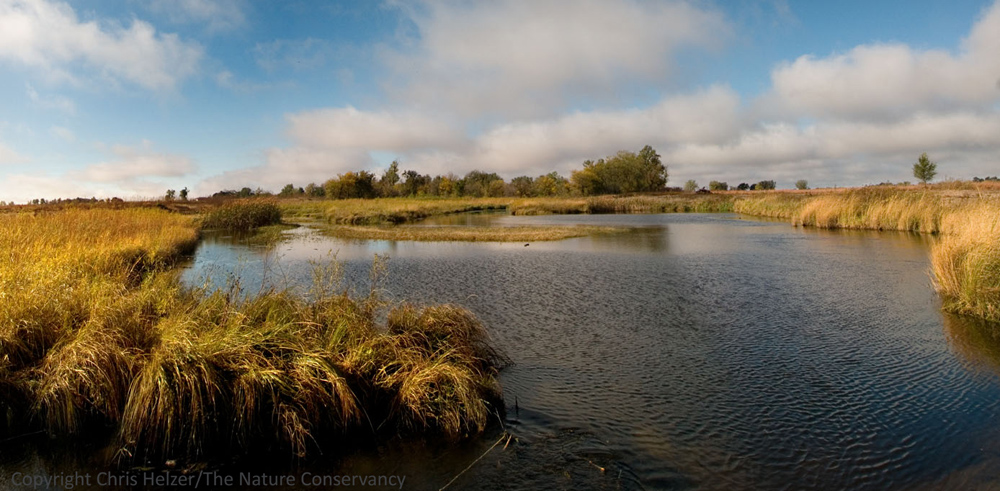
A photo of a backwater wetland within the west half of our sandpit restoration, ten years after construction and seeding. The water is no deeper than about 2 feet in any location.

Unfortunately, the relatively higher cost of restoring the second half of the lake (the wider and deeper portion) kept us from completing the rest of the project until this fall.  Once again, our partners were the Fish and Wildlife Service and Ducks Unlimited.  This time, the restoration process was essentially the same as the first phase, except that much of the sand to fill in the deeper portion of the lake had to be hauled from further away (from along the edges of what we’d restored earlier).  We recreated several stream channels and adjacent wetlands, and – except for a few finishing touches and one little issue – the site is done and ready for seed.

The right side of his photo shows a portion of the west (first) half of the project, completed in 2001. On the left, we pulled sand from piles that were still remaining after that 2001 phase, and hauled it to the east to help fill in the deeper portions of the lake this year.

.
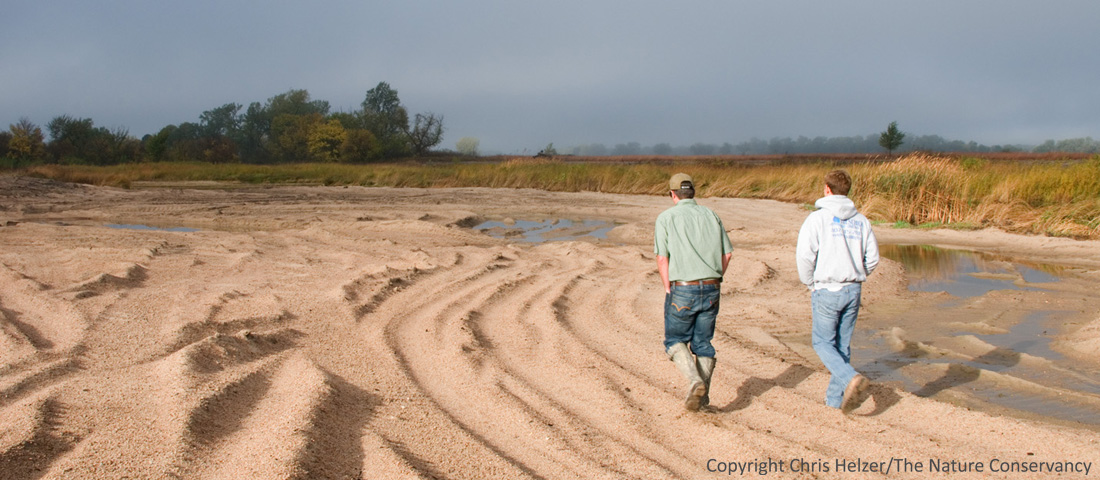
Jonas Davis (left) and Andrew Rieschick (right) with Ducks Unlimited inspect a portion of the new construction, including a nearly-completed shallow stream channel that was designed to function as a wetland slough in low water, and carry streamflow under high water conditions.

.

This panoramic of the nearly-completed east half of the project consists of multiple images stitched together.

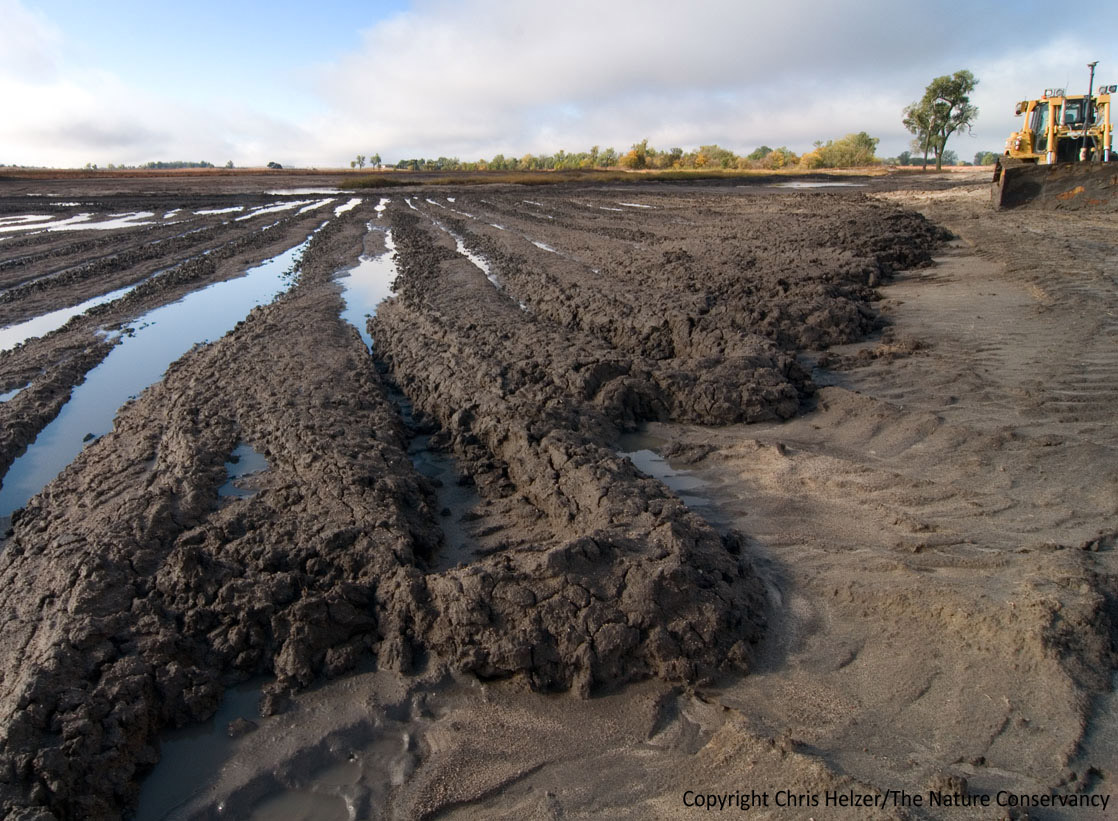
Unfortunately, it turns out that when you fill a lake with sand, the organic matter on the bottom of that lake gets displaced by the fill sand, rather than just covered up by it.  Eventually, when the lake is nearly full of sand, that organic matter becomes concentrated in the little sliver of lake that is yet to be filled in.  The consistency of that saturated, gooey organic matter (sludge) is essentially the same as mucky quicksand.  Oh, and it smells pretty bad too. 
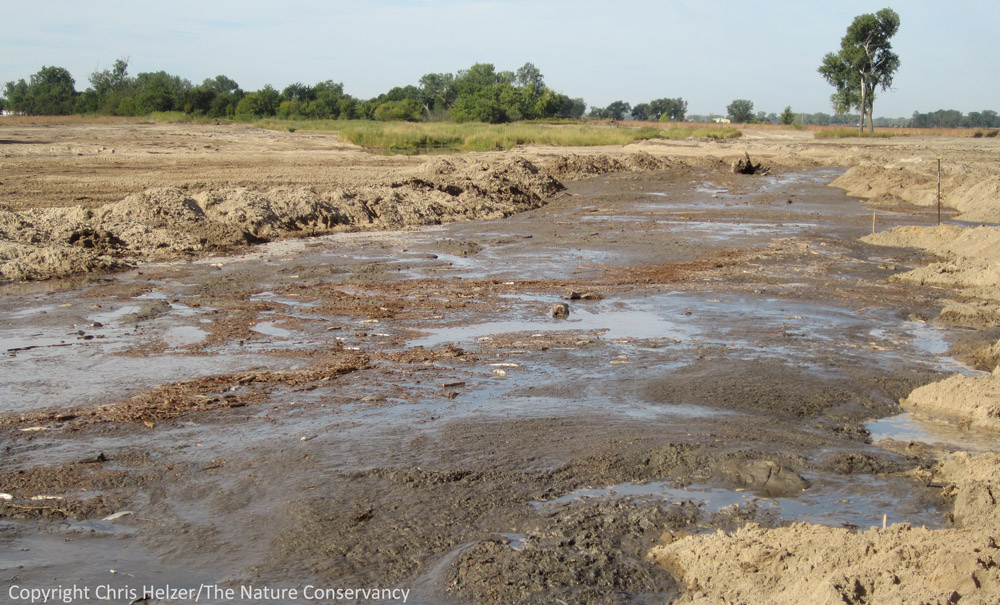
Here's what the sludge looked like when we were nearly done filling the east lake. It was essentially a long trench, filled with slimy, goopy sludge - up to 8 or 10 feet deep. It'd make a great castle moat, but isn't really what we wanted (or safe) for a wetland.

Dealing with this kind of sludge when filling small irrigation pits and other small bodies of water is commonplace for wetland restoration folks (I’m told) but no one around here has ever seen the volume of sludge that we now have at our restoration site.  Lucky us!  So what do we do now? 

We didn’t feel like we could leave the sludge in place, mainly because there are clearly some safety risks involved with leaving a long channel filled with 10 feet of quicksand-like sludge in the middle of a wetland restoration project.  Our immediate solution was to use an excavator to remove the sludge and a bulldozer to spread it out over a large area of the adjacent low-lying sandy soil.  We hoped it would dry out enough we could then deal with it in some way.  At the present time, we have an acre or two of 8-12 inch deep goop on top of sand along one edge of our new stream channel. 
Here's what the sludge looked like right after it was spread out. It covers about 2 acres of the land adjacent to the new stream channel. It's dried out more since then, but is still wet on the bottom. Anyone want to buy some goo?

So, now what?  After considerable discussion, we figure we have at least two choices:

1.) Leave the sludge in place, disk it smooth after it dries sufficiently (it’s getting fairly dry already) and broadcast wetland and wet prairie seed over the top.  One big question about this option is whether or not plants can grow in that organic matter – not knowing what kind of nitrogen concentration (or other chemical issues) we might have to deal with.  The second, more important question, is what the long term consistency of that organic matter will be like, assuming plants grow in it.  The sludge is sitting on sand that will be frequently flooded whenever the stream rises or groundwater comes up during wet seasons.  Thus, the sludge – though drying now – will resaturate fairly frequently.  Will it always be a sloppy mess that people and animals will struggle to walk through?  Or will the roots of the newly established plants mesh together sufficiently that they will “stabilize” the area fairly well?

2.) Remove at least some/most of the sludge and haul it somewhere else.  We could then disk the remaining organic matter into the sand and seed it – with confidence that we could establish a good wet prairie/wetland plant community on the site.  There are several options for how we could remove and haul the material.  We also have a few options for where to take it – including a neighboring farmer, who would be happy to incorporate it into his sandy cropfield…as long as he doesn’t have to pay for it. 

Unfortunately, removing the material is a little logistically complicated (we’d need a track loader that could move through the existing sludge and wet sand without getting stuck, trucks that could haul the material – potentially big manure spreader/dump trucks, and something to spread out and/or incorporate the material at its new location.)  It’s also heavy on cost, and we’re a little light on cash.

This is where you, helpful reader, come in.  I’m hoping that among the wide array of people who read this blog, or to whom this particular post is forwarded – by helpful readers – someone has dealt with a similar situation and can give me some good advice.  I’m going to be collecting some of the organic matter this week, and will do some greenhouse trials to see if wetland seed will grow in it.  That should help answer part of the question about potentially leaving the material in place.  Beyond that, I am really at a loss. 

Help and advice are welcome.  Good-natured ribbing will be grudgingly tolerated.

Thanks in advance.

Trying to Figure Out What We Did Right

When converting crop land to restored prairie, it’s always hard to predict what you’re going to get.  Numerous examples prove that even when you control as many variables as possible – including soil conditions and the rate, timing, and technique of planting – no two seedings turn out alike.  Sometimes, you can use hindsight to explain what happened (weather conditions, herbicide carryover, etc.) but most of the time it’s clear that we just don’t understand much of what’s happening out there.

I’ve been analyzing some data from one particular restored prairie lately, and trying to puzzle out what’s going on.  In this case, the results are good – which is nice.  It’d be nicer, of course, if I could explain WHY things worked so well and then replicate whatever happened…

The Dahms 2000 prairie restoration has turned into one of the most aesthetically pleasing prairies we manage along the Platte. It has tremendous diversity and abundance of wildflowers. Most importantly, its plant diversity is still increasing fairly rapidly after twelve field seasons.

The prairie in question was seeded with a mixture of about 200 plant species onto 69 acres of disked cropland that had been in corn the previous season.  The seed was planted sporadically between December 1999 and April 2000.  Wetlands were added to the site by excavating down close to groundwater and recreating the kind of swale/ridge topography that is typical of nearby Platte River meadows.  Those wetlands and sandy spoil piles (ridges) were seeded with appropriate seed as well. 

All of the seed was broadcast onto the site – some by fertilizer spreader and some by hand (I was experimenting) and no harrowing or packing of the soil was done.  Unfortunately, this was the last year BEFORE I started keeping good records of the amount of seed from each plant species I included in the mixture, so I only have a list of the species we harvested seed from that year.  What I know is that my seeding rate per acre was about 15 gallons of grass seed (mostly big warm-season natives) that was harvested by combine from nearby prairies, and about 1/2 gallon of hand-harvested forbs, grasses, and sedges.  That’s roughly 12 bulk pounds of grass seed and 1/2 pound of forb (wildflower) seed per acre.  I have no idea what germination rates were that year, but it was a pretty light seeding rate compared to what many others around the country use.  Today, our typical mix is a little lighter on grass and includes about twice the forbs.

To cut to the results, this prairie has turned into our most diverse and showy restoration we’ve ever done.  You’d never know we’d used such a light seeding rate of forbs by looking at the site now – its appearance is dominated by big showy wildflowers.  By every measure I use to look at the plant communities of our restored prairies, it comes out high.  I’ve found 178 plant species in the site so far, which is excellent.  The mean Floristic Quality (combination of species number and “conservatism values”) is high, and still climbing rapidly.  It averages twelve plant species per square meter, which is higher than most other restored or remnant prairies in the area.  (Yes, I know that seems like a very low number to you eastern tallgrass prairie folks, but it’s good for out here.  Don’t rain on my parade, ok?)  Twelve years after it was planted, tall warm-season grass species are still not very dominant.  The species found at the highest frequency is big bluestem, and it was only in about 80% of 1m2  plots stratified across the site last June.  In short, it’s a beautiful prairie.  And I don’t know why.

I know most of you are ITCHING to see the actual data tables and graphs, but because there are a few who aren’t, I’m including them as a PDF file, which you see by clicking here.  The PDF also includes a cumulative list of plant species found in the restored prairie.

Flower species such as black-eyed Susan (foreground) and bee balm (pink flowers in the background) are still dominating the plant community in this photo from 2009 (the 10th growing season of this seeding). The lasting abundance of those species is, I think, tied to the lack of dominance by major grass species.

It’s particularly impressive that this seeding turned out so well, because the odds seemed stacked against it early on.  It was seeded right at the beginning of a 7 year drought.  The first several years were dominated (as usual) by weedy species and a few colonizing native species such as Canada wild rye and common evening primrose, but in this prairie those species remained dominant for several more years than is typical.  Once other plant species started breaking through, there were few legumes present – and we don’t typically have problems establishing legumes in our prairies.  Those legumes are still more scarce than in other nearby sites, but they’re increasing over time.  Finally, in about its eighth season, the site stopped looking like a weed patch and matured into something that most people would recognize as a prairie.

As I’ve discussed in other blog posts, I’m still struggling to define success in our overall prairie restoration efforts, but at the scale of individual seedings, there are a couple things I look for.  First, I want to see a good diversity of plant species, and I want to see that diversity sustain itself over time.  Second, I don’t want to see invasive species increasing at the expense of that overall plant diversity, even as the prairie is exposed to disturbances such as drought, fire, and grazing.  So far, this restored prairie passes those tests with flying colors.  We’re moving toward implementing some measures of invertebrate use as well, but aren’t there yet.  Initial data and observations, however, show higher butterfly abundance and diversity in this site than in other nearby restored prairies – for whatever that’s worth.

The prairie has been managed with some periodic fire and grazing, which should be helping to suppress dominant grasses. However, this site has gotten much less of that kind of management than nearby restored prairies, and those other prairies have stronger populations of major grasses, so management can't explain the whole phenomenon. In this photo, cattle are grazing in the burned portion of this site - within a patch-burn grazing system. The grasses are primarily grazed short, helping to showcase the abundance of the forbs.

So why did this restoration turn out so well?  I really have no idea.  It caught a couple nice rains during its first spring, but the rest of the summer was awfully dry.  The overall seeding rate for forbs was considerably lower than we use now, but I don’t know how much seed we had of individual species.  I wish I understood why it has taken the big grasses so long to fill in, but I don’t.  I think the delayed grass dominance probably plays a role in encouraging the abundance and diversity of wildflowers at the site, but I don’t know how to replicate it.  The soils at the site are a little sandier than some of our other sites, but we’ve worked on sandier soils and had very quick grass establishment, so it seems unlikely that the sand is the key.

Besides its aesthetic appeal, the prairie is also a great seed harvest site because of its wildflower abundance. Nanette Whitten (left) and Mardell Jasnowski (right) are harvesting seeds in this photo.

The vast majority of our prairie restorations turn out pretty well, but this one is extraordinary, and I can’t explain it.  Was it something about our technique?  Something about the weather or soil conditions?  I know I should probably just be happy with the results, but I want to know WHY! 

Success is sure frustrating.