
One of our major objectives at the Platte River Prairies is to experiment with and demonstrate various prairie management techniques and strategies. All those strategies are aimed at creating and maintaining plant diversity, ecological resilience, and a wide range of wildlife habitat types. We hope that our work can be useful to private landowners and other grassland managers looking for ideas to incorporate into their own management. However, we don’t expect anyone to replicate exactly what we’re doing because every land manager has their own set of objectives for their land. As an example of how others might incorporate some of the lessons we’re learning into a different setting, I thought I’d share how I’m doing that at my family prairie.
My family prairie is very different from the Platte River Prairies in several respects. First, the Helzer prairie is on hills of loess (pronounced “luss”) soils, whereas the Platte River prairies grow in sandy loam. In addition, most of my prairie was farmland until my grandpa seeded it back to grass in the early 1960’s. There are a few small areas of remnant (unplowed) prairie embedded within the previously farmed area, and some plant species have spread from those. However, plant diversity is still fairly low, so I’ve been supplementing that by adding seed of more plant species over time.

This is one of the more diverse portions of our prairie – a part that was never plowed. It still has plants such as leadplant, stiff sunflower, and many others.
The most important difference between my prairie and the Platte River Prairies, though, has to do with my objectives. At the Helzer prairie, I want plant diversity and wildlife habitat, but I also need strong and steady income from my prairie to cover the taxes and contribute to our family’s finances.
Objectives for the Helzer family prairie:
- Increase plant diversity.
- Create a wide range of grassland habitat types each year (short/sparse to tall/dense and intermediate stages).
- Provide a place my family and I can enjoy. I want my kids to hike, explore, camp out, and learn about prairies and agriculture.
- Make money.
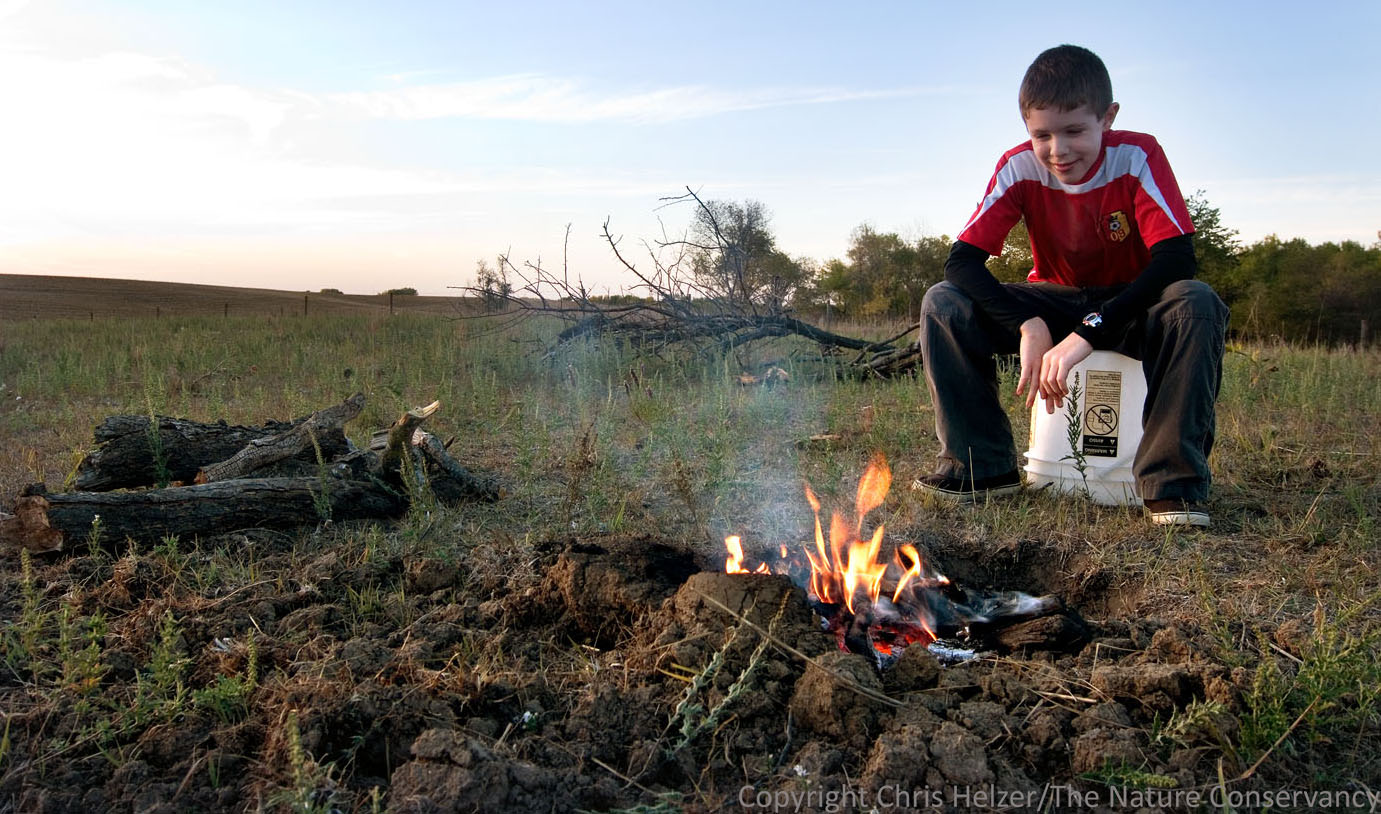
Recreation is one of our objectives for the prairie, but income is also very important.
Challenges:
- Poor soils – much of the organic matter in the soil, especially on slopes, eroded away when it was farmed and even more then 50 years of grassland cover has not rebuilt what was lost.
- Soil erosion. Because loess soils are easily erodible, heavy rain can wash exposed soil from both the crop fields and heavily grazed areas of our pasture, causing a number of problems. No-till farming techniques on the crop fields reduce erosion from them, but we also have to be careful about how we graze the prairie to avoid losing soil from the steeper slopes.
- Invasive species – smooth brome and Kentucky bluegrass are the big ones, and they can become dominant enough to swamp out plant diversity if left unchecked.
- Tree encroachment. Eastern red cedar trees are constantly trying to colonize the prairie. We’ve removed all the big cedar trees from our own property, but others nearby produce seed that birds helpfully carry into our prairie. Deciduous trees such as honey locust, white mulberry, and green ash also spread into the prairie unless we beat them back.
- Habitat fragmentation. Our prairie is truly an island of prairie in a sea of cropland. We own about 160 acres of land, about 50 of which is in crops. That leaves us roughly 110 acres of prairie on which we have to support populations of prairie plants and animals, and we can’t rely on the surrounding landscape as a source of recolonization if we accidentally wipe any of them out.
So, what to do?
Trees
Controlling the encroachment of trees, especially cedar trees, is pretty straightforward – we just cut them down as they come in. We use herbicide on the stumps of deciduous trees, but with the cedars, my kids and I just roam around with loppers and snip the little ones off. As long as we don’t get behind, it doesn’t take too much time, and it’s not hard work.

My son John, when he was 9, helping us clear cedar trees.
Of course, controlling cedars would be even easier if we were using fire, but we’re not. (Surprised?) I’d love to burn my prairie, but there are a two big reasons I don’t. First, I don’t have any equipment for conducting my own burns – not even a drip torch. I could probably borrow some equipment and find some people to help me burn if I really tried. However, the bigger reason I don’t burn is that there are only so many days a year when weather conditions are appropriate for burning, and on those days I’m burning at work! Maybe someday when I retire… In the meantime, we’re getting by with loppers and cows.
Grazing Plans
This is the real heart of our management, and the part that takes the most thought and adjustment over time. The first consideration every year is drought. We live in a part of the country where droughts are frequent, and drought impacts our prairie particularly strongly because we have so little organic matter (which helps hold soil moisture) in the previously farmed portions. As a result, I assume every year will be a drought year until I’m proven wrong, and my stocking rates are based on that assumption. If we have a wet year, I can increase our stocking rate the next year to take advantage of the bonus root reserves produced by “undergrazed” grasses. However, by stocking relatively conservatively, I can usually get through very dry years without overgrazing or putting an undue burden on my renter by making him pull his cattle off early.
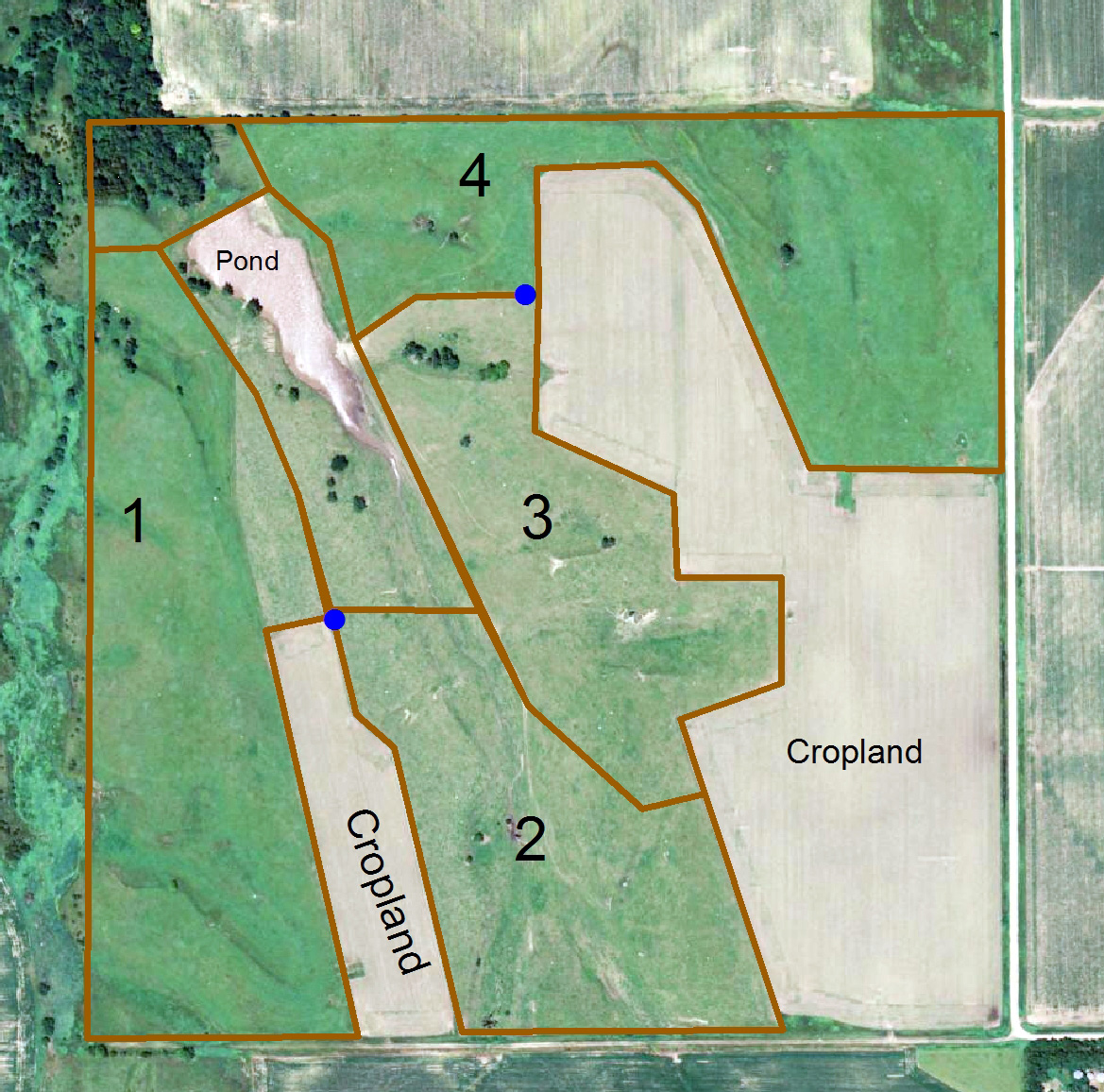
A map of our 160 acres of land, including both cropland and grassland. The prairie is split into four main pastures. The blue dots show water tanks that we recently installed.
Apart from drought, my main grazing strategy is to incorporate the concept of a “shifting mosaic of habitat types” across my prairie. In the Platte River Prairies, we often accomplish this with various patch-burn grazing techniques, but I don’t use fire on my own prairie. Instead, we have the prairie split up into four main pastures (and a couple smaller sites in and around the pond/wetland that are rarely grazed). The way we utilize those four pastures changes every year based on what happened the year before and on short-term objectives, but there is a basic framework (shown below) I’ve been using for the last several years.
TEMPLATE GRAZING PLAN FOR THE HELZER PRAIRIE
Year 1 Year 2
Late April – Early May: Pasture #1 Late April – Early May: Pasture #2
Early May – June 1: Pasture #2 Early May – June 1: Pasture #3
June 1 – July 15: Pasture #3 June 1 – July 15: Pasture #4
July 10 – October 1: Pasture #’s 1, 3, and 4 July 10 – October 1: Pasture #’s 1, 2, and 4
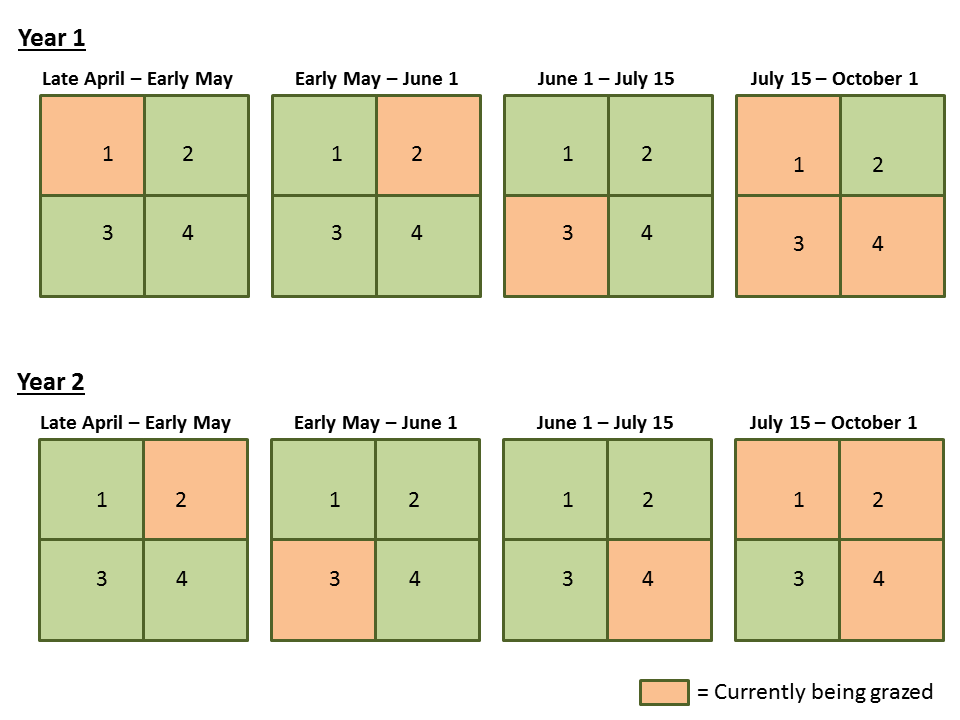
A graphical illustration of my grazing plan framework.
During Year 1 in the above example, pastures 1 and 2 are grazed early to knock back brome. Pasture 3 is then grazed until mid-July. For the latter half of the season, cattle have access to three pastures, but will continue to graze pasture 3 most intensively. This is because the vegetation in pastures 1 and 4 was ungrazed during June/July and reached a later stage of maturity (and is less palatable) than that in pasture 3, which is still relatively young and tender because of the grazing. In other words, the earlier season grazing stimulates later season grazing.
This creates a system somewhat similar to a patch-burn grazing system, but without the use of fire. Pasture 3 gets grazed intensively for most of the season in Year 1, but pastures 1 and 4 provide “overflow” grazing to help ensure that pasture 3 isn’t grazed excessively. That overflow also seems to limit wildflower grazing because the cattle aren’t forced to eat only from one pasture and can wander more broadly to find what they really want – mostly grass.
In Year 2, pasture 3 is rested (after a brief spring grazing bout to suppress brome) and pasture 4 has a year of intensive grazing. The pattern continues in Year 3 and Year 4 and then (probably) starts over. When everything works as planned, there’s always one pasture that’s short, one that’s got fairly tall vegetation, and another one or two in various phases of recovery from being grazed in previous years. Even plants strongly sought after by cattle get a chance to bloom and reproduce at least once every four years, and most bloom much more often.
I’ve had to adjust my approach to grazing over time to be sure I don’t overexpose the prairie to soil erosion. As a result, I graze a little less intensively than we do in our (mostly) flatter/sandier Platte River Prairies. I really like the plant diversity and habitat results I get from season-long intensive grazing and multi-year recovery periods, but have had to moderate that somewhat as I’ve learned more about what the soils can take. I still take the grass pretty short, but limit the length of time it’s kept that short – especially in parts of the prairie most prone to soil erosion.
Overseeding
Introducing seed to increase plant diversity over time is an important part of our restoration/management process. My grazing management is facilitating the spread and survival of the plant species we have, but there’s limited abundance and diversity to work with. My kids (sometimes) help me harvest seeds from around the county during the summer and fall. During the winter, we broadcast those seeds in the pasture most heavily grazed during the previous year – where they can make contact with the soil where they fall. That pasture is typically grazed the next spring, and then rested for the remainder of the year. As a result, seedlings have a decent chance of survival because the surrounding vegetation was weakened by grazing, but they are not exposed to (much) grazing during their first season of growth. So far, results from overseeding have been encouraging – we’re just limited by the time we have to harvest seed.

Here’s Daniel, throwing seeds into an area that was grazed intensively the previous season.
By far, the most critical aspect of my management is adaptability. While there is a basic framework for our grazing management, I don’t hesitate to stray from it in order to react to drought or invasive species concerns, or because it just looks like we need to try something different. The pasture that gets the most intensive grazing each year is the one that has recovered most fully from its last intensive grazing bout. That recovery time depends upon the stocking rate when it was grazed and the weather during and after that grazing period. Most importantly, I try to ensure that all the plant species in the prairie are allowed to bloom at least once every few years (without getting their flowers nipped off) and that we always have a wide range of habitat structure (short, tall, and recovering vegetation) across the prairie. If I see issues with either of those conditions, I adapt my grazing management accordingly.
There is no cook book for how to manage a prairie because every prairie and every prairie manager’s objectives are different, and those unique conditions require unique strategies. However, I do think there are broad lessons about how to facilitate wildlife habitat and plant diversity (such as the “shifting mosaic of habitat patches” idea), and those lessons can be applied to almost any situation. The trick is to figure out how to adapt them for an individual site and set of objectives, and to continue adapting them as weather and other conditions change. In my case, I’ve come up with a system that works pretty well for my particular prairie and objectives, as well as with the time and equipment I have.
As I said earlier, I don’t want people to replicate the management we’re using in the Platte River Prairies. Instead, I am always thrilled to hear that other land managers have picked up ideas from us and incorporated them into their own grassland management. Hopefully, those ideas have helped those land managers increase plant and wildlife diversity on their land, while still meeting their other objectives. That would make me very happy.

 The Prairie Ecologist