Photo of the Week – March 13, 2014

Here are two photos that caught my attention as I was going through timelapse imagery the other day…

In my last post, I showed some timelapse photos from a fenceline at The Nature Conservancy’s Niobrara Valley Preserve in north-central Nebraska.  At the time, I promised a good story about the trail that developed on the cattle side (right side) of the fence.  As a reminder, the fence in these photos was installed in what had been a cattle pasture, but the left side is now grazed by bison (light stocking rate) and the right side is grazed by cattle (moderate stocking rate).  More details on the stocking rates below…

The first photo in which cattle appear in their pasture is this one, taken on June 21 at 6:36 pm.

Cattle

June 21, 2013.  6:36 pm

Notice the absence of a cattle trail in this first photo.  Then look at the photo below, which was taken ONE HOUR LATER.

trail

June 21, 2013.  7:41 pm

Seriously?  A trail formed the very first time cattle walked along the fenceline??

I’m not surprised or bothered by the development of the trail, but I’m relatively shocked that it only took one pass by cattle to make it!  I would have expected the gradual development of a path over a few weeks.  On the other hand there were 110 cows and 110 calves in the pasture.  Rich Walters, Niobrara Valley Preserve manager, pointed out that if all those cattle followed the fence line in single file formation, that was 880 hooves stepping on those relatively loose sandy soils.  I suppose that would have an immediate impact.

Here’s one more surprise.  The cattle were brought into this pasture on June 2.  Why did it take until June 21 for them to (apparently) make their way to the north edge to graze and then create a trail?  I can’t say for sure that they hadn’t explored this part of the pasture prior to the 21st, but there isn’t any indication of grazing impact in the timelapse photos taken between June 2 and June 21.  It may be that the cattle had enough forage further south (and closer to their water tank) that they just never wandered very far, but I would have expected them to have made an exploratory pass around the pasture within the first few days – just to see what they had to work with…

Before I go further, I’m sure some people are already mentally condemning cattle for their trail-making and other faults, but that’s not the point I’m making here.  As I wrote in a recent post, I think cattle are very useful as prairie management tools, and are comparable to bison in most respects – though the formation of these narrow trails is certainly one difference between the two animals.  Sure, cattle trails can cause problems, especially in chronically overgrazed sites with steep slopes and erodible soils, but the vegetation beneath cattle trails can also recover pretty quickly if given the chance.  In the meantime, trails can provide valuable habitat for reptiles and invertebrates looking for a place to warm up in the morning sun, and are used as transportation corridors by many other animals besides cattle.

Oh, and in case you doubted me, the photo below proves that there truly were bison on the left side of the fence in 2013, though their numbers and the relative size of their pasture to the cattle pasture on the right created a very different grazing environment.
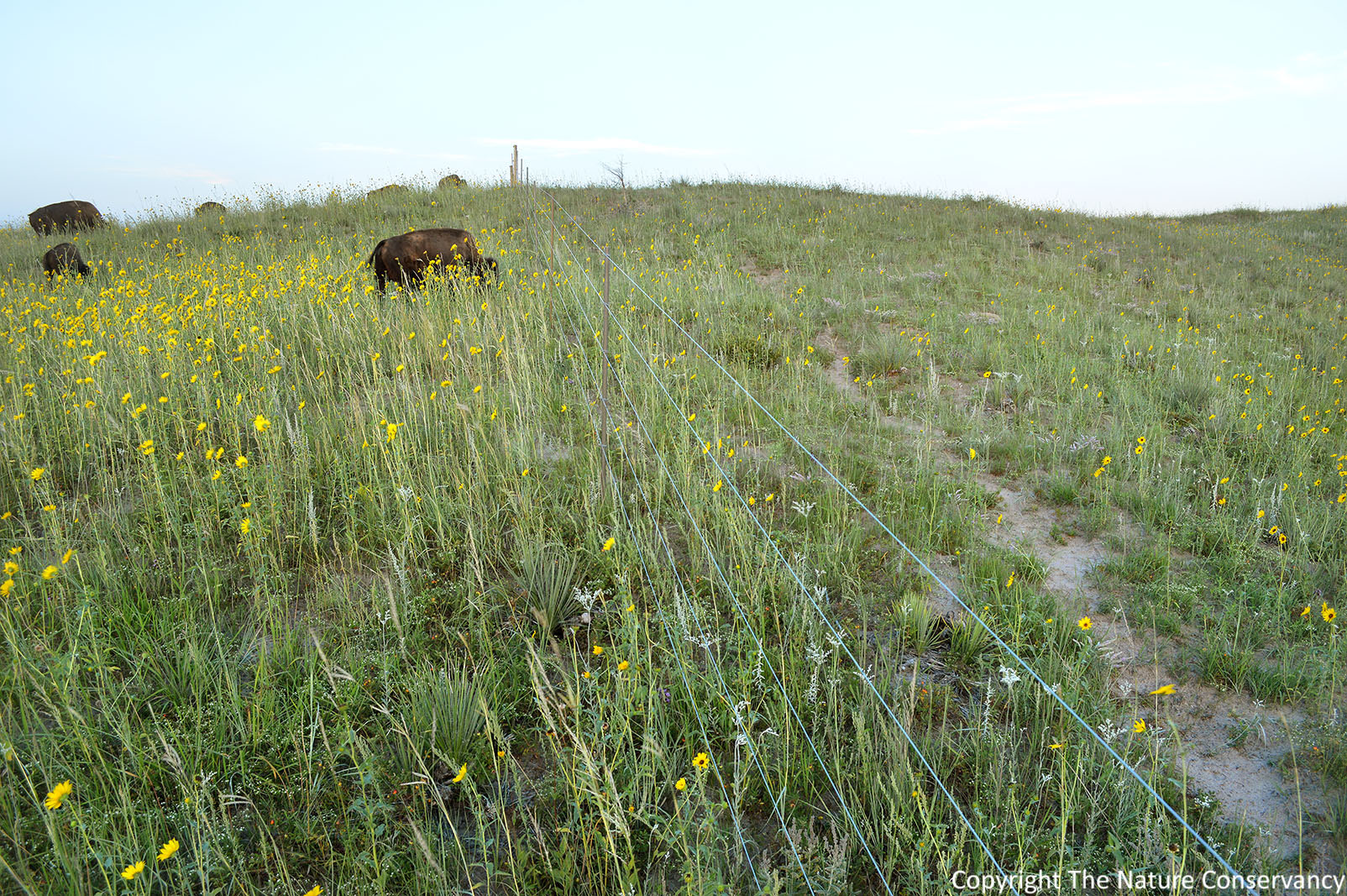
Bison grazing on the left side of the fence.  August 10, 2013

Bison grazing on the left side of the fence. August 10, 2013

The two sides of the fence looked pretty different from each other by the time cattle were removed, in terms of vegetation height and density.  After my last post, several of you asked about the stocking rates on each side.  There were approximately 225 bison (cows, calves, and bulls) in the 10,000 acre bison pasture to the left of this fence in 2013.  They were grazing year round, but had plenty of room to roam since the Preserve staff had cut back their numbers pretty drastically following the big wildfire in 2012.  At that stocking rate, bison didn’t graze very intensively in most parts of the pasture, including the area shown in this photo.  On the cattle side of the fence, the 110 cow/calf pairs were restricted to only 640 acres of pasture.  Even though they were only in the pasture for about 5 weeks (June 2 – July 12), that’s still a much higher effective stocking rate than that in the bison pasture.  The difference in the height of vegetation between the left and right sides of the fence, then, is due to stocking rate, not grazer species.

I’m already learning an awful lot from looking at the first year of timelapse imagery at the Niobrara Valley Preserve, and much of what I’m learning has been unexpected.  The rapid formation of a cattle trail is a great example.  I’ll be sharing another example within the next week or two, though it’s more of a mystery than a lesson at this point.  For now, I’ll just tease that post by saying it has to do with a stick that moves by itself…  You can have fun thinking about that for a while!

Just When I Think I’ve Got Something Figured Out…

I pay close attention as I walk through prairies.  I watch for tracks to see what animals are around and I notice which flowers are blooming and which insects are feeding on them.  Often, I notice changes in prairie plant communities and try to attribute them to our management treatments, weather patterns, or other factors.  Observations such as these are an important part of how I learn more about prairies and adjust the way we manage and restore them.

Observations are a critical component of understanding natural systems and how management and restoration actions affect them.

Careful observation helps ecologists and land managers understand how natural systems work and how they are impacted by management actions.  However, observations are tricky because they provide an incomplete picture of what’s happening and are influenced by personal bias.

Unfortunately, observations are inherently biased.  When I start to notice a pattern through observation, I construct a theory to explain it.  That’s good science.  However, once I have a theory in mind, it influences the way I see things – and I tend to interpret my observations based on my theory.  That means it’s pretty easy to start telling myself a story that sounds good, but isn’t actually true.  Sometimes, I figure out that my story is wrong through repeated observations.  More often, however, what causes me to stop and reconsider is cold hard data.  Here’s a recent example of my data showing me that I need to reconsider a theory based on observations.

Canada wildrye (Elymus canadensis) is a native cool-season grass that establishes very quickly from seed in our prairie restoration (cropfield conversion) work.  It is often very abundant during the early years of a seeding before settling down into the plant community after a few years as other prairie plants become more dominant.  A common complaint from those working with Conservation Reserve Program (CRP) or similar prairie seeding projects is that wildrye tends to disappear a few years after planting, leading people to question the value of including the species in the seed mixture.  However, in our restored prairies, I’ve observed that while Canada wildrye declines in abundance after the initial establishment phase of a seeding, it seems to persist pretty well at a moderate abundance from then on.  I’ve attributed that to our grazing management, which is partially aimed at periodically decreasing the vigor of dominant grasses.  Weakening dominant grasses should help prevent less dominant species such as Canada wildrye from being pushed out of the community altogether.

Canada wildrye  is a native cool-season grass that is common in our restored prairies.

Canada wildrye is a native cool-season grass that is common in our restored prairies.

So, my theory (which I’ve shared with many people) has been that Canada wildrye is a grass species is tied to disturbance regimes.  If a prairie is managed with a mixture of intensive grazing periods and rest periods, wildrye can sustain a fairly steady population.  It was a good theory, and seemed to fit my observations.  Until last week, I was pretty happy with it.  Then I looked at some recent data.

One

These data were collected from about a hundred 1 meter square plots across a prairie.  Each time I laid down the plot frame, I listed the plant species found within it.  By looking at the data from all of the plots, I can calculate a frequency of occurrence for a plant species (the % of all plots it was found in).   The data in this graph were collected from a restored prairie seeded in 2002.

.

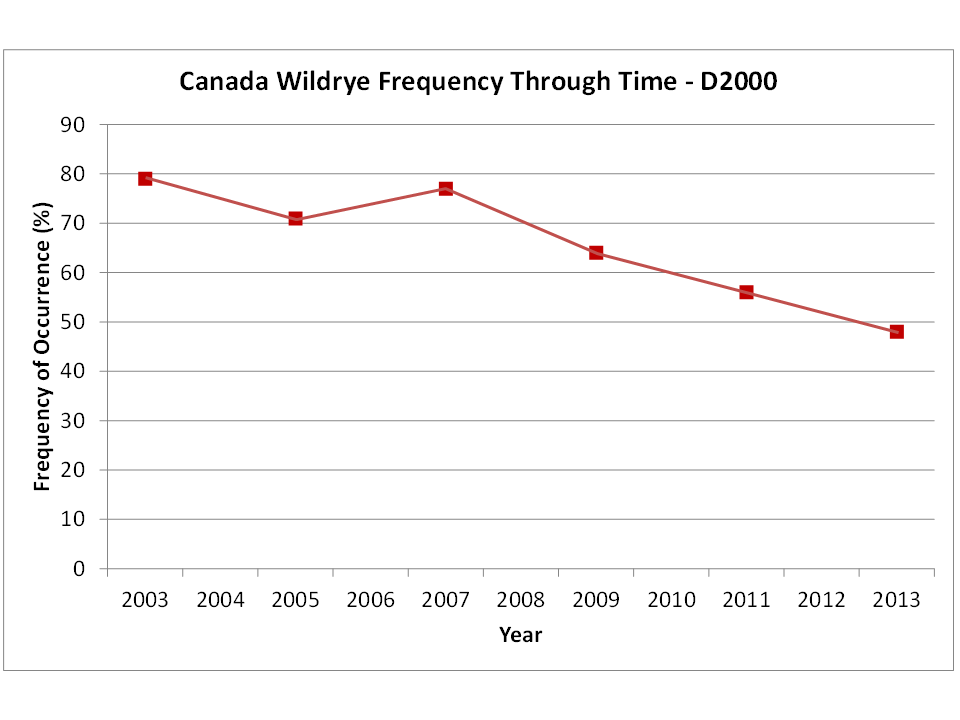
Two

These data were collected from a restored prairie that was seeded in 2000.

.

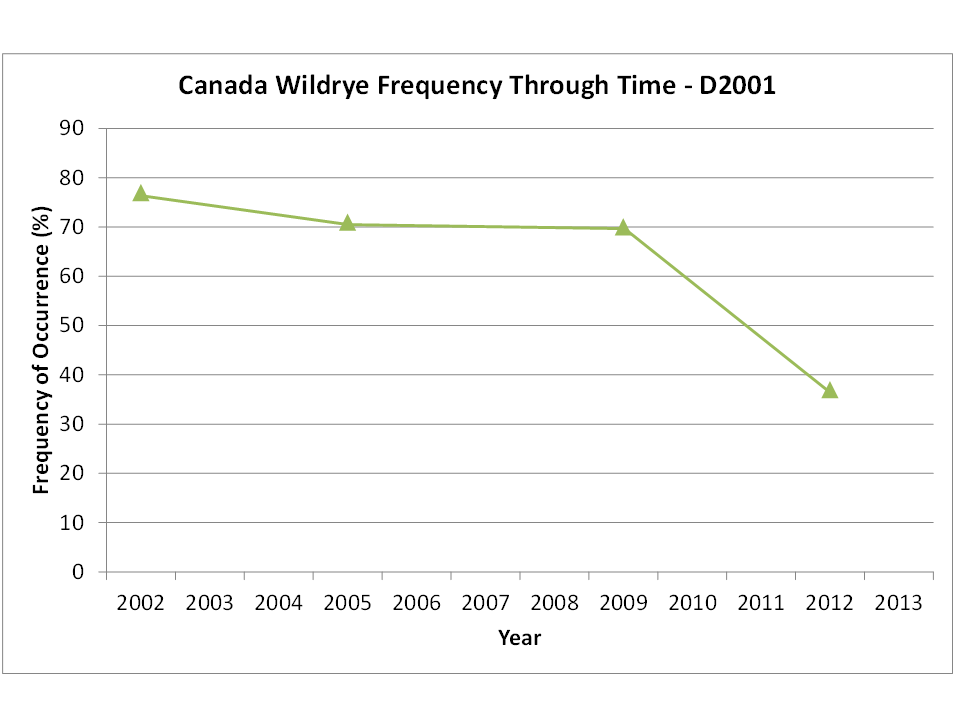
three

More data – this time from a restored prairie seeded in 2001.

From looking at the above three graphs, you might conclude that Canada wildrye populations stayed high for the first eight or nine years after planting a restored prairie and then started to taper off.  Another interpretation might be that our grazing was able to prop up those wildrye populations for a certain amount of time, but it is now starting to suffer the same fate my colleagues have complained about in CRP plantings.

Now, consider this next graph.

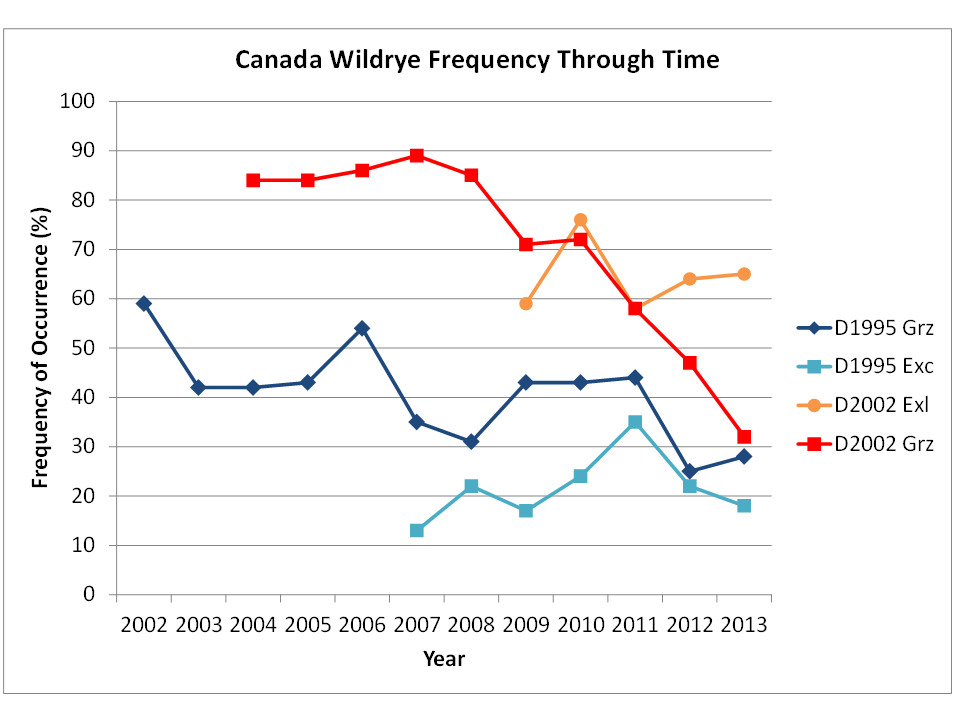
four

This graph shows data from the same 2002 planting as shown in the first graph (red lines in both graphs).  In this graph, however, the orange line is data from a large exclosure at the same site that has been burned but never grazed.  The two blue lines are from a different restored prairie seeded in 1995.  The dark blue has had fire and grazing management since 2002, while the light blue line is from a large exclosure at that site that has never had grazing within it.

By looking at the red and orange lines you might conclude that grazing management had a strong negative impact on Canada wildrye in the 2002 planting between 2011 and 2013.  The lines from the grazed portion of the site (red) and the exclosed portion (orange) are heading strongly in opposite directions.  However, the site was also grazed in 2008 and 2009, and there is less difference between grazed and exclosed in those years.  In addition, the blue lines on this graph show data from populations in a different nearby restored prairie (seeded in 1995) which don’t seem to be strongly affected by whether or not they are grazed.  There is less wildrye in the ungrazed exclosure of that 1995 planting but the changes in frequency seem pretty similar between the grazed and ungrazed areas.  Hmmm…

five

This graph shows data from two of the sites shown earlier (2000 and 2001 plantings) as well as another nearby restored prairie that was seeded in 1999.  Despite very similar management regimes, the 1999 restoration seems to be maintaining a high population of Canada wildrye.

This last graph just muddies the water even more.  While populations in the 2000 and 2001 restoration seem to be declining over time, wildrye frequency in the 1999 restoration has been holding steady for 15 years.  All of these sites are within a mile or two of each other, were planted with the same kinds of seed mixtures and have been managed with very similar mixtures of periodic fire, intensive grazing, and rest (modified patch-burn grazing).

It’s possible that soils play a role in the differences between sites, but all the prairies above are on similar alluvial (river deposited) soils.  None of them seem all that different from each other (I need some data on that!).  Weather could also be a factor, though most of the declines seemed to start around 2008 or 2009 – a few years after a long drought period – and have continued through both wet and dry years since.  I’m not sure what weather factors might have popped up since 2009 that would cause a decline in wildrye abundance (and only at some sites).

Surprise!  Reality is more complicated than a simple cause and effect relationship between a management regime and a plant species…

I take two major lessons from this.  First, I need to be more careful in my assumptions about how our management is impacting prairies.  That’s nothing new – I fall into that trap all the time, and frequently have to remind myself not to overgeneralize.  In this case, I had constructed a logical story explaining why Canada wildrye was abundant in our well-established (old) restored prairies but rare in ungrazed plantings such as CRP fields.  There are, of course, many possible explanations for that phenomenon (differences in soil types, plant diversity, seeding rates – particularly of warm-season grasses, fire management, etc.) but I grabbed one simple explanation without adequately considering all those other factors.

The second lesson is that it’s dangerous to rely solely on observations when trying to figure out natural systems.  This is not a new lesson either, and it’s why I try to collect as much data as I can.  Observations are really important, but are easily biased by what we think is – or should be – happening.  It’s natural to see what you expect to see.

Collecting some unbiased data, even just a little, is well worth the effort – especially if you target the data collection to your objectives.  It’s not useful to just collect data for the sake of data, but if you have a specific question (“are we maintaining diverse plant communities in our restored prairies?”) data can help answer it.  I consider plant community data collection to be a very important part of my job, but it doesn’t actually take that much time.  It takes about a day per year for each site I sample, including data collection, data entry, and analysis.  I strongly encourage every land manager to collect some kind of data from their sites.  It doesn’t have to be complicated or time consuming – just something that can help evaluate how management treatments are working.  Observations are great, but unbiased data is a good way to make sure you’re telling yourself (and others) the right story.

I’m not sure what to think about Canada wildrye now.  It’s a little disappointing to find out that my story was wrong – or at least incomplete.  On the other hand, the complexity of interactions that apparently drives Canada wildrye populations are why I love prairies and prairie management.  If it were simple, it’d be boring.

And no one likes a boring story.