Habitat Heterogeneity in One Photo

I was featured on a podcast episode that came out today. I’ve enjoyed being a guest on quite a few podcasts, but I think this one might have produced the best synthesis of many of my thoughts on prairie management. If you’re interested in listening to it, check out the Wild Ag Podcast on your favorite app or click here.

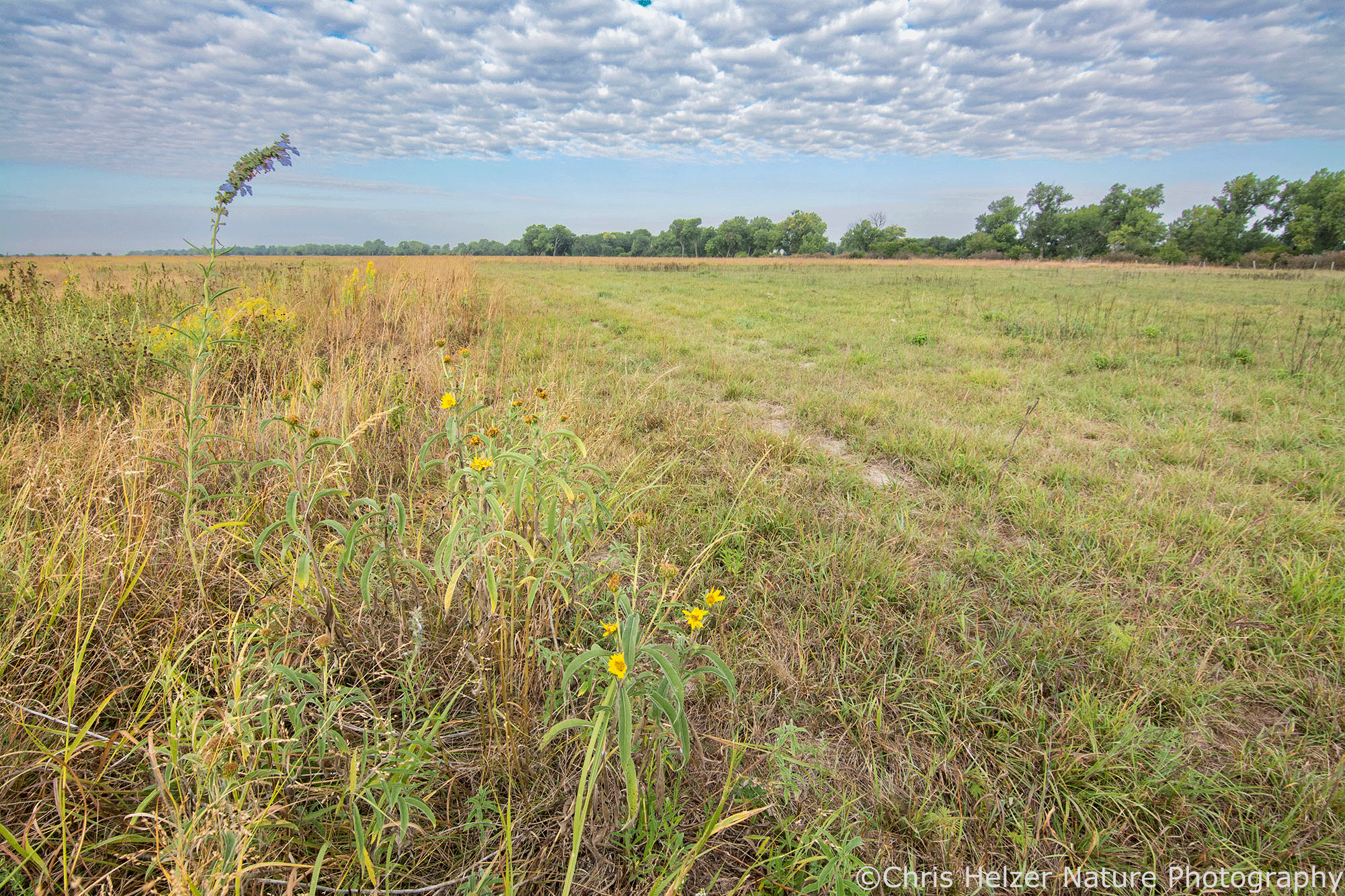
A variety of habitat conditions across one swath of grassland at The Nature Conservancy’s Platte River Prairies in Nebraska back in 2023. Click on the photo if you want to see a bigger version.

Speaking of prairie management, as I was preparing a presentation on the topic last week, I came across an aerial photo I’d taken a couple years ago at our Platte River Prairies. The image does a great job of illustrating what habitat heterogeneity can look like across one management unit.

Variation in available habitat conditions (habitat heterogeneity) can be created by many factors. Some of those factors are unrelated to our actions as land managers. Topography, soil texture, and soil moisture, for example, all have big influences on what plant species can grow in a particular place. The same conditions can also drive the height and density of plants – high/dry/south facing slopes will have much shorter/sparser vegetation than low-lying/moist valleys, for example.

In the photo shown above, that influence can be seen in at least a couple ways. First, in the foreground of the photo, there are yellow stripes created by concentrations of blooming perennial sunflowers and goldenrods. Those plants are spread throughout the site, but are most lush and abundantly flowering in soils laid down by old river channels hundreds/thousands of years ago when this part of the prairie was part of the active Platte River.

Similarly, in the top part of the photo, you can see a broad slough that looks slightly darker than the surrounding vegetation. That slough is also an old river channel and has not only different soils, but is also lower in elevation and closer to groundwater, which helps determine both the plant species growing there and the height and vigor of those plants.

The management history of this site also plays a big role in the available habitat today. The top portion of the photo is unplowed (remnant) prairie, though it had some years of chronic overgrazing that decreased its plant diversity before The Nature Conservancy acquired it. We’ve replenished some of that lost plant diversity by overseeding missing species, but the plant community is still not what it was. On the other hand, it does have a very strong native sedge community and a pretty nice set of early season wildflowers that aren’t in the portion of prairie shown at the bottom of the photo.

That area shown in the lower portion of the photo was in row crops for years before being planted (not by us) back to grassland with a few wildflower species. Since then, it has increased in plant diversity, but no botanist would mistake it for an unplowed remnant prairie. It provides excellent habitat for many animal species, but has obvious differences from the adjacent remnant site.

Finally, the most dramatic variation in vegetation structure at the time this photo was taken was driven by recent management actions taken by Platte River Prairies manager Cody Miller and others. The entire prairie shown in the photo had cattle on it during the year of the photo (and in prior years). However, the grazing pressure across the site was very uneven, driven by prescribed burning.

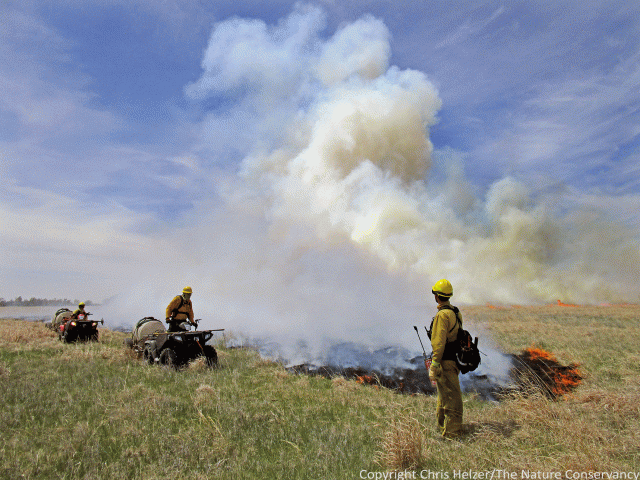
In 2023, a spring fire was conducted in the area shown in the foreground, and a late July burn took place near the top right of the photo. When the 2023 growing season started, cattle focused most of their grazing in the recent spring burn, keeping that vegetation short and allowing plants elsewhere to grow tall. After the smaller August burn took place, cattle shifted some of their grazing there, reducing grazing pressure on the spring burn – which is partly why the sunflowers are blooming so abundantly. If you’re interested, you can read more about that summer fire and see more photos of it here and here.

Meanwhile, most of the remainder of the site had lots of tall vegetation and relatively thick thatch (accumulated dry vegetation from previous years’ growth) because it hadn’t been burned recently and had recovered from previous grazing bouts.
This mid-September photo shows part of the remnant prairie, with unburned grassland on the left and the summer burn on the right. The two areas provide very different habitat conditions for plants and animals, each of which is valuable.

As a whole, this management unit (roughly 500 acres, with more prairie across the creek to the north – out of frame to the right) provided a wide variety of habitat conditions for the plants and animals living in it back in 2023. Last year, in 2024, we burned yet another patch, which shifted grazing pressure to a new portion of the site and allowed the 2023 burned areas to start growing tall again. New management treatments in 2025 will continue to shift things around, while maintaining the same kind of habitat variety – just in different places.

If you missed it, I talked much more about habitat heterogeneity and why it’s important in this recent post. Our primary objective for the Platte River Prairies is to sustain high ecological resilience, which relies heavily upon species diversity (animals, plants, and more). We’re working under the assumption that providing a constantly-shifting mosaic of habitat types is the best way to support that species diversity.

There’s a lot of science that backs up that shifting mosaic assumption, but we try to test it whenever we can. Plant diversity has been very stable over the last 20 years or so on the sites I’m able to monitor closely. Habitat use by wildlife, including insects, is harder to quantify, but what we’ve seen has been positive. Birds species appear in different places each year, but all the species we’d expect to see always show up. Similarly, regal fritillary butterflies and other insect species seem to be doing well, but follow their favorite habitat conditions around the site. The plains pocket mouse – a species of concern in this part of the world – maintains surprisingly consistent populations, regardless of our management actions.

We’re always looking for researchers who’d like to help us look more closely at any aspect of the system – let me know if you’re interested! In the meantime, we’ll keep experimenting and learning the best we can.
Open Gate Rotational Grazing

An alternative approach to facilitating wildlife and plant diversity in grazed prairie.

UPDATE as of October 2022 – since writing this in 2017, we’ve gained five more years of experience with this and it’s still working very well.  In addition to seeing great habitat heterogeneity, we also have pilot data on soils that look great and have embarked on a four year project to look more deeply (haha) into that subject.  I gave a 20 minute presentation on the approach at the 2022 Great Plains Fire Summit, which you can watch here if you like. 

Based on the last 20 years of experience and data collection, the shifting mosaic approach to habitat management seems to support plant and animal diversity and foster ecological resilience in our prairies.  One of the most important parts of our shifting mosaic management is that each patch of prairie goes through a progression of season-long intensive grazing, followed by a multi-year recovery period.  At any time, only part of a prairie is in each phase of the system (intensive grazing, early recovery, late recovery), so there is always a variety of habitat structure available (short, “weedy” and tall) for wildlife.  In addition, as that grazing/recovery progression occurs, plant species experience a different set of growing conditions each year.  Regardless of its competition ability or strategy, each plant is ensured favorable conditions for its growth and reproduction at least once every few years.  Based on our long-term data sets, our management has sustained plant species richness, and both conservative and opportunistic plant species are persisting in our prairies.

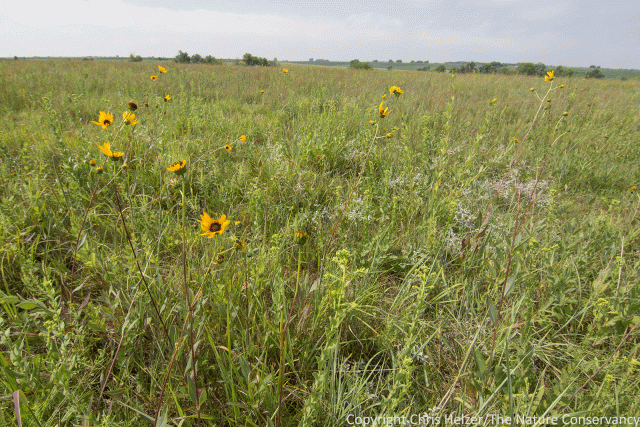
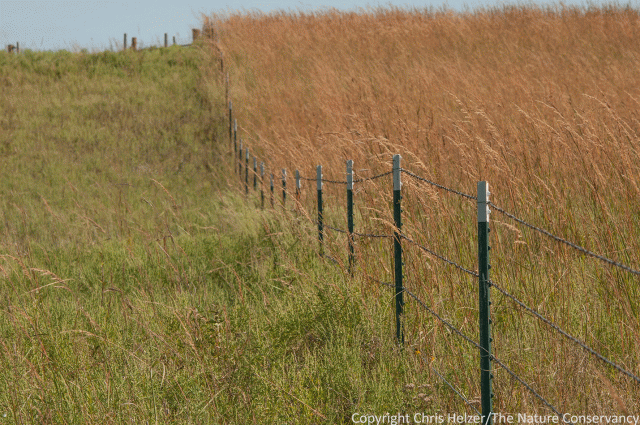
A fenceline contrast at our family prairie shows the kind of habitat heterogeneity found in a shifting mosaic approach to prairie management.

Patch-burn grazing is one way to create a shifting mosaic, but it’s certainly not the only way.  While patch-burn grazing has some attributes that make it easy to implement (no need for cross fences or moving animals during the season), it does require regular application of prescribed fire, which can be difficult for some landowners.  In addition, patch-burn grazing is very different from the kinds of rotational grazing systems many ranchers are comfortable with and have set up their pastures for.  We’ve been experimenting with an approach to creating a shifting mosaic that keeps many of the wildlife and diversity-friendly attributes of patch-burn grazing but might fit better within the comfort zone and logistical framework of many ranchers.

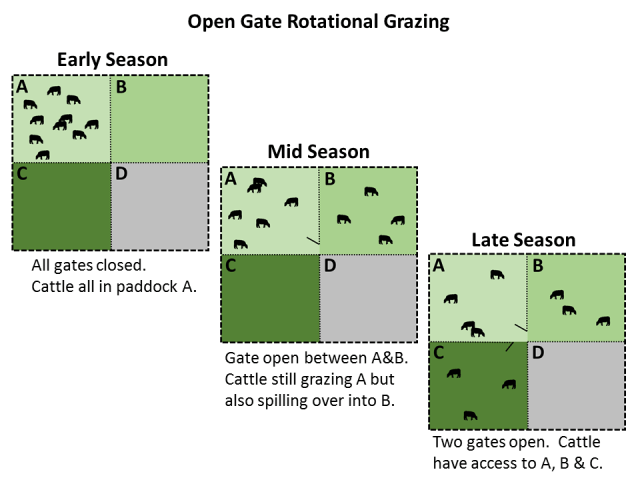
For lack of a better idea, I’m currently calling this approach “Open Gate Rotational Grazing”.  It is not a rigid prescribed grazing system, but rather a general and adaptable way of managing multiple grazing paddocks within a prairie.  It’s similar to a traditional deferred grazing strategy, but with one big difference.  In most rotational grazing systems, cattle are moved from one pasture to the next, closing the gate behind them to allow the previous paddocks to rest.  In the open gate system, when cattle are presented with their next paddock, the gate behind them remains open – allowing the cattle to continue grazing the initial paddock even as they have access to new grass.

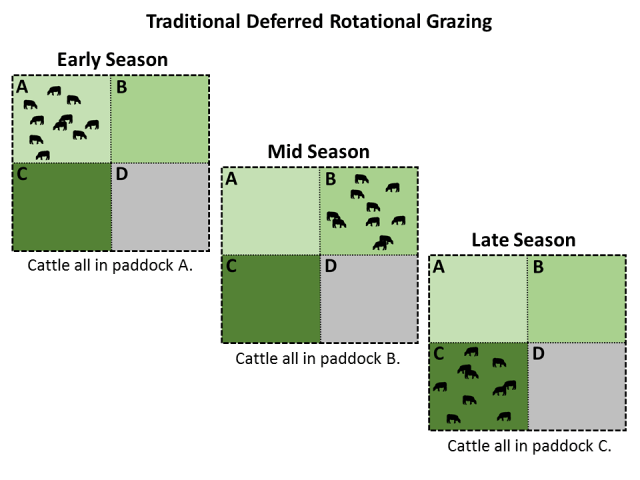
In a traditional rotational grazing system, cattle are progressively moved through a series of paddocks, closing the gate behind them.  In a deferred rotational system, at least one paddock is usually rested for the season.

Under an open gate approach, gates are left open when new paddocks are made available, allowing cattle to graze both the new paddock and the one(s) they had been grazing before. 

The idea started one year when we weren’t able to get a burn done in a prairie under patch-burn grazing management.  Since we didn’t have a burned patch to focus cattle grazing, we instead used electric fence to concentrate the cattle in the area we’d hoped to burn.  We kept them in the enclosure until they had it grazed pretty short.  Then we removed the electric fence and allowed cattle to access to the whole site.  For the remainder of the season, the cattle continued to focus most of their grazing in that former enclosure, attracted by the tender regrowth.  As a result, the overall grazing pattern was fairly similar to what we’d expect with patch-burn grazing.  Seeing how strongly cattle were drawn back to where they’d grazed earlier provided the seed for the open gate rotational system.

On my family prairie, I’ve been using the open gate approach for the last several years.  I have four paddocks, and I basically think of the gates between those paddocks as relief valves.  We start with the cattle in one paddock, and when they have grazed most of the grass down in that pasture, I open the gate to an adjacent paddock so they have more options.  The cattle can keep grazing the regrowing plants in paddock #1, but they aren’t forced to eat more than they want to in that paddock because they have another whole paddock available to them.  If the cattle graze down most of the plants in the second paddock, I can open a gate to a third paddock and provide them with even more options.  I keep the fourth paddock closed off for the entire season so it can rest.

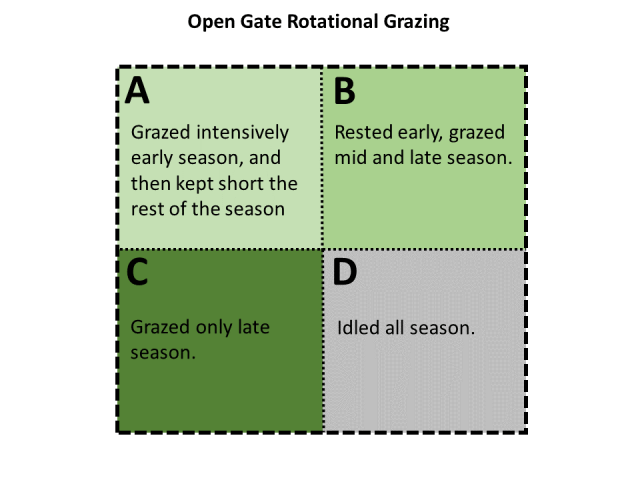
The result of an open gate approach is that one paddock is grazed all season long, one is rested all season, and the others have intermediate levels of grazing.  This results in heterogeneity of habitat structure as well as a wide range of growing conditions for plants.  Each year, grazing starts in a different place, shifting the disturbance regimes among the various paddocks.

In the above example, paddock A would rest the following season and the grazing rotation would start with paddock B.  Paddock A would rest for a full year and most or all of the next year, giving it lots of time to recover vigor.  The grazing pattern for each paddock is as follows: grazed 2nd half of the season, grazed all season, rested, rested/grazed only late season if needed.

The open gate approach can be used with just about any rotational grazing system, as long as there are adjacent paddocks that can be opened up.  One key component of the open gate approach is that paddocks grazed early in the season continue to receive grazing pressure for the rest of that season without forcing cattle to eat progressively lower quality forage as the season goes on.  Instead, cattle can regulate their diet freely, choosing between previously grazed areas and those they haven’t yet grazed.  Typically, when cattle are given that kind of choice, they eat very little other than grasses.  This works out well for pollinators because it means many wildflowers are allowed to grow and flower amongst grazed grasses.

At our family prairie, the open gate approach seems to be helping with our continuing quest to increase plant diversity in areas formerly dominated by grasses.  New plants are introduced via overseeding (after a season of intensive grazing), and then persist under our grazing management.

In the open gate system, there is great flexibility about when, and how intensively, each paddock is grazed each year, though some of that flexibility depends on how the paddocks are arranged.  Ideally, all the paddocks would be connected through a single hub so the manager can choose to open any gate to any pasture, as needed.  However, my family prairie doesn’t provide that amount of flexibility (the four paddocks are arrayed in a donut-like loop, with no way to connect them through the donut hole) and the approach still works.  Most of the time, the paddock grazed most intensively one year gets complete rest the next.  However, the pattern of grazing each year always depends upon how I think recovery from previous years’ grazing is going.

I think there are great benefits to longer grazing periods and longer rest periods than are typically found in rotational grazing systems.  Certainly, those prolonged grazing and rest periods can provide a greater variety of wildlife habitat conditions, especially on the shorter and taller ends of the vegetation structure spectrum.  In most rotational grazing systems, cattle are moved out of a pasture before grasses are grazed very short, allowing them to recover quickly.  In addition to reducing habitat heterogeneity, that approach can favor strong grass dominance at the expense of wildflowers and plant diversity.

Even when grazing pressure is intense within each paddock of a traditional rotational system, short duration grazing may not foster habitat heterogeneity.  For example, if a paddock is grazed hard in May, it might suppress cool-season grasses, but warm-season grasses won’t be much affected, and once cattle are removed, summer vegetation will fill in quickly, resulting in vegetation structure of moderate to tall height.  The same can happen with summer grazing bouts followed by fall growth of cool-season grasses.  By maintaining grazing pressure for the entire growing season, two things happen.  First, there is sustained short vegetation structure for wildlife that need it.  Second, and perhaps more important, all dominant grasses are weakened by that long term grazing, leading to a fairly long recovery period (1-3 years, depending upon grazing intensity and geographic location), during which wildflowers and other plant species are temporarily released from that grass competition.  That long recovery period creates terrific wildlife habitat and also helps sustain plant diversity.

While prescribed fire isn’t necessary in open gate rotational grazing, it can certainly be incorporated.  The paddock to be grazed all season could be burned before the season starts, for example, which would further add to its attractiveness to livestock (and remove eastern red cedar trees, excess litter, etc.).  At my own prairie, I haven’t been using fire for a variety of reasons, including that I’m so busy burning for work I don’t have time/energy to burn my own place.  So far, I’ve been happy with the way the prairie is responding in the absence of fire, but if I can get myself better organized, I wouldn’t mind doing some burning.  If nothing else, it would mean less time cutting little cedar trees with loppers.

Prescribed fire is not a strategy all ranchers are willing or able to include in their operations.  The open gate approach provides options for creating a shifting habitat mosaic without relying on regular prescribed fire.

I don’t have many years of experience with this open gate approach, or much data to help me understand all the nuances of its impacts on flora and fauna.  However, what I’ve seen from early experiments seems promising.  I’m sharing the idea and our experiences so far, not because I’m endorsing the open gate approach as the next big thing, but because I hope others might find ways to try it and report back.  Because the basic idea is as simple as not closing a gate when opening a new paddock, it can be employed in many different scenarios if people see potential for it.  Also, I’m not trying to claim or patent the idea, and I’d be shocked if there aren’t people reading this that have already tried it in various forms.  If so, I’d love to hear about it.