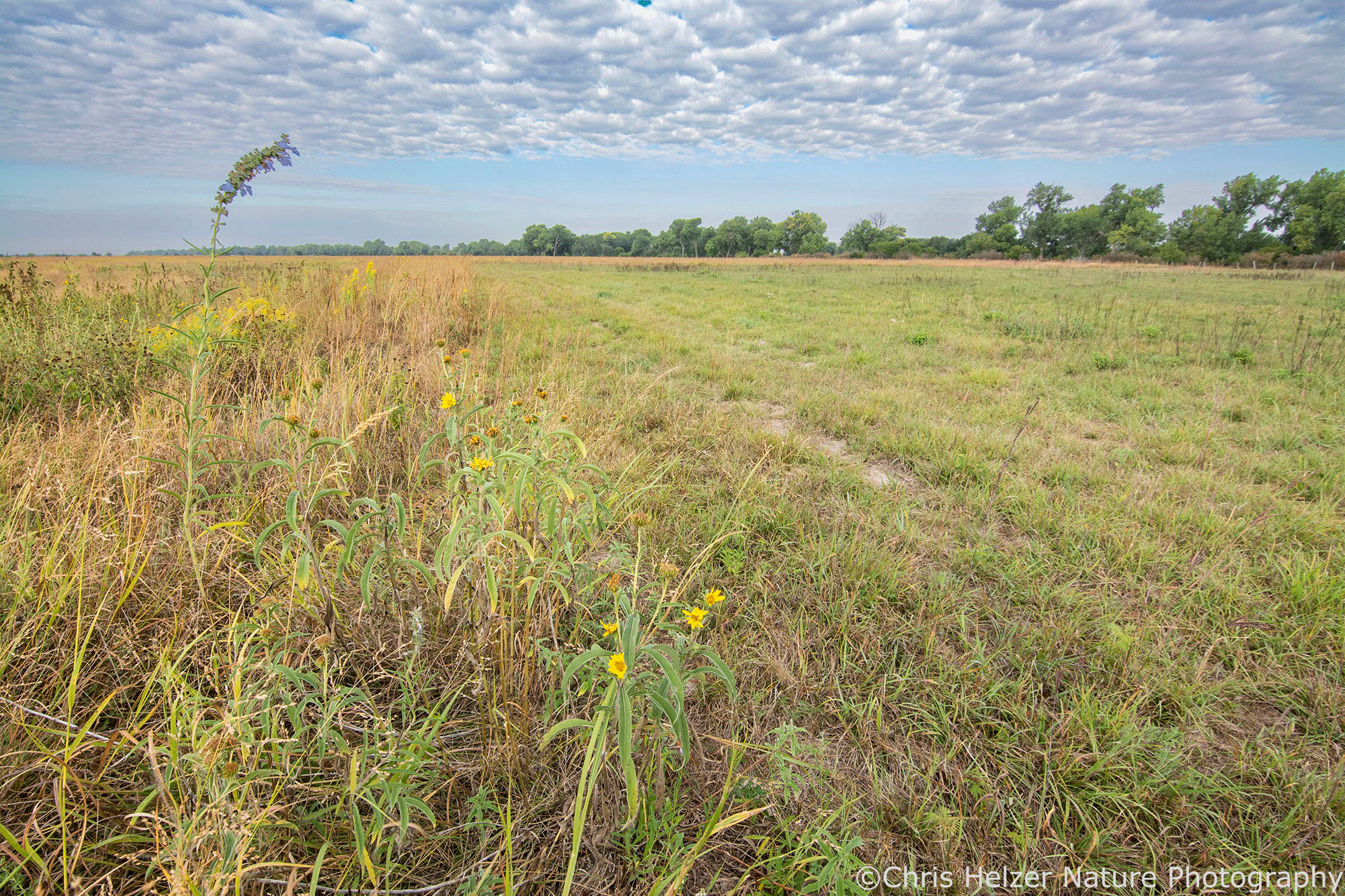
You might recall a couple posts back in the summer of 2025 about woody encroachment in prairies. In the first, I talked about how it is becoming increasingly difficult to prevent woody encroachment in many prairie landscapes. Within those landscapes, we need to start learning how to manage shrubbier grasslands for biodiversity and productivity. In the second post, I discussed a couple small trials we were conducting to examine various stewardship approaches to suppressing the height and density of shrubs (one of which is the subject of today’s post).
Feel free to go back and read those posts if you like. They’re reasonably well-written, if I do say so myself. To save you time, though, the quick summary of the first is that increased carbon dioxide in the atmosphere is making woody plants much more competitive these days. That, combined with altered fire regimes, changes in native browsers, and other factors, means many prairies are getting shrubbier.
Where we can maintain open prairies with minimal woody cover, we should do that. However, if you’re managing a prairie that already has a lot of shrubs or trees, or if your prairie is surrounded by a landscape full of woody plants, it might be time for a different approach.
Trying to eradicate big patches of shrubs from prairies, even if it’s possible (and it probably isn’t), is likely to cause losses in plant diversity and other negative impacts. Instead, what if we figure out how to mitigate some of the downsides of those shrubs and try to preserve diverse, if woodier, prairies? Again, I’m greatly simplifying this whole topic, so if this seems illogical or confusing, please go back and read those earlier posts.
We’ve been experimenting with various approaches toward managing the habitat structure of shrubby prairies. Today, I’m sharing some results of early trials with smooth sumac. I’ll report soon on some work we’re doing with roughleaf dogwood and western snowberry.
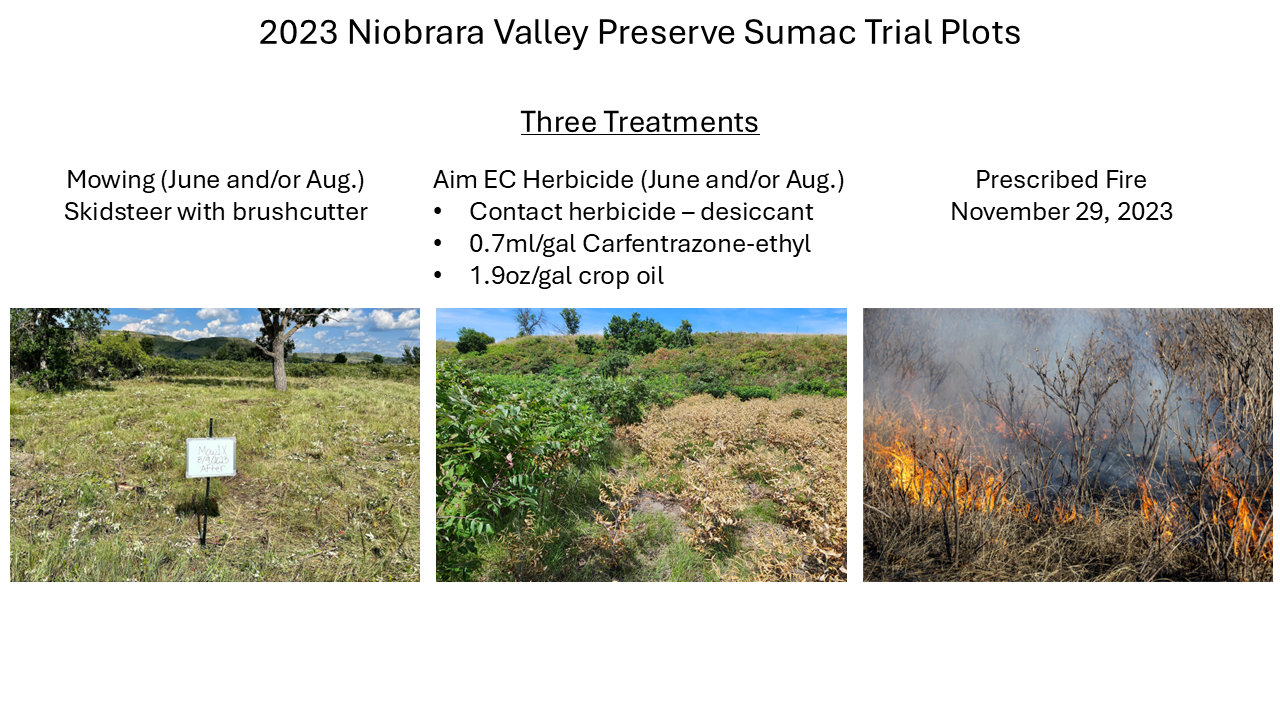
Back in 2023, we set up some trial plots at the Niobrara Valley Preserve to test the basic idea that multiple treatments in a growing season would have longer lasting effects than a single treatment. Others have seen that combining treatments leads to better results, so we were trying to build on those efforts. We tested combinations of three treatments – mowing, fire, and an herbicide called AIM, which is a contact herbicide that basically desiccates the foliage of broadleaf plants and shrubs. All these plots were treated in 2023 only. I went back to measure the results three years later in late 2026.
I was particularly interested in the herbicide because unlike most herbicides used for shrub control, this one won’t kill either the shrubs or any surrounding perennial wildflowers. The hope was that it would act similarly to a fire. The first thing we learned is that it doesn’t do very much to full-size sumac plants. The herbicide spray didn’t penetrate well into the canopy and just burned off some of the top leaves. However, it worked much better as a second treatment on the regrowth of mowed stems. As a result, we abandoned the plots where we sprayed AIM as a first treatment.
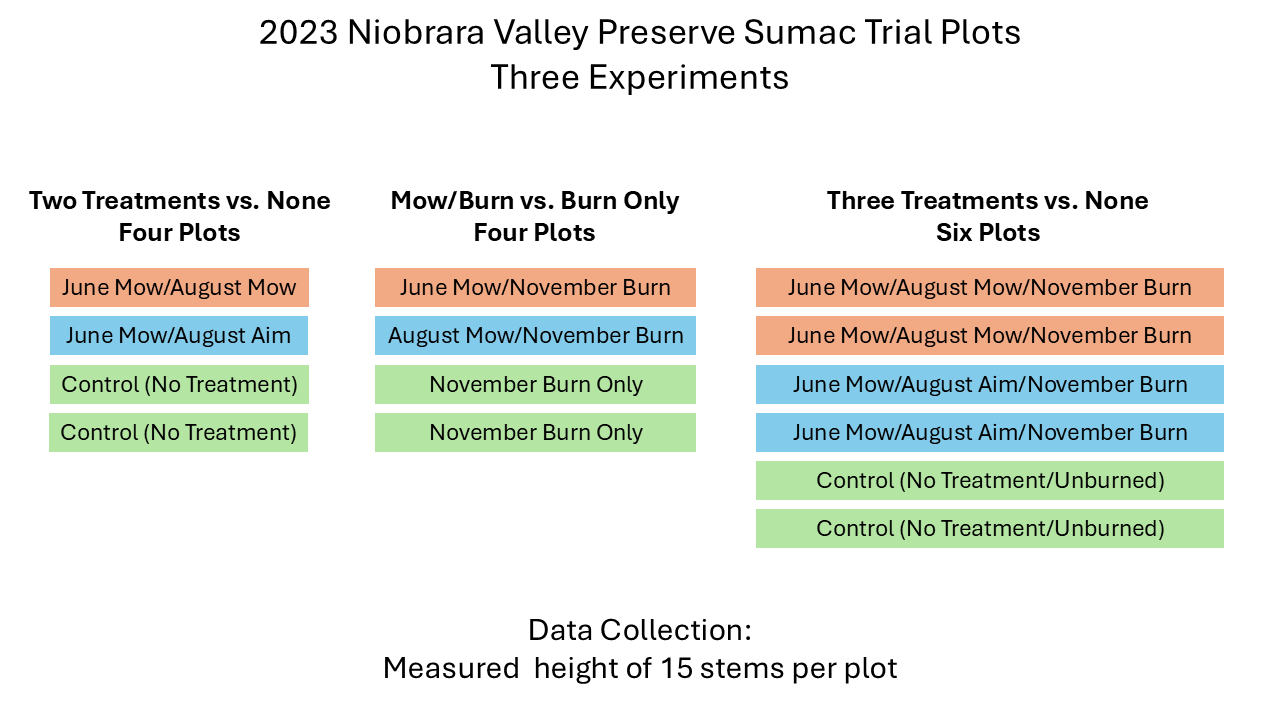
Through a series of intentional and unintentional circumstances, we ended up with three different small experiments (see above). Each has very little replication, so please remember that when you look at the results. THESE ARE VERY PRELIMINARY TESTS. We were just looking for hints of patterns to pursue more rigorously in the future.
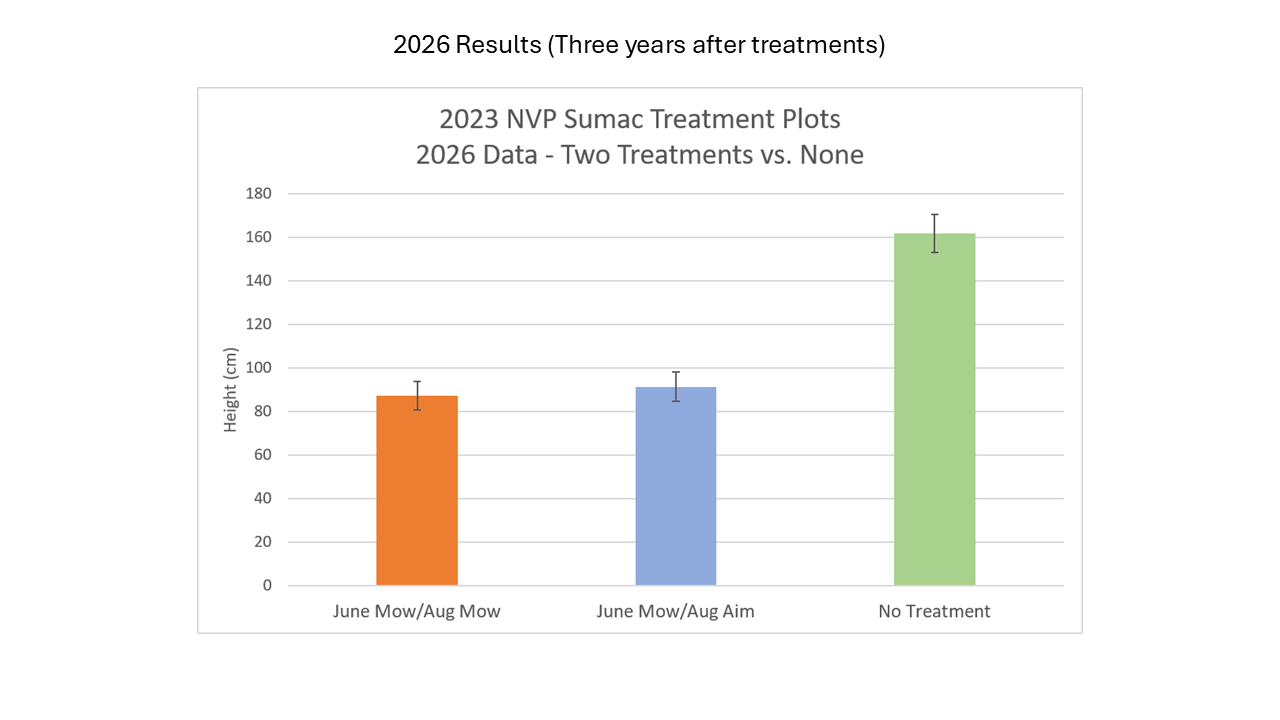
In 2026, I went back to the plots and measured the height of the sumac – three years after our treatments. I was surprised and pleased with how durable the impacts had been. I wish I’d measured changes in stem density too, especially because I saw a fair number of top-killed stems in the plots, but I didn’t, and we’ll all have to live with that.
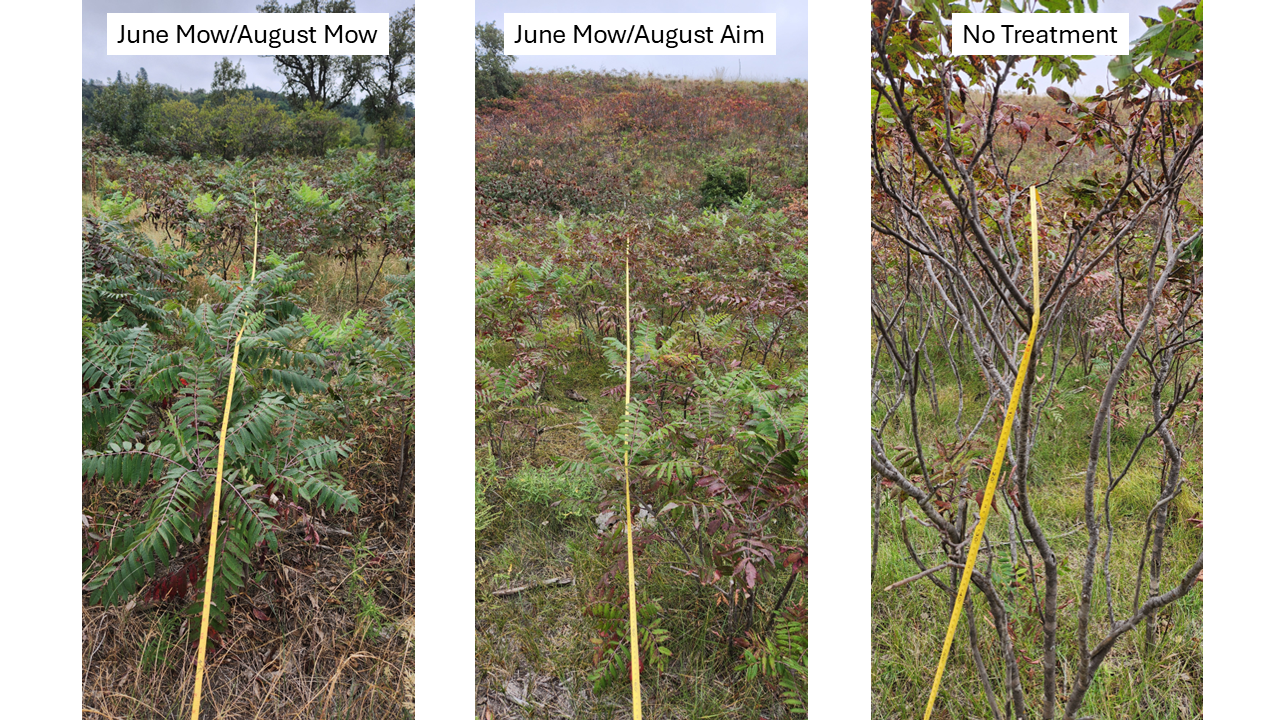
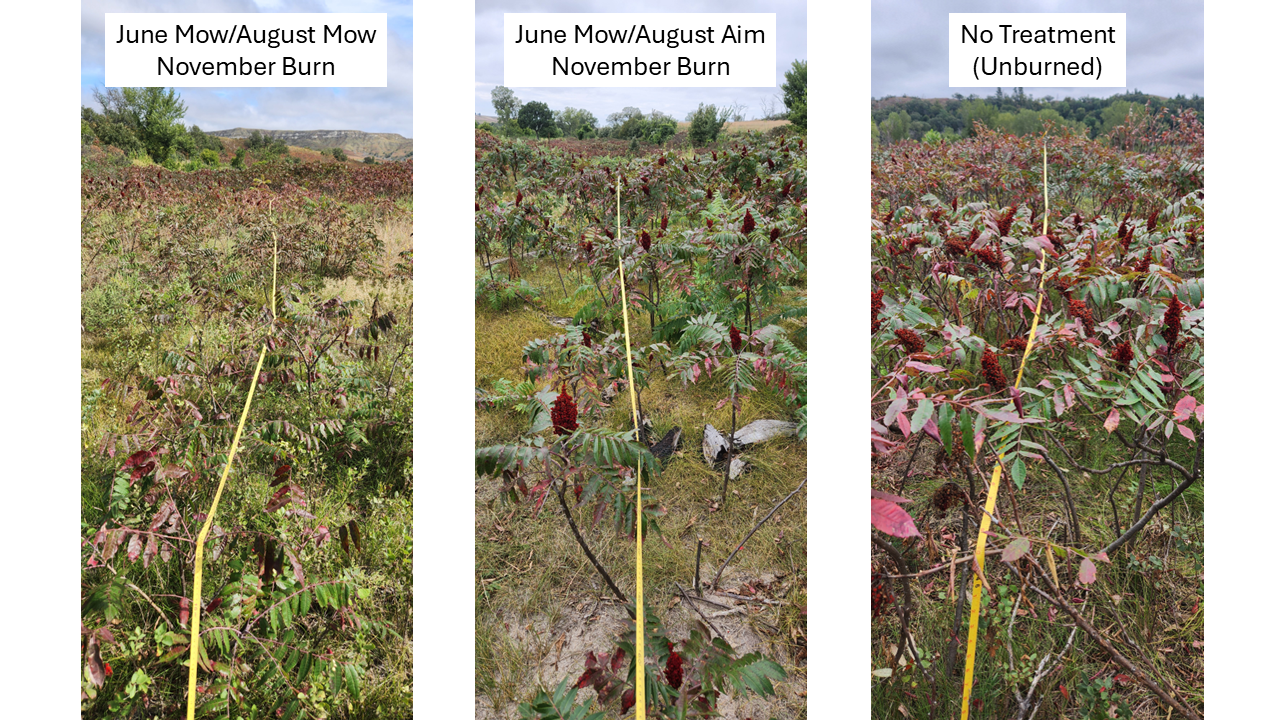
You can see the graphs above and photos below, showing the results of experiment #1. Three full field seasons after treatment, sumac stems that were either mowed twice or mowed and sprayed with AIM were still about half as tall as untreated stems. It’s a pretty striking difference.
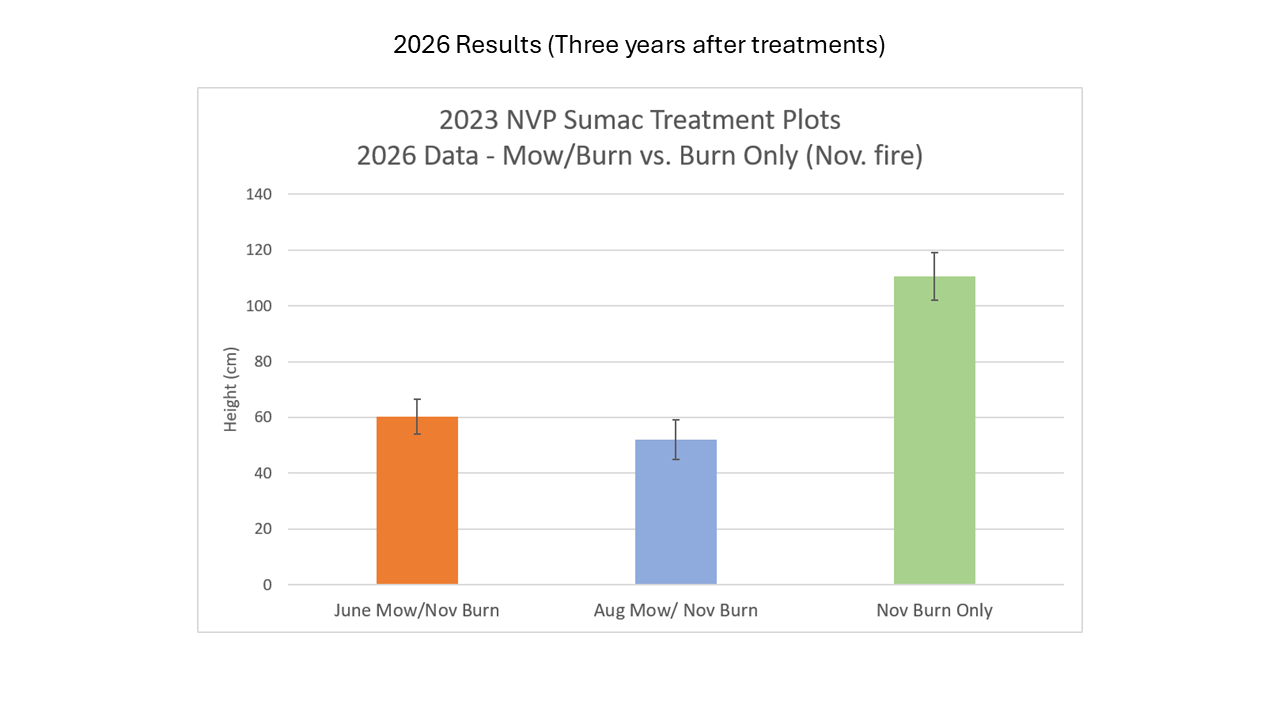
The second experiment looked at plots that were mowed in either June or August and then burned in late November of the same year. This took place on a site with a drier soil type (I think, based on aboveground observation only) than the first. As a result, the sumac grows shorter and less densely here than in the other nearby sites.
I was surprised that both the June and August mowing treatments seemed to significantly reduce sumac height (even three years after treatment!) when combined with a November fire. The stems that were burned without being mowed first seemed to rebound to their full height within two years (based on visual comparison to nearby patches the fire missed). The stems that were mowed first were still about half that height after three full field seasons.
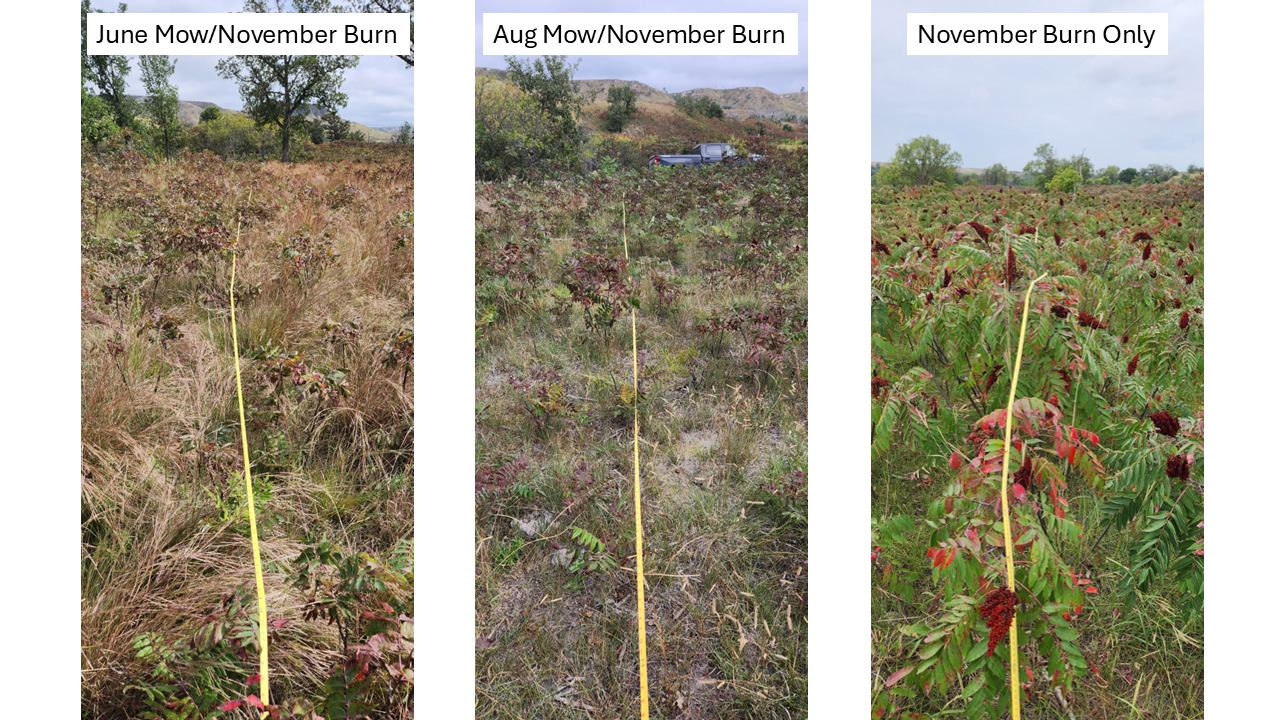
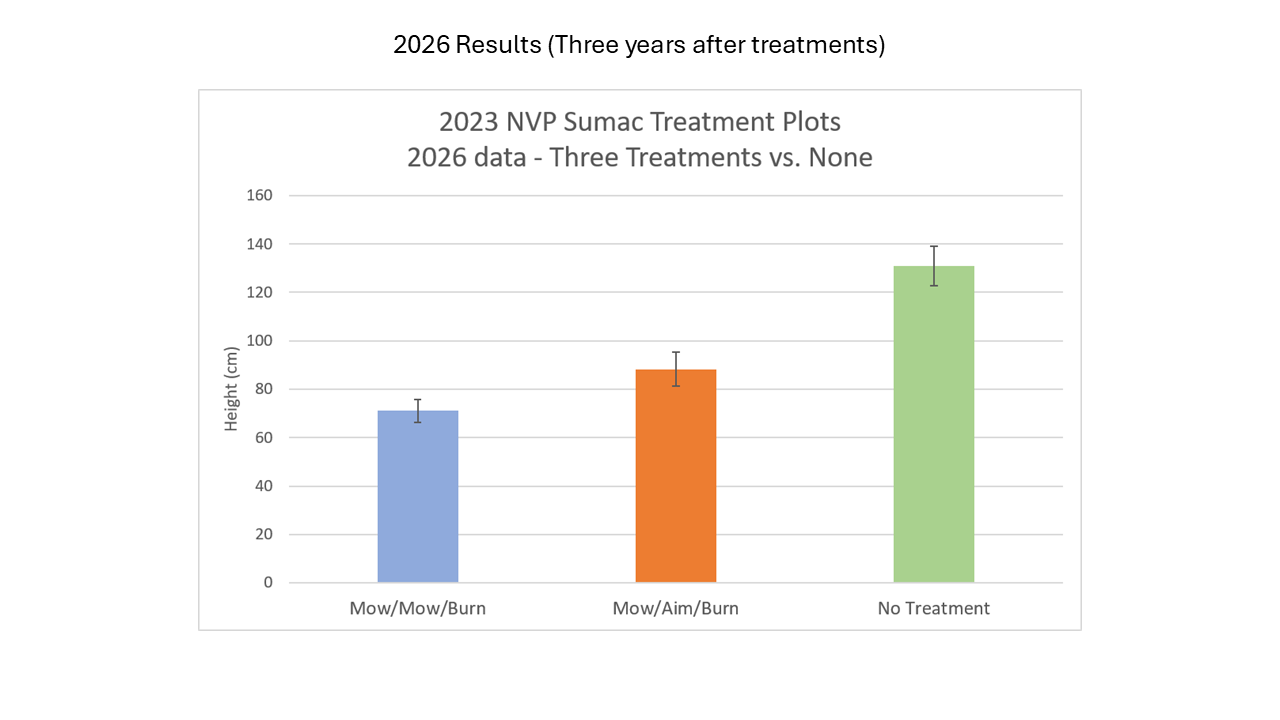
In experiment #3, we looked at the cumulative effects of three treatments, including mowing in June, mowing or AIM herbicide in August, and then a late November burn later that year. The treatment plots were again very different than the untreated plots. In this experiment, the Mow+AIM herbicide results looked a little less impressive than the Mow+Mow results, but remember that this was based on only TWO replications, so take those results with a grain of salt. However, even the Mow+AIM plots were still much shorter than the plots that weren’t treated at all.
We will be following up on this work in the coming years, hopefully with some larger treatment areas. I’m particularly intrigued by two things. First, adding a dormant season burn following summer mowing had a bigger impact than I’d expected. At a site like the Niobrara Valley Preserve where we have thousands of acres of sumac-encroached grassland, it’s not feasible to mow much of that twice in the same season. But if we can mow some of it before or after a burn and strongly amplify the effects of the burn, that might be worth trying.
Second, the AIM herbicide results were promising enough to warrant more testing. It is an herbicide treatment that shouldn’t decrease plant diversity around or beneath treated shrubs. It can also be used on topography that is too steep or rough to be mowed. That means we might be able to combine it with burning and (as above) greatly increase the effectiveness of that fire on shrub suppression.
All of this is great, of course, and provides me with more optimism that we can manage shrubby prairies in ways that sustain plant diversity, offer good habitat for most prairie wildlife species, and prevent big losses in livestock productivity. The simultaneous challenge, though, is to figure out what to aim for with our management. We don’t know much about how various wildlife species respond to different heights and densities of shrubs, or at what height/density shrubs start decreasing plant diversity or productivity beneath them. We’ll be trying to answer some of those questions in the coming years as well. Hopefully, some of you will be doing the same!