Smooth Sumac Suppression

You might recall a couple posts back in the summer of 2025 about woody encroachment in prairies. In the first, I talked about how it is becoming increasingly difficult to prevent woody encroachment in many prairie landscapes. Within those landscapes, we need to start learning how to manage shrubbier grasslands for biodiversity and productivity. In the second post, I discussed a couple small trials we were conducting to examine various stewardship approaches to suppressing the height and density of shrubs (one of which is the subject of today’s post).

Feel free to go back and read those posts if you like. They’re reasonably well-written, if I do say so myself. To save you time, though, the quick summary of the first is that increased carbon dioxide in the atmosphere is making woody plants much more competitive these days. That, combined with altered fire regimes, changes in native browsers, and other factors, means many prairies are getting shrubbier.

Where we can maintain open prairies with minimal woody cover, we should do that. However, if you’re managing a prairie that already has a lot of shrubs or trees, or if your prairie is surrounded by a landscape full of woody plants, it might be time for a different approach.
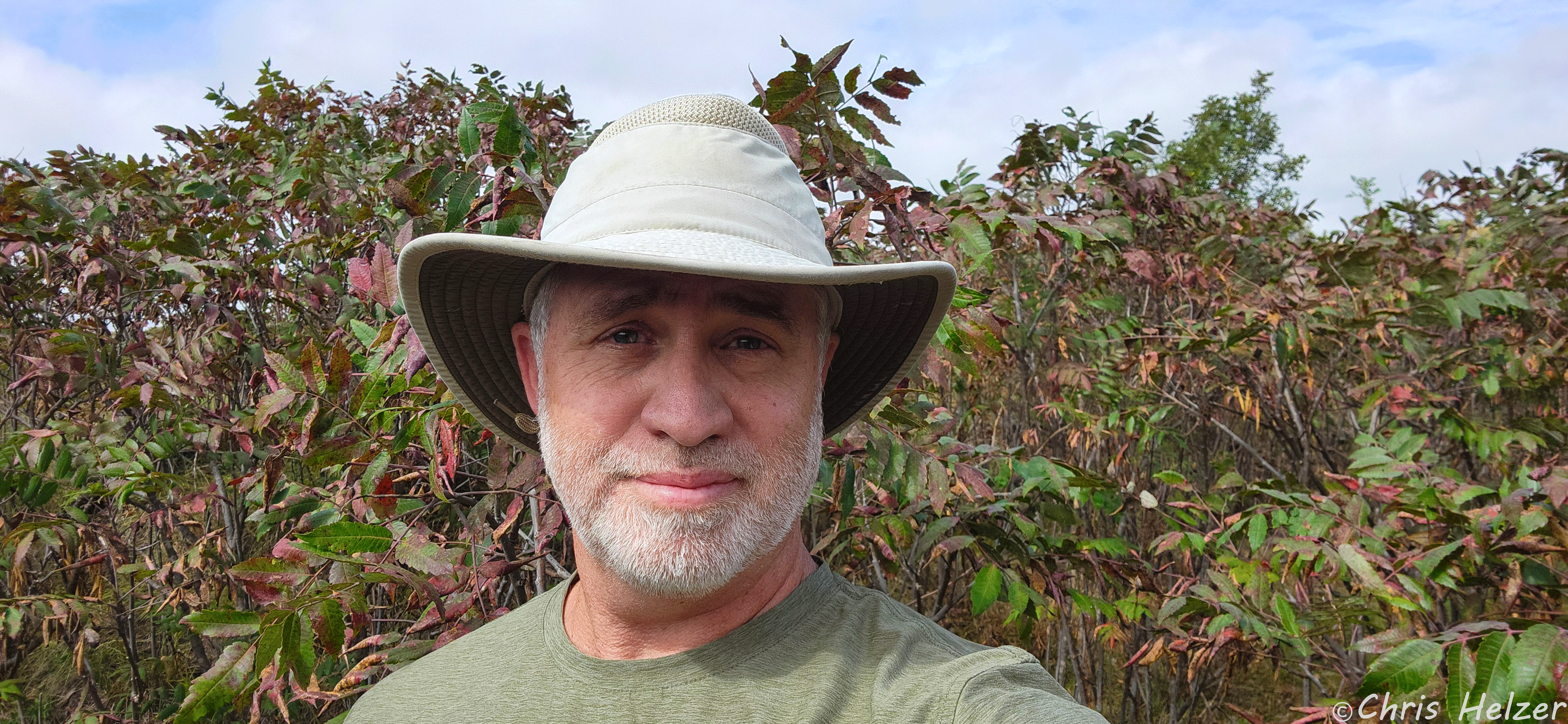
Your intrepid author, surrounded by smooth sumac taller than himself. Not all woody encroachment has to look like this. I, apparently, do.

Trying to eradicate big patches of shrubs from prairies, even if it’s possible (and it probably isn’t), is likely to cause losses in plant diversity and other negative impacts. Instead, what if we figure out how to mitigate some of the downsides of those shrubs and try to preserve diverse, if woodier, prairies? Again, I’m greatly simplifying this whole topic, so if this seems illogical or confusing, please go back and read those earlier posts.

We’ve been experimenting with various approaches toward managing the habitat structure of shrubby prairies. Today, I’m sharing some results of early trials with smooth sumac. I’ll report soon on some work we’re doing with roughleaf dogwood and western snowberry.
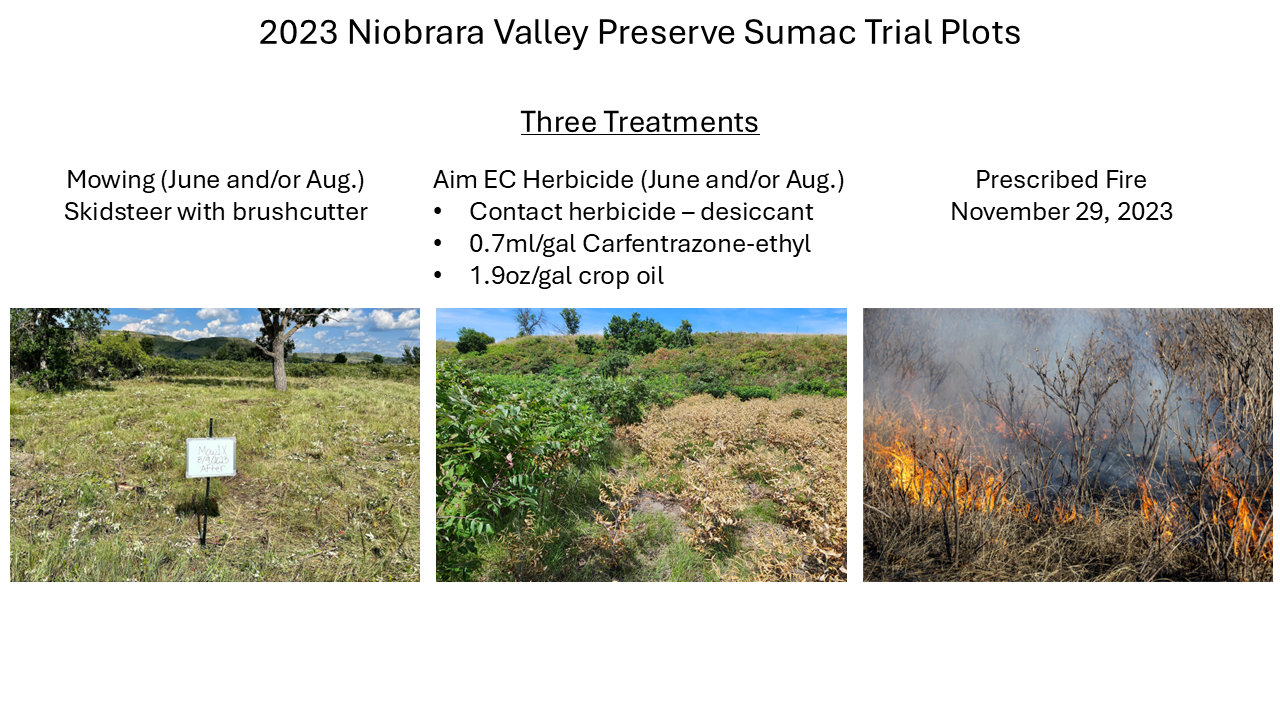
You can click on graphs and photos to see larger versions of them. If you’re reading this in an email, you might have to first click on the title of the post to open it online.

Back in 2023, we set up some trial plots at the Niobrara Valley Preserve to test the basic idea that multiple treatments in a growing season would have longer lasting effects than a single treatment. Others have seen that combining treatments leads to better results, so we were trying to build on those efforts. We tested combinations of three treatments – mowing, fire, and an herbicide called AIM, which is a contact herbicide that basically desiccates the foliage of broadleaf plants and shrubs. All these plots were treated in 2023 only. I went back to measure the results three years later in late 2026.

I was particularly interested in the herbicide because unlike most herbicides used for shrub control, this one won’t kill either the shrubs or any surrounding perennial wildflowers. The hope was that it would act similarly to a fire. The first thing we learned is that it doesn’t do very much to full-size sumac plants. The herbicide spray didn’t penetrate well into the canopy and just burned off some of the top leaves. However, it worked much better as a second treatment on the regrowth of mowed stems. As a result, we abandoned the plots where we sprayed AIM as a first treatment.
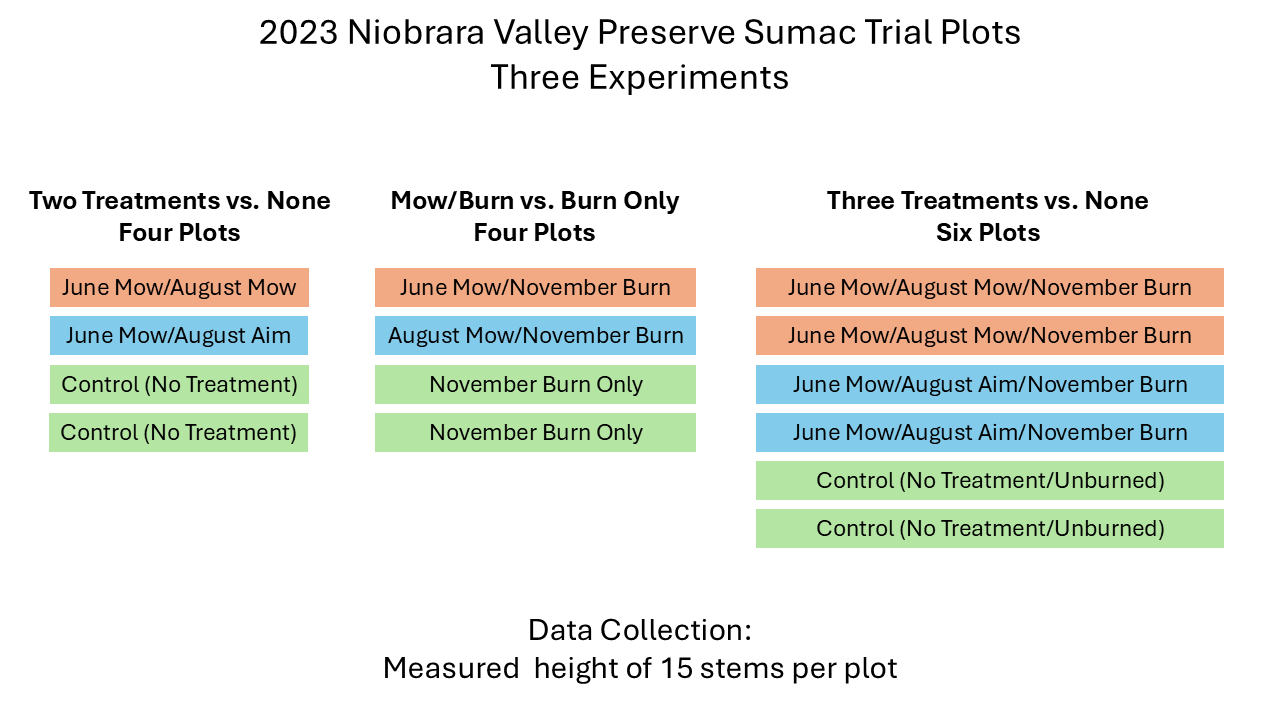
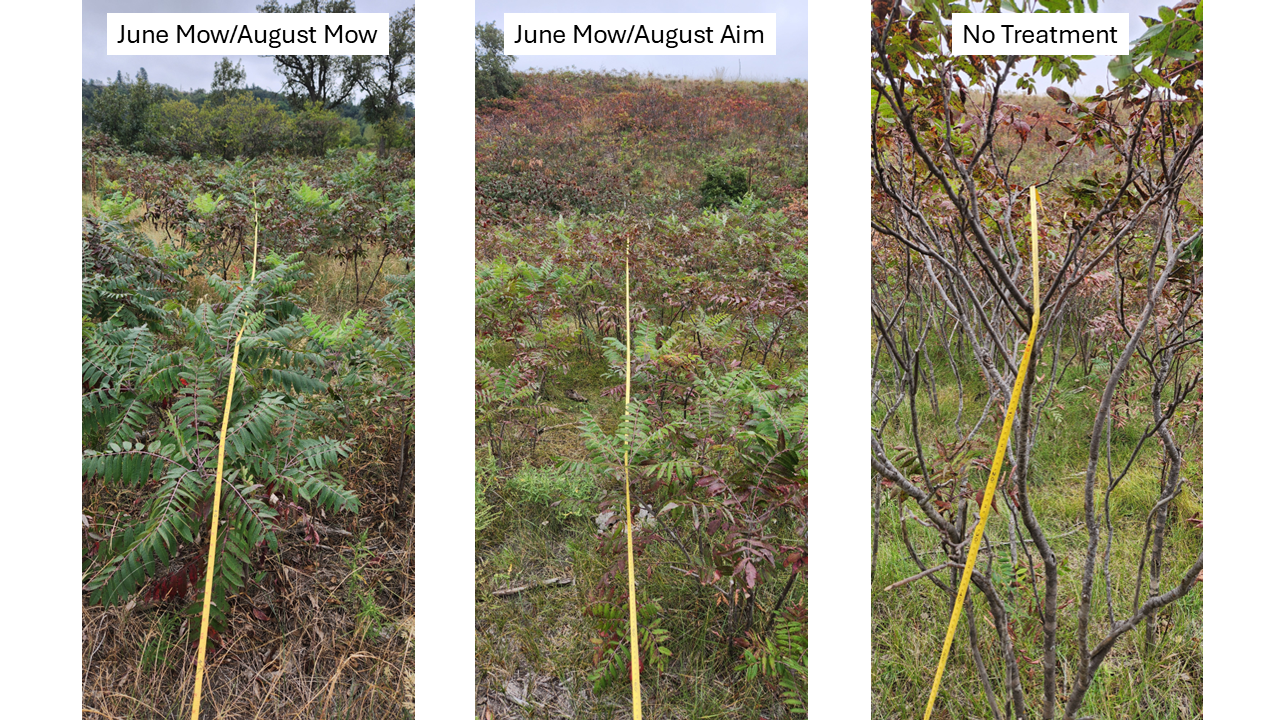
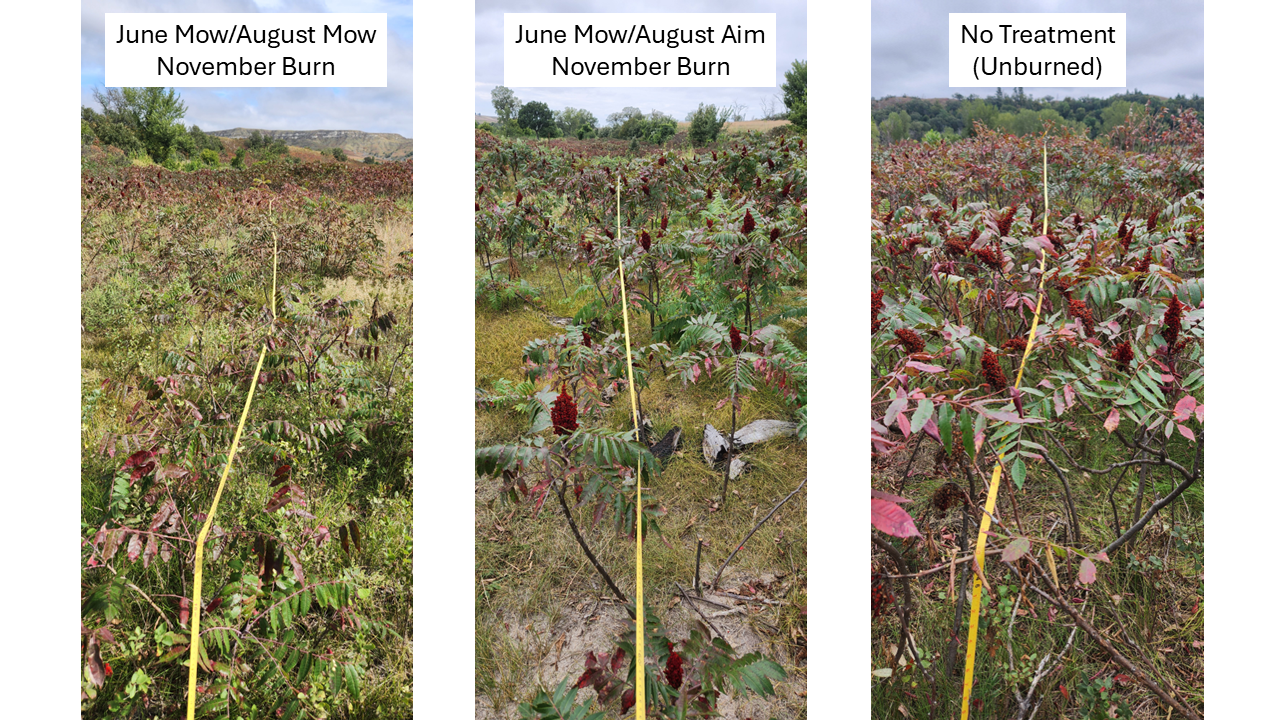
Through a series of intentional and unintentional circumstances, we ended up with three different small experiments (see above). Each has very little replication, so please remember that when you look at the results. THESE ARE VERY PRELIMINARY TESTS. We were just looking for hints of patterns to pursue more rigorously in the future.
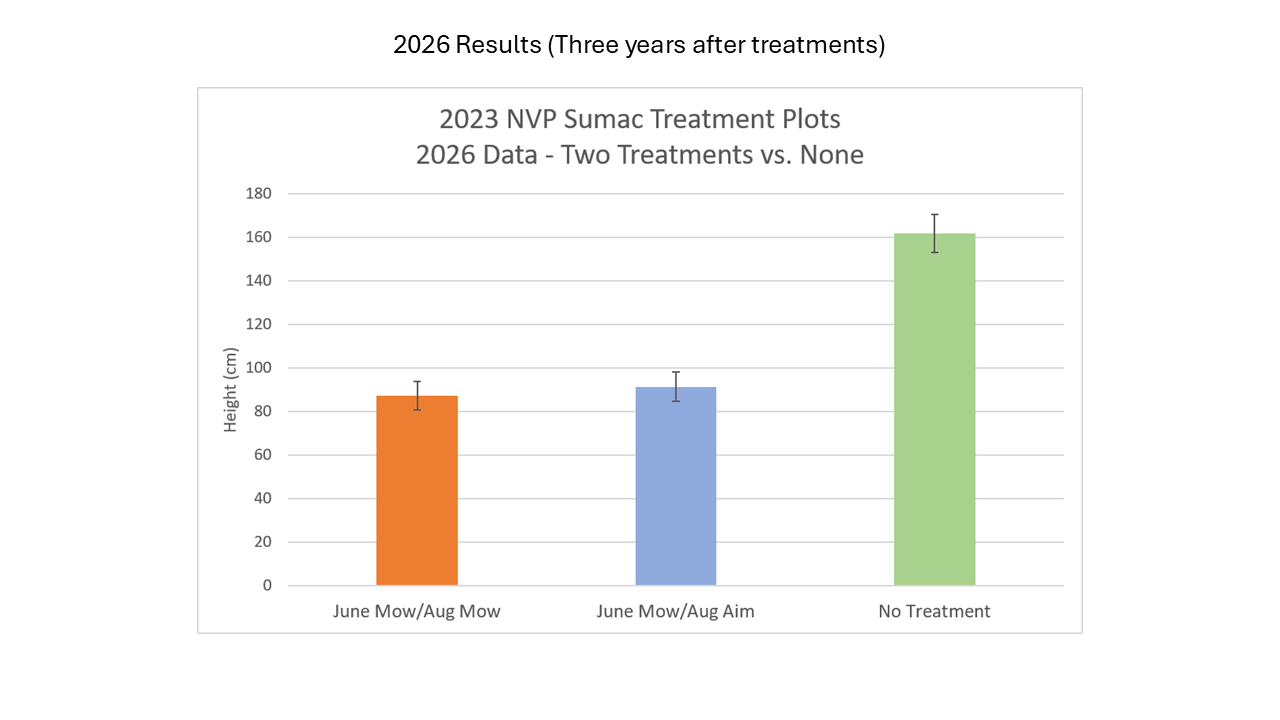
In 2026, I went back to the plots and measured the height of the sumac – three years after our treatments. I was surprised and pleased with how durable the impacts had been. I wish I’d measured changes in stem density too, especially because I saw a fair number of top-killed stems in the plots, but I didn’t, and we’ll all have to live with that.

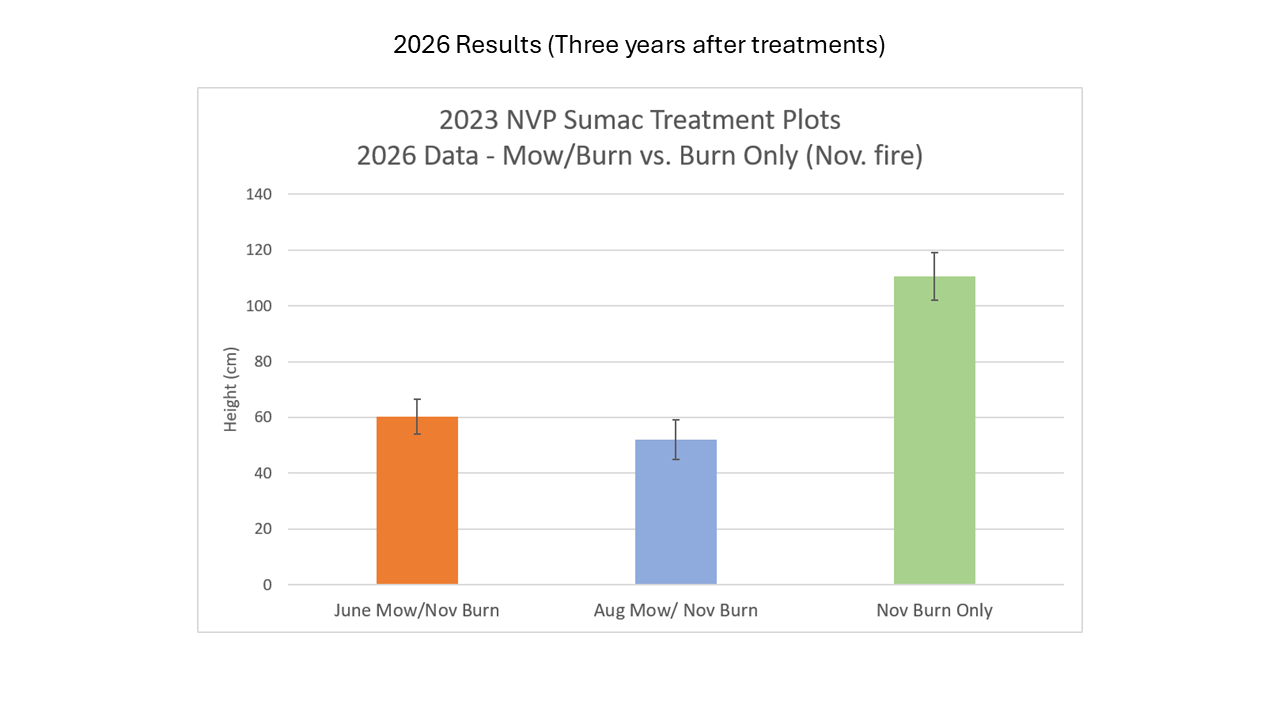
You can see the graphs above and photos below, showing the results of experiment #1. Three full field seasons after treatment, sumac stems that were either mowed twice or mowed and sprayed with AIM were still about half as tall as untreated stems. It’s a pretty striking difference.
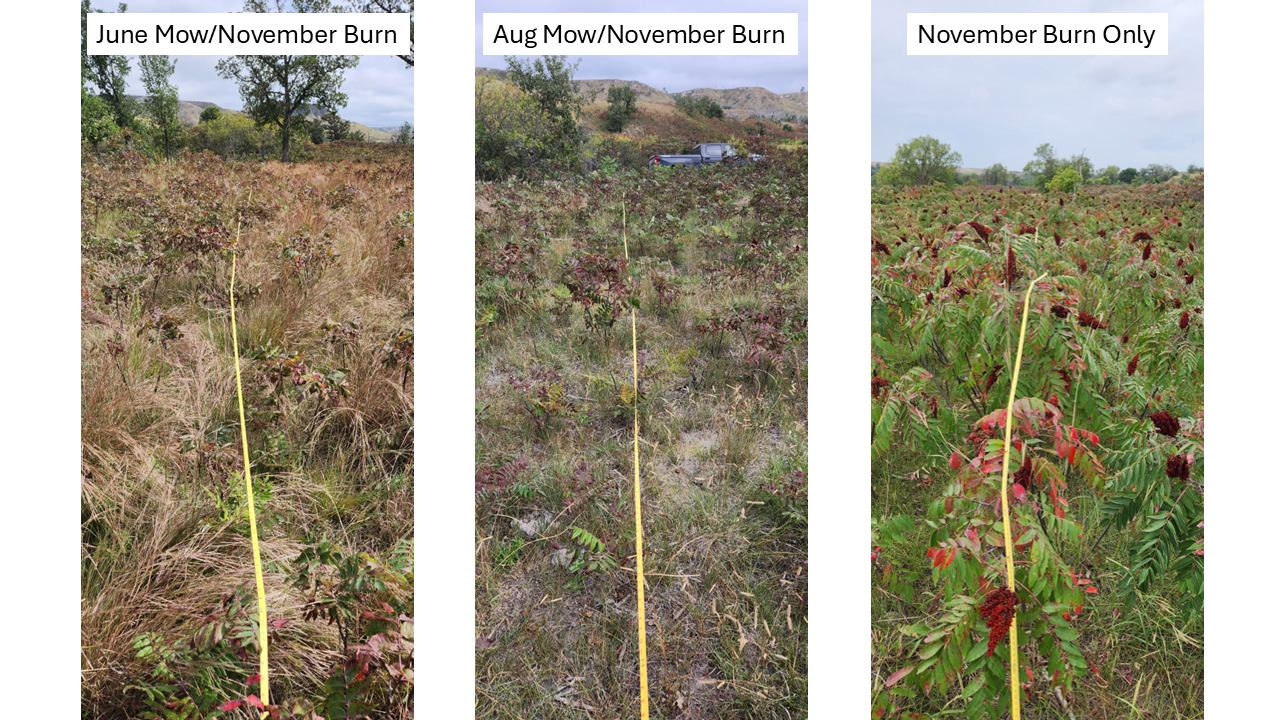
The second experiment looked at plots that were mowed in either June or August and then burned in late November of the same year. This took place on a site with a drier soil type (I think, based on aboveground observation only) than the first. As a result, the sumac grows shorter and less densely here than in the other nearby sites.

I was surprised that both the June and August mowing treatments seemed to significantly reduce sumac height (even three years after treatment!) when combined with a November fire. The stems that were burned without being mowed first seemed to rebound to their full height within two years (based on visual comparison to nearby patches the fire missed). The stems that were mowed first were still about half that height after three full field seasons.
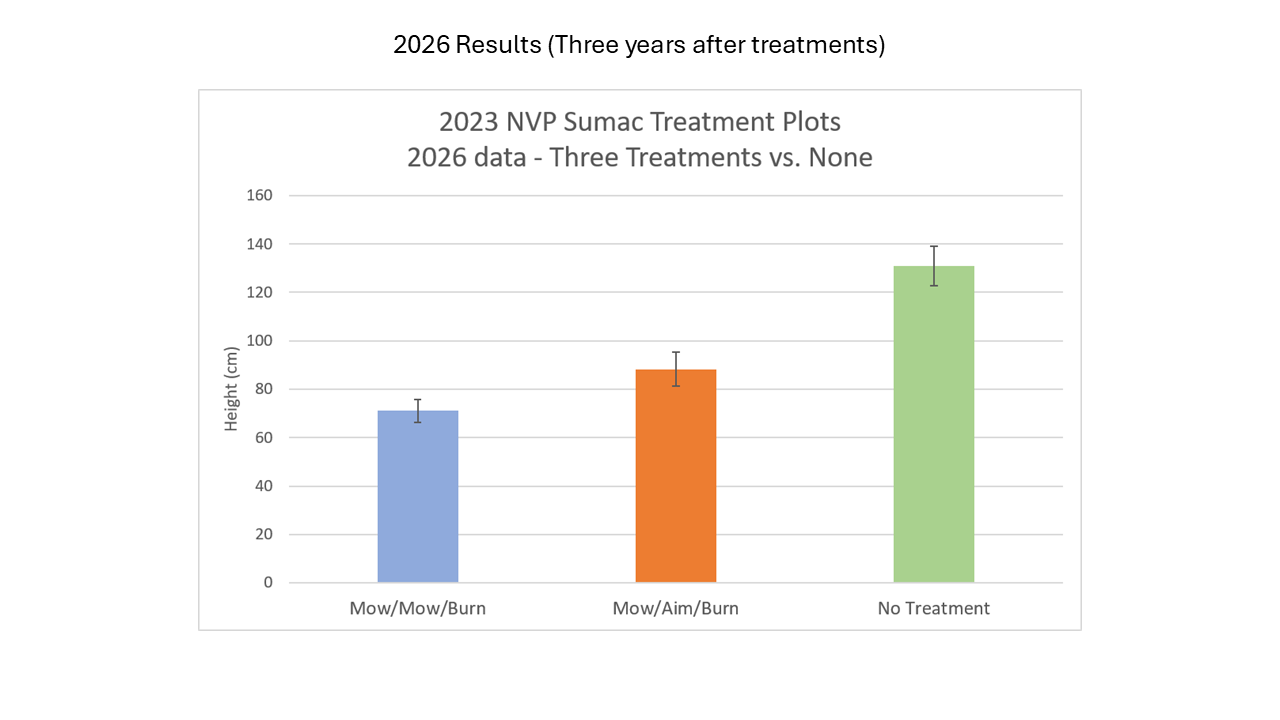
In experiment #3, we looked at the cumulative effects of three treatments, including mowing in June, mowing or AIM herbicide in August, and then a late November burn later that year. The treatment plots were again very different than the untreated plots. In this experiment, the Mow+AIM herbicide results looked a little less impressive than the Mow+Mow results, but remember that this was based on only TWO replications, so take those results with a grain of salt. However, even the Mow+AIM plots were still much shorter than the plots that weren’t treated at all.
We will be following up on this work in the coming years, hopefully with some larger treatment areas. I’m particularly intrigued by two things. First, adding a dormant season burn following summer mowing had a bigger impact than I’d expected. At a site like the Niobrara Valley Preserve where we have thousands of acres of sumac-encroached grassland, it’s not feasible to mow much of that twice in the same season. But if we can mow some of it before or after a burn and strongly amplify the effects of the burn, that might be worth trying.

Second, the AIM herbicide results were promising enough to warrant more testing. It is an herbicide treatment that shouldn’t decrease plant diversity around or beneath treated shrubs. It can also be used on topography that is too steep or rough to be mowed. That means we might be able to combine it with burning and (as above) greatly increase the effectiveness of that fire on shrub suppression.

All of this is great, of course, and provides me with more optimism that we can manage shrubby prairies in ways that sustain plant diversity, offer good habitat for most prairie wildlife species, and prevent big losses in livestock productivity. The simultaneous challenge, though, is to figure out what to aim for with our management. We don’t know much about how various wildlife species respond to different heights and densities of shrubs, or at what height/density shrubs start decreasing plant diversity or productivity beneath them. We’ll be trying to answer some of those questions in the coming years as well. Hopefully, some of you will be doing the same!
Is Prairie Stewardship Hampered By Our History Goggles?

I often think one of the biggest issues we face in grassland restoration and management is that we’re a little too stuck in the past.  This expresses itself in various ways, but I think it’s a nearly universal issue with everyone involved in prairie ecology and stewardship.  To one degree or another, we’re all looking backward.  Let me explain.

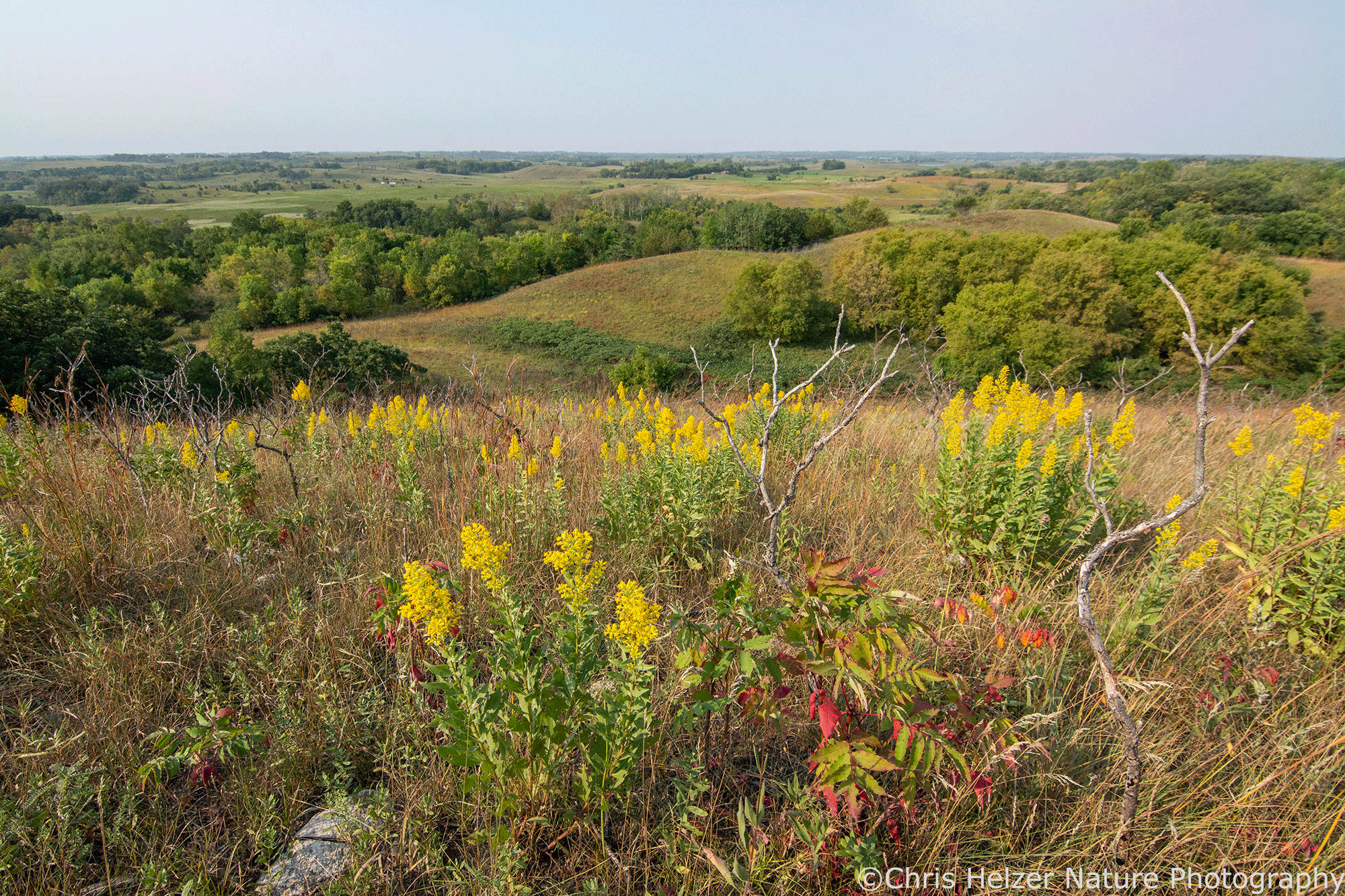
We’ve all stood on a hill and stared into the distance, trying to envision what that view would have been a few hundred years ago.

An obvious example of what I’m talking about appears in prairie restoration (reconstruction) when someone’s goal for a prairie planting project is to create a prairie that looks like it used to look a few hundred years ago.  I hear this a lot less than I used to, which is good, given the numerous problems with that goal.  However, even those of us who claim to be focused on more practical objectives can slip up sometimes.  It just feels good to recreate something from the past, especially when the past must have been so great!

The same romanticism for the old days affects our management, too.  Regardless of what our plan says (you’ve all got a clear, written management plan, right?), most of us can’t resist glancing around and wondering what a particular site must have looked like “back in the day”.  It’s real easy to for the resulting mental pictures to start influencing the way we evaluate the condition of a prairie and the direction we try to push things through stewardship actions.  We don’t really think we can get back to what it used to be, and yet…

I see the impact of those “history goggles” all the time, both in my own head and during conversations with other prairie people.  One of the more frequent appearances comes during thinking or talking about plant community composition.  “Oh,” someone will say, “that wildflower used to be much more common before European settlement.” Or, similarly, “Those grass species never used to be as prominent when these prairies were surveyed in the 1920’s”.

Don’t get me wrong – historic plant community composition can be helpful.  It’s nice to know how things have changed because it helps us understand why, or at least helps us ask the right questions.  Answers to those questions can guide us as we devise management strategies.  Where we get into trouble is when we use past conditions as explicit targets for today’s stewardship. 

Our prairies live in a different world than prairies of old.  Habitat fragmentation, rising atmospheric CO2 rates and nitrogen deposition, climate change, and invasive species are just some of the major factors that have changed within last century or two.  We should expect prairies to adapt to those drastic changes.  After all, adaptation is one of their best features!  

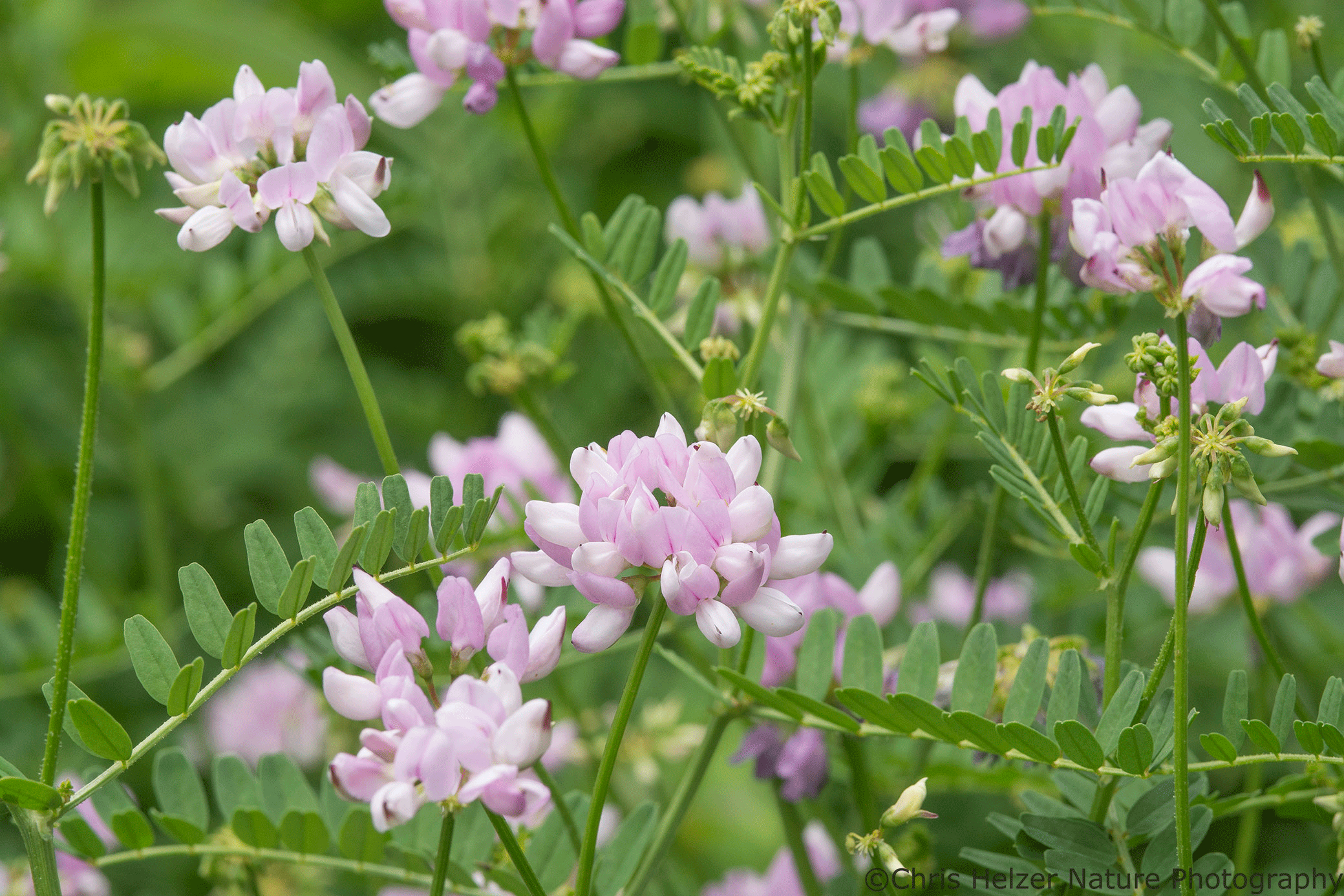
Invasive species such as crown vetch (Securigera varia) and many others have drastically changed the competitive environment within prairie plant communities.

History goggles also come into play when we think about prairie management tools and tactics.  How many discussions have you been in that center on the historic frequency and/or season of fire in prairies?  As with plant composition, understanding when and how fires burned in the past can be helpful, but yesterday’s fire frequency shouldn’t automatically be today’s fire frequency.  See above for some of the major differences between historic and present-day prairies.

People who apply grazing to grasslands often wear very thick history goggles.  If I had a nickel for every time someone’s tell me their particular grazing strategy mimics what bison used to do, I’d be swimming in nickels.  I don’t want to swim in nickels.  Even if your approach somehow perfectly mirrors what bison used to do (and it doesn’t), why would that be the best approach for today’s prairies, which aren’t what they used to be?  That applies, by the way, to whatever grazing animal you’re working with – including bison. 

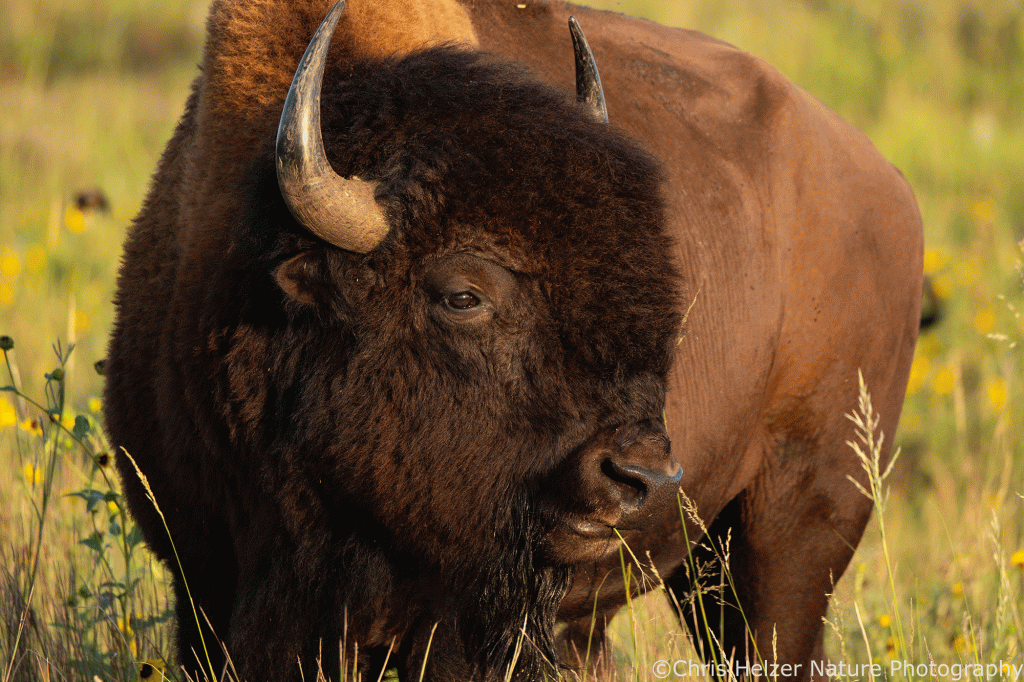
There are lots of great reasons to put bison in prairies, cultural, ecological, and otherwise.  Expecting them to eradicate smooth brome and reverse climate change, though, is going to lead to some big disappointment.  That doesn’t mean bison (or cattle, for that matter) can’t play important roles in today’s prairies.  In many grasslands, especially larger ones, they can manipulate habitat structure, combat the dominance of grasses, and create lots of wonderful messiness.  They can’t (or won’t), however, turn back the clock. 

Bison or other large grazers can play important roles in some prairies, but they can’t suppress rising atmospheric carbon dioxide.

We’ve got to cast off our history goggles and look forward if prairie conservation is going to succeed.  Restoration and management strategies need to be built on creating future prairies, not past ones.  That’s an uncomfortable, even scary, prospect though, isn’t it?  We don’t have any reference points in the future, after all.  It’s easier to look back (or guess) at what used to be and try to aim there.

I don’t have the answers to this dilemma.  I do have ideas.

Prairie communities really are good at adaptation.  Because of that, I think we should be looking for ways to facilitate and guide prairies as they adjust to new conditions.  One way to do that is to help them maintain the resilience they need to adapt.  We do know something about how to do that.  (Remember, ecological resilience doesn’t mean natural communities don’t change.  Instead, it’s a measure of their capacity to adapt.) 

The ecological resilience of prairies relies heavily on two factors: habitat size/connectivity and biological diversity.  The first helps the second persist and the second provides the redundancy of function that means there are species to fill crucial roles no matter what’s a prairie has thrown at it.  Making prairies bigger and better connected comes through restoration (reconstruction) efforts that build new grassland habitat adjacent to and between existing habitats.  We have lots of evidence that prairie species respond well to that kind of restoration.

There are lots of thoughts about how to manage for biological diversity in prairies, many of which seem to work well.  There isn’t a single best way to do it, and the effectiveness of practices and approaches can vary by geography, soil type, prairie size, and many other factors.  The key is to focus on the diversity of the plant community, as well as the more difficult to measure communities of animals, fungi, bacteria, and others. 

The diversity of plant and animal communities (and other taxonomic groups) is a key to the ability of prairie communities to adapt to change.

This is where I think it’s most important to push past our reliance on history.  It’s tempting to judge plant species, for example, by whether we think they used to be part of the plant community at a particular site, or how abundant they might have been.  We’re getting to the point where that may not be very relevant anymore.  That includes non-native plants, by the way. 

Now we’re getting into really uncomfortable territory for some folks but let me be clear that I’m not proposing we stop preventing the appearance or spread of all non-native plants in prairies.  What I am proposing, however, is that the native or non-native status of plants might not be the best metric to apply.  Many of us have already started down this path by looking at natives like Canada goldenrod, for example, as a species that can be problematic if it’s allowed to run rampant.  Why do we care?  Because in some places, it can become dominant enough that it suppresses the diversity of the plant community.  That’s a bad thing for ecological resilience.

Non-native plants that have the same potential to suppress diversity need to be targets for management action.  However, some non-native plants don’t suppress the diversity around them – they add to it.  I think that’s ok.  The immigration of new species into prairie communities is inevitable, so fighting it seems fruitless. 

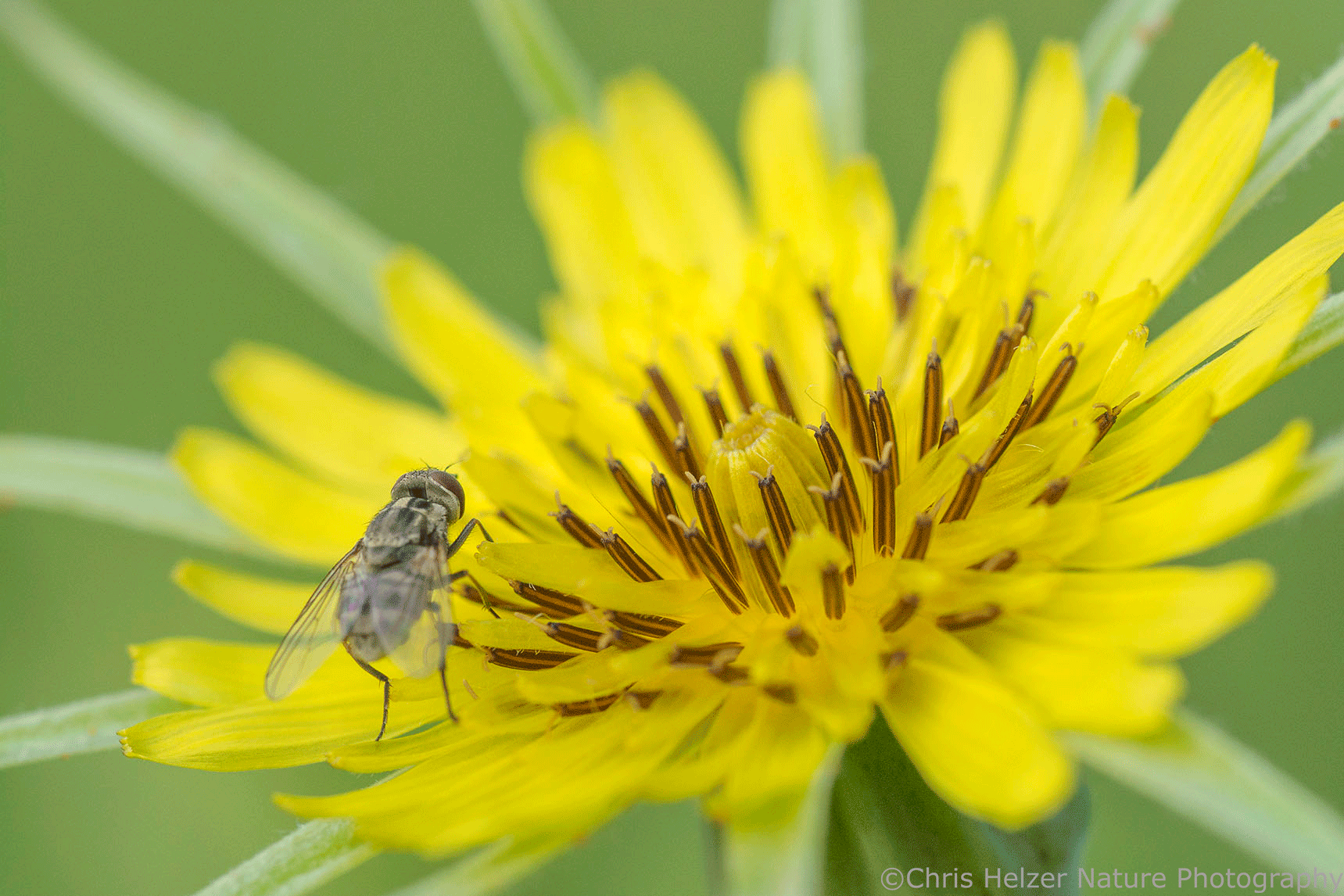
Yellow salsify, aka goat’s beard (Tragopogon dubius) is an example of a non-native plant that seems to have joined plant communities I’m familiar with in an innocuous, if not helpful, way.

In many places, woody plants – native and non-native – are becoming more abundant in prairies.  Their success is driven largely by rising CO2 levels, which prairie managers have no control over.  That means that in some cases, we’re just going to have to figure out how to manage for biodiversity in shrubby prairies.  We don’t know enough about how to do that yet.  Instead of pouring all our limited resources into resistance, we’d be smart to start learning about how to manage the height and density of shrubs and see how plant and other communities respond.

I could go on, but I think the key point is that focusing on ecological resilience, and thus biological diversity, gives us a target to aim for as we look forward.  We can evaluate the success of our management strategies by whether they lead to increased or decreased plant and animal diversity.  If our prairies are maintaining their diversity, they should have a good chance at adapting to whatever is thrown at them. 

It’s hard to turn away from history as our reference point for success.  You know what else is hard?  Failure.  It’s frustrating to try and try to restrain prairies from moving away from what they used to be.  Why are we subjecting ourselves to that frustration?  Let’s see if we can learn how to support our favorite ecological communities as they flex their adaptation muscles and find ways to thrive in this new world.