My Own Prairie, For What It’s Worth

A couple years ago, I wrote about the history of our family’s prairie.  The prairie is about 110 acres (within a 160 acre farm) and is only a ten minute drive from my house.  Most of it was farmed before my grandpa bought it and planted it with six species of grass in the early 1960’s, so the plant community is not very diverse.  However, there is a lot to love about the prairie.  (Did I mention it’s only ten minutes from my house?)
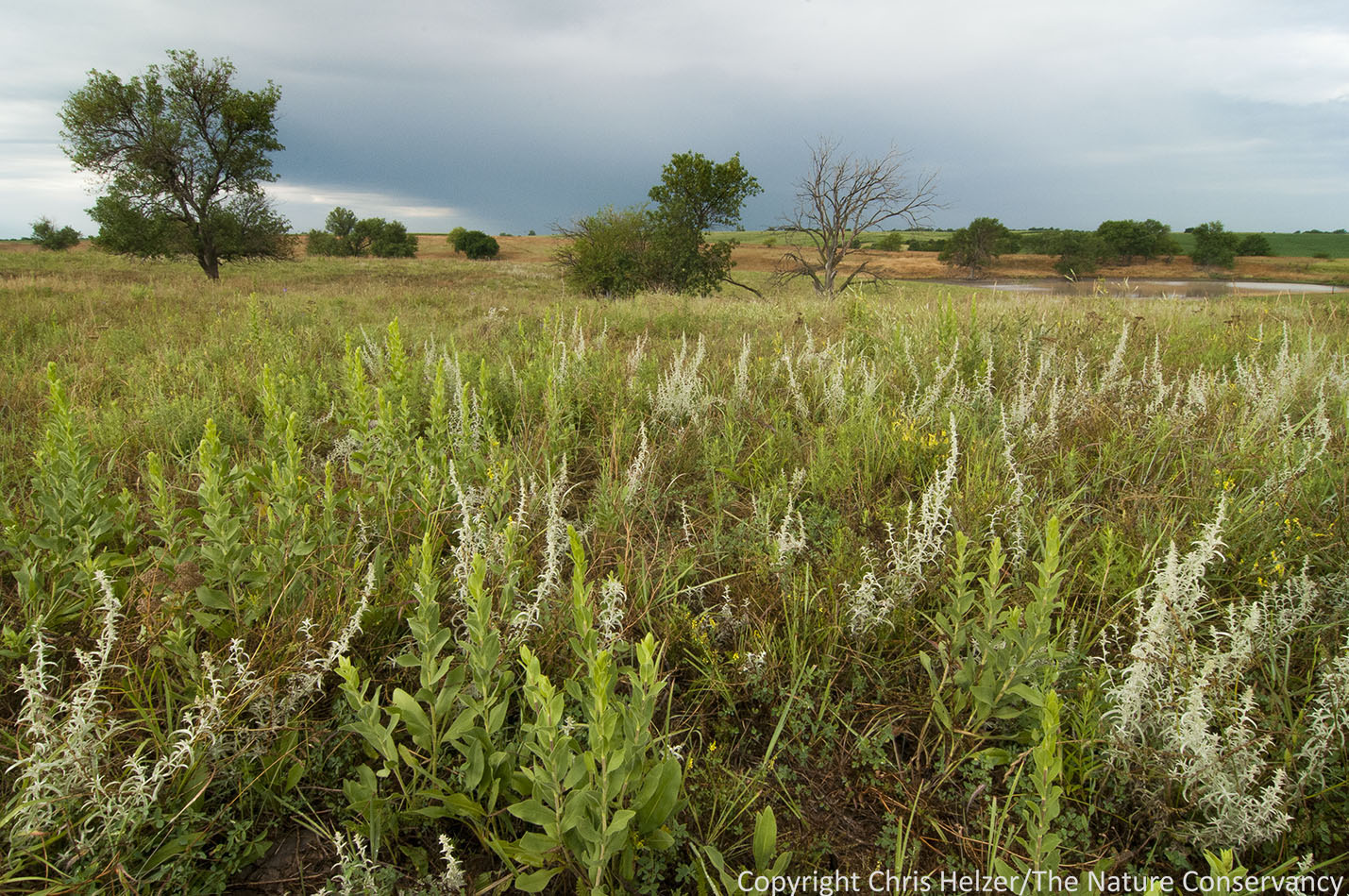
Most of our prairie is old cropfield planted to grass in the 1960's, so the forb community consists mainly of species such as stiff goldenrod and white sagewort that can colonize easily.

Most of our prairie is old cropfield planted to grass in the 1960’s, so the forb community consists mainly of species such as stiff goldenrod and white sagewort that can colonize easily.

Some botanists would dismiss the value of my prairie because only small pockets of it were left unfarmed, and even those have only a few scattered “conservative” prairie plant species such as leadplant and prairie violets.  Those botanists, however, would be ignoring the many other contributions the prairie makes to the world and our family.

While there are a few places that were left unfarmed (foreground), much of the prairie is of low plant diversity, and the draws are dominated mainly by smooth brome.

While there are a few places that were left unfarmed (foreground), much of the prairie is of low plant diversity, and the draws are dominated mainly by smooth brome.

The prairie is the only significant grassland patch within several miles in any direction, so while grassland birds and some larger insects can fly in and out each year, the prairie is a world unto itself for most of the other species that live there.  That makes the prairie both very important to those prairie species and a big responsibility for me as the owner/manager.  I try to ensure that I’m always providing a good mixture of habitat types to allow every species a chance to survive.

Regal fritillaries are one of many butterflies we see in the prairie.  There are apparently enough violets (their only larval food plant) to keep the population going.

Regal fritillaries are one of many insect species we see in the prairie. There are apparently enough violets (their only larval food plant) to keep the population going.

At work, I oversee the management of prairies for The Nature Conservancy, and get to try out all kinds of crazy ideas in the name of science and in the hope of finding tricks other prairie managers might be able to use.  It’s a great job, and the freedom to play with ideas that might fail is a big perk.  Owning my own prairie, on the other hand, is a valuable dose of reality.  My prairie has to pay its own way in the world, and property taxes and bank loan payments are the same during drought years as they are in years of adequate moisture.  We graze the prairie both as a management tool and because we need the income.  I definitely adopt many of the prairie management principles I espouse as a manager at The Nature Conservancy, but the way I manage my own prairie is also very much influenced by my economic bottom line.  It’s a great way for me to stay grounded, and to be able to better think about how to translate some of my crazy ideas from the Conservancy’s land to the “real world” of private ownership.

One strategy I've adopted from my work at The Nature Conservancy is overseeding.  I harvest my own seeds and broadcast them in the fall after a portion of the prairie has been grazed fairly intensively.  The results are not overwhelming, but I'm starting to see some good results, including "easy" plants such as black-eyed susan and bergamot (shown here) but also more conservative plants as well.

One strategy I’ve adopted from my work at The Nature Conservancy is overseeding. I harvest my own seeds and broadcast them, using grazing to weaken competition and give them a chance to grow.  I’m starting to see some good results, including “easy” plants such as black-eyed susan and bergamot (shown here) but also more conservative plants as well.

I don’t do nearly as much monitoring of the plant and animal communities in my own prairie as I do on The Nature Conservancy’s prairies.  That said, I am trying to document the responses of the plant community to my grazing practices and weather patterns.  I make management plans each year based on both long-term and short-term objectives and adapt them based on what I see happening on the ground.  Each time I visit the prairie, I try to take some notes on what I’m seeing, both in terms of management responses and just general observations of species and ecological processes.  I can see improvements in the plant community over time, and I hope I’m also making a difference in habitat quality for the other species in the prairie, though I’m not tracking bees, ants,  or small mammals, for example, as I am at work.
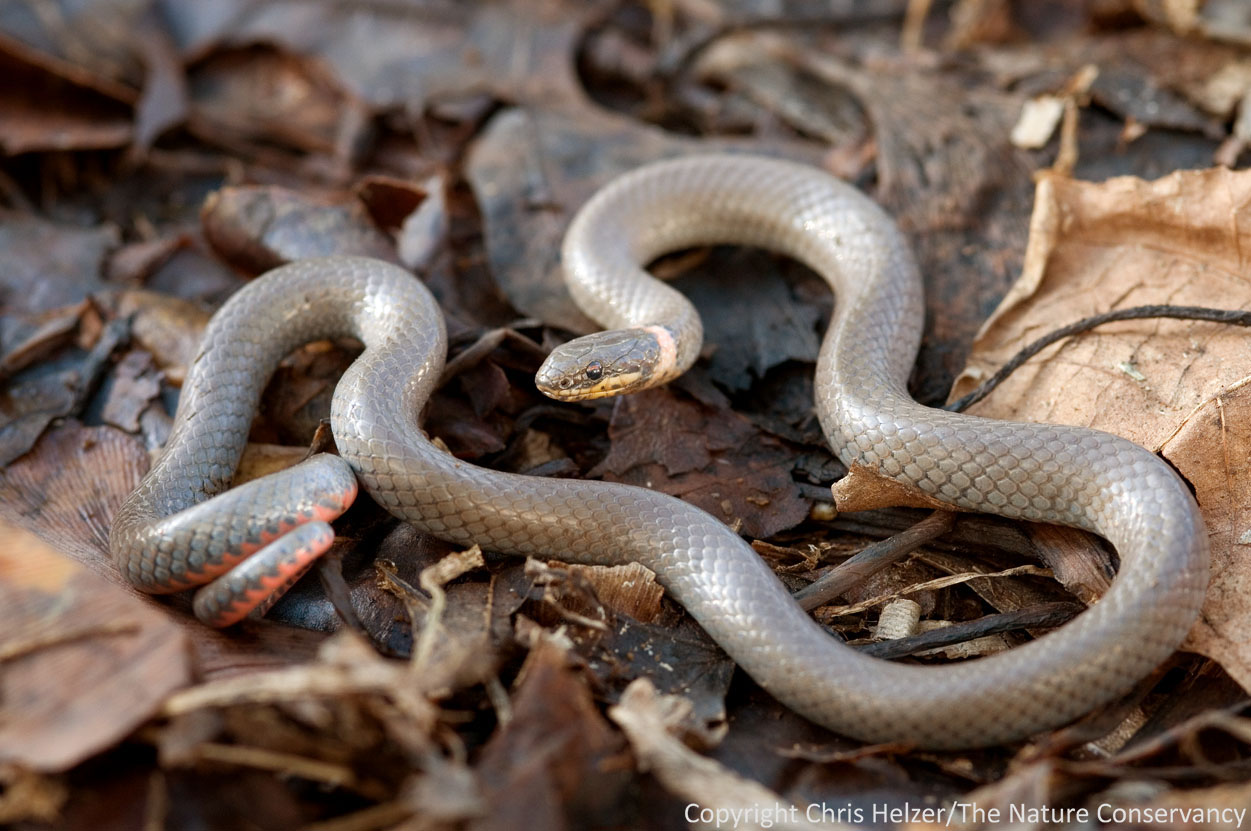
I found this ring-necked snake underneath a small eastern redcedar tree I was cutting down.  My kids got to see it too, which was a nice bonus.

I found this ring-necked snake underneath a small eastern redcedar tree I was cutting down. My kids got to see it too, which was a nice bonus.

.
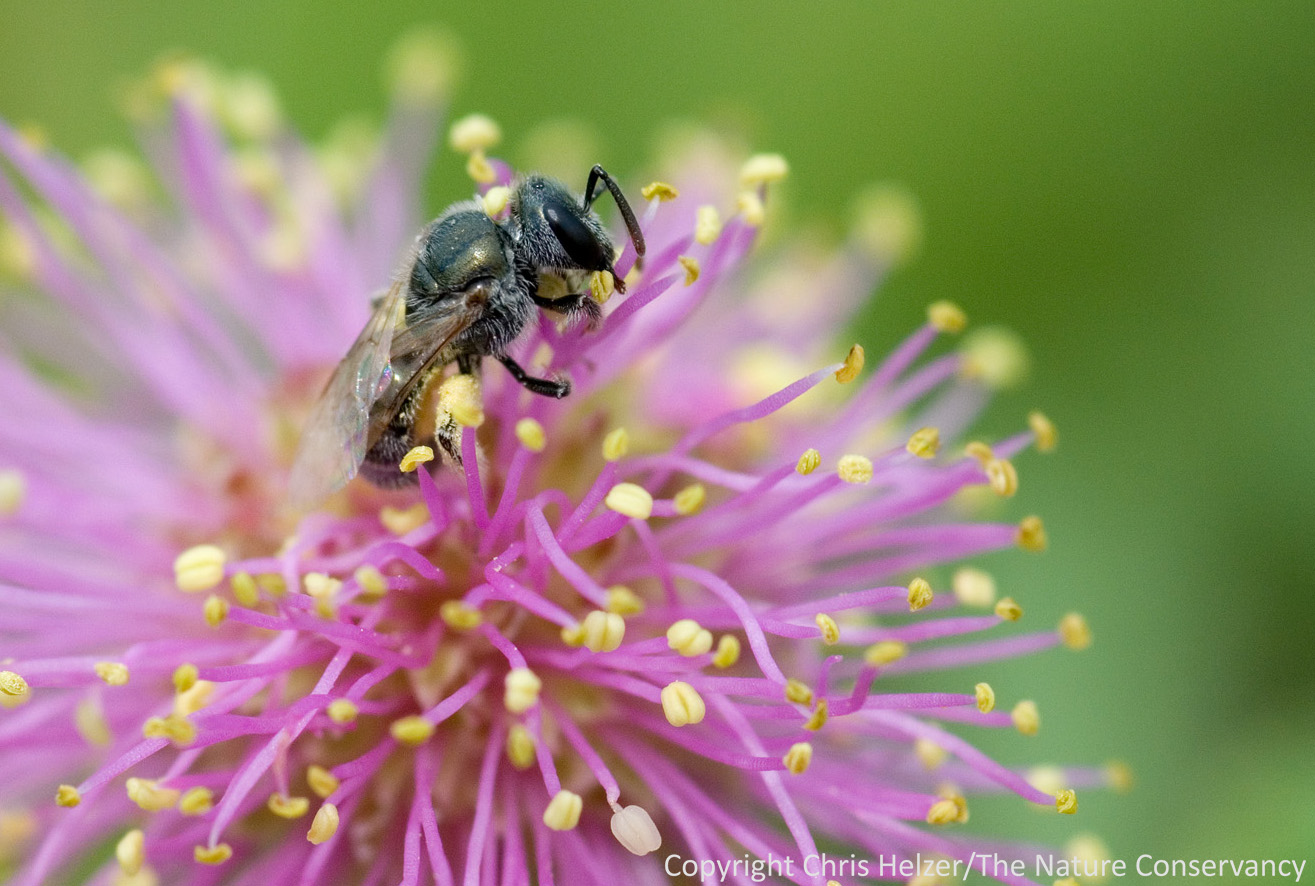
I'm not collecting data on bees at my own prairie, but I definitely pay attention to both the abundance and diversity I see each time I visit, and I take note of whether or not there are always nectar plants blooming across the prairie.

I’m not collecting data on bees at my own prairie, but I definitely pay attention to both the abundance and diversity I see each time I visit, and I take note of whether or not there is a consistent supply of nectar plants blooming across the prairie.

While I think my little prairie has fairly substantial ecological value, for all its shortcomings, I don’t measure it’s worth purely in conservation terms.  I feel very fortunate to be able to carry on the ownership and stewardship of a piece of land my grandfather bought.  Taking my kids out to their own prairie gives them, I hope, an enhanced sense of connection with the land, and a conservation ethic.  I don’t care if they grow up to be prairie ecologists, but I do want them to have an awareness of and appreciation for the natural world.  I could take them hiking or camping on other prairies (and I do) but there’s something pretty special about having a place that’s our own.

My kids like to climb trees and make forts in the scattered pockets of trees around the property.  They also dig in the mud, chase grasshoppers, and do all kinds of other kid things.

My kids like to climb trees and make forts around the property. They also dig in the mud, chase grasshoppers, and do all kinds of other kid things.

.
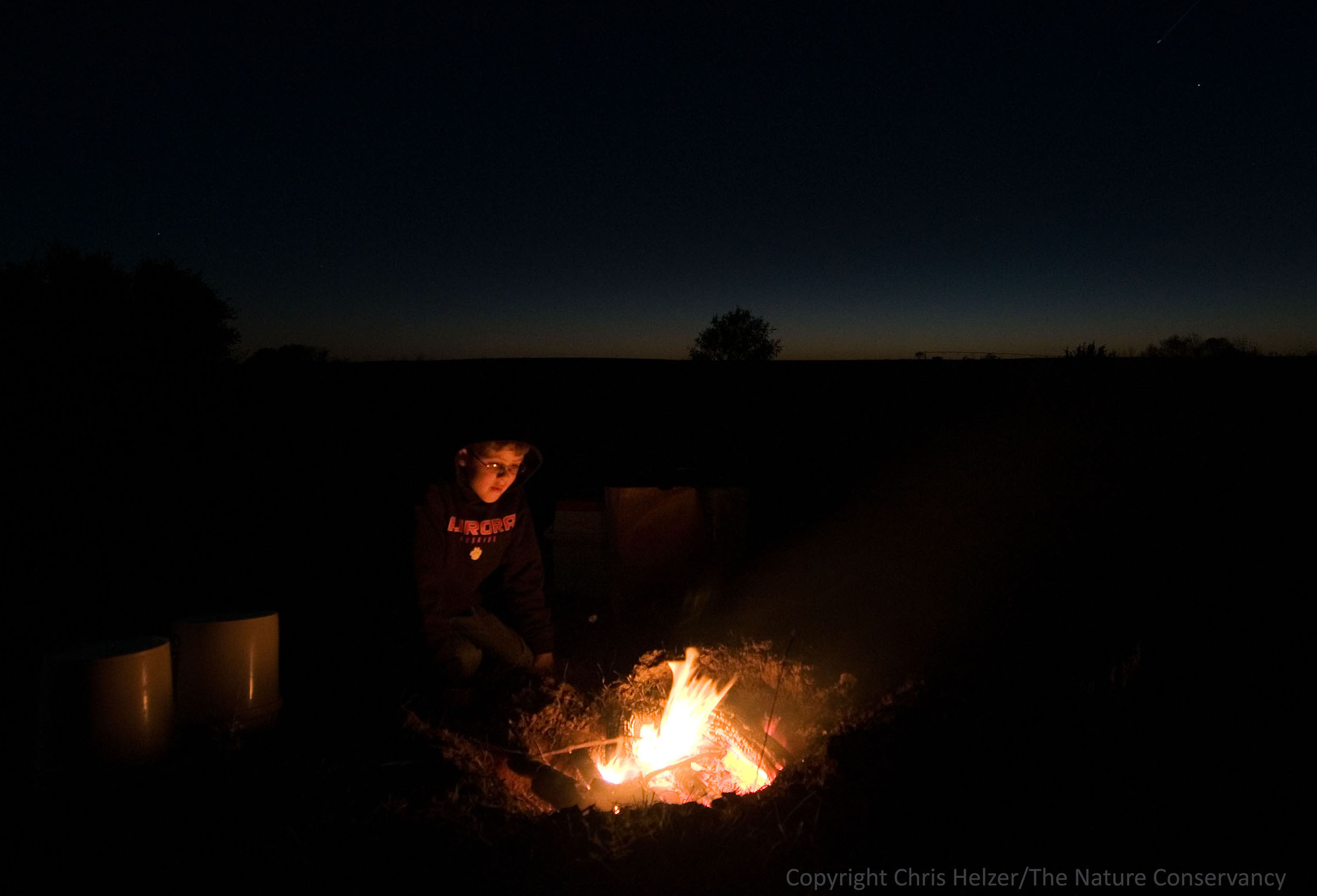
I hope that taking my kids camping at their own prairie will deepen their sense of connection with both their land and their family.
I hope that taking my kids camping at their own prairie will deepen their sense of connection with both their land and their family.
Grandpa’s “Accidental” Prairie Restoration Project

In the late 1950’s, my grandfather bought a quarter section of farmland just southwest of Stockham, Nebraska.  At the time, all but about 26 acres of that 160 acre land parcel was in row crops.  The unfarmed areas (the steepest slopes and wettest draws) were a combination of native prairie and other “waste” ground.  From what I understand, Grandpa’s intent was to buy the land and put much of the cropland back to native grass pasture, keeping only the flattest areas and most productive soils to farm.  Regardless of whether or not that was his initial intent, he did indeed do that restoration project in 1962 – using the Soil Conservation Service’s Great Plains Program to provide cost-share for the seeding and construction of a livestock dam.  Approximately 87 acres of cropland was planted with a mixture of native grasses, including primarily big bluestem, indiangrass, switchgrass, little bluestem, side oats grama, and western wheatgrass – with a little blue grama thrown in too.  (We still have the receipts from the seed company.)

Starting in 1964, Grandpa started grazing the new pasture – including the unfarmed portions – and it’s been grazed annually ever since.  The pasture grazing was designed to be both profitable and sustainable, and as far as I can tell it has been.  There is no evidence of chronic overgrazing, and a number of “grazing sensitive” plant species are still abundant, especially in the old remnant areas.  My grandpa died in 1990, and Grandma died earlier this year.  After Grandma’s death, most of the other family farm land was sold, but after some long discussions, we kept the ¼ section in the family.  My wife and I now own a 2/3 interest and my aunt and uncle own the other 1/3.  Although I was helping Grandma manage the pasture for more than a decade before her death, actually owning the land makes me see the pasture in a much different way.  Before we shelled out our hard-earned money to buy it, the pasture was an interesting place to go cut cedar trees and walk around, and I tried to help Grandma set up the grazing leases to ensure that the land stayed in good condition while bringing in a reasonable income.  Now, as an owner, that lease income means a whole lot more, as does the current and future condition of the grassland.  Decisions about how to balance stocking rate and income with plant community impacts are a little more real!

I bring all this up as background discussion for the real subject of this post.  Though I’m sure it wasn’t Grandpa’s intent when he seeded the site back to grassland in 1962, he actually did some pretty great prairie conservation work.  He took a series of very small isolated remnant prairie islands and filled the space between them with grassland habitat.  It’s hard to know how many plant and insect species populations have larger and more viable populations now because of his work.  Certainly the site has improved habitat conditions for the grasshopper sparrows, western meadowlarks, and other grassland birds that are nesting there.

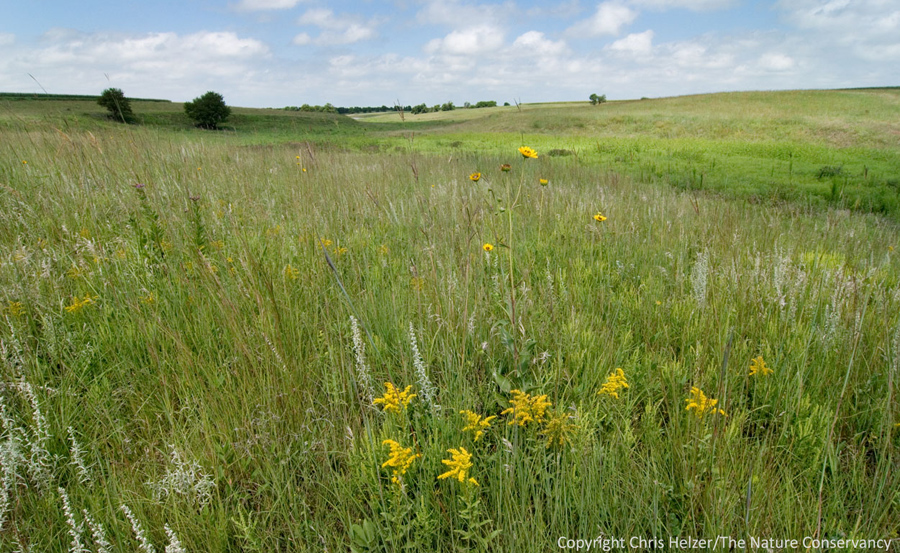
A portion of remnant (unplowed) prairie on our farm. It has retained a good mixed-grass plant community, with fairly abundant leadplant, stiff sunflower, prairie clovers, and other characteristic prairie plants. Shown here are Missouri goldenrod, white sage, stiff goldenrod, and many others.

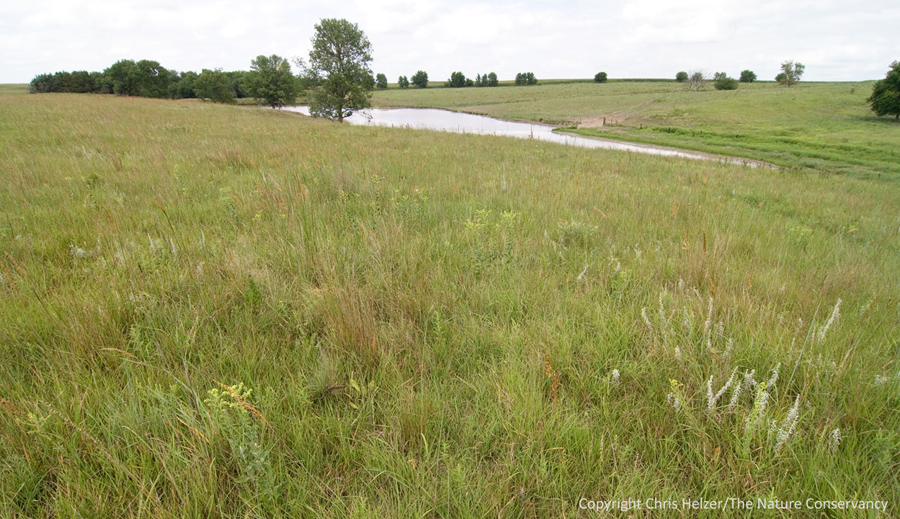
While any grassland is better than no grassland, the re-seeded areas of the prairie are still distinct in appearance and composition from the unplowed areas.  Many of the prairie remnants contain fairly abundant populations of conservative forb species, including leadplant, stiff sunflower, prairie violet, prairie clovers, and many others.  A few of those species have moved into the re-seeded areas, but mostly at low abundances.  The re-seeded areas are dominated by grasses, but also have an abundance of many common forb species such as goldenrods, white sage, ironweed, hoary vervain, yellow prairie coneflower, dotted gayfeather, yarrow, and others – along with strong populations of sweet clover.

This photo shows some of the re-seeded prairie. Many native forbs have moved into the stand of grass that Grandpa planted, but others are still rare or missing.

I only recently found some hand-drawn maps showing the exact locations of the unplowed areas, and was able to cross-check those with old aerial photos from before and after the 1962 seeding.  Now that I know those locations more exactly, I’ll be able to start making even better comparisons between the remnant and re-seeded areas.  I started that process this last weekend, taking an inventory of plant species in the re-seeded areas (I found 65 species).  I’m sure I’ll add to that list over time, but that’s not too bad, considering only 6-7 grasses were planted there initially.  I don’t know yet how many plant species are in the remnant portions – I’m still working on that.

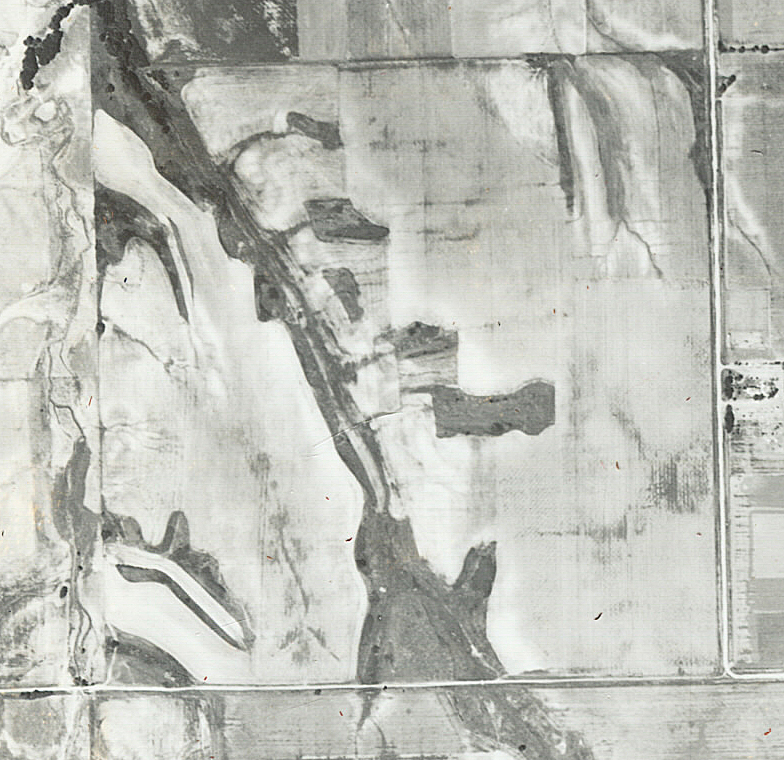
This aerial photo from 1956 shows our 1/4 section just prior to Grandpa buying it. The darkest areas are the unfarmed portions. You can see how small and isolated many of them were. Only the steepest and wettest areas avoided the plow.

In some ways, it’s amazing to see the diversity of plants in those previously farmed areas.  If I took a botanist to the site without divulging its history, I’m pretty they’d have no idea it had once been farmed.  At the same time, while there is good plant diversity at the site, it’s interesting to see how few conservative plant species have made their way into the previously farmed areas.  I’ve seen a few individuals of leadplant, a few patches of purple and white prairie clover, some areas of purple coneflower, and a few stiff sunflower colonies.  Prairie violets have begun creeping from the remnants into the re-seeded areas too – but in 50 years, they’ve only made it about 20 or 30 yards.

All of this points out the importance of protecting and managing remnant prairies to avoid losing those conservative plant species.  Once they’re gone, it’s not realistic to expect them to just come waltzing back in from nearby sites.  During the last 10 years or so, I’ve been overseeding portions of the re-seeded prairie with locally harvested seed.  As is typical, the results of that have been fairly muted, but I’m hoping my work gets those plants to establish a little faster than they otherwise would have…

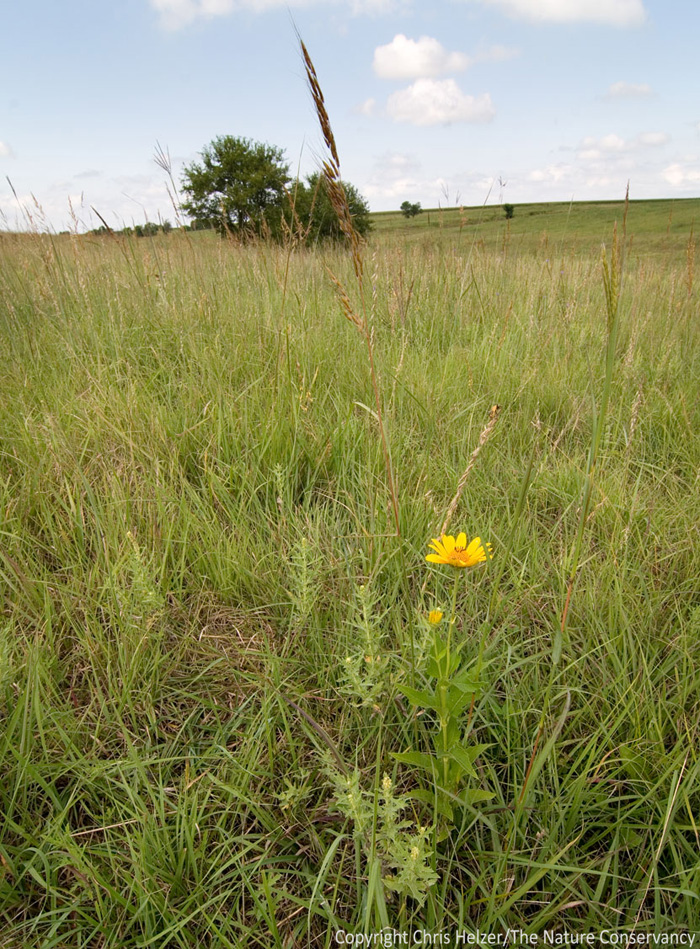
This false sunflower is one of a handful of species that is showing up here and there across the old farmed portions of the prairie as a result of our overseeding efforts. It's a slow process, but one that will, I hope, pay long-term dividends.

Of course, if Grandpa’s restoration project was being done today, and the main goal was really to ecologically reconnect those small prairie islands, the cropland around the prairie remnants would be seeded with a high-diversity mixture of prairie plant species.  That would help ensure that the seeded area facilitated a number of ecological needs, including the availability of host plants for a variety of insects and genetic flow between plant species.  In 1962, no one in Nebraska was even thinking about anything like that, and Grandpa’s goal was (I think) simply to take a piece of land that was being overused and make it into productive agricultural land.  I’m pretty sure he’d never heard of a grasshopper sparrow.  Regardless of his initial goal, there is now a 108 acre prairie in southern Hamilton County, Nebraska – and that’s a rare and valuable commodity.  The nearest prairie to ours is at least several miles away, across many acres of cropland.

I don’t know exactly know how to measure the ecological value of our prairie, but I’m sure proud to own it.