Introducing the New Hubbard Fellows!

We have entered the second year of our Hubbard Fellowship program.  Eliza Perry and Anne Stine completed their Fellowships earlier this season, and we brought in two new Fellows, Jasmine and Dillon, on June 2nd.   They have seen and learned a lot in their first month or so with us, and have agreed to introduce themselves and share some of their early perspectives here in their first of many blog posts.  Dillon’s essay is first, followed by Jasmine’s.

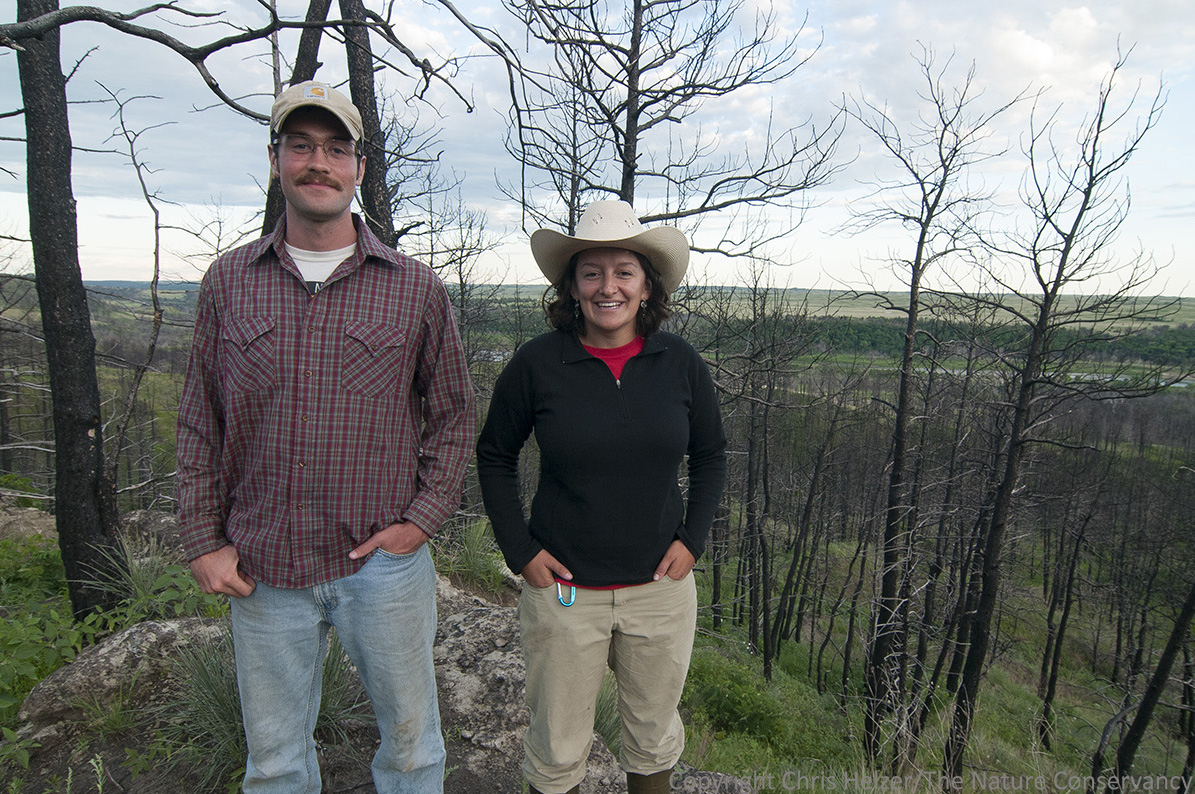
Dillon Blankenship and Jasmine Cutter (with her new hat!) at The Nature Conservancy’s Niobrara Valley Preserve.

 Dillon Blankenship is an Arkansas native and graduated from Hendrix College in 2012 with a B.A. in Biology and a B.A. in Environmental Studies.  He has studied native pollinators at The Nature Conservancy’s Zumwalt Prairie Preserve in Oregon and has volunteered with TNC in Arkansas where he helped burn and monitor the effects of burning.  He earned a Thomas J. Watson Fellowship in 2012, and spent a year studying honey bees and hive management.  His travel took him to England, Wales, Tanzania, Egypt, India, Russia, and Germany. 

Growing up in northwest Arkansas I was always on the cusp of the Great Plains. My home was definitively in “the woods,” but we shared a property boundary with a neighbor’s herd of bison. I was so close, but I can’t say I had a lot of real contact with prairies until college when I took a summer research position with Oregon State University. They had me chasing native bees in diverse ecosystems across the state, but working on the 33,000 acre Zumwalt Prairie Preserve was, by far, the highlight. I was completely awestruck by the landscape’s expansiveness. Wildflowers stretched to the horizon and I marveled at how, despite the gently undulating hills and absence of trees, it was still possible to lose oneself.

While different from the prairie in eastern Oregon, I have thoroughly enjoyed the last five weeks in Wood River. I identify with the rural-ness out here and am consistently taken by the beauty of our prairie. Stewardship is rewarding work. When I chop a musk thistle or pull up poison hemlock I can see the immediate impact of my effort. I know these actions are a mere drop in the conservation bucket (and that there is often a sad, high possibility of another invader filling the spot I just opened with my spade), but applying my knowledge and skills to real management is something I have been craving for the last few years. I am excited to be in the fray of the conservation profession. Researchers come through with interesting projects, new conservation issues arise for discussion, and I get to be a part of it now. I am excited for all the new experiences and opportunities for professional development that await. Already, I have learned a lot – the depth with which I look across the landscape has probably quintupled. I am recognizing species that were completely foreign when I arrived and am beginning to make inferences about how the land is functioning and responding to the various pressures we place on it.


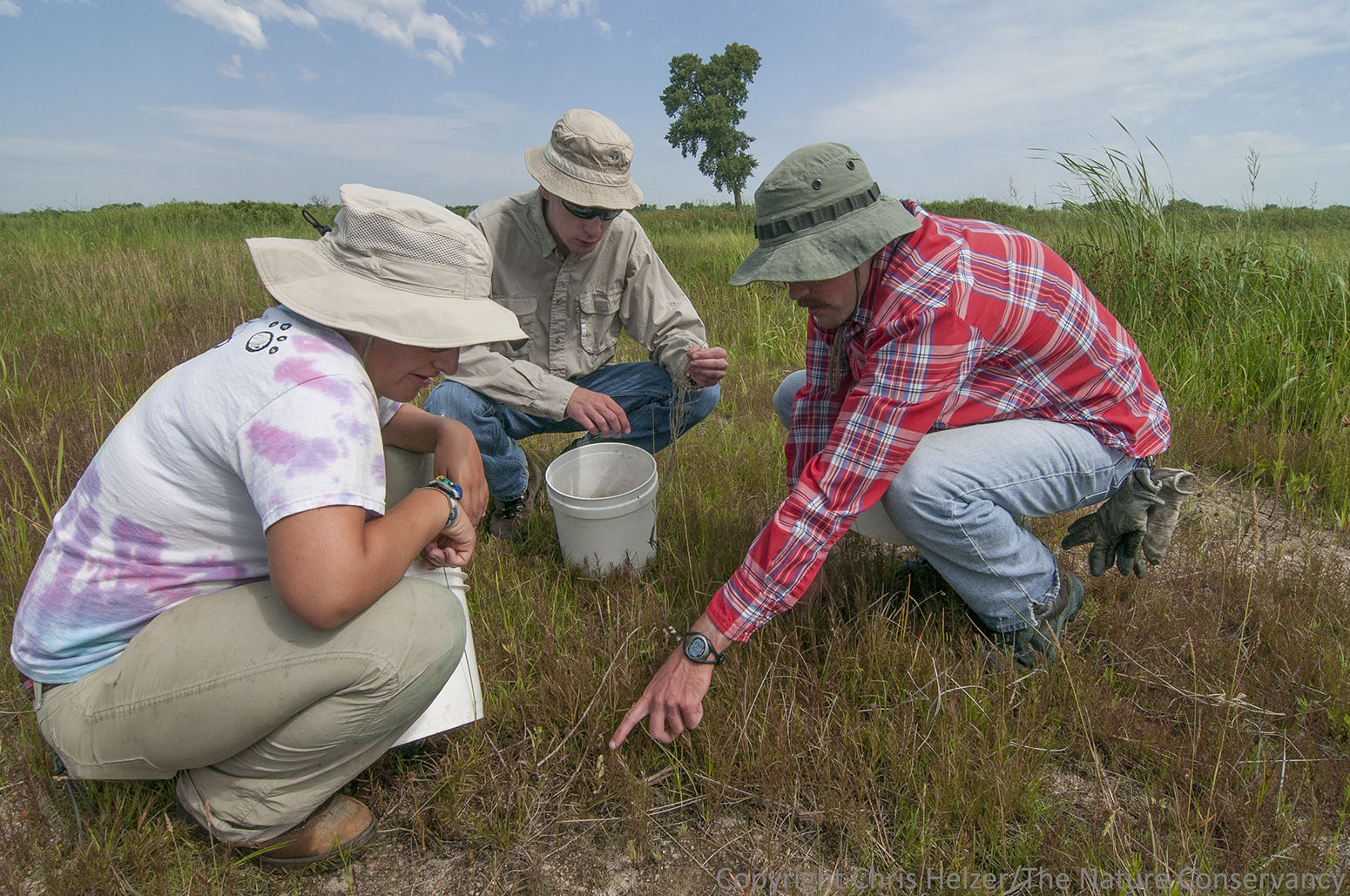
Jasmine and Dillon, along with intrepid volunteer, Sam Sommers (middle) work on some plant identification in the Platte River Prairies.

Jasmine and Dillon, along with intrepid volunteer, Sam Sommers (middle) work on some plant identification in the Platte River Prairies.

Jasmine Cutter grew up in Delaware but is a 2013 graduate of Carleton College in Minnesota.  She has a B.A. in Environmental Studies and most recently was working as a research assistant in the Greater Yellowstone Area, surveying mountain goats and bighorn sheep.  Jasmine has conducted several pollinator surveys as a research assistant, and she has extensive experience as an interpretive educator when she served with Americorps at White Clay State Park in Delaware and with “Kids for Conservation” and the Science Olympiad in Minnesota. 

I first fell in love with prairies in Minnesota. At first I think I liked the novelty – that there could be a landscape that was grass, flowers, and sky – and no trees! As an east-coaster that was pretty crazy. Although there was plenty to see aboveground, I was awed when I first learned that the extent of prairie plants’ roots are often 2-3 times greater than what is visible above. I marveled that these huge root systems allow plants to regrow after fires, and to contribute to the regeneration and retention of nutrients. In addition, I was fascinated by the human aspect of how intentionally-set fires perpetuated the prairies, and how the agricultural productivity of the midwest (and great plains) has been enabled by the rich prairie soils.

For all of these reasons – aesthetic, ecological, cultural – I am excited to be in Nebraska. Already it’s hard to keep track of everything we’ve done. For the most part, we’ve been subduing musk thistles, but we’ve also been catching small mammals (cute photos to follow, I promise), tearing down windmills, learning our plants, cleaning ATVs, meeting TNC people from across the country, building bottomless tanks, hosting a field day, swabbing tadpoles, planting our garden, and learning how TNC functions. I am really excited to build competency in many areas that I currently know nothing about: livestock/grazing, vehicle and tool maintenance, driving large machines, and learning the nitty-gritty of how to plan and assess restoration projects. Although we have big shoes to fill, I’m also looking forward to this blog, and to a chance to hear from all you folks. I greatly value the comments that I have read on previous posts, and I know that they have enhanced my understanding of many topics – so please share your expertise and insights!


Hubbard Fellowship Blog – Eliza’s (Sort of) Farewell

This is Eliza Perry’s final blog post as a Hubbard Fellow.  However, as you’ll see below, it is not the end of her employment with The Nature Conservancy.  Meanwhile, two new Fellows have moved in to fill the void left by Eliza and her fellow Fellow, Anne Stine.  Dillon and Jasmine will be introducing themselves to you shortly.

 From Eliza –

For me, Friday June 6th marked the last day of a wild ride—a totally unforeseen, extraordinary, defining year of my life. I had been stalking The Nature Conservancy’s employment website for weeks before this incredible opportunity popped up and I went for it with all I had. This has easily been the most fulfilling year of my life and I know I have learned a great deal more than I could have ever anticipated.

Eliza gave a presentation on her Fellowship year and accomplishments at the May Board Meeting of The Nature Conservancy's Nebraska Chapter.

Eliza gave a presentation on her Fellowship year and accomplishments at the May Board Meeting of The Nature Conservancy’s Nebraska Chapter.

Under normal circumstances, I would have documented every day of my last few weeks, taking upwards of a thousand photos in fourteen days. Tragically, I dropped my camera while filming our wetland restoration at night so words will have to suffice. Growing season is such a busy time for us, but I had to leave just as it was getting underway. Invasives like musk thistles and poison hemlock were becoming very apparent features in certain areas of our properties, and we use this early window to beat them back before they outrun us. I also got to hang out with and train the next class of Hubbard Fellows, which was an incredible privilege because maybe the best part of all this is knowing others will be able to experience something like my year at the Platte River Prairies.

I’m writing this with my feet dangling off a pier in my hometown, looking out on a view that I took for granted my whole life. But the blue ocean doesn’t feel like home right now because I’m missing the golden green oceans in Nebraska. I could not be more excited about the fact that I will be back to the Good Life in a few weeks to start in my new position with The Nature Conservancy in Nebraska as our Major Gifts Manager in Omaha! I am thrilled (and nervous) and convinced that there could not a better continuation of my journey in conservation. I’ll be entering the whole new world of fundraising alongside my favorite TNC chapter.

While rummaging around in my old bedroom after returning to Maine, I found letters I wrote in high school to lots of intangible, inanimate things during a peculiar phase in my journaling habit. The following is a sample of my letter to nature:

“Nature,  I just want you to BE there for all of time and forever, doing your thing as you see fit. I know I personally get in your way and so do billions of my peers, but what I plan to do is use my life to help keep you on track in at least my little corner of the world.”

While I might have worded that a little differently these days, it still perfectly describes why I am working in the field of conservation. I want Nebraska’s beauty to continue to exist and thrive because it must and because it ought to. Everyone in conservation has their own reasons for fighting the good (often steeply uphill) fight, but this past year has made it only more of a compulsion for me.

Eliza got experience

Prescribed fire was just one of the activities Eliza (left) gained experience with during her Fellowship year.

And boy was I in good company. As all of the visitors to this blog know, Chris Helzer is a marvel and an inspiration. His passion can sway some of the most staunchly opposing forces. I am still amazed I got to work with him and try to absorb some of his wisdom. The same goes for Nelson Winkel, land manager at the Platte River Prairies, who is truly my hero. The amount of work that each of them and all the other staff members at our chapter accomplish every day is astonishing. The fellowship is only one of innumerable things vying for their attention, but we were always given the support and guidance we needed to get ourselves working independently and well. This chapter, especially trustee Anne Hubbard whose generosity is the reason I just spent the year with TNC, recognizes the important voice that inexperienced aspiring conservationists can contribute to the cause of protecting and enhancing natural resources. Together we have pioneered a growing movement within the organization to provide professional development opportunities to young people so they can propel conservation forward.

Ending one chapter and beginning another always feels surreal and I tend to get extra sentimental. I am so proud to be a Hubbard Fellow. I feel fortunate beyond words to have spent the last twelve months with my mentors on the Platte River working for an organization that does so much good for the world and for Nebraska.